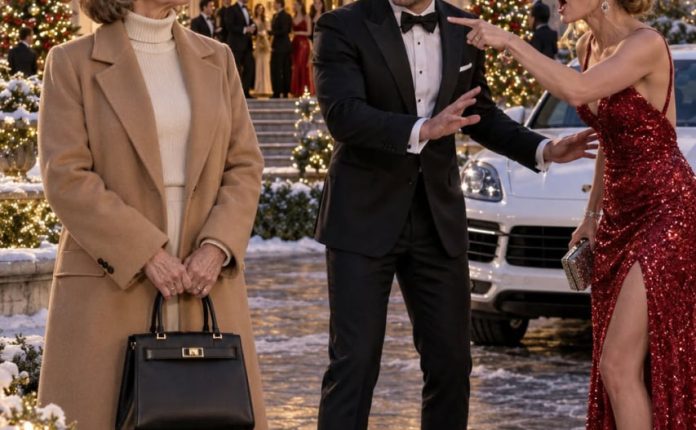
Then cooperate with the review.” Lauren looked at me. “You’re really going to do this?” “I’m really going to find out what happened.” “I’m your sister.” “Stepsister.” Her face changed. “That’s cruel.” “No. Cruel was letting me spend years thinking I failed at things Dad secretly sabotaged.” My father looked up sharply.
He knew exactly what I meant. Lauren looked between us. “What is she talking about?” My father said, “Nothing.” I opened the briefcase. “Mom left a letter.” The color drained from his face. Patricia whispered, “Robert?” For the first time, Lauren wasn’t looking at me like an enemy. She was looking at him.
And suddenly I realized there might be things he had hidden from her too. Lauren followed me into the hallway after the meeting. “Megan.” I kept walking. “Megan, stop.” I turned near the executive elevators. Morning sunlight reflected off the glass walls, cold and bright, and somewhere downstairs a janitor’s vacuum hummed across the marble lobby. “.
What?” She looked younger without gala makeup. Not innocent. Just less protected. “What did your mother’s letter say?” “My mother.” She closed her eyes. “Fine. What did Diane’s letter say?” “That Dad interfered with my college plans and a job offer.” Lauren folded her arms tightly. “Why would he do that?” “.
To keep me here.” She stared through the glass toward the city. Then she said, “He did something similar to me.” That surprised me enough to stay. “When?” “Three years ago.” She told me she had been offered a partnership track at the event firm where she worked before joining Prescott Dynamics.
My father convinced her the company was failing and that her manager planned to replace her. Weeks after Lauren quit, she discovered the firm hadn’t been failing at all. “Why didn’t you go back?” “Pride.” That sounded believable. She laughed bitterly. “He told me you hated me because I was everything you weren’t.” I said nothing. “.
He said you resented that I knew how to deal with people, that you were always jealous of Mom and me.” “Patricia helped remove my mother’s photographs from the house.” Lauren winced. “I know.” “And you moved into my old room.” “I know.” “You accepted my projects.” “I know.” “So don’t stand here and make yourself another victim.”
Her eyes filled, but she nodded. “I’m not.” That answer disarmed me more than an excuse would have. Lauren rubbed her hands together. “I liked winning.” There it was. “At least you’re admitting it.” “I liked him choosing me over you because I spent most of my childhood watching my own father choose everybody else over me.
Robert made me feel important.” “And I was the price.” “Yes.” She whispered it. No excuses. No demand for forgiveness. For the first time since I’d known Lauren, I respected something she said. That didn’t mean I trusted her. “You should cooperate with Helen.” “I will.” I stepped toward the elevator. “Megan?” I turned. “.
What happens to us?” I knew what she meant. Family dinners. Birthdays. Christmas. The carefully staged photographs my father valued more than the people inside them. “I don’t know.” “Can we fix it?” “No.” She flinched. I softened my voice, not the answer. “Some things can improve. That doesn’t mean they go back.”
The elevator opened. I left. Over the next six weeks, Prescott Dynamics felt like a building being rewired while people were still living inside it. Every department seemed to contain some quiet consequence of my father’s management. Promotions had gone to loyalists instead of performers. Safety upgrades had been delayed while executive spending increased.
Three experienced women had left senior roles after being labeled “difficult” for questioning Patricia’s influence. I met with employees in groups of ten. No stage. No cameras. No inspirational slogans. I asked what was broken. Then I listened. Carlos from operations gave me a list that filled three pages. “Our equipment is older than Lauren’s handbag collection,” he said.
I laughed for the first time in weeks. We replaced two machines immediately. The board named Judith interim chair and asked me to serve as acting chief executive during the investigation. My first instinct was to decline. Graham asked why. “Because I don’t want everyone thinking I grabbed the company the second Dad fell.” “Do you want the job?”
I looked through the conference room window toward the production floor. “Yes.” “Then do it well.” So I accepted. Not as my father’s daughter. Not as my mother’s heir. As the person who already knew where the company hurt. The investigation concluded in March. Patricia’s consulting company had received more than $800,000 in questionable payments over four years.
My father had authorized most of them. Lauren had benefited from company-paid personal expenses, but investigators found no evidence that she controlled the transfers or understood their classification. She still resigned. “I don’t deserve an executive title here,” she told the board. That was the smartest professional decision I had ever seen her make.
My father avoided criminal prosecution after full repayment agreements, civil settlements, cooperation, and the fact that some accounting issues fell into gray areas his attorneys fought aggressively. But he lost his job, his board seat, his reputation inside the company, and much of his personal fortune. He and Patricia sold the lake house first.
Then the city home. They moved to a two-bedroom rental twenty miles away. My father called me forty-three times between January and April. I answered once. It was early March. “Megan,” he said. “We need to talk like family.” “We’re talking.” “Not through lawyers.” “You lost the right to demand access to me without boundaries.” “.
I’m your father.” “You keep saying that like it’s a job title you can’t be fired from.” He went quiet. Then his voice cracked. “I did what I thought was best.” I looked at my mother’s portrait hanging in the lobby outside my office. “No. You did what kept you powerful.” “.
I was trying to keep the company together.” “You sabotaged my education.” “I kept you close.” “You falsified my approval trail.” “I didn’t know accounting was doing that.” “Dad.” Silence. “You knew.” Another silence. Longer. Finally he said, “I never thought it would go this far.” That sentence told me everything.
He wasn’t sorry he had done it. He was sorry consequences had exceeded his forecast. “I have to go.” “Megan, wait.” I ended the call. That afternoon, Lauren came to headquarters carrying a cardboard box. Inside were photographs. Dozens of them. My mother. And me. Pictures Patricia had removed from the family house years earlier.
Lauren set the box on my desk. “I found these in storage while Mom was packing.” My throat tightened. There was one photograph of Mom and me standing beside the company’s first production line. I was fourteen. She had her arm around my shoulder. On the back, in her handwriting, were three words. She sees everything.
I looked up at Lauren. “Thank you.” She nodded. Then she left without asking for anything. It wasn’t forgiveness. But for the first time, it felt like the beginning of truth. By summer, the story people had told about me for years had become almost funny. Apparently I wasn’t antisocial. I just hated pretending.
I wasn’t bad with people. I simply preferred technicians, plant supervisors, warehouse crews, engineers, and blunt clients over cocktail parties where everyone said “We should have lunch” without meaning it. And I wasn’t uncomfortable with leadership. I was uncomfortable with performance replacing competence. Prescott Dynamics posted its strongest operating quarter in four years that June.
We cut executive perks, reinvested in production, reopened a training program my father had canceled, and created an internal promotion review so one person could no longer hand titles to relatives over better-qualified employees. I also changed the name of the company’s annual engineering scholarship. The Diane Prescott Innovation Scholarship.
At the ceremony, I placed my mother’s photograph beside the podium. No dramatic speech. No mention of my father. Just her name where it belonged. Lauren attended quietly in the back row. She had taken a project coordinator job at a regional nonprofit and, from what I heard, was starting close to the bottom.
Afterward she approached me beside the empty chairs. “You did good.” “So did Mom.” She nodded. We stood in silence. Then she said, “Mom wants me to ask if you’ll come to dinner.” “No.” “I told her you’d say that.” “Then why ask?” “Because she made me promise.” I almost smiled. Lauren shoved her hands into her jacket pockets. “.
She keeps saying everybody needs to heal.” “People who caused the wound always love group healing.” Lauren laughed despite herself. “She’s angry at you.” “I can live with that.” “She’s also angry at Dad.” “That’s their marriage.” “What about him?” “What about him?” “Have you seen him?” “No.” I knew where he lived.
I knew he had started consulting informally for a small distributor because our settlement prohibited him from representing Prescott Dynamics or contacting certain clients. I also knew he had started telling mutual acquaintances that he had “stepped back for health and family reasons.” Still editing the story. Still trying to control the lighting after the stage had collapsed.
In August, he came to my house. No warning. I was watering basil on the back patio when the doorbell rang. When I opened the front door, my father stood on the porch wearing khakis and a pale blue shirt I remembered from better years. He had lost weight. His hair looked grayer.
For one dangerous second, I saw the father who taught me to ride a bicycle. Then I remembered the man who called Boston. “Can I come in?” “No.” His mouth tightened. “I drove forty minutes.” “That wasn’t my decision.” “Megan.” I stayed in the doorway. He looked past me into the house as though searching for evidence of my life. “.
I hear the company is doing well.” “It is.” “You changed suppliers.” “Yes.” “You dropped Hensley.” “They had quality issues.” “They were loyal for twenty years.” “They were overpriced for ten.” He almost smiled. For a moment, we sounded like we used to when I was twenty-two and still believed debate meant respect.
Then he said, “I’m proud of you.” My stomach tightened. There had been a time when those words could have controlled me for weeks. Now they simply sounded late. “Okay.” He blinked. “That’s all?” “What do you want me to say?” “I thought maybe after some time—” “No.” “I haven’t even finished.” “.
You’re going to say enough time has passed and we should rebuild the family.” His face changed. I had guessed exactly right. “Megan, carrying anger forever isn’t healthy.” “I’m not angry forever.” “You won’t even let me inside.” “That’s a boundary, not an emotion.” He looked toward the street. A lawn mower buzzed somewhere down the block.
Finally he said, “I made mistakes.” “You made choices.” “I was under pressure.” “So was Mom.” “That’s not fair.” “There it is.” “What?” “The moment where your apology becomes my responsibility.” He rubbed both hands over his face. “I don’t know what you want from me.” “Nothing.” That hurt him. I saw it.
Oddly, it hurt me too. Not because I wanted to punish him. Because I finally understood that indifference wasn’t dramatic. It was quiet. And final. He looked at me for a long time. “I thought keeping you close would protect you.” “You kept me small because small people don’t threaten you.” “I loved you.” “I believe you.”
That surprised him. I continued. “But you loved control more.” His eyes reddened. For a moment I thought he might cry. I didn’t rescue him from it. “I’m sorry,” he whispered. I believed he meant it. Maybe not perfectly. Maybe not enough. But sincerely, in that moment. “Thank you for saying it.” “Can we start again?” “.
No.” His face fell. “I forgive parts of what happened because I don’t want to carry them. That doesn’t mean you get your old place in my life back.” “I’m your father.” “Yes.” “And that means something.” “It means a lot. That’s why what you did mattered so much.” He nodded slowly. Then he stepped backward.
I expected one final argument. He didn’t give me one. He walked down my front path toward his car. At the curb, he turned. “Your mother would be proud of you.” This time, I smiled. “I know.” I closed the door. Two months later, Judith entered my office carrying a folder. “We have a problem,” she said.
I looked up. “What kind?” “The kind your father may not have created.” She placed a contract in front of me. At the bottom was my mother’s signature. And according to the date, it had been signed three months after she died. For about ten seconds, I couldn’t move. My mother’s signature was unmistakable.
The long D in Diane. The tight angle of the P. The tiny upward stroke she always added at the end of Prescott. But the date was impossible. “What is this?” Judith sat across from me. “A patent licensing amendment discovered during archive digitization.” Prescott Dynamics held several valuable industrial patents developed during my mother’s engineering years.
The amendment transferred certain licensing rights to a shell company I had never heard of. “Who owns the company?” “That’s what we’re tracing.” My first thought was my father. Of course it was. Old habits survive even after the people attached to them lose power. I called Graham. For two weeks.
Our legal team followed corporate registrations through three states before identifying the original beneficial owner. It wasn’t my father. It was a former general counsel named Martin Keene, a man who had left Prescott Dynamics four years before Mom died. Keene had forged the amendment after her death and quietly collected licensing payments through a third party for years.
The discovery changed something important inside me. For months I had treated every hidden document like another possible betrayal by my father. This one wasn’t. When Graham informed him because several historic corporate approvals required clarification, my father surprised us. He provided old emails, calendars, and handwritten meeting notes that helped prove Keene’s fraud.
No bargaining. No request to see me. No attempt to use cooperation as a ticket back into my life. He simply helped. The company recovered most of the licensing rights and eventually reached a substantial settlement. Afterward, I sent my father a short message. “Your records helped. Thank you.” He replied three minutes later. “.
Your mother would have wanted it fixed.” That was all. I didn’t answer. And for once, he didn’t send another message. By December, nearly a year had passed since the New Year’s Eve gala. The Bellweather Hotel called in October to ask whether Prescott Dynamics wanted to reserve the ballroom again.
I almost said no. Then Carlos overheard me discussing it with my assistant. “You cancel that party because of Robert, he still owns a piece of it.” That annoyed me because he was right. So we booked the ballroom. But we changed nearly everything. No head table. No family seating chart.
No giant executive portrait wall. Employees could bring partners, friends, parents, or whoever mattered to them. The catering staff probably thought I had lost my mind when I replaced the seven-course plated dinner with food stations, because half our night-shift technicians had complained for years that the fancy dinners never contained enough actual food.
At 7:00 p.m. on December 31, I walked into the Bellweather wearing a dark blue dress and my mother’s earrings. For the first time, the room didn’t feel like my father’s stage. It felt like a party. Carlos shouted my name from near the bar. Helen was talking with Judith.
Engineers danced badly. Warehouse supervisors laughed beside salespeople who finally knew their names. Near the entrance, I spotted Lauren. She looked nervous. “You came.” “You invited me.” “I invited every former employee from the last eighteen months.” “Romantic.” I laughed. She handed me a small wrapped box. “What is this?” “Open it later.” “Why?” “.
Because I don’t want to cry at a corporate party.” “That has never stopped this family before.” She groaned. Inside the box, which I eventually opened twenty minutes later in a quiet hallway, was one of Mom’s old silver star ornaments from those early machine-shop New Year’s parties. Lauren had found it while sorting Patricia’s storage unit.
A note was taped beneath it. This belongs where the story started. I carried the star back into the ballroom and hung it carefully from a small decorative tree near the company-history display. The display now began with two photographs. My father and mother standing outside the first workshop. Not just Mom.
Not just him. Both. I had thought about removing my father from company history. It would have been emotionally satisfying. It also would have been dishonest. He had helped build Prescott Dynamics. He had also nearly damaged it beyond repair. Both things were true. At 11:45, Lauren found me near the windows. “.
Are you nervous?” “About midnight?” “Yeah.” “No.” “I am.” “Why?” She looked around the ballroom. “Last year changed my entire life in fifteen seconds.” “Mine changed before midnight.” She nodded. “Do you ever wish you had done it differently?” I thought about that. “I wish Dad had.” “That’s not what I asked.” “.
It’s my answer.” At 11:58, Judith pushed a microphone into my hand. “You’re CEO. Say something.” “I hate speeches.” “Everyone knows.” The room laughed when I walked onto the small stage and announced that Judith had threatened my employment unless I spoke for ninety seconds. I looked out at nearly three hundred people.
Last year, I had watched this room through a laptop because my father believed my presence would ruin the mood. Now people were waiting for me. Not because I was Diane Prescott’s daughter. Not because I controlled fifty-one percent. Because we had survived a hard year together. “I’m not going to give you a speech about fresh starts,” I said. “.
January first doesn’t magically erase December thirty-first.” A few people laughed. “But I learned something this year. Starting over doesn’t always mean rebuilding what broke. Sometimes it means admitting that something is finished and building differently.” The room grew quiet. I glanced at my mother’s portrait. “Prescott Dynamics spent too many years confusing loyalty with silence.
We’re not doing that anymore.” Applause rose slowly, then spread. I lowered the microphone. “That’s enough emotional growth for one evening. Somebody start the countdown.” The screen lit up. Ten. Nine. Lauren stood beside Carlos. Eight. Judith raised her glass. Seven. My phone buzzed in my hand. A message. Dad. I hesitated.
Then opened it. “Happy New Year, Megan. I won’t call. Just wanted you to know I’m thinking of you and your mother.” Six. I read it once. Five. There was no demand. No guilt. No “we need to talk.” Four. For the first time, he had respected the distance I asked for.
Three. I typed three words. “Happy New Year.” Two. Send. One. The ballroom erupted. Confetti fell. Music filled the room. Lauren hugged me without warning, then immediately stepped back. “Sorry. Boundary.” I laughed. “That one was okay.” She smiled. Outside the windows, fireworks burst above the city. At exactly 12:01 a.
M., my phone remained silent. No frightened call. No crisis. No father gasping at a screen. No family demanding I fix the consequences of choices they had made. Just music, voices, bright lights, and the silver star from my mother’s first New Year’s party turning slowly on the little tree beside us.
A year earlier, my father had told me I made everyone uncomfortable. He was right in one way. I made people uncomfortable when they depended on my silence. I made them uncomfortable when numbers didn’t match, when stories changed, when credit went to the wrong person, when power expected obedience.
For years, I thought that meant something was wrong with me. Now I knew better. Some rooms are only comfortable because everyone inside has agreed not to tell the truth. I didn’t need those rooms anymore. I had built a different one. And this time, nobody had to disappear so someone else could belong.
THE END!
Disclaimer: Our stories are inspired by real-life events but are carefully rewritten for entertainment. Any resemblance to actual people or situations is purely coincidental.