My Father Banned Me From His New Year’s Eve Gala Because “You Make Everyone Uncomfortable.” At Midnight, He Raised A Glass To His “Perfect Family.” At 12:01 A.M., My Sister Called Me Sobbing: “What Did You Do? Dad Saw The News—He Can Barely Breathe!” I Took A Sip Of Tea And Said, “He Found Out Too Late.”
My father banned me from the most important New Year’s Eve celebration our family had ever hosted because, according to him, I made people uncomfortable. He expected me to spend midnight alone while my stepsister was publicly crowned as his successor. Instead, I sat in my apartment with my late mother’s leather briefcase beside me and watched their gala live.
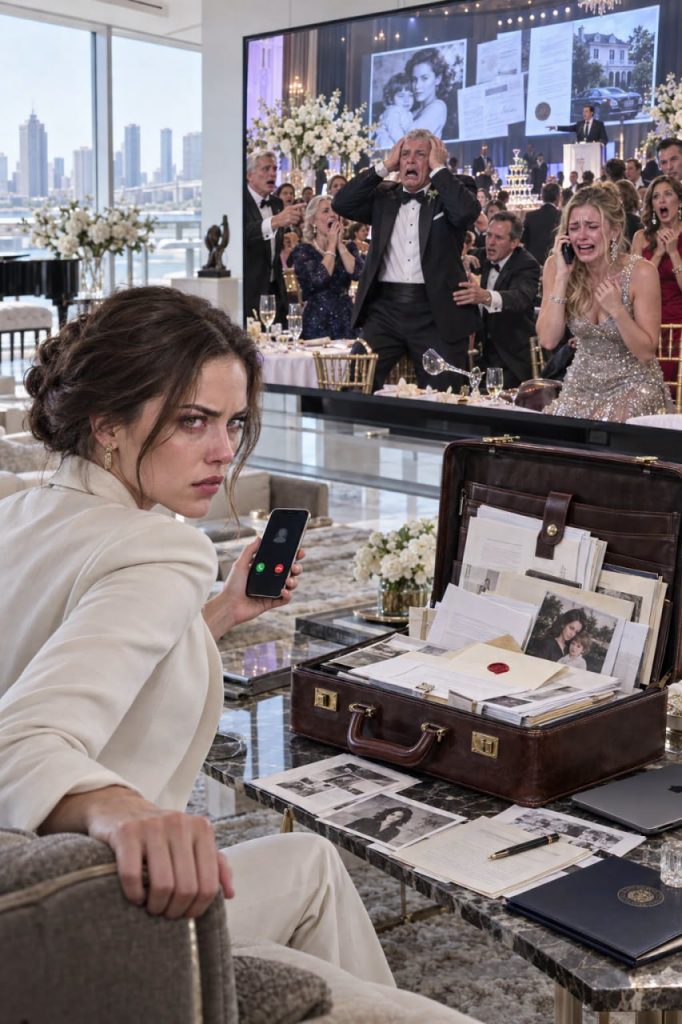
At exactly 12:01 a.m., my stepsister called, sobbing, “What did you do?” By then, what my father had hidden for years was already on every screen in the ballroom. The message from my father arrived at 10:07 on the morning of December 30 while I was standing in the operations warehouse holding a clipboard and arguing.
With a freight company about forty-seven missing refrigeration components. The loading bay smelled like cardboard, diesel exhaust, and burnt coffee, and somewhere behind me a forklift kept making that sharp electronic beep that gets inside your skull after an hour. I glanced at my phone expecting another vendor complaint and found eight words from the man who had raised me: “.
Don’t come tomorrow. You make everyone uncomfortable.” For a few seconds, I honestly thought he had sent it to the wrong person. Tomorrow was the annual Prescott Dynamics New Year’s Eve gala at the Bellweather Hotel, a two-hundred-guest event attended by clients, board members, suppliers, local reporters, investors, and employees who had been saving cocktail dresses and tuxedos for months.
My mother had started the tradition when I was twelve, back when Prescott Dynamics was still operating from a converted machine shop and the “gala” meant folding tables, supermarket champagne, and my mother taping silver paper stars to the walls herself. I called my father before I could talk myself out of it.
He answered on the fourth ring with music playing behind him and said, “Megan, I’m in the middle of something,” as though I had interrupted him instead of responding to his command. “You told me not to attend the company gala,” I said. “I want to hear you say why.”
He sighed so deeply that I could picture him rubbing the bridge of his nose. “Because every year you show up looking miserable, you sit there like somebody forced you to come, and people notice. This year needs to feel optimistic.” I looked down at my steel-toed shoes, the navy sweater I had worn because our warehouse.
Heater had failed again, and the grease mark on my wrist from crawling beneath a damaged conveyor that morning. “So optimism has a dress code now?” “Don’t make this difficult,” he said. “Lauren will represent the family. She understands how to work a room.” Lauren was my stepsister, thirty years old, photogenic, socially effortless, and somehow senior vice.
President of strategic development despite occasionally asking me what EBITDA meant. She had joined Prescott Dynamics three years earlier after leaving an event-planning company and had immediately received an office twice the size of mine. I said, “Mom helped create that gala.” The silence changed. My father’s voice hardened. “Your mother has been gone for five years, Megan.
At some point, you need to stop using her as a reason to resist every change.” That landed exactly where he intended it to. I stared through the open loading dock at a pale December sky and remembered my mother, Diane Prescott, wearing safety glasses over her reading glasses because she always forgot to switch them.
She had been an engineer before she was a founder, the kind of woman who could discuss licensing strategy with a lawyer and then spend twenty minutes helping a technician diagnose a jammed press. “I’m not resisting change,” I said. “I’m working.” “And Lauren is leading.” There it was. Tomorrow night wasn’t simply a party.
I had heard whispers for weeks that my father intended to announce Lauren as executive vice president and “future leader” of Prescott Dynamics. He had never discussed it with me, even though I had spent nine years in the company and currently managed the operations teams responsible for almost forty percent of our annual revenue.
My father continued, softer now, using the tone he always used when he wanted cruelty to sound reasonable. “Stay home tomorrow. Enjoy yourself. Order something good. Start the new year without turning everything into a conflict.” “You’re telling me not to attend my own family’s company celebration because my presence bothers you.” “.
You make people uncomfortable,” he repeated. “I’m trying to avoid a scene.” I almost laughed. I had never caused a scene at one of those events. What I had done was refuse to laugh when Lauren claimed credit for projects she hadn’t touched. I had corrected my father when he exaggerated quarterly numbers in front of vendors.
I had declined to pose for a “family leadership” photograph after discovering my mother’s name had been removed from the company history display in the lobby. Apparently accuracy had become uncomfortable. “Fine,” I said. My father paused, probably surprised. “Fine?” “I won’t come.” “That’s the mature choice.” He hung up.
I stood still long enough for one of my supervisors, Carlos Medina, to approach and ask, “You okay?” Carlos had worked with my mother during the early years and had the unnerving ability to read my face before I knew what expression I was making. I slipped my phone into my pocket and said, “.
Apparently I’ve been given New Year’s Eve off.” He studied me but didn’t push. “Then take it.” “I might.” What my father didn’t know was that I had already started taking something else. Six days earlier, on Christmas Eve, I had gone to the old family house to retrieve a box of ornaments my mother had left me.
My father and his wife, Patricia, were attending a charity dinner, which meant I had the attic to myself without Patricia following me around asking whether I “really needed” things that had belonged to my mother. The attic smelled like cedar boards and dust. I found the ornament box behind a broken lamp.
But when I dragged it forward, the corner caught on something wedged beneath an old cedar chest. It was my mother’s leather briefcase. Dark brown. Scratched near the handle. Brass latches. I recognized it instantly. My father had spent nearly a year looking for that briefcase after Mom died. He claimed it contained old insurance documents.
That afternoon, alone beneath a bare attic bulb, I discovered he had lied about that too. The combination was three numbers. I tried Mom’s birthday first and nothing happened, then mine. Click. Inside were folders, certificates, a small flash drive, two handwritten notebooks, and a sealed envelope with my name on it.
I had only read the first page of the envelope before I stopped breathing normally. My mother hadn’t left me sentimental letters. She had left me leverage. And after my father told me to stay away from New Year’s Eve, I finally understood why he had spent five years making sure I never knew it existed.
I didn’t confront him. That surprised even me. For years, whenever my father hurt me, I reacted first and thought later. I challenged him in hallways, sent long emails he ignored, and once walked out of Thanksgiving dinner after Patricia announced that Lauren should inherit my mother’s jewelry because “she actually attends formal events.”
Every reaction became evidence in the family story that Megan was emotional, difficult, jealous, still grieving, unable to move on. So on Christmas Eve, sitting cross-legged on the cold attic floor, I forced myself to do the one thing they never expected from me. I became quiet. The envelope contained a letter written in my mother’s precise handwriting.
Along with copies of legal documents I only partly understood. She explained that during the final year of her illness, she had reorganized her ownership in Prescott Dynamics because she had grown concerned about “future dilution of founding control.” My father had always presented himself publicly as the company’s principal founder, but Mom’s records told a different story.
She had owned fifty-one percent. More importantly, months before she died, she had transferred those shares into an irrevocable family trust. The sole beneficiary was me. The acting trustee was an attorney named Graham Hale. I knew the name. Mr. Hale had attended my mother’s funeral and disappeared from our lives shortly afterward.
My father once called him “an ambulance-chasing parasite” when I asked why he had stopped handling company business. At 8:15 the morning after Christmas, I called the number printed on a yellowed business card inside the briefcase. A receptionist answered. “Graham Hale’s office.” I nearly hung up. Instead I said, “My name is Megan Prescott.
I’m Diane Prescott’s daughter.” The silence on the other end lasted perhaps two seconds, but it felt much longer. Then the receptionist said, “Ms. Prescott, Mr. Hale has been waiting for this call for five years.” I met him on December 27 in an office on the thirty-third floor of a glass building downtown.
Graham Hale was in his late sixties, silver-haired, thin, and so composed that I immediately understood why my father hated him. His office smelled faintly of leather and coffee, and the city beneath his windows looked clean and distant beneath winter sunlight. He spread the documents across a conference table and spent nearly three hours explaining them.
My mother had anticipated resistance. The trust could not be revoked by my father, Patricia, the board, or even me. My mother’s fifty-one-percent interest remained legally intact, and because I had reached the required age stated in the trust two years earlier, certain control rights should already have been activated. “Should have been?” I asked.
Graham leaned back. “Your father represented to the board that Diane’s controlling shares were tied up in unresolved estate litigation.” “They weren’t?” “No.” “So everybody believed him?” “Not everybody.” That was the first moment I understood the problem was larger than inheritance. Graham opened another folder. Inside were corporate resolutions, bank records, and emails printed in chronological order.
He explained that one former finance officer had contacted him two years earlier after noticing unusual transactions, but she resigned before gaining access to the underlying accounts. Recently, a second whistleblower had sent supporting records. I scanned a page filled with transfers between Prescott Dynamics, a consulting company owned by Patricia, and several holding accounts.
The amounts were not small. “What is this?” “That,” Graham said, “is why I strongly recommend you do nothing impulsive.” Over the next forty minutes, he showed me payments for renovations on my father’s lake house billed as “executive client facilities,” luxury travel charged to business development, Lauren’s personal apartment deposit disguised as a relocation expense.
And a six-figure consulting arrangement paid to a company Patricia had formed only weeks earlier. My stomach turned. I had spent the previous year cutting overtime, renegotiating vendor contracts, and telling employees we couldn’t replace aging equipment because cash flow was tight. Meanwhile, they had been using company money like a private checking account. “.
Does Dad know you have this?” “Your father knows questions have been raised. He does not know what we have.” I stared at the city beyond the glass. “Can we stop him?” Graham folded his hands. “Yes.” That answer came too easily. “How?” “With your authority under the trust, combined with sufficient evidence, we can demand an emergency board review.
Depending on what the audit confirms, the board could suspend him.” I thought of Lauren’s gala announcement. “Tomorrow night he’s going to introduce her as the company’s future leader.” Graham nodded. “I know.” “You know?” He slid a printed internal memo toward me. It described a proposed restructuring to be announced at midnight on New Year’s Eve.
Lauren would receive expanded executive authority and a new stock incentive package, while several voting procedures would be changed. My father wasn’t merely promoting her. He was trying to build a structure around himself before my mother’s trust could surface. “Can he dilute my shares?” “Not lawfully under the existing agreements.
But if nobody challenges the representations being made, confusion becomes useful.” That sounded exactly like my father. For years he hadn’t needed to erase me officially. He had simply moved me farther from information, meetings, and decisions until everyone assumed I didn’t belong near them. “What do you need from me?” I asked. “Patience.” I laughed once. “.
Everybody keeps asking me for that.” “This time it serves you.” We arranged a forensic review. Graham brought in a former federal financial investigator named Helen Park and a corporate governance specialist. I spent December 28 answering questions about projects, approvals, passwords, internal cost centers, and people who had quietly disappeared from the company after disagreeing with my father.
By December 29, Helen had found enough to make my skin cold. The suspicious transactions weren’t random. Someone had systematically moved money through categories I controlled operationally but could not authorize financially, making it look as though losses belonged to my division. “They were preparing a narrative,” Helen said. “What narrative?” “.
That operations were deteriorating under you.” I sat back. Suddenly the comments from my father made sense. His complaints about my “poor leadership energy.” Lauren mentioning at Thanksgiving that maybe I would be happier “somewhere smaller.” Patricia asking whether I had considered taking a year off to travel. They hadn’t simply been sidelining me.
They were preparing to blame me. That night I barely slept. Then, the next morning, my father sent his message banning me from the gala because I made everyone uncomfortable. By lunchtime, Graham called. “We confirmed the last piece.” I closed my office door. “What piece?” “Your father’s team prepared a board packet for tomorrow night.
After Lauren’s announcement, they intend to recommend removing you from operations in January.” I watched snow spit weakly against my window. “For cause?” “Operational mismanagement.” I almost admired the symmetry. They were going to use money they had taken to prove that I had failed. “What happens if we act before the gala?”
I asked. “We can seek immediate relief.” “And if we wait until midnight?” Graham was quiet. Then he understood. “Megan.” “They want a public announcement,” I said. “Let them have one.” Graham argued with me for nearly twenty minutes. Not because what I proposed was illegal, but because lawyers generally prefer controlled rooms, careful language.
And outcomes that don’t unfold beneath chandeliers in front of two hundred witnesses. I wasn’t asking him to embarrass anyone for entertainment. I wanted every corporate filing, board resolution, and leadership change to become effective at the precise moment my father believed he was finalizing mine. “If we proceed,” Graham said, “this must be governance, not theater.” “.
Agreed.” “You do not touch their event systems.” “I don’t need to.” He studied me. The Bellweather gala had a financial-news display integrated into the ballroom’s media system because Prescott Dynamics was a publicly followed regional manufacturer with several institutional investors. At midnight, the event traditionally displayed market headlines, company announcements, and a prerecorded corporate message.
If our board action became official at midnight, the news would travel without my help. I didn’t need to hijack a screen. I only needed to stop protecting my father from reality. The emergency board process began quietly that afternoon. Three independent directors received sealed evidence packets through outside counsel. Two called Graham within an hour.
One called me directly. Her name was Judith Lane, a retired aerospace executive who had known my mother for twenty years. “Megan,” she said, “why didn’t you bring this to me sooner?” “Because until six days ago, I didn’t know the trust existed.” There was a long breath on the line. “.
Your father told us Diane’s interest was tied up indefinitely.” “I know.” “And you’re certain these documents are authentic?” “They’ve been verified.” Judith’s voice changed from shock to something colder. “Then we have a serious problem.” By six that evening, the independent directors had authorized an emergency audit session for the following day.
My father was informed only that governance concerns had been raised and that outside counsel required preservation of financial records. He called me at 6:42. I let it ring. He called again. Then Patricia texted: “Your father says you’re stirring things up at work. Please don’t punish everyone because you’re upset about the party.”