My mother hadn’t spoken to me in fifteen years, but when she appeared at my front door, she didn’t say she was sorry. She smiled. Then she opened her arms toward the newborn sleeping against my chest and said, “We’re ready to forgive you.” For a moment, I honestly thought I had misheard her.
Behind me, my four-week-old daughter, Ren, made a tiny sleepy sound against my shoulder. Somewhere inside the house, our dryer hummed. A cartoon played quietly on the television because Silas had forgotten to turn it off before going upstairs. Everything about my life was ordinary. Safe. Mine. And standing on my porch was the woman who had.
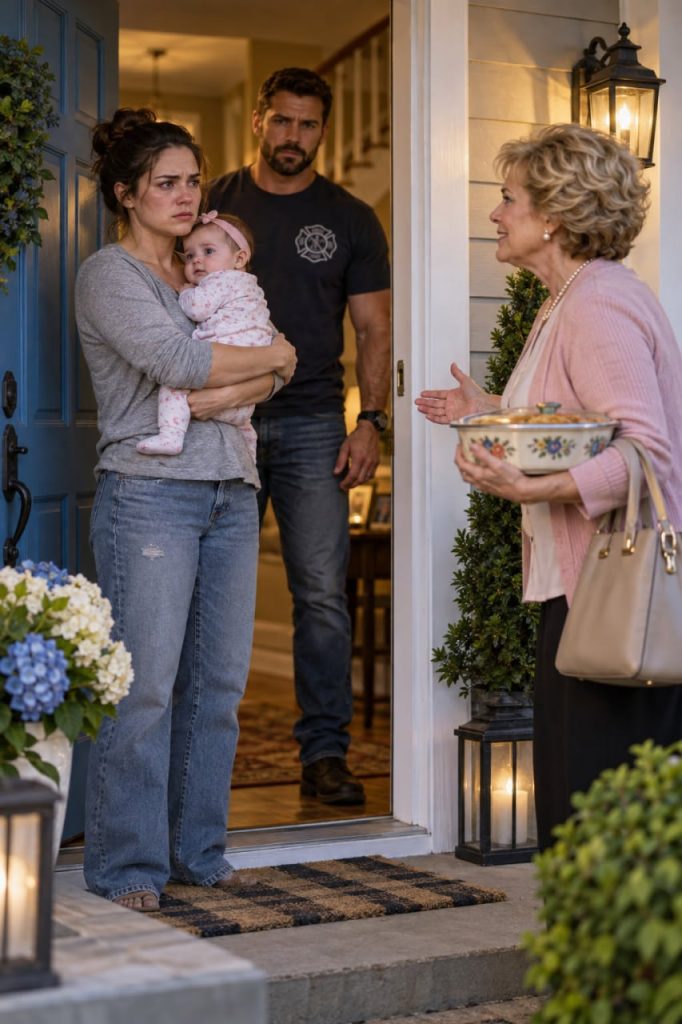
Watched my father throw my suitcase onto a rain-soaked lawn when I was nineteen. She carried a casserole dish covered with aluminum foil. As if fifteen years of silence could be repaired with baked chicken. “Forgive me?” I repeated. Mom’s smile wavered. “You know what I mean, Colleen. We’ve all made mistakes.” I stared at her. “No.
I don’t think I do.” Her eyes dropped to Ren. “Oh, look at her.” She stepped forward. Her hands lifted. Instinct moved faster than thought. I stepped back. Mom froze. Something flickered across her face—not hurt. Offense. As though I had violated some agreement I didn’t know existed. “She’s my granddaughter.” “You’ve known she existed for four weeks.” “.
That doesn’t change what she is.” I almost laughed. Then Mom’s attention shifted past my shoulder toward the brass nameplates Silas had installed beside the blue front door. SILAS CALLAHAN. COLLEEN CALLAHAN. Her lips tightened. There it was. Fifteen years disappeared in an instant. I was nineteen again, standing in my parents’ foyer while rain hammered against the windows.
My father’s face had been purple with rage. “No daughter of mine marries trash.” Silas had been twenty-one then. He drove an old pickup with one working headlight. His father rented half of a duplex. They shopped at discount stores and fixed things instead of replacing them. Apparently, in my father’s world, poverty was contagious. “.
You want to be a Callahan?” Dad had shouted. Then he opened the front door. “Go be one.” Mom had stood halfway up the stairs in her robe. Watching. Silent. My suitcase landed on the lawn. So did a box of nursing-school textbooks. By the time I picked them up, rain had soaked through the cardboard.
I waited. I actually waited for my mother to come outside. She never did. Silas found me twenty minutes later. He didn’t ask me to choose between him and my family. He simply took off his jacket, wrapped it around me, loaded my ruined things into his truck, and said, “We’ll figure it out.” And we did.
We slept on his father’s foldout couch for eight months. We counted my diner tips into a coffee can marked RENT. There were weeks when Silas ate peanut-butter sandwiches for dinner and insisted he preferred them because tuition was due. I became a nurse. Silas entered the fire academy. Years passed. I became a NICU nurse. Silas became a firefighter.
Then a lieutenant. Then a captain. We bought a modest house with white siding and a blue door. We paid it off early. Then, after years of hoping and one miscarriage I had cried through mostly alone, Ren arrived. Holding her for the first time had taught me something that somehow hurt worse than being thrown out.
Love for your child wasn’t supposed to come with conditions. I looked at Ren and knew there was no person she could become that would make me erase her for fifteen years. Now my mother stood on my porch pretending those years were a disagreement. “I should go,” she said finally. “I think you should.” Her mouth hardened. “.
Your father is sick, Colleen.” That stopped me. Not enough to invite her inside. But enough. “What happened?” “His heart.” My stomach tightened. “How bad?” “He collapsed.” “When?” “A few weeks ago.” Before she appeared here. Of course. “He’s recovering,” she added. “But experiences like this change people.” Apparently not enough to make either of them apologize.
Mom touched the foil covering the casserole. “He’s been thinking about family.” “He had fifteen years.” “People get stubborn.” “You mean Dad?” “I mean everyone.” I stared at her. She still couldn’t say it. They threw me out. They cut me off. They ignored my graduation, wedding, promotions, birthdays, and pregnancy. Yet somehow responsibility remained evenly distributed.
She put the casserole on the porch table. “Call me when you’re ready.” “I don’t have your number.” Mom smiled faintly. “Yes, you do.” There was a card beneath the casserole. Then she walked away. That should have been the end of it. Instead, it was the beginning of a campaign. My aunt Deborah called two days later.
Then Pastor Nylin from the church I had attended as a child. Then women I had not spoken to since high school began dropping off cards. RECONCILIATION HEALS. FAMILY IS FOREVER. HONOR THY FATHER AND MOTHER. No one wrote: WE HEARD YOUR PARENTS ABANDONED YOU. ARE YOU OKAY? Mom had gotten there first.
She told them Dad had nearly died. She told them his only wish was to hold his granddaughter. And she told them I was refusing because I was “still angry about something that happened when I was nineteen.” Something. As if I had lost a prom dress. Then she came to my hospital.
I was carrying Ren through the main corridor after bringing her in briefly to meet several coworkers when I heard my mother’s voice. “Colleen.” Every face turned. My mother walked toward me wearing a pale pink cardigan and carrying another casserole. Of course. I had spent nine years in that hospital becoming the calm person.
The nurse people requested by name. The woman who could stand beside terrified parents at three in the morning and explain ventilators without making their fear worse. Now my mother was turning my workplace into a stage. “There’s my beautiful granddaughter.” She reached for Ren. I stepped back again. Mom stopped.
A couple of nurses looked away awkwardly. “I only want to hold her.” “No.” Her face crumpled immediately. Perfectly. “You won’t even let your own mother hold her grandchild?” I understood then. This wasn’t reconciliation. It was pressure. Public pressure. Mom had expected embarrassment to accomplish what guilt hadn’t. But she had made one mistake.
She thought silence meant I was still nineteen. I wasn’t. That night, after Ren fell asleep, I opened the top drawer of my nightstand and removed an old envelope. Nana Ruth’s handwriting covered the front. For Colleen. My grandmother had been the only Whitfield who ever contacted me after I was thrown out. Never openly.
Birthday cards arrived without return addresses. Cash appeared in Christmas cards. When I graduated nursing school, flowers arrived with a note: KNEW YOU WOULD. Before she died, she mailed me one final letter. Part of it had become carved into my memory. “People like that don’t come back for you when they love you.
They come back when they’ve lost everything else and need somewhere to put their hands. You don’t owe them the door.” I had always assumed she meant emotionally. That night, I noticed something I hadn’t before. The envelope was thicker near one corner. I ran my thumb beneath the paper lining. Something small fell into my palm.
A brass key. No label. No explanation. Just a key. I was still staring at it when someone knocked downstairs. Silas was working overnight. I checked the porch camera. My brother Grant stood outside. I hadn’t seen him in fifteen years. He looked twenty years older. When I opened the door, he didn’t hug me.
He said, “You shouldn’t sign anything Mom gives you.” My hand tightened around the doorknob. “What?” “The agency is collapsing.” The Whitfield Insurance Agency had been my family’s pride for forty years. Dad talked about it like royalty talked about bloodlines. “What does that have to do with me?” Grant laughed once, but nothing about it sounded amused. “.
A lot more than anyone told you.” I let him inside. We sat at the kitchen table. Grant rubbed both hands over his face. “The agency has debt. Serious debt. Dad borrowed against the house. There are liens. The commercial building is collateral.” “How much?” “Almost nine hundred thousand.” My stomach dropped. “Why?” “He made bad decisions.
Then he made more bad decisions trying to fix the first ones.” “And Mom came to me because?” Grant looked toward the hallway where Ren slept. “They need a signature.” I stared at him. “Whose?” “Yours.” He reached inside his jacket. Then he put a thick envelope on my kitchen table. On the first document was my name.
COLLEEN WHITFIELD CALLAHAN. Beneath it was an amount. $1,240,000. My fingers went cold. “What is this?” “A personal guaranty.” “I never signed this.” Grant’s eyes met mine. “I know.” There was a signature at the bottom. It looked remarkably like mine. But it wasn’t. Someone had forged it. I could hear my heartbeat. “.
What the hell did they do?” Grant lowered his voice. “Nana left you part of the agency.” I stared at him. “No.” “She did.” “How much?” “Fifty-one percent.” I laughed because sometimes your body chooses the wrong reaction when reality becomes too absurd. “That’s impossible.” “She changed the trust after Dad threw you out.” The room went very still.
According to Grant, Nana Ruth had controlled most of the original Whitfield Agency stock because she and my grandfather had founded the business. Before she died, she had transferred controlling interest into a trust. For me. Dad had hidden it. Years earlier, papers were filed claiming I had voluntarily transferred those shares back to him.
The signature was forged. The recent loan had been built partly on that lie. And now a bank review had uncovered discrepancies. “They need you to ratify everything,” Grant said. “If you sign now, it makes the old transfer look legitimate.” “So Mom didn’t come because Dad almost died.” Grant looked down. “.
She came because the bank froze the deal four days after he collapsed.” I sat there without speaking. For fifteen years, my parents had acted as if I were dead. Then I became useful. And suddenly they believed in family. I looked at the brass key lying beside Nana Ruth’s letter. “What does this open?” Grant’s face changed. “.
I’ve never seen it.” Three mornings later, another piece fell into place. Silas was making pancakes. Ren slept in a bassinet nearby. I had spent half the night searching public records connected to the agency. Dad’s collapse had occurred at his house on Sycamore Street. I looked at Silas. “Which crew answered the cardiac call on Sycamore?”
His spatula stopped. His shoulders went rigid. My skin prickled. “Silas.” He turned slowly. “That was my crew.” I couldn’t breathe for a second. “What?” He switched off the burner. “That was me, Colleen.” “You were there?” “Yes.” “You knew it was him?” “Not until I walked into the kitchen.” I stared. Silas leaned against the counter. “.
He was on the floor. No pulse. Your mom was screaming.” “What did you do?” His expression barely changed. “My job.” CPR. Defibrillation. Medication. More CPR. Silas had stayed kneeling on my parents’ kitchen floor until Dad’s heart started beating again. The man my father had called trailer trash had brought him back from the dead. “.
Why didn’t you tell me?” “Because you had just given birth. Because you were exhausted. Because I didn’t want his emergency becoming another way your family entered our house.” I started crying. Not because Dad nearly died. Not entirely. Because Silas had every reason to hate him. And he had saved him anyway. “.
What did Dad say when he recognized you?” Silas was quiet. Finally, he said, “He said my name.” That hurt more than I expected. After fifteen years refusing to speak it, my father had looked at Silas from a hospital stretcher and whispered: “Callahan.” Pastor Nylin arranged the family meeting the following week.
My parents arrived believing they were walking toward reconciliation. Mom brought tears. Dad brought his cane. Aunt Deborah sat beside them. Grant sat near the back. Ren stayed with Silas’s father. I entered alone. Mom began almost immediately. “We forgive her for everything, Pastor. We only want our daughter back.” I looked at her. “.
For everything?” She blinked. “What exactly are you forgiving me for?” Dad shifted. “Colleen—” “No.” I turned toward him. “You threw me out at nineteen. I didn’t run away. I didn’t abandon this family. You removed me from it.” Nobody spoke. Then I asked him something I had waited fifteen years to ask. “Say his name.”
Dad frowned. “What?” “My husband.” His jaw tightened. “Say his name.” Mom whispered, “This is ridiculous.” “No. It isn’t.” Dad stared at me. He couldn’t do it. For fifteen years, Silas had been “that man.” “That Callahan.” “Trash.” Anything except himself. I leaned forward. “His name is Silas Callahan.” Dad’s hand tightened around his cane.
I took one breath. “And the night your heart stopped in that kitchen, Silas Callahan was the man who brought you back.” Mom stopped crying. Aunt Deborah’s mouth fell open. Pastor Nylin looked sharply toward Dad. My father went white. “Is that true?” Deborah whispered. Dad looked at the floor. “Yes.” The word barely existed.
I waited. Then Dad finally lifted his head. “Silas Callahan saved my life.” Fifteen years. That was all it took. One sentence. And somehow hearing it didn’t heal me. It only proved he had always been capable of saying the name. Then I placed the forged guaranty on the table. Mom’s face changed before Dad’s did.
That told me everything. “What is this?” Pastor Nylin asked. “My signature,” I said. Then I looked directly at my mother. “Except I didn’t sign it.” Her lips parted. Dad whispered, “Margaret.” Interesting. Not Colleen. Not calm down. Margaret. I turned toward him. “You knew?” Dad looked older than he had five minutes earlier. “.
I knew about the shares.” “The forged transfer?” He didn’t answer. “That’s a yes.” Mom stood abruptly. “This is private family business.” “No,” I said. “You made it public when you brought half the church to my hospital.” Grant spoke from behind us. “Tell her why you needed the signature.” Mom spun around. “Grant, stop.”
He walked forward. “The bank won’t recognize the refinancing unless Colleen ratifies the old transfer.” Dad closed his eyes. Mom’s face hardened. This time, there were no tears. “You have no idea what it takes to hold a family together.” I laughed. “You threw one of your children away.” “I was protecting this family.” “.
From Silas?” “From instability.” I looked around the fellowship hall. Then back at her. “My husband has never missed a mortgage payment. You forged my name for more than a million dollars.” Mom flinched. For the first time, I saw shame. But then Grant said something strange. “Ask her about the payments to Hawthorne Consulting.”
Mom went completely still. Dad looked confused. “What payments?” And just like that, the room changed again. Grant removed another stack of documents. Transfers. Dozens of them. Thousands of dollars each. Hawthorne Consulting. “What is that?” Dad asked. Mom didn’t answer. Grant looked at me. “I found these after Dad collapsed.” Something bothered me.
Grant sounded nervous. Not sad. Not angry. Nervous. I looked at the transfers. Then at him. “You said the agency was collapsing because Dad made bad decisions.” “It is.” “But you already knew money was disappearing.” “Yes.” “How long?” Grant hesitated. Too long. The brass key in my pocket suddenly felt heavy.
I stood. “I’m done.” Mom called after me. “Colleen!” I turned at the door. “You wanted me back in the tent.” My voice shook, but not from fear. “You should’ve made sure there wasn’t a fire inside it first.” The next morning, I called the law firm listed on Nana Ruth’s old correspondence.
When I gave my name, the receptionist went silent. Then she transferred me directly to a senior partner. “Mrs. Callahan,” he said, “we have been waiting nearly eleven years for you to call.” The brass key belonged to a safe-deposit box. Nana Ruth had arranged everything. The box contained original trust documents.
Stock certificates. Letters. And a small digital recorder wrapped in one of her scarves. There was also a note. Colleen— If you are opening this, then someone finally needed something badly enough to remember you exist. My hands trembled. I played the recorder. Nana Ruth’s voice filled the tiny bank consultation room. Older. Weaker.
But unmistakably hers. She explained the trust. The shares. Dad’s anger. And then she said something that stopped me cold. “Your father thinks I changed the trust because of what he did to you.” A pause. “I did not.” My skin prickled. “I changed it because I discovered what was happening inside the agency.”
She mentioned irregular accounts. False vendors. Missing premium payments. Thousands disappearing. Then hundreds of thousands. “I confronted your father,” Nana said. “He denied stealing anything. For once, I believed him.” My heart thudded. If not Dad— Then who? Nana continued. “I became suspicious of Margaret.” My mother. But then came another pause. Longer this time. “.
I was wrong about her too.” I stopped breathing. “Colleen, if this recording has reached you, do not trust the person who brings you the truth too easily.” Grant. I replayed the sentence. Then again. Nana’s voice continued. “Your brother learned very young that honest people hesitate. Liars arrive prepared.” The room seemed to tilt.
Grant had appeared at my door. With documents. With answers. With exactly enough truth to make me stop asking who had assembled it. I called an attorney. Then a forensic accountant. Forty-eight hours later, we knew. Hawthorne Consulting belonged to Grant. Not directly. Through two shell companies and an LLC registered under his wife’s maiden name.
For eleven years, Grant had been siphoning money from the family agency. Small amounts first. Then larger ones. When Dad began noticing cash-flow problems, Grant blamed market losses and bad investments. When the business needed loans, Grant prepared the paperwork. When the forged share transfer became an obstacle, Grant forged my signature.
Mom knew the transfer was questionable. Dad knew I had never willingly signed away the shares. They were guilty. But not of everything Grant had claimed. They had agreed to let Grant “fix” the documentation rather than contact me. Why? Pride. Fear. And because contacting the daughter they had disowned would require admitting what they had done.
Then came the final discovery. Dad’s cardiac arrest hadn’t happened randomly. He had collapsed during an argument with Grant. A neighbor’s doorbell camera showed Grant leaving my parents’ house eight minutes before the 911 call. Mom had found Dad on the kitchen floor minutes later. When I confronted Grant, he laughed.
We were in the agency conference room. My attorney sat beside me. Silas waited outside. “You think Nana made you some kind of hero?” Grant said. “No.” “You weren’t here, Colleen. You got to leave.” I almost couldn’t believe him. “Leave?” “You escaped all of it. Dad’s expectations. Mom’s control. This business.
Everything landed on me.” “So you stole from them?” “I took what I was owed.” “Then why come to me?” His smile disappeared. Because now we had reached the part he hadn’t planned for me to understand. The agency wasn’t actually beyond saving. Its property alone was worth more than its debts.
If I had signed the ratification documents Grant brought, the refinancing would have gone through. My controlling interest would have been legally surrendered. And within thirty days, Grant planned to sell the building and agency book. He would pay the bank. Pay my parents enough to keep them quiet. Then walk away with nearly two million dollars.
He hadn’t come to rescue me from them. He had come to use my anger as a weapon. “You knew Mom would pressure me,” I said. Grant smiled without humor. “I knew she couldn’t help herself.” “And you knew I’d believe the worst.” “You had fifteen years of evidence.” That was the cruelest part.
He was right. My parents had treated me badly enough that Grant barely needed to lie. I looked at my brother. “You were the one who told Mom to get me back in the tent.” He didn’t answer. But his face did. Police arrested Grant three weeks later. Bank fraud. Forgery. Embezzlement.
The investigation uncovered more. My parents weren’t innocent. Dad had signed false corporate resolutions. Mom had knowingly notarized one document she knew I hadn’t signed. Their desperation had turned them into accomplices to their own son. But Grant had built the machine. My parents had simply been arrogant enough to believe it would never crush them.
Dad came to my house two months later. Alone. He stood on the porch where Mom had once held that casserole. He looked smaller. Older. He stared at the blue door. “I owe Silas my life.” “Yes.” “And I owe you…” He stopped. I waited. This time I did not rescue him from the sentence. “.
I owe you an apology.” I said nothing. “For throwing you out.” Still nothing. “For what I called him.” He swallowed. “For making love something you had to earn.” That one hurt. Because it was the first thing he had said that sounded like he understood. Dad looked at me. “I was wrong about Silas Callahan.”
The front door opened behind me. Silas stepped outside holding Ren. Dad stared at him. Then at the baby. For a second, I saw the hope in his face. I also saw how easy it would be to mistake apology for repair. They weren’t the same. “You can’t have fifteen years back,” I said.
Dad nodded. “I know.” “And you don’t get access to Ren because you said sorry.” His eyes lowered. “I know.” “But maybe someday she’ll know you.” He looked up. “Maybe?” “If you earn it.” Dad nodded. Then he looked at Silas. “Captain Callahan.” Silas raised an eyebrow. Dad almost smiled. “.
Thank you for saving my life.” Silas shifted Ren gently. “I didn’t do it for you.” Dad blinked. Silas looked at me. “I did my job because that’s who I am.” Dad nodded slowly. “I understand.” After he left, I leaned against Silas. Ren grabbed my necklace. “You okay?” he asked. “I think so.”
But there was one final piece. Weeks later, after Grant accepted a plea agreement, Nana Ruth’s attorney called. “There’s something else in the trust.” I almost laughed. “Of course there is.” We met the following afternoon. He opened a sealed envelope. Inside was one last letter. Colleen— If everything has happened the way I feared.
Then by now you know about the agency. You also know it belongs to you. That part was true. Grant’s conviction voided several transactions. The forged transfer had never been valid. Legally, I still owned fifty-one percent. Dad owned twenty-four. Grant’s shares were subject to seizure. The rest belonged to a family trust. I kept reading.
I did not leave you this business because I wanted you to run it. I did not leave it because Whitfield is your name. It isn’t anymore, and that is all right. I left it because when your father threw you out, he wanted you to believe he had taken your future with him.
I wanted you to know he never had that power. My eyes blurred. Then I reached the final paragraph. And discovered Nana Ruth’s last secret. Silas’s father had known. Years earlier, when Nana first suspected money was disappearing, she needed someone outside the Whitfield family to quietly help her verify whether several insured properties and claims were real.
She contacted a man she trusted. A maintenance worker who also volunteered with the local fire department. Patrick Callahan. Silas’s father. The man my father later called trash. Patrick had helped Nana uncover the first false vendors Grant created as a teenager working summers at the agency. Nana had planned to confront Grant.
Then she became ill. Before she could finish, Dad discovered Patrick had been looking through company records. He assumed Patrick was trying to expose or blackmail the family. That was the real reason Dad hated the Callahans. Not poverty. Not class. Fear. When Silas and I started dating, Dad panicked.
He threw me out because he believed loving Silas might eventually lead me to the truth. I sat frozen. For fifteen years, I had believed I lost my family because they thought the man I loved wasn’t good enough. The truth was uglier. Silas had always been too close to the truth for them to feel safe.
I showed him Nana’s letter that night. Silas read it twice. Then he sat quietly on our kitchen floor. “My dad knew?” “He helped her.” Silas laughed softly. Then covered his face. Patrick Callahan had died seven years earlier without ever telling his son. We went through his old things the next weekend.
At the bottom of a battered metal toolbox, Silas found an envelope. Nana Ruth’s handwriting was on it. PATRICK. Inside was a single note. Thank you for protecting my granddaughter before she even knows she needs protecting. Silas cried. I had seen my husband carry injured children from buildings. I had watched him stand beside hospital beds.
I had watched him remain steady through funerals. I had never seen him cry like that. Six months later, I sold the Whitfield Insurance Agency. I paid every legitimate debt. My parents lost the big house on Sycamore, but not because I took it from them. They sold it themselves.
Dad moved into a small condominium. Mom moved in with Aunt Deborah for a while. They began therapy. Separately. I did not forgive them because a pastor asked me to. I did not forgive them because Dad nearly died. I did not forgive them because people told me life was short.
Forgiveness, I learned, wasn’t a door other people were entitled to walk through. Sometimes it was simply deciding their choices would no longer own the rooms inside you. With part of the agency proceeds, Silas and I created a fund in Patrick Callahan and Ruth Whitfield’s names. It helped families with babies in intensive care.
It also provided emergency assistance to firefighters injured in the line of duty. The two people my family had underestimated most ended up sharing the name on the same foundation. A year after my mother first appeared on my porch, she came again. No casserole. No audience. No tears prepared in advance.
She stood with her hands at her sides. “I drove here three times before I had the courage to knock.” I waited. “I’m sorry.” Two words. Fifteen years late. But finally the right ones. “For what?” I asked. Her eyes filled. “For standing on those stairs.” That nearly broke me. Not because it fixed anything.
Because she finally remembered the exact moment I did. “I watched him put you out,” she whispered. “And I chose being his wife over being your mother.” I swallowed hard. “Yes.” “I can’t undo that.” “No.” She nodded. Then she turned to leave. “Mom.” She stopped. Ren was toddling behind me now, clutching a stuffed rabbit.
My mother looked down at her. She did not reach. That mattered. “Five minutes,” I said. Mom looked at me. “On the porch.” Her face crumpled. She nodded. “Five minutes.” I sat outside with Ren in my lap. Mom sat across from us. No one pretended we were healed. No one called us whole.
But something had changed. Not because my parents finally chose me. Because somewhere between nineteen and thirty-four, between a rain-soaked suitcase and a blue front door, I had learned to choose myself. Ren reached for the brass nameplate beside the door. CALLAHAN. Mom followed her tiny hand with her eyes.
I remembered the first day she had stood there. The way her face changed when she saw that name. She had thought Callahan meant I had chosen the wrong family. She had been wrong about that too. Because the Whitfields had given me blood. But Silas gave me shelter when I had nowhere to sleep.
Patrick helped protect me before I even knew I was in danger. Nana Ruth reached across silence to leave me a choice. And my daughter taught me the simplest truth of all. Family wasn’t the people who demanded you return after they hurt you. Family was the people who never made love the price of staying.
Mom looked at Ren. “What’s her full name?” I smiled. It occurred to me then that after everything—the casseroles, the church campaign, the forged documents, the desperate talk about her only granddaughter—my mother had never once asked. I kissed Ren’s hair. “Ren Ruth Callahan.” Mom went completely still. “Ruth?” “After Nana.”
Tears slid down her face. This time, I believed them. Ren wriggled out of my arms and toddled toward Silas, who had appeared in the doorway. He scooped her up. Mom looked at the three of us. At Silas. At me. At Ruth’s namesake. At the name beside the door she had once despised.
And finally she understood the part none of them had understood fifteen years earlier. My father had thrown my suitcase onto the lawn and told me that if I wanted to be a Callahan, I should go become one. He believed he was giving me a punishment. He had no idea he was giving me directions home.
THE END!
Disclaimer: Our stories are inspired by real-life events but are carefully rewritten for entertainment. Any resemblance to actual people or situations is purely coincidental.