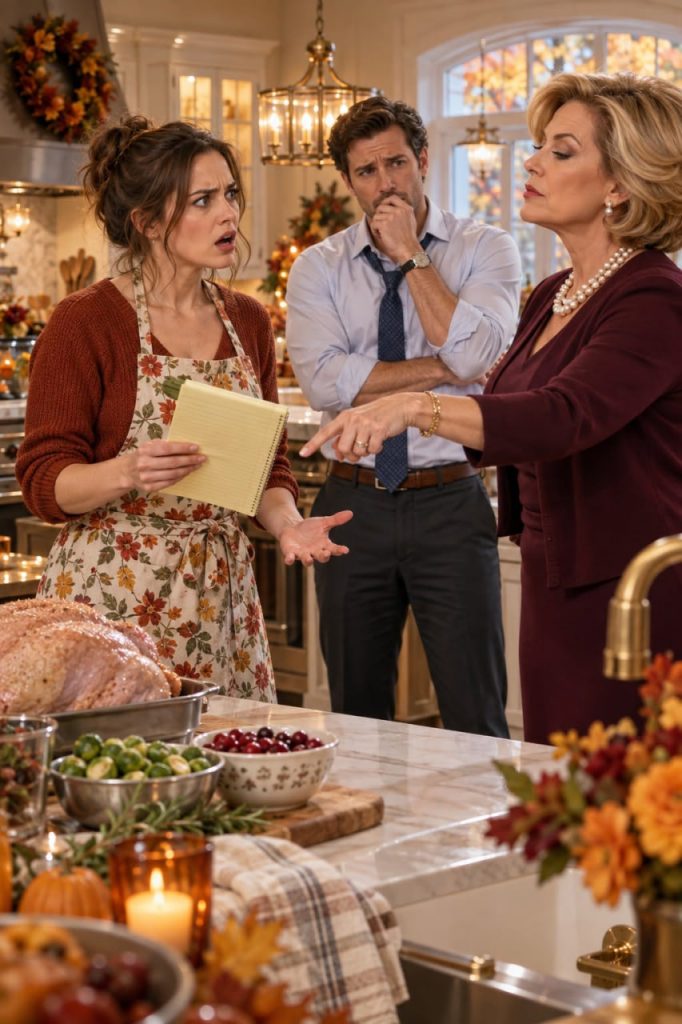
Three days before Thanksgiving, my mother-in-law walked into my kitchen, placed a yellow legal pad on the marble island, and calmly informed me that I needed to start cooking at 3:30 Thursday morning if I didn’t want to embarrass my husband.
I thought she was joking.
Then I looked at the list.
Two turkeys.
Prime rib.
Cornbread dressing.
Mashed potatoes.
Sweet potato casserole.
Mac and cheese.
Green beans.
Brussels sprouts.
Dinner rolls.
Cranberry sauce.
Pumpkin pie.
Pecan pie.
Chocolate bourbon cake.
I counted twice.
Then I noticed the number Cynthia had written in the upper-right corner.
32.
“Thirty-two people?”
Cynthia gave me the same patient smile she used when explaining obvious things to children and waiters.
“Thirty-two confirmed.”
My grip tightened around the legal pad.
Thanksgiving at our house was supposed to be twelve.
My husband Graham and me. His parents. His brother and sister-in-law. Their three girls. My mother. My younger sister and her boyfriend.
Twelve.
Not thirty-two.
I was thirty years old and worked as an events manager for a regional museum foundation in Charlotte. I organized donor dinners, gallery openings, fundraising galas, weddings, corporate receptions.
I could coordinate two hundred guests without breaking a sweat.
Unfortunately, Graham’s family had learned something dangerous about me.
I was competent.
And somewhere along the way, they had decided competence meant permanent availability.
Cynthia tapped the list.
“The Sanders family is eight.”
I looked up.
“The who?”
Her eyebrows rose.
“Graham didn’t tell you?”
My stomach dropped.
That sentence had become one of my least favorite combinations of words.
“Tell me what?”
“Richard and Anne Sanders. Their daughters. Son-in-law. Grandchildren.”
I knew Richard Sanders.
Not personally.
But I heard his name almost every day.
He was one of the senior partners at the financial-advisory firm where Graham worked, and Graham had spent nearly a year talking about making partner.
Richard thinks—
Richard said—
Richard wants—
Richard believes—
I knew more about Richard Sanders’s management philosophy than I knew about some of my cousins.
“Why is Graham’s senior partner coming to our Thanksgiving?”
“They don’t have plans this year.”
“And?”
“Graham invited them.”
I laughed.
Cynthia didn’t.
I slowly set the legal pad down.
“Without asking me?”
“He said you wouldn’t mind.”
“He was wrong.”
Her mouth tightened.
“Elise, this isn’t some random dinner. The Sanderses have become very important to Graham.”
“Then Graham can cook Thanksgiving for them.”
She stared at me.
I smiled.
Neither of us laughed.
“Be serious.”
“I am.”
“You already agreed to host.”
“Twelve people.”
“It’s still Thanksgiving.”
“Twenty additional guests isn’t an adjustment. It’s a catering problem.”
Then Cynthia opened my refrigerator.
Actually opened it.
She moved a container and inspected the shelves like she was evaluating warehouse capacity.
“We can fit two turkeys if you move these.”
I shut the door.
“No.”
She blinked.
“No what?”
“No two turkeys. No thirty-two-person feast unless we cater it or make it a potluck.”
Cynthia looked horrified.
“You cannot ask the Sanders family to bring food.”
“Why?”
“They’re guests.”
“So are the other twenty people.”
“They’re family.”
For one second, I almost admired the logic.
Apparently relatives became unpaid labor the moment wealthy strangers entered the building.
“I’ll call a caterer.”
“Three days before Thanksgiving?”
“Exactly.”
“You’ve handled bigger events than this.”
“At work.”
“Yes.”
“Where I have a staff.”
“You have me.”
I looked at her.
Cynthia had once burned canned biscuits.
“We are not defining you as staff.”
Her face hardened.
“You’re making a joke out of something that matters to your husband.”
There it was.
Not dinner.
Not family.
Graham. His career. His image. His performance.
“I didn’t invite his senior partner.”
“No,” she said coolly. “But you married a man whose career affects your future too.”
My jaw tightened.
“That sentence isn’t going to make me brine two turkeys.”
She picked up her purse.
“I’d start at 3:30 if I were you.”
I laughed again.
She didn’t.
Then she paused near the doorway.
“And please, Elise, don’t experiment this year.”
“What does that mean?”
“The Sanderses entertain beautifully.”
I stared at her.
“So?”
“Simple. Elegant. And maybe don’t make the house look like a craft fair.”
My usual Thanksgiving table involved mismatched antique brass candlesticks, linen napkins, dried oranges, and whatever branches I found in our backyard.
Apparently rustic was now a career liability.
Cynthia adjusted the strap on her purse.
“And make sure everything is perfect. Graham doesn’t need to be embarrassed in front of Richard.”
That was the moment I stopped finding any of it funny.
“You need to leave.”
Her face changed.
“What?”
“You came into my house, tripled my guest list, handed me thirteen dishes to make and told me not to embarrass your son.”
“I am trying to help.”
“No.”
I held out the legal pad.
“You’re trying to assign me a job.”
She didn’t take it.
“You’ll regret turning this into a power struggle.”
I put the pad beside her purse.
“Then I guess I’ll regret it.”
Graham came home that night carrying a laptop bag and a bottle of Cabernet.
“Hey.”
“Did you invite the Sanders family to Thanksgiving?”
He froze.
Only slightly.
But enough.
“Yes.”
“How many?”
“Eight.”
“Why didn’t you tell me?”
“I was going to.”
“When?”
“Tonight.”
“Your mother beat you to it.”
He closed his eyes.
“Great.”
“No. Not great.”
He loosened his tie.
“Elise—”
“Why are thirty-two people coming to my house?”
“Our house.”
I laughed once.
“Fantastic. How many of those thirty-two people are you cooking for in our house?”
“I’ll help.”
“With what?”
“Whatever you need.”
“Name one thing.”
He stared at me.
“Why do you do this?”
“Do what?”
“Turn every request into an audit.”
“Because nobody calls them requests until after they’ve already decided I’m doing them.”
His mouth tightened.
“This dinner matters.”
“To your partnership?”
“Yes.”
At least he admitted that.
“Richard is one of the people pushing for me.”
“Then take him to dinner.”
“It isn’t the same.”
“Why?”
“Because relationships matter.”
“And your relationship with me?”
“Oh, come on.”
“No. Explain why one relationship requires me to cook for thirty-two people without being asked.”
“I thought you liked hosting.”
“Twelve.”
“What?”
“I liked hosting twelve.”
He rubbed his forehead.
“Mom said she’d help.”
“I’ve seen your mother cook.”
That almost made him smile.
I didn’t.
“Elise, what do you want?”
“Cater it.”
“Nothing decent is available.”
“Potluck.”
“No.”
“Why?”
“Because I invited them to dinner.”
“You invited them to a dinner you don’t cook.”
His face went still.
Then he said quietly, “I need you to support me here.”
Support.
Marriage’s favorite vague currency.
“What happens if I don’t?”
He laughed in disbelief.
“Seriously?”
“Yes.”
“You want me to call Richard Sanders and say my wife doesn’t want to cook?”
Every muscle in my body went cold.
“Is that how you’d phrase it?”
“What do you want me to say?”
“The truth.”
“And what’s the truth?”
“That you invited eight business guests to a thirty-two-person Thanksgiving without asking the person you expected to prepare it.”
His face hardened.
“That makes me sound like an asshole.”
I held his gaze.
“Then maybe don’t do things that require better wording.”
We barely spoke that night.
The next morning, I went to work.
At 10:18, my phone buzzed during a vendor meeting.
Unknown number.
I opened the message.
Hi Elise — Anne Sanders here. I hope Graham gave you my number. I just wanted to thank you for insisting on hosting us Thursday. Richard told me you were determined to cook everything yourself, which is incredibly generous. Please let me bring SOMETHING, even if you won’t let me help!
I read it twice.
Then again.
Insisting.
Determined.
Wouldn’t let me help.
I stepped into the hallway and called Graham.
No answer.
I called again.
Nothing.
Then another message appeared.
Graham said this is a tradition you love and that you were excited to make it special for everyone. We are really looking forward to meeting you properly.
Something inside me became very quiet.
The problem wasn’t that Graham had assumed I would eventually agree.
He had already turned my imaginary agreement into a story for other people.
I called him a third time.
He answered.
“I’m in a meeting.”
“What did you tell Richard Sanders?”
Silence.
“Elise.”
“What did you tell him about Thanksgiving?”
“I told him you love hosting.”
“What else?”
“Can we do this tonight?”
“No.”
His voice lowered.
“I told him you wanted to have them.”
“Why?”
“Because saying my wife reluctantly agreed doesn’t exactly sound welcoming.”
“I never agreed.”
Silence.
Then:
“I knew you would.”
There it was.
“So you invited them first.”
“Elise—”
“And told them it was my idea.”
“I was trying to make it gracious.”
“No. You were using my hospitality as part of your pitch.”
“That’s not fair.”
“Isn’t it?”
“Richard values family.”
“So you manufactured a wife who was thrilled to cook for his.”
“This is my career.”
“And this is my labor.”
“I said I’d help.”
“You told eight people I wouldn’t even let them bring food.”
“I didn’t mean literally.”
“Anne did.”
He went quiet.
Then he said something I’ll never forget.
“If you back out now, they’re going to think you invited them and changed your mind.”
And there it was.
The trap.
Graham had created the invitation in my name.
Telling the truth would make me look rude.
Keeping his lie alive required me to work for it.
And Graham knew exactly which version of me he was counting on.
The woman who would rather exhaust herself than let strangers think she had bad manners.
I hung up.
Then I opened Anne’s message.
Anne, that’s incredibly kind. There seems to have been a misunderstanding. I’d actually LOVE for everyone to bring something. Thirty-two people is a lot for one kitchen, and I think a Thanksgiving potluck would be much more fun.
I stared at it for five seconds.
Then I pressed Send.
Her answer arrived almost instantly.
Oh! Absolutely. I’m so glad you said something. Graham made it sound like you were very particular about doing everything yourself. I’ll bring stuffing and a pie.
I smiled for the first time in twenty-four hours.
Then my phone rang.
Graham.
Decline.
Again.
Decline.
A text appeared.
WHAT DID YOU SAY TO ANNE?
Then:
Richard just asked me why I told him you refused help.
I slipped my phone into my purse and returned to my meeting.
Twenty minutes later, I checked again.
Eleven missed calls.
Three from Graham.
Two from Cynthia.
Then Cynthia’s message:
You need to fix this. Now.
But underneath it was another message from Anne.
Elise, Richard and I think there’s something you should know before Thursday.
My pulse slowed.
Then another bubble appeared.
It’s about Graham.
I called her from my car during lunch.
Anne’s voice was warm, but careful.
“I’m sorry to put you in an uncomfortable position.”
“What happened?”
There was a pause.
“Does the name E. Mercer Hospitality mean anything to you?”
I frowned.
“No.”
“Are you sure?”
“My maiden name is Mercer.”
Another pause.
“Elise… Richard’s firm has paid invoices to a company called E. Mercer Hospitality six times during the past year.”
I gripped the steering wheel.
“For what?”
“Private client dinners. Event coordination. Catering arrangements.”
“I don’t own a company.”
Anne exhaled.
“That’s what Richard was afraid you might say.”
The parking lot seemed to tilt.
“How much money?”
“I don’t know the exact number.”
“Anne.”
“More than forty thousand dollars.”
I stopped breathing.
She continued gently.
“Richard noticed the vendor name because Graham talks about you often. Your museum work. Your events. He assumed it was a legitimate side business.”
“It isn’t.”
“I understand.”
“No. You don’t.”
My voice started shaking.
“I have never invoiced Graham’s firm. I have never been paid by Graham’s firm. I don’t run private events. I’m not even allowed to take outside event clients without disclosing them to my employer.”
“I’m sorry.”
I pressed my forehead to the steering wheel.
Then Anne said, “There’s something else.”
Of course there was.
“Some of the invoices have your signature.”
I sat completely still.
“I never signed anything.”
“I believe you.”
That sentence nearly broke me.
Not because of what it meant.
Because someone I had never met trusted me more easily than my own husband respected me.
“Why did Richard accept the Thanksgiving invitation?”
“He wanted to meet you.”
“To ask about this?”
“Yes.”
Suddenly the entire dinner looked different.
Cynthia’s obsession with perfection.
The massive guest list.
The thirteen dishes.
Graham telling Richard I loved hosting.
The way Cynthia had said, Don’t experiment.
The way Graham kept insisting Richard valued family.
They weren’t merely trying to impress Richard.
They needed Richard to see me hosting.
To see me managing a large event.
To see the fiction come alive in front of him.
My hands started trembling.
“Anne, please don’t tell Graham we spoke.”
“I won’t.”
“I need to check something.”
“What?”
“I don’t know yet.”
I left work early.
At home, I pulled Graham’s and my tax folders from the cabinet.
Nothing.
Then I searched our desktop computer.
Graham barely used it anymore, but several folders from his laptop automatically synced to the family cloud account.
Most were boring.
Tax documents.
Insurance.
Old vacation photos.
Then I found a folder named:
VENDOR SUPPORT
Inside were PDFs.
Invoices.
Six of them.
The logo read:
E. MERCER HOSPITALITY LLC
Charlotte, North Carolina.
Each invoice described an elegant private dinner.
Wine service.
Floral design.
Menu coordination.
Vendor management.
Exactly the kind of work I did professionally.
Except I had never done any of it for Graham’s firm.
At the bottom of each invoice was my name.
Elise Mercer Pierce.
And underneath it—
my signature.
Except it wasn’t mine.
It was close.
Terrifyingly close.
I searched the North Carolina business registry.
E. Mercer Hospitality existed.
It had been created eleven months earlier.
The registered mailing address belonged to Cynthia.
I felt physically sick.
My mother-in-law hadn’t been helping Graham impress his boss.
She was involved.
I printed everything.
Then I photographed every page.
Then I emailed copies to a private account Graham didn’t know existed.
Finally, I called my sister.
When she answered, I said, “Can I stay with you tonight?”
Her voice changed immediately.
“What happened?”
“I think Graham stole my identity.”
She didn’t ask another question.
“Come over.”
Graham was waiting when I got home to pack a bag.
“What the hell did you say to Anne?”
I walked past him.
“Elise.”
He followed me upstairs.
“Richard called me into his office.”
I opened a suitcase.
“You should probably focus on that.”
“This isn’t funny.”
“I’m not laughing.”
“What are you doing?”
“Leaving for the night.”
His face changed.
“Why?”
I folded two sweaters.
“Elise.”
I said nothing.
Then he grabbed my wrist.
Not hard.
But enough.
I looked down at his hand.
He released me.
“What did Anne tell you?”
That was all the confirmation I needed.
I looked him directly in the eye.
“What is E. Mercer Hospitality?”
His face emptied.
Not anger.
Not confusion.
Fear.
Pure fear.
“Elise—”
“Don’t.”
“I can explain.”
“Thursday.”
“What?”
“You can explain Thursday.”
“To who?”
I zipped my suitcase.
“Everyone.”
Thanksgiving morning, I woke up at my sister’s apartment at 7:12.
Not 3:30.
For a moment, lying beneath her old quilt, I almost laughed.
At 8:00, my mother called.
At 8:15, my sister made coffee.
At 9:00, Anne texted that her family was bringing stuffing, pie, green beans, and rolls.
My brother-in-law volunteered mashed potatoes.
My mother brought cranberry sauce and sweet potatoes.
Everyone brought something.
No one died because Thanksgiving became a potluck.
By noon, my kitchen smelled like butter, sage, roasted turkey, cinnamon, coffee, and the faint burnt edge of my mother’s marshmallow topping.
It was beautiful.
Not because it was perfect.
Because it wasn’t.
Children ran through the living room.
Someone had put a serving spoon in the wrong bowl.
My sister’s boyfriend brought supermarket rolls after misunderstanding his assignment.
One centerpiece leaned sideways.
I left it that way.
At 12:47, Graham entered the kitchen.
His face looked gray.
“We need to talk.”
“Not now.”
“Elise.”
“Guests are arriving.”
He lowered his voice.
“Richard doesn’t know everything.”
“I know.”
“You have no idea what’s going on.”
“I know enough.”
His eyes darted toward the doorway.
“Whatever Anne told you—”
“She told me to ask you.”
He swallowed.
Cynthia arrived ten minutes later.
The second she saw me, she marched into the pantry and hissed, “What have you done?”
I shut the door behind us.
“I was about to ask you the same thing.”
Her face stiffened.
“Graham said Anne contacted you.”
“She did.”
“Elise, there are business issues you don’t understand.”
“You used my maiden name to register a company.”
Her face went pale.
“You need to lower your voice.”
“I’m done lowering anything for this family.”
“It was paperwork.”
“You forged my signature.”
“I did no such thing.”
“Then Graham did?”
Silence.
That silence said more than an answer.
She reached for my arm.
“Elise, listen to me. Your husband has spent years building his career.”
“And apparently eleven months stealing my identity.”
“It wasn’t stealing.”
I stared at her.
She realized too late what she’d admitted.
“Then what was it?”
Her eyes hardened.
“We were helping him.”
“We?”
Before she could answer, the doorbell rang.
The Sanders family had arrived.
Richard Sanders was nothing like I’d imagined.
Graham had described him so often that I expected someone enormous.
Instead, he was a silver-haired man in a navy sweater carrying two bottles of wine.
Anne hugged me as though we already knew each other.
Then Richard shook my hand.
“Elise.”
“Richard.”
His eyes stayed on mine for half a second longer than normal.
He knew.
I knew.
And Graham knew we both knew.
Dinner began at two.
Thirty-two people filled our house.
Conversation bounced between football, school, grandchildren, travel, museums.
The turkey was slightly dry.
Nobody cared.
At one point I caught Graham staring at Richard from across the table.
Waiting.
Trying to figure out how much his senior partner knew.
Cynthia barely ate.
By dessert, the room had relaxed.
Then Richard set down his coffee cup.
“Elise,” he said casually, “Anne tells me you work in events.”
Every muscle in Graham’s body tightened.
“Yes.”
“At the museum foundation?”
“Yes.”
“Do you do private consulting as well?”
Silence spread outward from the table like spilled water.
I looked directly at Graham.
Then Cynthia.
Then back at Richard.
“No.”
Graham cleared his throat.
“Elise occasionally—”
I raised one hand.
“No, Graham.”
The room went completely silent.
Richard asked, “You’ve never operated a business called E. Mercer Hospitality?”
“No.”
Cynthia stood.
“This is hardly appropriate dinner conversation.”
Richard didn’t even look at her.
“Mrs. Pierce, your address is listed as the company’s mailing address.”
Someone dropped a fork.
Graham pushed back his chair.
“Richard, we should discuss this privately.”
“I tried.”
“Not here.”
“You invited me here.”
Graham looked at me.
For one horrifying second, I saw it.
The calculation.
The same calculation that had created the original trap.
He was trying to decide which version of the story might still save him.
“Elise knew about the company.”
My heart stopped.
There it was.
His escape route.
My husband looked around our Thanksgiving table and said, “She may not have handled the administrative side, but she knew.”
I stared at him.
My mother whispered my name.
Graham continued.
“It was structured for tax and vendor purposes. Mom helped with paperwork. Elise knew we were billing for events.”
Cynthia nodded too quickly.
“That’s right.”
Something inside me broke.
But strangely, it didn’t hurt.
It felt clean.
Final.
I reached beneath my chair and picked up the folder I had placed there before anyone arrived.
Then I slid copies of the invoices across the table.
“These are forged.”
Graham’s eyes widened.
I pulled out the LLC registration.
“This company was created using my maiden name and Cynthia’s home address.”
Then I placed a copy of my employment agreement beside it.
“My employer prohibits undisclosed outside event work.”
Richard read silently.
I continued.
“And because I thought someone might eventually claim I was involved, I spoke with an attorney yesterday morning.”
Graham went white.
“You what?”
“I also froze my credit.”
“Elise—”
“And provided copies of everything I found.”
Cynthia’s voice became shrill.
“You had no right!”
I turned toward her.
“No right to what? Protect my own name?”
Then Richard spoke.
“Graham.”
Graham looked at him.
Richard’s voice was quiet.
“You told compliance Elise independently operated the company.”
No one moved.
“You told them she organized six client events.”
Graham opened his mouth.
“You also said,” Richard continued, “that Thanksgiving would give me a chance to see the kind of private hospitality she provided.”
I felt ice move through me.
There it was.
The whole truth.
The menu.
The thirty-two guests.
The two turkeys.
The perfect table.
The demand that I cook everything.
Thanksgiving had never been about impressing Richard.
Not really.
It had been evidence.
A performance designed to make a fake business look real.
I looked at Cynthia.
“You knew.”
Her lips trembled.
“We were protecting Graham.”
“From what?”
Richard answered.
“An internal audit.”
The room erupted.
Graham stood.
“This is ridiculous.”
Richard’s expression didn’t change.
“Sit down.”
Something in his voice made Graham obey.
Richard continued.
“The firm discovered irregular vendor payments three months ago.”
I looked at Graham.
“Three months?”
He said nothing.
“More than sixty thousand dollars was eventually routed through E. Mercer Hospitality.”
Anne looked at me.
My stomach turned.
“Sixty?”
“Sixty-one thousand four hundred,” Richard said.
Cynthia whispered, “Oh God.”
Richard turned toward her.
“You didn’t know the final amount?”
She stared at Graham.
And that was when the first unexpected crack appeared between them.
“I thought it was forty-eight.”
Graham looked furious.
“Mom.”
Cynthia’s face transformed.
“You told me forty-eight.”
“Stop talking.”
“No.”
For the first time since I had known her, Cynthia looked frightened of her own son.
“You said it was temporary.”
“Mom.”
“You said you’d replace it after your bonus.”
Everyone at the table had stopped breathing.
Richard’s voice sharpened.
“Replace what?”
Graham stood again.
“This conversation is over.”
I looked at him.
“No.”
His eyes snapped toward mine.
And I said the sentence I had been waiting three days to say.
“You don’t get to decide that anymore.”
The Sanderses left shortly afterward.
So did nearly everyone else.
My mother kissed my forehead before leaving.
My sister stayed.
Graham’s brother left without speaking to him.
Cynthia sat frozen at the table until Graham finally shouted at her to go home.
She stared at him.
Then she said quietly, “You told me she would never know.”
I watched her leave.
Graham and I stood alone in the kitchen.
Thirty-two dirty plates surrounded us.
Half a pecan pie sat on the counter.
Someone had left cranberry sauce on one of my linen napkins.
Three days earlier, that would have bothered me.
Now it felt meaningless.
Graham stared at me.
“You humiliated me.”
I almost laughed.
“You forged my signature.”
“You don’t understand the situation.”
“Then explain it.”
He dragged both hands over his face.
“I was trying to keep things moving until partnership.”
“Richard said there was an audit.”
“It wasn’t supposed to become an audit.”
“You stole sixty-one thousand dollars.”
“I borrowed it.”
“From your employer.”
“It was reimbursement money.”
“For events that never happened.”
He said nothing.
I stared at the man I had married six years earlier.
The man who remembered how I took my coffee.
The man who brought me soup when I had pneumonia.
The man who cried at our wedding.
The man who had apparently forged my signature six times.
“Why my name?”
His silence told me before his words did.
“Elise…”
“Why?”
“Because it made sense.”
I felt nauseated.
“What does that mean?”
“You work in events. If anyone asked questions, it was plausible.”
I closed my eyes.
Not because I couldn’t understand.
Because I understood perfectly.
He had chosen me because I was believable.
Not as a wife.
As cover.
“You were going to blame me.”
“No.”
“If the audit got worse, you were going to tell them I handled the company.”
“No.”
“You already did.”
He stepped toward me.
“I was trying to protect us.”
“There is no us.”
His face changed.
“Don’t say that.”
“I want you out.”
“Elise.”
“Tonight.”
“You’re emotional.”
I laughed.
That word.
Emotional.
As though discovering your husband had built financial fraud around your identity was something a reasonable woman might greet with mild curiosity.
“I’m calling my sister back.”
“This is my house too.”
“Then I’ll leave.”
He moved in front of me.
“Do you understand what you did today?”
I stared at him.
“You destroyed my career.”
And finally, finally, I understood something that had been hiding underneath every argument we had ever had.
Whenever Graham said support, he meant sacrifice.
Whenever he said our future, he meant his ambition.
Whenever he said marriage, he meant access.
My time.
My work.
My reputation.
My credibility.
My name.
“No,” I said.
His face twisted.
“No what?”
“I didn’t destroy your career.”
I picked up Cynthia’s yellow legal pad from the counter.
The original Thanksgiving menu was still written on it.
Two turkeys.
Prime rib.
Thirteen dishes.
Thirty-two guests.
I held it between us.
“I just stopped cooking your alibi.”
I filed for divorce eleven days later.
Graham’s firm placed him on leave while outside counsel reviewed the vendor payments.
Cynthia called me seventeen times during the first week.
I answered once.
“You’re destroying this family,” she said.
“No.”
“Elise, please.”
“You taught your son that the women around him existed to absorb consequences.”
“That is cruel.”
“It’s accurate.”
“He made a mistake.”
“A mistake is forgetting the cranberry sauce.”
Silence.
“Forging my signature six times is a plan.”
She never called again.
By February, I had moved into a townhouse fifteen minutes from work.
It had a small kitchen.
No marble island.
No enormous dining room.
I loved it.
The divorce became ugly.
Graham insisted that I had known about the company.
My attorney requested records.
Emails.
Bank statements.
Vendor forms.
Internal messages.
For months, I thought I knew the worst of it.
I didn’t.
The final piece arrived in a discovery packet on a rainy Monday afternoon.
My attorney called.
“Elise, I need you to come in.”
My stomach tightened.
“What is it?”
“Something you should see in person.”
I almost laughed at the phrasing.
I had heard a version of that sentence before.
When I arrived, she placed a stack of emails in front of me.
The first was dated August 14.
Months before Thanksgiving.
It was from Richard to Graham.
The subject line read:
Partnership Consideration
I started reading.
By the second paragraph, my hands went numb.
Graham had not been waiting to hear whether he would make partner.
He had already been removed from consideration.
In August.
Richard had written that concerns regarding judgment, expense reporting, and disclosure made promotion impossible that year.
My attorney slid another email forward.
September.
Compliance requested documents related to E. Mercer Hospitality.
October.
Graham told them his wife independently managed the company.
Then came an email from November 3, more than two weeks before Cynthia entered my kitchen with that legal pad.
Graham had written to Cynthia.
I read it twice.
Then a third time.
If Richard sees Elise host something at scale, it helps. It needs to look like this is normal for her. Invite enough people that it feels professional. She’ll complain, but she won’t let it fail once people are coming.
I couldn’t breathe.
My attorney quietly pushed the final page toward me.
It was Cynthia’s reply.
I’ll handle her.
Underneath that, Graham had answered:
Make sure she does the whole thing herself. If everyone brings food, it defeats the point.
The room disappeared around me.
The invitation.
The Sanders family.
The thirty-two guests.
The ridiculous menu.
Cynthia inspecting my refrigerator.
Her insistence that the Sanderses couldn’t bring anything.
Graham refusing a potluck.
His demand that I “support” him.
His warning that backing out would make me look rude.
Every piece snapped into place.
There had never been a partnership opportunity to save.
That was the final lie.
By Thanksgiving, Graham already knew Richard wasn’t promoting him.
The dinner wasn’t meant to win Richard over.
It was meant to create evidence.
If Richard saw me single-handedly host thirty-two people, prepare an enormous meal, coordinate everything flawlessly and behave as though this were ordinary, Graham could point to Thanksgiving and say:
See? Elise really does private events.
And if the investigation became serious?
He had already built the answer.
The company was named after me.
The services matched my profession.
The invoices carried my signature.
Thanksgiving would establish the story.
My husband hadn’t merely expected me to cook dinner.
He had expected me to unknowingly perform the role of the person he planned to blame.
I sat in my attorney’s office for a long time.
Then, strangely, I started laughing.
Not because anything was funny.
Because three months earlier I had believed Cynthia’s legal pad was the most insulting thing anyone had ever handed me.
In reality, it had been something much worse.
A script.
And all I had needed to ruin the entire production was one word.
No.
The following Thanksgiving, I hosted again.
Twelve people.
Exactly twelve.
My mother brought sweet potatoes.
My sister made macaroni and cheese.
Her boyfriend was assigned ice because none of us trusted him with bread anymore.
I cooked one turkey.
Not two.
There was no prime rib.
No chocolate bourbon cake.
No career strategy hiding beneath the tablecloth.
I used my mismatched brass candlesticks.
I put branches from the backyard down the center of the table.
One of them dropped leaves onto the stuffing.
Nobody cared.
After dinner, my niece asked why one chair at the end of the table was empty.
I looked at it.
For a second, I thought about Graham.
The divorce had been finalized six weeks earlier.
His former firm had settled the financial matter privately while cooperating with authorities and insurers. My attorney advised me not to follow every development.
So I didn’t.
For most of my marriage, I had spent too much time monitoring Graham’s moods, ambitions, disappointments and needs.
I wasn’t going to build my new life around watching the consequences of his old one.
“That chair isn’t empty,” I told my niece.
She frowned.
“Yes, it is.”
I smiled.
“Then we’ll move it.”
So we did.
My sister carried it downstairs.
My mother opened another bottle of wine.
Someone turned on music.
We ate pie standing around the kitchen island.
At one point, my phone buzzed.
A message from Anne.
Happy Thanksgiving. Richard says to tell you the stuffing still isn’t as good as ours.
I laughed.
Then another message appeared.
Also, I thought you’d appreciate knowing that when the investigators asked Graham why he chose E. Mercer Hospitality as the company name, he finally answered.
I stared at the screen.
Another bubble appeared.
He said because everyone already believed you were the capable one.
I read it once.
Then I placed my phone facedown.
For months, that sentence might have hurt.
That night, it didn’t.
Because Graham had been right about one thing.
I was capable.
Just not in the way he had expected.
I was capable of refusing.
Capable of walking away.
Capable of letting people misunderstand me.
Capable of allowing a dinner to be imperfect.
Capable of choosing my own reputation over protecting someone else’s lies.
Most importantly, I had learned the difference between being needed and being used.
My mother raised her wineglass.
“What are we drinking to?”
I looked around my small kitchen.
At the crooked centerpiece.
At the one turkey.
At my family laughing.
At the table where nobody needed me to prove anything.
I lifted my glass.
“To smaller guest lists.”
Everyone laughed.
Then my sister grinned.
“And potlucks.”
“To potlucks,” I agreed.
We clinked glasses.
And for the first time in years, Thanksgiving felt exactly the way I had always wanted it to feel.
Not perfect.
Not impressive.
Not useful.
Just mine.