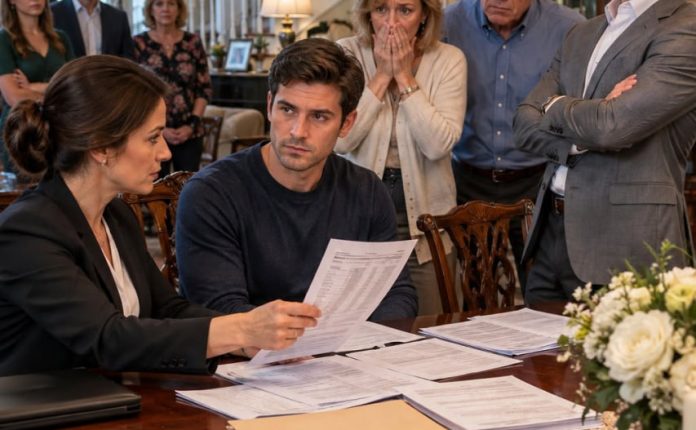
Dad’s voice became dangerously soft. “Marianne.” She ignored him. “You told me the bridge loan was six hundred.” Dad stepped toward her. One officer shifted between them. Rebecca opened her file. “Mr. Grant, the application requests $1.8 million.” “That application was preliminary.” “It includes executed disclosures.” He had spent years treating resistance as disrespect, which made his plans harder to challenge until the documents finally spoke for themselves. The scheme felt larger every time another old decision revealed how carefully he had managed the story around him. The facts were easier to trust than the shifting explanations around them.
“I never signed final documents.” Rebecca turned one page. “You signed enough.” Dad laughed. It was not a real laugh. “This is absurd. She transferred the property.” Caleb held out his hand. “Then give me the deed.” Dad didn’t. “Mr. I was beginning to see that his greatest advantage had never been intelligence alone, but certainty delivered before anyone else could question him. That moment became another line between the life I had inherited and the one I was choosing. For the first time, Dad could not force reality to become more convenient simply by speaking louder than everyone else.
Grant,” one officer said, “hand him the document.” After a few seconds, Dad passed it over. Caleb compared it with the copy in his file. “Same recorded instrument.” Rebecca removed another page. “There’s another problem.” Dad said nothing. “The signature verification used in the loan file includes a copy of your daughter’s driver’s license.” I was grateful we had saved evidence before confronting anyone, because memory alone would never have carried the same weight. Every boundary felt more natural once I stopped treating someone else’s disappointment as an emergency. I did not need revenge; I needed the pattern to stop.
I blinked. “What?” She placed a photocopy on the table. My license. Same number. Same expiration date. But the photo had been replaced. With another woman. For several seconds I couldn’t breathe. Caleb leaned closer. “Who is that?” Every preserved email, signature, recording, and timestamp narrowed the space where anyone could still call the scheme a misunderstanding. The more calmly I looked at the facts, the less complicated the situation became. I did not need another promise before deciding what I would protect. Legal process moved slower than anger wanted, but its patience made the eventual conclusions harder to dismiss.
Mom made a sound. Barely audible. “Oh God.” Dad looked at her. And in that instant, I knew she recognized the woman. “Who is she?” I asked. Mom’s eyes filled with tears. Dad said sharply, “Don’t.” I stepped toward my mother. “Who is she?” Mom’s shock mattered because it showed she had participated without understanding every layer of what Dad intended. She was not innocent of everything, but neither was she carrying the same knowledge Dad had hidden from her. Watching Mom’s certainty collapse made me realize how long fear and loyalty had kept her from asking the right questions.
Her lower lip trembled. Then she whispered a name I had not heard in seventeen years. “Claire.” The room disappeared around me. Claire was my mother’s younger sister. My aunt. The family ghost. She had vanished when I was fourteen. Claire’s return forced me to reconsider seventeen years of family history in a matter of minutes. She had lived inside our family as a warning story for so long that seeing her alive made the old version impossible to maintain. I wanted answers from her, but I also understood that fear had shaped every choice she made about staying away.
According to my parents, she had stolen money from my grandparents, disappeared with a married man, and cut off everyone who tried to help her. Grandpa never discussed her. Grandma cried whenever her name came up. And now her face was on my identification. “That’s impossible,” I said. Their final safeguards were not sentimental, but they carried a kind of care I understood only after everything began unraveling. The more I learned, the more their estate plan felt less like control and more like a structure built to preserve consent. Every new fact made the earlier explanations harder to believe.
Mom sank into a chair. Dad looked furious rather than afraid. Which somehow frightened me more. Caleb asked, “Where is Claire?” Mom covered her mouth. “I don’t know.” Dad barked, “She knows nothing.” Rebecca placed another photograph on the table. A security image from the notary’s office. Once attorneys, investigators, and official records entered the situation, emotional pressure stopped being enough to control the outcome. I had spent too many years softening facts so other people would not have to feel responsible for them. Once I saw the pattern clearly, I could no longer pretend the latest incident stood alone.
A woman in a baseball cap sat at a desk. The picture wasn’t perfect, but it was clear enough. Claire. Seventeen years older. But unmistakably her. The same sharp jaw. The same eyes as Mom. The same scar near her eyebrow from a horseback accident when I was little. I could see her trying to separate what she had chosen from what she had been told, and the distinction was painful. Nothing about family made entitlement more reasonable. Her anger shifted as the truth widened, first toward me, then toward the husband whose explanations had shaped her decisions for years.
My aunt had impersonated me. The front door was still open. The movers stood awkwardly outside, pretending not to listen. One of the officers closed it. My voice sounded distant. “You’ve been in contact with her?” She had lived inside our family as a warning story for so long that seeing her alive made the old version impossible to maintain. Every fact about Claire carried two histories now: the one I had been told and the one she had actually survived. I had spent too many years softening facts so other people would not have to feel responsible for them.
Mom began crying. Dad stepped in. “She came to us.” Rebecca looked at him. “When?” “Two months ago.” Mom shook her head violently. “No. No, she contacted you last year.” Dad’s eyes flashed. There it was. Another crack. Rebecca noticed it too. “Last year?” Dad’s confidence had always depended on other people accepting his version quickly enough that nobody examined the details. He had spent years treating resistance as disrespect, which made his plans harder to challenge until the documents finally spoke for themselves. I no longer believed that keeping the family comfortable was a job assigned only to me.
Mom stared at her husband. “You said we had to keep it quiet because of Dad’s trust.” I turned to Caleb. “What trust?” He didn’t answer. He was staring at my mother. “What trust did Thomas create?” Mom wiped her eyes. “I don’t know the details.” I could see her trying to separate what she had chosen from what she had been told, and the distinction was painful. The facts were easier to trust than the shifting explanations around them. Watching Mom’s certainty collapse made me realize how long fear and loyalty had kept her from asking the right questions.
Dad moved toward the door. One officer blocked him. “We’re not finished.” “You have no authority to hold me here.” “You’re free to leave,” the officer said. “But the investigator has asked us to document the suspected fraudulent instrument, and we have questions regarding identification fraud.” That detail stayed with me because it connected too many earlier moments I had once explained away. I was grateful we had saved evidence before confronting anyone, because memory alone would never have carried the same weight. I stopped asking what explanation would keep the peace and started asking what the evidence actually showed.
Dad stopped. Rebecca looked at Mom. “What did your husband tell you about the trust?” Mom hesitated. Then the whole story began spilling out. A year earlier, Dad had received an anonymous email. It referenced a trust Grandpa had allegedly created before he died. For the first time, Dad could not force reality to become more convenient simply by speaking louder than everyone else. That moment became another line between the life I had inherited and the one I was choosing. The scheme felt larger every time another old decision revealed how carefully he had managed the story around him.
The message claimed the estate was connected to money that could not be distributed while I controlled the property. Dad initially believed it was a scam. Then someone sent him scanned pages bearing Grandpa’s signature. One sentence caught his attention. Every room carried memories that existed long before the forged transfer, and no recorded document could make those years disappear. The property mattered because it represented continuity, not status, and that was something Dad never seemed to understand. Owning the property had never made me feel powerful; it made me responsible for protecting what my grandparents trusted me to keep.
If the residence is transferred outside the direct bloodline, secondary assets shall become eligible for release. Dad became convinced Grandpa had hidden money. A lot of money. Claire contacted him shortly afterward. She claimed Grandpa had created a secret trust worth more than $12 million. Grandpa had understood that access to money could become a test of character, especially when entitlement already existed. Money had created the temptation, but the structure around it revealed who respected boundaries and who only respected opportunity. The decoy references were strange, but their purpose became clear once the exact false story resurfaced years later.
She said the estate was the trigger. If ownership changed properly, the trust could be accessed. I stared at Dad. “So you forged my deed because you thought stealing a $3.5 million house would unlock twelve million more?” He pointed at me. The estate became the center of the scheme because everyone involved understood its value, but they underestimated what the records around it could prove. Every room carried memories that existed long before the forged transfer, and no recorded document could make those years disappear. I could care about everyone involved without volunteering to absorb the consequences again.
“You don’t understand what your grandfather did to this family.” “What did he do?” “He controlled everyone with money.” Caleb spoke quietly. “Thomas protected his assets from people who tried to steal them.” Dad’s face hardened. “You always worshipped him.” “No,” Caleb said. “I read his documents.” The more I looked back, the more I realized our family had survived for years by letting one person’s version of events become everyone else’s reality. I wanted honesty more than appearances because appearances had hidden too much already. Clarity felt harsh only because denial had protected the wrong people for too long.
That stopped everyone. Caleb walked to his briefcase. “I didn’t want to raise this until I understood what we were looking at.” He removed a sealed envelope. My name was written across the front. In Grandpa’s handwriting. I stared at it. “What is that?” Grandpa and Grandma had always believed preparation mattered more than dramatic promises, which explained why their protections survived long after they were gone. They had known that money could magnify old resentments, so they left records strong enough to outlast anyone’s memory. Some consequences feel cruel only to people who expected someone else to prevent them.
“A letter your grandfather instructed me to keep with a supplemental estate file.” “Why haven’t I seen it?” “Because the conditions for opening it were very specific.” My heartbeat quickened. “What conditions?” Caleb looked at Dad. “An attempted involuntary transfer of the residence by an immediate family member.” The family had not been broken by one morning; that morning simply exposed fractures that had existed for years. Every revelation made old memories feel unstable, as though entire conversations had been built on facts I never possessed. The silence after a firm answer often revealed more than another hour of arguing.
Nobody spoke. Then Dad actually laughed. “You’re lying.” Caleb set the envelope on the table. “Thomas knew you better than you thought.” My hands went cold. Caleb broke the seal. Inside was a letter and a small flash drive. The documents mattered because they could be tested independently instead of relying on whichever family member sounded most certain. The hardest part was accepting that one clear fact could expose years of assumptions. The records kept pulling us back to reality whenever emotions threatened to blur it. The more calmly I looked at the facts, the less complicated the situation became.
He handed me the letter. The first line was written in Grandpa’s blocky handwriting. If you are reading this, someone in the family has tried to take the house from you. I covered my mouth. Mom began sobbing. Dad whispered, “Son of a bitch.” I kept reading. What hurt most was understanding how easily love had been turned into a reason not to ask difficult questions. The truth did not become cruel simply because someone disliked hearing it spoken without excuses. The family had not been broken by one morning; that morning simply exposed fractures that had existed for years.
Grandpa explained that years earlier, he had become convinced Dad was trying to gain control over family assets through signatures and shell companies. The “simple estate housekeeping” papers Grandpa once rejected? They had not been harmless. They would have granted Dad power to move several investments. Dad’s confidence had always depended on other people accepting his version quickly enough that nobody examined the details. I was beginning to see that his greatest advantage had never been intelligence alone, but certainty delivered before anyone else could question him. I had learned how expensive it could be to ignore my own uneasiness.
Grandpa had investigated quietly. He discovered fabricated invoices, unauthorized account access attempts, and documents prepared for signatures Grandma never intended to give. But Grandpa had never prosecuted him. Because Mom begged him not to. Instead, Grandpa rebuilt the estate plan. Grandpa and Grandma had always believed preparation mattered more than dramatic promises, which explained why their protections survived long after they were gone. The more I learned, the more their estate plan felt less like control and more like a structure built to preserve consent. Every boundary felt more natural once I stopped treating someone else’s disappointment as an emergency.
The house went to me. Several other assets went into protective structures. Then came the paragraph that made the entire room silent. **There is no twelve-million-dollar trust activated by the sale of the residence. The trust documents changed the meaning of everything because they separated real inheritance from the fantasies people had built around it. Grandpa had understood that access to money could become a test of character, especially when entitlement already existed. The real trust was designed to protect beneficiaries from each other as much as from outside threats. That distinction became more important with every decision that followed.
Any document claiming otherwise was created as part of a private integrity test designed to identify future fraudulent attempts against my estate.** I looked up. Dad’s mouth had fallen open. Mom stared at the floor. Rebecca frowned. “A test?” Caleb nodded slowly. “Thomas anticipated someone might eventually try this.” I continued reading. Once attorneys, investigators, and official records entered the situation, emotional pressure stopped being enough to control the outcome. Every preserved email, signature, recording, and timestamp narrowed the space where anyone could still call the scheme a misunderstanding. I was finally learning that patience has limits when respect disappears.
Grandpa had intentionally created decoy references in restricted family files. Different versions contained different false details. One mentioned $12 million. Another mentioned $8 million. Another mentioned property in Colorado. Each version had been shown to different people. If one ever surfaced, Grandpa’s attorney would know where the leak came from. Their decisions looked complicated only because they had spent years imagining the ways family pressure might eventually distort ordinary choices. Their final safeguards were not sentimental, but they carried a kind of care I understood only after everything began unraveling. This time I let the consequences remain where they belonged.
My hands started shaking. The $12 million version had only been given to one person. Claire. I stared at the security photograph. “Then Claire was behind this?” Dad answered instantly. “Yes.” Too instantly. Grandpa’s letter continued. Claire had not stolen from my grandparents seventeen years earlier. The more I learned, the more their estate plan felt less like control and more like a structure built to preserve consent. I could care about everyone involved without volunteering to absorb the consequences again. They had known that money could magnify old resentments, so they left records strong enough to outlast anyone’s memory.
She had discovered evidence that Dad was moving money through one of Grandpa’s vendors. She threatened to expose him. Dad turned the family against her first. He accused her of theft. And because Claire had a history of addiction at the time, everyone believed him. He had spent years treating resistance as disrespect, which made his plans harder to challenge until the documents finally spoke for themselves. The scheme felt larger every time another old decision revealed how carefully he had managed the story around him. Clarity felt harsh only because denial had protected the wrong people for too long.
Everyone except Grandpa. Grandpa quietly helped her leave New Mexico and enter treatment under another name. Grandma knew. My mother did not. I looked at Mom. She appeared to stop breathing. “You said Claire stole from them.” Dad said nothing. Grandpa and Grandma had always believed preparation mattered more than dramatic promises, which explained why their protections survived long after they were gone. Their decisions looked complicated only because they had spent years imagining the ways family pressure might eventually distort ordinary choices. That detail stayed with me because it connected too many earlier moments I had once explained away.
Mom turned toward him. “You told me my sister stole from my parents.” “Marianne—” “For seventeen years.” “Listen to me.” “You told me she was dangerous.” “She was unstable.” Mom stood. “You made me hate my own sister.” Dad’s composure finally shattered. Mom’s shock mattered because it showed she had participated without understanding every layer of what Dad intended. Her anger shifted as the truth widened, first toward me, then toward the husband whose explanations had shaped her decisions for years. She was not innocent of everything, but neither was she carrying the same knowledge Dad had hidden from her.
“She was going to destroy us!” “No,” Caleb said. “She was going to expose you.” Then Rebecca’s phone rang. She glanced at the screen and stepped aside. I barely noticed. My entire childhood was rearranging itself inside my head. Grandpa refusing to discuss Claire. Grandma crying. Grandpa and Grandma had always believed preparation mattered more than dramatic promises, which explained why their protections survived long after they were gone. Their final safeguards were not sentimental, but they carried a kind of care I understood only after everything began unraveling. Nothing about the situation improved when everyone avoided the obvious question.
Dad calling her a thief. Mom throwing away birthday cards that arrived without return addresses. I suddenly remembered one. I had been sixteen. A plain envelope. Inside was a card with nothing but: **Someday you’ll understand why I had to leave. I hope you still remember me. For the first time, Dad could not force reality to become more convenient simply by speaking louder than everyone else. I stopped asking what explanation would keep the peace and started asking what the evidence actually showed. Once I saw the pattern clearly, I could no longer pretend the latest incident stood alone.
—C** Dad had taken it from my hand and torn it in half. I looked at him. “You knew where she was.” He said nothing. “You knew.” Mom whispered, “Answer her.” Rebecca returned. Her expression had changed. She looked at the officers. The documents mattered because they could be tested independently instead of relying on whichever family member sounded most certain. I was grateful we had saved evidence before confronting anyone, because memory alone would never have carried the same weight. Every preserved email, signature, recording, and timestamp narrowed the space where anyone could still call the scheme a misunderstanding.
Then Caleb. Then me. “The notary has been located.” Dad visibly flinched. Rebecca continued. “She’s agreed to cooperate.” I looked at the security image again. “What about Claire?” Rebecca paused. “That’s the problem.” My stomach tightened. “What?” “The woman in this photograph is not Claire Grant.” Legal process moved slower than anger wanted, but its patience made the eventual conclusions harder to dismiss. I was grateful we had saved evidence before confronting anyone, because memory alone would never have carried the same weight. That moment became another line between the life I had inherited and the one I was choosing.
Mom stared at her. “Yes, it is.” “No.” Rebecca placed another photograph beside it. An older image from DMV records. Claire. Similar. But not identical. I leaned closer. The difference was subtle. The woman at the notary’s office had Claire’s hair. Claire’s posture. Claire’s return forced me to reconsider seventeen years of family history in a matter of minutes. Every fact about Claire carried two histories now: the one I had been told and the one she had actually survived. I wanted answers from her, but I also understood that fear had shaped every choice she made about staying away.
Even Claire’s scar. But the scar was slightly too high. Makeup. Prosthetic. A disguise. I felt sick. “Then who is she?” Rebecca looked at my father. “Maybe he should answer.” Everyone turned. Dad backed into the entry table. His face had gone gray. Dad’s confidence had always depended on other people accepting his version quickly enough that nobody examined the details. I was beginning to see that his greatest advantage had never been intelligence alone, but certainty delivered before anyone else could question him. I no longer believed that keeping the family comfortable was a job assigned only to me.
Mom whispered, “Richard?” He said nothing. Rebecca opened a new document. “The phone number used to coordinate the notary appointment was registered through a prepaid service. But the device connected to hotel Wi-Fi the night before.” She looked at Dad. “The reservation was made by your company.” For the first time, Dad could not force reality to become more convenient simply by speaking louder than everyone else. Some consequences feel cruel only to people who expected someone else to prevent them. I had spent too many years softening facts so other people would not have to feel responsible for them.
Mom stepped away from him. “You hired someone?” His jaw tightened. “The plan was supposed to be temporary.” I stared. “You hired someone to pretend to be Claire pretending to be me?” “No.” Then he realized what he had admitted. Rebecca’s expression sharpened. I could see her trying to separate what she had chosen from what she had been told, and the distinction was painful. Her anger shifted as the truth widened, first toward me, then toward the husband whose explanations had shaped her decisions for years. I wanted honesty more than appearances because appearances had hidden too much already.
“So there was a plan.” Dad turned toward the door. This time both officers moved. One raised a hand. “Sir, don’t.” Dad stopped. And then another voice came from the hallway behind us. “Richard never was good at knowing when to stop.” My mother screamed. He had spent years treating resistance as disrespect, which made his plans harder to challenge until the documents finally spoke for themselves. The scheme felt larger every time another old decision revealed how carefully he had managed the story around him. The silence after a firm answer often revealed more than another hour of arguing.