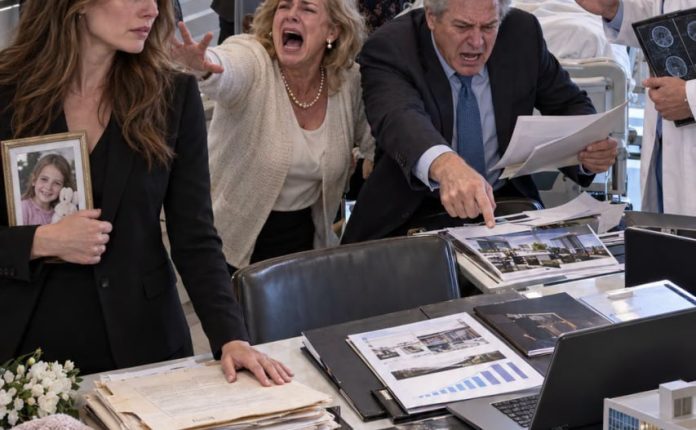
My mother wanted me out of the family photo. She never expected that one small gesture would expose a secret nobody in the room was prepared to face. For years, I had been the invisible daughter, useful only when something needed fixing.
My name is Claire Whitaker. I was thirty-five when my younger brother, Captain Ryan Whitaker, came home to Arlington, Virginia, after his final overseas deployment. Nearly sixty relatives, neighbors, officers, and family friends crowded into my parents’ backyard to celebrate him.
I had planned most of the party myself. I ordered the food, rented the tables, arranged the flowers, coordinated the photographer, and spent two days cleaning my parents’ house because my mother insisted everything had to look perfect for Ryan.
That was how things had always worked in our family. Ryan was the bright center, and I was the person quietly adjusting everything around him. I never hated him for it. He had never asked to be worshiped. My mother had simply decided he should be.
When Ryan earned his first school medal, Mom framed the newspaper clipping. When I graduated at the top of my class, she asked whether I could stop by the grocery store afterward because we were out of milk.
When Ryan joined the military, my parents held a farewell dinner for forty people. When I received a promotion that doubled my salary, Mom sent a thumbs-up emoji and reminded me that Ryan needed help paying for new luggage.
The strange part was that Ryan always noticed. He called after my promotion and apologized for missing the dinner I had never been given. I laughed it off. That was my specialty: turning disappointment into jokes before anyone had to feel uncomfortable.
By the time of his homecoming party, I had stopped expecting fairness. I just wanted Ryan to have a good day. He had been through enough overseas, and I knew from our private calls that his final deployment had changed him.
He had become quieter, more observant, and less willing to accept things simply because our mother said they were normal. I noticed it immediately when he stepped into the backyard and hugged me longer than anyone else.
“You did all this, didn’t you?” he whispered. I told him everyone had helped. He pulled back and gave me the same look he used when we were children and he knew I was covering for someone.
The party lasted three hours before the photographer called for family pictures. Mom moved everyone into position with military precision. Dad stood beside Ryan. Aunts and uncles filled the second row. I stepped toward the edge automatically.
Then Mom looked directly at me. “Claire, why don’t you step aside and help with the food?” she said brightly, as though she were doing me a favor instead of removing me from my own family’s photograph.
A few people glanced down. Nobody challenged her. That silence was familiar too. I smiled because smiling had always made exclusion easier for everyone else. “Sure,” I said, and turned toward the patio doors.
Ryan reached out before I took two steps. His hand closed around mine. “No,” he said. His voice was calm, but every conversation around us stopped. “She stays. You all need to know why.”
Mom laughed too quickly. “Ryan, don’t make this dramatic. Claire doesn’t care about pictures.” He did not release my hand. “That’s not true,” he said. “She learned not to care because you kept teaching her she didn’t belong.”
My face burned. I wanted to pull away and disappear into the kitchen. Public confrontation terrified me, especially with Mom. Ryan seemed to understand because he squeezed my hand once before turning toward the guests.
“I found something while I was overseas,” he said. “Something Dad sent me by accident.” Dad’s expression changed instantly. Mom’s smile vanished. For the first time all afternoon, she looked genuinely afraid.
Dad asked Ryan what he was talking about. Ryan reached into the inside pocket of his uniform jacket and removed a thick cream envelope. I recognized my grandmother Evelyn’s handwriting before he even said her name.
Grandma Evelyn had died when I was nineteen. She was the one person in our family who treated Ryan and me exactly the same. She taught me to drive, encouraged me to study engineering, and told me never to shrink just to make others comfortable.
After her death, Mom told me Grandma had left no individual inheritance. She said everything went into a family trust controlled by my parents. At nineteen, grieving and inexperienced, I believed her without asking to see any documents.
Ryan held up the envelope. “Grandma did leave Claire something,” he said. “A lot, actually.” Nobody moved. My mother’s face had gone pale enough that even the photographer slowly lowered his camera.
Ryan explained that Dad had emailed him scanned financial documents months earlier while helping with a security clearance review. One attachment had been mislabeled. Inside was Grandma Evelyn’s original will and a trust statement bearing my name.
The trust contained $420,000 when Grandma died. It was intended for my education, first home, and future business. I stared at Ryan because every number sounded impossible. I had worked two jobs through college and graduated with crushing debt.
Mom interrupted sharply. “That money became family money after Evelyn died. You don’t understand the legal arrangement.” Ryan looked at her. “I understand it perfectly. I had a military attorney review everything before I came home.”
The attorney found something worse. Over twelve years, withdrawals had been made from my trust using documents that appeared to contain my signature. I had never seen those forms, never signed them, and never received a dollar.
Ryan unfolded a second sheet. The money had paid for his private school tuition, his first car, travel expenses, part of his academy preparation, and the down payment on my parents’ vacation property near Chesapeake Bay.
The entire backyard seemed to tilt. I looked at Ryan, then at Dad. “You knew?” I asked. Dad opened his mouth but said nothing. That silence answered me before any confession could.
Mom stepped forward. “Claire, please don’t misunderstand. We invested in the child who needed opportunities at the time. You were always independent. You never asked us for anything.” Her words hurt more than if she had simply admitted stealing.
I finally found my voice. “I never asked because you told me there was nothing to ask for.” Mom glanced toward the guests and lowered her tone. “This is not the place.” Ryan answered, “You made it the place when you erased her again.”
He turned to me. “There’s more.” I almost told him to stop. I had already learned enough to rearrange my entire childhood. But I could see in Mom’s face that the worst part had not yet been spoken.
Ryan said the forged trust withdrawals began only months after Grandma died. The first signature was witnessed by someone named Patricia Lane. I knew that name immediately. Patricia was Mom’s closest friend and had attended every major family celebration for years.
Patricia was standing near the dessert table. When everyone looked toward her, she started crying. Mom snapped, “Don’t say anything.” Patricia covered her mouth, then whispered, “I told you this would come back someday.”
I felt something inside me go completely still. Patricia admitted Mom had asked her to witness several forms, claiming I had already signed them but could not attend the bank appointment because I was away at college.
“I believed her at first,” Patricia said. “Later I realized the signatures changed from form to form. I asked questions. Your mother told me the money was being managed for both children and that Claire would eventually benefit too.”
She never told anyone because Mom threatened to expose Patricia’s own financial problems from years earlier. Patricia’s explanation did not excuse her, but at least she was finally saying the words out loud instead of hiding behind family loyalty.
Dad sat down heavily in a patio chair. He admitted he discovered the withdrawals after the third year. Mom convinced him the money had already been spent and that reporting it would destroy the family and damage Ryan’s future.
“So you protected Ryan with my money and protected Mom with my silence,” I said. Dad nodded once, tears forming in his eyes. “I told myself I would replace it before you ever knew.” He never did.
Ryan looked devastated. “I didn’t know any of this, Claire. I swear.” I believed him immediately. He had been a child when most of the money disappeared. None of this belonged to him, even if much of it had been spent on him.
Then he said something that made my mother flinch. “That’s why I’m giving it back.” He handed me another folder containing documents from a financial institution and a signed property-transfer agreement.
Ryan had sold an investment property he bought after his second deployment. He had also liquidated a portion of his savings. Together, the proceeds totaled just over $310,000. He had placed the money into an account in my name.
I shook my head immediately. “No. Absolutely not.” Ryan said he knew he could never replace what had been taken, especially the years of compound growth, but he refused to benefit from money that should have belonged to me.
“You earned your life,” I told him. “You didn’t steal anything.” He nodded. “Then consider this something I’m choosing, not something I owe. You spent your whole life taking care of me. Let me do one thing for you.”
Mom interrupted again, angry now rather than frightened. She accused Ryan of humiliating her after everything she had sacrificed for him. Ryan’s expression hardened. “You didn’t sacrifice for me. You sacrificed Claire for me. There’s a difference.”
That sentence landed harder than the numbers. I realized every family story I had been told was built around the idea that Ryan required support while I required nothing. My independence had not been admired. It had been used as permission.
The photographer quietly asked whether he should leave. Ryan said no. Then he guided me back beside him and faced the camera. “We’re taking the picture,” he said. “Claire stands next to me.”
Mom did not move. Dad remained seated. Several relatives stepped away from her and came closer to me instead. Aunt Susan, who had rarely challenged Mom, took my other hand and whispered, “I’m sorry I never asked questions.”
The photograph captured nothing like the polished family portrait Mom had planned. Ryan and I stood in the center. Dad looked shattered. Mom remained several feet away, furious and pale. Half the guests were visibly crying.
After the picture, I went inside because I could no longer breathe normally. Ryan followed me into the kitchen. For several minutes, neither of us spoke. Then I asked the question that had been burning inside me.
“Why did you wait until today?” He looked ashamed. “Because I wanted proof before accusing anyone. And because every time I tried to talk to Mom privately, she denied everything and told me you would destroy the family if you found out.”
I laughed once, but there was no humor in it. Even in her confession, Mom had made me the threat. Ryan reached across the counter. “You are not destroying anything. The lie did that years ago.”
The party ended early. Most guests left quietly. Patricia stayed long enough to give me her contact information and promise a written statement. Dad asked to speak with me, but I told him I needed time.
Mom cornered me near the front hallway before I left. She looked smaller without an audience. “I did what I thought was necessary,” she said. “Ryan had potential. You were capable of making your own way.”
I stared at her. “So because I was capable, you decided I deserved less?” She shook her head impatiently. “That’s not what I said.” I answered, “It’s exactly what you said. You just used nicer words.”
Then she said the sentence that ended something between us. “You should be grateful. Look at who you became without that money.” For the first time in my life, I did not soften my response to protect her feelings.
“I became this person despite you, not because of you.” I walked out before she could answer. Ryan followed me to my car, but he did not try to stop me when I said I needed to be alone.
The following week, I hired an attorney. The bank still had archived copies of the trust documents. A forensic document examiner concluded several signatures had likely been traced from old school and tax forms bearing my real signature.
Because some withdrawals fell outside criminal filing limits, the legal situation was complicated. But civil claims remained possible, especially because Mom and Dad still owned assets purchased partly with trust money.
My attorney advised me not to negotiate privately. That was difficult because my mother called constantly. Her messages shifted from apology to anger, then blame, then warnings that lawyers would permanently divide the family.
I stopped answering. For once, division did not frighten me as much as pretending everything was whole. Ryan came with me to every legal meeting, even when I told him he did not need to.
Dad eventually hired his own attorney and agreed to cooperate. He provided bank statements, emails, and records proving he had known about the misuse for years. His cooperation helped, but it could not erase his decision to remain silent.
Patricia also gave a sworn statement. She admitted witnessing signatures she had not seen me write. She expected me to hate her. I did not. I simply told her that telling the truth late was better than never telling it at all.
Six months later, we reached a settlement. My parents sold the Chesapeake property, liquidated several investments, and transferred enough money to restore most of what had been taken, adjusted for a negotiated amount of lost growth.
I returned Ryan’s $310,000. He argued for almost an hour. Eventually, I convinced him to keep it by reminding him that his own future should not become another casualty of our mother’s choices.
Instead, he used a small portion to create an education fund in Grandma Evelyn’s name. The fund offered grants to students who were supporting themselves without family help. He asked me to help choose the first recipients.
That project became the beginning of something better between us. Ryan and I had always loved each other, but after the truth came out, we stopped communicating through family roles. He no longer treated me like his endlessly capable older sister.
I stopped treating him like the favored child who needed protection from uncomfortable truths. We became adults in the same family, each responsible for our own choices. It was the healthiest relationship either of us had ever had.
Dad and I eventually began speaking again. Our conversations were cautious and sometimes painful. He apologized without excuses and accepted that forgiveness would not return us to the relationship we had before.
Mom found that much harder. She wanted forgiveness to mean restoration. She wanted holidays, photographs, and family dinners to resume as proof that what happened had been resolved. I refused to perform reconciliation for appearances.
For nearly a year, I saw her only in therapy sessions. She hated them. The therapist repeatedly asked why she believed Ryan’s potential deserved investment while mine justified neglect. Mom never had a satisfying answer.
Eventually, she admitted something simple and ugly. Ryan had needed her more when we were young, and being needed made her feel important. My independence felt like rejection, so she punished it while convincing herself she was rewarding strength.
That confession did not fix anything, but it was the first time she described her behavior without disguising it as parenting. I could finally separate her insecurity from my worth. That distinction changed more than the settlement ever could.
A year after the homecoming party, Ryan was promoted. There was another ceremony, another photographer, and another family picture. This time, nobody asked me to step aside. Mom stood near the edge and waited for Ryan to arrange everyone.
Ryan looked at me and smiled. “Where do you want to stand?” It was such a small question, but it hit me harder than the dramatic confrontation had. For once, nobody was assigning me a place based on what made them comfortable.
I stepped beside my brother. Dad stood on my other side. Mom joined us after a moment, leaving enough space that I could choose whether to close it. I did, but only slightly. Healing, I learned, does not require pretending.
The photographer counted down. Just before the shutter clicked, Ryan whispered, “You know this whole thing started because she tried to kick you out of one picture.” I smiled. “Maybe she finally picked the wrong picture.”
That photograph now sits on my desk. Not because everyone in it is happy or healed, but because it captures the first time my family stopped arranging reality for appearances. The truth is visible in every face.
For years, I thought being the easy child meant asking for less, forgiving faster, and making myself useful whenever everyone else needed something. I mistook invisibility for maturity because the people around me rewarded it.
I know better now. Strength is not accepting whatever people decide you can survive. Independence is not permission to take from someone. And love that requires one person to disappear so another can shine is not love worth protecting.
My mother wanted me out of a family photo because that was where she had placed me for years: just outside the frame, close enough to help, never important enough to center. Ryan’s hand changed that in one second.
He did not simply pull me back into a photograph. He forced our family to look at what had been hidden behind every celebration, every sacrifice, and every story about who deserved what.
The secret cost us money, trust, and the version of our family we had pretended was real. But losing that illusion gave me something I had never possessed before: the right to stand exactly where I chose.