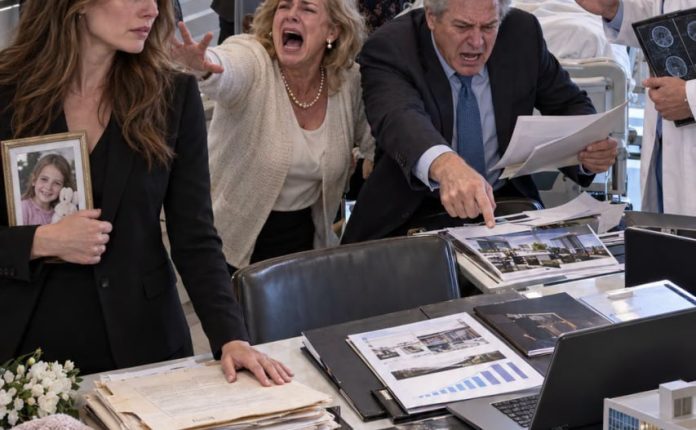
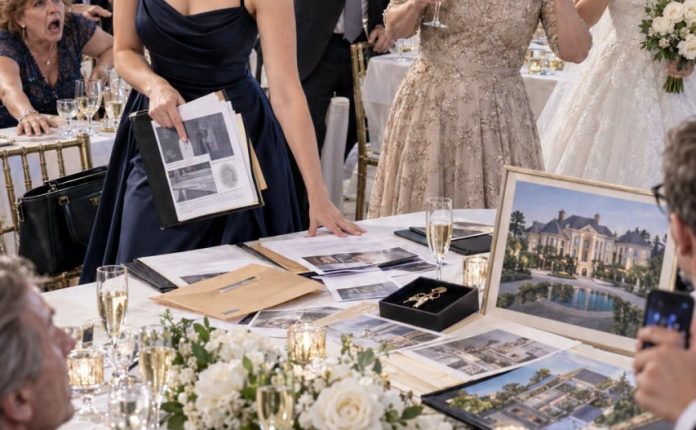
I Overheard My Dad Tell My Brother, “Alicia? She Gets A Contract. You Get It All.” I Looked At Mom—She Was Already Smiling. I Drove To The Office And Signed The Papers That Ended Them. The Next Morning, They Panicked.

The night I learned my family had already planned my exit, I was standing barefoot in the upstairs hallway of my parents’ house, holding an empty water glass and listening to my father discuss my future as if I were
an employee whose badge had already been deactivated. I was thirty-eight years old, a licensed real estate attorney, and the person who had spent eleven years dragging Caldwell Properties out of a financial hole deep enough to bury it.
None of that mattered in that hallway. The hardwood beneath my feet was cold, the same boards that had creaked beneath me when I was twelve and trying to sneak downstairs after bedtime, and for one strange second I felt twelve again too.
Then I heard my brother’s name. “Gavin gets the properties, the operating accounts, the management company, everything that matters,” my father said. Russell Caldwell never raised his voice when he was making a decision. He became quieter. More deliberate.
My mother, Diane, asked, “And Leah?” There was a soft clink of ice against glass. “Leah gets a consulting agreement. Two years. Market-rate compensation.” My mother gave a small laugh. “That should keep her happy.” My fingers tightened around the
glass. “She’ll complain,” my father said. “But she won’t fight us.” “No,” my mother answered. “She never does.” That sentence hurt more than the first one. Not because it was completely false. Because once, years earlier, it had been true.
My name is Leah Caldwell, and by that October weekend I had spent more than a decade becoming the person my family depended on whenever something went wrong while carefully making sure no one felt threatened by the fact that I was usually
the person capable of fixing it. When I joined Caldwell Properties at twenty-seven, we were managing a tired collection of apartment buildings, small office properties, and neighborhood retail centers that looked impressive from a distance and terrifying once you opened the books.
We had delayed maintenance, inconsistent occupancy, three major clients threatening to leave, and a loan covenant my father seemed convinced would repair itself if everyone simply stopped mentioning it. I rebuilt our leasing procedures. Renegotiated vendor contracts. Created reserve requirements.
Reorganized the property entities. Handled litigation that could have cost us millions. When interest rates shifted, I refinanced two properties before the window closed. When a major tenant disappeared overnight, I found a replacement before the vacancy triggered a lender default.
By that fall, the properties and contracts under our management were valued at more than forty-seven million dollars across four states. My brother Gavin liked to call that “the family business.” He had joined six years after I did.
His first title was vice president. Mine, after seven years of doing the work, was still general counsel and director of finance. I stood outside the study door long enough to hear my father pour another drink. “Friday still
works?” my mother asked. “Yes.” “And after Friday?” “After Friday,” my father said, “it won’t matter what Leah thinks.” I walked upstairs before I heard anything else. I remember almost nothing about entering the guest room except that I
put the glass down too hard and water jumped over the rim onto the nightstand. The old radiator clicked twice against the wall. Somewhere outside, leaves scraped across the driveway in the October wind. Friday. Four days away.
I sat on the edge of the bed, staring at the wallpaper my mother had chosen twenty years earlier, and one memory rose through everything else. My grandfather’s trust. Arthur Caldwell founded Caldwell Properties in the early seventies with one brick apartment building,
a borrowed pickup, and a belief that owning a property meant you were responsible for every person whose livelihood depended on it. He died when I was twenty-six. One week after his funeral, I had walked into my father’s study and
seen a thick legal document on the desk. “What’s that?” I asked. “Your grandfather’s trust.” “Should I read it?” My father slid it into a folder. “There’s nothing in here that concerns you right now.” I had been exhausted from grief.
I trusted him. More importantly, I still believed asking twice would make me difficult. So I let the folder disappear into a drawer. Eleven years passed. I never saw it again. Until that night. I waited. My parents went upstairs after midnight.
Their bedroom door clicked shut. A few minutes later, my father switched on the window air conditioner he insisted on running even in October because he claimed he couldn’t sleep without the noise. I waited another twenty minutes.
Then I went downstairs. The study smelled exactly the way it had when my grandfather was alive: cedar shelves, furniture polish, old paper, and the faint trace of the cigars my father pretended he no longer smoked.
Grandpa’s desk still sat beneath the window, a heavy walnut thing he had ordered from Vermont shortly after starting the company. I knew my father’s filing habits. He organized everything chronologically because he trusted systems more than people.
The bottom drawer resisted when I pulled it. My pulse jumped. I pulled harder. Folders. Taxes. Insurance. Estate documents. Then I saw it. A divider marked ESTATE—RESOLVED. Behind it was my grandfather’s trust. Fourteen pages. I photographed each one.
Page one. Page two. Page three. My hands were steadier than I felt. I was about to close the drawer when I noticed something behind the folder. A large manila envelope. G.C. My brother’s initials. I opened it.
At first, nothing made sense. There were operating agreements for LLCs I had never seen. Transfer resolutions. Draft deeds. Six newly formed entities with generic names that sounded intentionally forgettable. Cedar Brook Holdings. Northline Asset Group. Haven Ridge Partners. Three more.
I knew every legitimate entity owned or controlled by Caldwell Properties. These were not ours. Then I found a three-page memo addressed to a commercial broker named Evan Pike. The first paragraph made my stomach turn. The second made me sit down.
Nine of Caldwell Properties’ most valuable assets were scheduled to be moved into the new LLCs. Not sold openly. Transferred. Restructured. Separated from the operating company. Then bundled for sale to an outside buyer Gavin had apparently been negotiating with for months.
I scanned the asset list. Westfield Apartments. Grantham Center. Elmwood Plaza. The Riverside complex. Nine properties representing most of our reliable cash flow. The proposed closing date was Friday. Now I understood what my father meant. After Friday,
it wouldn’t matter what I thought. I kept reading. There was nothing about our maintenance employees. Nothing about existing pension obligations. Nothing about the dozens of local contractors who depended on us. Nothing about the tenant guarantees backed by the parent company.
I was a real estate lawyer. I understood what Gavin had designed. Strip valuable assets into separate entities. Sell them. Leave the operating company holding obligations without enough assets behind them. It might have been dressed up as restructuring.
It was really an escape hatch. I put the memo back. Then something pale yellow caught my eye. A sticky note was attached to the final page. My mother’s handwriting. I recognized the looping D immediately. “L thinks she’s executive material.
Useful until she isn’t. Friday.” For several seconds I simply stared at it. My father’s betrayal was cold. My brother’s was greedy. My mother’s hurt differently. She had reduced eleven years of my life to a joke on a sticky note.
I photographed it. Then I returned every page, every folder, every divider exactly where I had found it. Upstairs, I lay on top of the blanket until dawn. I didn’t cry. I kept hearing my mother. “She never does.” At sunrise,
I packed my bag and left before anyone woke up. I made it forty miles down the interstate before pulling into a rest area and calling Simone Brooks. Simone and I had met during our second year of law school.
She had become a corporate litigator with a reputation for making opposing counsel regret underestimating her. She answered on the second ring. “Leah?” “I need you to listen before you say anything.” Then I told her. The conversation in the study.
Friday. The shell companies. The memo. The sticky note. When I finished, Simone was silent. Not surprised. Thinking. Finally she said, “Send me every photograph.” “I will.” “And Leah?” “What?” “What exactly do you know about Arthur Caldwell’s trust?” I looked
through the windshield at cars sliding past beneath a gray morning sky. “Almost nothing.” “Then that’s where we start.” “Why?” “Because you mentioned that trust to me once in law school. Years ago. You said your grandfather put restrictions on transfers
because he was afraid your father would eventually break up the company.” I remembered the conversation only vaguely. Simone continued. “If I’m remembering correctly, there may be something buried in that document your father has spent eleven years hoping you would
never bother to read.” I drove to a diner three exits away, ordered coffee I never drank, and opened the photographs on my phone. The trust was dense. Definitions. Voting rights. Trustee powers. Restrictions on transfer. I reached page eight.
Read a paragraph. Read it again. Then I sat so still the waitress asked whether I was feeling okay. My grandfather had anticipated a transfer of control. And he had written my name directly into the clause governing what happened next.
For the first time that morning, fear gave way to something else. My family thought Friday was the day they removed me. They had no idea my grandfather had left me a way to move first. I did not call my father.
That surprised me. The old version of me would have called immediately, not to confront him but to give him an opportunity to explain. I had spent years doing that for my family—handing them softer versions of their
own behavior and then thanking them when they chose one. This time I sat in the corner booth of that diner and read every word. The clause was more powerful than I had understood from the first pass.
If any controlling interest in Caldwell Properties was transferred through sale, assignment, restructuring, gifting, or any substantially equivalent transaction, I held a binding option to acquire that interest at the most recent independent appraisal value. There was more.
The option could not be revoked by management. Any proposed control transfer triggered mandatory notice to the beneficiary holding the option. And if a dispute existed over valuation, any pending transfer was automatically suspended until an independent appraisal was completed.
I called Simone. “I found it.” “I knew there was something.” “They were supposed to notify me.” “Did they?” “You know they didn’t.” “Then don’t touch anything yet.” I stared at the words on my phone. “They’re four days from closing.” “That
means we need facts before they realize you’re awake.” The phrase stayed with me. Before they realize you’re awake. For eleven years I had been awake professionally and asleep personally. I knew which properties were underperforming by half a percentage point.
I knew which roofs needed replacement next year and which boilers would probably survive three. I could remember clauses from leases I had negotiated six years earlier. But when it came to my own family, I had accepted information selectively.
My father saying Gavin needed leadership experience. My mother saying titles weren’t important. Gavin asking me to clean up problems while presenting the solutions as his own during board meetings. I had noticed every piece. I had simply refused to assemble them.
That afternoon I called Calvin Reed. Calvin was sixty-one, broad-shouldered, gray-haired, and so methodical that he kept handwritten backup logs even though the company had moved to digital systems years earlier. He had spent most of his career in Army logistics
before joining Caldwell Properties and could tell you which elevator motor had been installed in a building fifteen years ago without opening a file. He managed nine of our eleven major properties. I called his personal phone. “Can I ask
you something off the record?” He paused. “You can ask.” “Have you noticed anything unusual with maintenance invoices in the last six months?” His silence gave me the answer. Finally he said, “How unusual?” “Duplicate billing. Vendors you don’t recognize.
Payments that don’t match completed work.” Another pause. “I’ve been keeping notes.” My stomach tightened. “How long?” “Since May.” “Why didn’t you send them to me?” “I brought them to Gavin in July.” “And?” “He said it was part of the accounting migration.
Told me finance already approved it.” “I didn’t.” “I figured that out.” He emailed me forty-three pages. I read them from my apartment with every lamp turned on even though it was still afternoon. Duplicate invoices. Payments to vendors with slightly altered names.
Amounts small enough individually to avoid attention. A landscaping company that Calvin insisted had never performed work at Westfield. A maintenance supplier billing both Caldwell Properties and one of the new LLCs I had photographed in my father’s study.
That connection changed everything. I logged into the company’s financial system. My credentials still worked. That was luck. Or arrogance. Gavin had already requested that IT suspend my administrative access during what he described as an upcoming security upgrade,
but the actual system migration was still two weeks away. He thought he had time. So did my father. I began downloading reports. The first hour showed irregularities. The third showed a pattern. By midnight, I stopped calling it irregular.
Someone had been siphoning money. Eleven contractor profiles existed in payroll with no corresponding personnel files. Several shared mailing addresses. Those addresses led back to entities connected to Gavin’s proposed property transfers. There were duplicate vendor payments going back eighteen months.
A recurring group of contractors received more than thirty thousand dollars a month collectively. No one at our properties recognized their names. Then I found another line. “Strategic Advisory—R.C.” My father’s initials. The account had received one hundred eighty-four thousand
dollars in less than a year. I sat back from my computer. The refrigerator compressor clicked on in the kitchen. Outside my apartment window, a delivery truck groaned down the street. For several minutes I could not make myself click anything else.
I had been hoping—ridiculously—that my father had merely chosen Gavin. Favoritism was painful. Fraud was something else. I opened the underlying payment records. The money had gone to an entity that did not appear in our approved vendor list.
The authorization chain included Gavin. And my father. Then I searched email archives. At two in the morning, I found the conversation that killed the last excuse I had been preserving for Russell Caldwell. Gavin had written six weeks earlier. “She’s
been pulling asset reports again. If Leah connects the Hartford entities to the Pike buyer before Friday, we have a problem.” My father answered nine minutes later. “Leave her to me. I’ll tell her the board wants an outside performance review.
We suspend her access during the review. By the time she understands, it’s finished.” Gavin replied the next morning. “What if she pushes?” My father’s answer was short. “She won’t. Leah is cautious. We take away the consulting agreement if necessary.
She won’t destroy the family relationship over something she can’t prove.” I read that message once. Then again. Then a third time. Not because I misunderstood it. Because I understood it perfectly. The consulting agreement had never been compensation.
It was a leash. Two years of money in exchange for silence. A respectable little check handed to the daughter who had done the work while the son walked away with the company. I called Simone.
It was late enough that I expected voicemail. She answered immediately. “I have more.” “How bad?” “Federal bad.” She exhaled. “Send it through the secure link.” “I have ghost payroll. Duplicate vendors. shell entities tied to the property transfers.
Payments to my father.” “And the emails?” “I have those too.” “Good.” I almost laughed. “Good?” “Not morally. Evidentially.” That was Simone. She continued, “Do not warn them.” “I wasn’t planning to.” “Do not confront Gavin.” “I won’t.” “And do not
make any transfer yourself until we’ve checked the trust procedure. If you exercise that option incorrectly, they’ll attack the process instead of the substance.” For the next three hours, Simone worked from her office while I worked from my kitchen table.
The trust named an independent trustee. Not my father. That mattered. My grandfather had appointed an old Hartford estate firm and given the office—not one individual—the continuing authority to acknowledge any exercise of the option. The firm still existed.
The trust had never formally terminated. At dawn, Simone called me back. “We can invoke it.” My heart began pounding. “When?” “Today.” I looked at the stack of printed reports spreading across my table. “There’s something else I need
to do first.” “What?” “Find out who gets hurt if Gavin’s deal closes.” That morning I called Calvin again. Then our pension administrator. Then two outside vendors I trusted. Then I reviewed the guarantees tied to the nine properties.
The picture became uglier with every call. If Gavin stripped those assets and sold them as planned, Caldwell Properties would retain several obligations without the revenue base that supported them. Employment cuts would be almost inevitable. Vendor contracts could be terminated.
Retirement contributions could be delayed or challenged depending on the buyer’s structure. Hundreds of people would not understand what had happened until after the papers were signed. By noon I no longer cared whether stopping the deal cost
me my relationship with my family. The relationship they were threatening me with losing did not actually exist. It was three people benefiting from my obedience. At three that afternoon, Simone called. “I spoke to the trustee’s firm.
They’ll acknowledge an election if the paperwork is complete.” “And the appraisal demand?” “Automatically stays the disputed transfer under the trust.” “So Friday dies.” “If we file correctly.” I closed my eyes. For the first time in two days, I could breathe.
Then Simone said, “There’s one problem.” Of course there was. “What?” “The trust protects your option. It doesn’t automatically protect you from retaliation inside the operating company. Gavin may try to fire you, lock you out, destroy records, or accelerate anything he
thinks he can still move.” I looked at the company laptop on my dining table. “What do you suggest?” “Assume your access disappears the second he knows.” So that night, just after midnight, I drove to Caldwell Properties’ main office in Elmwood.
Marcus Bell was working security. He had been on the overnight shift for six years, and his wife ran an after-school program at the elementary school nearby. He buzzed me in. “Late night, Ms. Caldwell.” “Very.” He glanced at the
bag over my shoulder. “Everything okay?” I almost gave him the automatic answer. Fine. Instead I said, “No.” His expression changed. “But I’m trying to make sure the people who work here are.” Marcus studied me for a moment.
Then he nodded. “That sounds worth losing sleep over.” At one in the morning, I began documenting every financial irregularity. At two, I preserved copies of the communications. At three, Simone sent me the final election packet. I signed it.
The cursor hovered over the submission button. Friday was still three days away. My father and brother believed they owned those three days. At three seventeen in the morning, I clicked submit. And for the first time in my life,
I made a move my family had not given me permission to make. Exercising the option was only the beginning. The election went electronically to the registered agent and the trustee’s law firm. Simone simultaneously delivered an emergency demand
for an independent appraisal, invoking the provision that suspended any disputed change in control. At three twenty-four, we received confirmation of electronic delivery. At three forty-one, an automated response from the trustee’s firm appeared. Received. Not acknowledged. Not yet.
I hated those two words. The company was quiet enough that I could hear the ventilation system breathing through the ceiling. I looked through my office window toward the rows of empty desks and thought about everyone who would arrive
in a few hours assuming this was an ordinary Tuesday. They had no idea how close their jobs had come to being collateral damage in a family argument they knew nothing about. I turned back to the financial system.
Years earlier, I had implemented controls requiring additional verification when vendor accounts were modified or when duplicate payment patterns crossed certain thresholds. Gavin had twice suggested eliminating those controls because they “slowed down operations.” I had refused.
Now I understood why he hated them. I flagged every suspicious contractor account for mandatory review. Future disbursements stopped. I froze modifications to the affected vendor profiles pending verification. I flagged the strategic advisory account connected to my father for external audit.
I did not delete anything. I did not alter history. I preserved it. At four thirty, Simone sent me a secure evidence packet she had organized from the material I provided. Financial records. Entity documents. Emails. Calvin’s logs.
The transfer memo. We submitted the packet to the appropriate state commercial fraud authorities and federal investigators with a cover letter from her firm. Then I waited for the worst sound imaginable. Footsteps. Instead there was a knock.
Marcus stood outside my office holding a stainless-steel thermos and two paper cups. “My wife says anyone working this late is either doing something heroic or making a terrible decision.” “Which one does she think this is?” “She
said coffee helps both.” I laughed. It came out rougher than I expected. He poured me a cup. “Whatever’s happening,” he said, “I hope it sticks.” “So do I.” Just before five, the trustee’s law firm called.
A senior partner named Helen Voss was on the line. “Ms. Caldwell?” “Yes.” “We have reviewed the election for procedural sufficiency.” My fingers tightened around the phone. “And?” “We are prepared to acknowledge it, subject to your appearance today to
verify execution.” “What time?” “Two o’clock.” “I’ll be there.” I left the building as dawn thinned the sky over the river. My phone began ringing before I reached home. Gavin. I let it ring. Then my mother. Then Gavin again.
Then my father. He left a voicemail. “Leah, call me immediately. There appears to have been unauthorized activity in company systems associated with your credentials. I’m sure there’s an explanation. Call me before this becomes unnecessarily difficult.” Unauthorized activity.
I played the message twice. My father had spent my entire childhood teaching me that word choice revealed intention. His did. He was already building a story in which I was the threat. At nine fifteen,
IT formally suspended my company access. At nine twenty-three, Simone emailed Gavin, my father, and the company’s outside counsel. All communications relating to the disputed transfers, my access, or the trust option were to be directed through her firm.
Gavin called me eleven times. At eleven, my mother texted. “You are embarrassing your father.” Not “What happened?” Not “Are you okay?” Not even “We need to talk.” I stared at the message. Then I deleted it.
At two, Simone and I entered the offices of Voss, Hale & Mercer, the Hartford firm that had administered my grandfather’s estate decades earlier. The lobby smelled faintly of leather and coffee. Everything about the building suggested patience: dark wood,
old framed maps, clocks that ticked loudly enough to remind you that certain institutions expected to outlive whatever crisis brought you through their doors. Helen Voss was in her late sixties, silver-haired, sharp-eyed, and completely unimpressed by my surname.
She placed the trust on the conference table. “My father told me this document was resolved.” “It was administered,” she said. “That is not the same thing.” “Why didn’t anyone contact me about this clause?” “Because there had been no triggering
transaction reported to us.” “Until now.” “Until now.” Simone slid the transfer documents across the table. Helen reviewed them. Then she looked at me. “I knew your grandfather.” That surprised me. “He was difficult,” she continued. “Impatient. Suspicious of easy answers.
He came into this office shortly before the trust was signed and said something I remember because it seemed unusually sad.” “What did he say?” Helen folded her hands. “He said, ‘I hope I am wrong about my son.’” The
room became very still. “He put this clause in because of my father?” “I cannot tell you every privileged conversation from decades ago. But I can tell you this: Arthur Caldwell believed control of the company should remain with
the person willing to protect the enterprise rather than liquidate it for convenience.” I looked at the trust. For years I had imagined my grandfather as a man who simply failed to protect me because he died too soon.
Now I wondered how much he had seen before I was old enough to understand it. Helen pushed an acknowledgement form toward me. “Once this is executed, your election is formally recognized. The proposed transfers remain suspended pending appraisal and resolution.” I signed.
Simone signed as witness. Helen signed last. Friday was dead. When I walked outside, the October air felt different. Not lighter. Sharper. I had barely reached my apartment that evening when someone knocked. I checked through the peephole. Gavin.
I considered ignoring him. Then I opened the door but left the chain engaged. His jacket was wrinkled. His hair looked as though he had been running his hands through it all day. For the first time in years,
my brother did not look entitled. He looked frightened. “What did you do?” “No hello?” “Leah.” “I exercised the option Grandpa left me.” “You had no right.” I almost smiled. “The document literally says I did.” “You know what I mean.” “No.
For once, I don’t think I do.” He stepped closer. “You’re going to destroy everything.” The irony was so enormous that I stared at him. “You were moving nine assets into shell companies.” “They weren’t shell companies.” “Then what were
they?” “Special-purpose entities.” “For a bulk sale you hid from me.” “It was a restructuring.” “With ghost payroll?” His face changed. Only slightly. But enough. “Who told you that?” There it was. Not denial. A search for the leak.
I leaned against the doorway. “You should leave.” “You think this company is yours because you stayed late and fixed spreadsheets?” “I think stealing from it disqualifies you from lecturing me about ownership.” His jaw tightened. “You always
thought you were better than me.” “No. That was the story you needed.” He laughed once. It sounded bitter. “You want the truth? Mom and Dad always said you were the smart one. Grandpa thought you were special.
Every meeting, every lawyer, every banker—you walked into the room and people listened.” I waited. “But being smart doesn’t make you the heir,” he said. “It never did. Dad knew that.” Something inside me settled. Not healed.
Settled. “You had eleven years to build something, Gavin.” He stared at me. “You built a fraud instead.” His face hardened. “You don’t understand what happens next.” “I understand exactly what happens next.” “You think Dad is going to choose you
after this?” I almost felt sorry for him. Almost. “That’s the part none of you understand. I’m finished waiting to be chosen.” I closed the door. The next morning, state investigators requested records. By afternoon, federal investigators requested additional preservation.
Before the week ended, Evan Pike—the commercial broker Gavin had been negotiating with—had hired counsel. Then Simone called me. “Pike is cooperating.” “How much does he have?” “A lot.” Apparently Evan had questioned several elements of Gavin’s proposed transaction months earlier.
Gavin had dismissed those concerns, so Evan began preserving emails, notes, and draft agreements to protect himself. He had records I had never seen. Including communications between Gavin and my father. Friday arrived without a closing. At ten that morning,
I stood at the Westfield property watching Calvin argue with a contractor about a leaking drainpipe when Simone called again. Her voice sounded different. “Leah, you need to prepare yourself.” “For what?” “Your father retained criminal counsel.” I closed my eyes.
Then she added, “And he has asked about cooperating.” It took me a second to understand. My father had spent eleven years protecting Gavin from consequences. Now, with consequences approaching him, Russell Caldwell was preparing to save himself.
For the first time, I wondered what my brother would do when he realized our father’s loyalty had always had a price too. My father called me two days later. I almost didn’t answer. Simone had instructed me not to discuss evidence,
so I knew the conversation could not be substantive anyway. But some part of me wanted to hear what a man like Russell Caldwell sounded like when his certainty was gone. “Leah.” “Dad.” His breathing was audible. That alone unsettled me.
My father believed even breathing should look controlled. “I assume your attorney has told you I’m cooperating.” “She told me you retained counsel.” “I’m trying to correct what can be corrected.” There were a hundred things I could have said.
Instead I waited. He continued. “Gavin came to me with the restructuring.” “Dad.” “I’m explaining.” “I know.” That stopped him. I looked out my apartment window at pedestrians moving beneath the orange leaves. He finally said, “He felt you had
taken over too much of the company.” “I took responsibility for things no one else wanted.” “He saw it differently.” “And you?” Silence. “I thought he deserved a chance.” “He had one.” “He’s my son.” I closed my eyes. “And
I’m what?” “That isn’t what I meant.” “It is exactly what you meant.” “No, Leah. You were always capable. You always landed on your feet.” There it was. The justification. The sentence parents use when they punish the child least
likely to collapse. “So because I could survive losing it, you decided it was acceptable to take it from me?” “I didn’t see it that way.” “You were paid one hundred eighty-four thousand dollars.” Another silence. “I will repay all
of it.” “That wasn’t my question.” “I know.” For once, he sounded old. Not powerful. Not strategic. Just old. He told me Gavin had spent years telling him the company needed a traditional successor. That I would eventually leave.
That I had my law license and could build another career anywhere. That Gavin had a wife and daughters and needed the business more. Need. That word. Gavin’s need outweighed my labor because my competence had become evidence that I required nothing.
My father had chosen the child who demanded more because the other child had learned not to demand. “I told myself you would be fine,” he said. “I will be.” “I know.” “But that does not make what you did
acceptable.” “I know.” He did not apologize. Not really. He explained. There is a meaningful difference between those two things. I ended the call. A week later, Gavin’s wife Rachel moved with their two daughters to her mother’s house.
Rachel had apparently believed the transfers were legitimate estate-planning steps. She discovered the truth only after investigators interviewed her. I heard through Simone that she had filed for divorce. I did not contact her. Not because I blamed her.
Because I knew what it felt like to have your life explode and then have people arrive asking you to narrate the debris before you understood what had broken. Meanwhile, I had a company to protect. Calvin called me one morning from
Westfield. “The crews are asking questions.” “What kind?” “Whether they’ll still have jobs next month.” I looked at the calendar. “I’ll be there by noon.” That week I met with every property team. Not executives. The people who actually kept buildings alive.
Maintenance technicians with knees worn out from twenty years of stairs. Leasing coordinators who remembered tenants’ children by name. Superintendents who answered calls during snowstorms before anyone at corporate knew the weather had turned. Bookkeepers. Front-desk staff. Cleaners. Grounds crews.
I told them the truth. Not every investigative detail. But enough. “There was an attempted transfer of major company assets,” I told the Elmwood staff. “That transfer has been stopped. Financial irregularities are under investigation. No one in this room caused them,
and no legitimate employee is losing a job because someone else decided to steal.” A woman named Teresa, who had worked reception for fourteen years, raised her hand. “What about retirement contributions?” “Protected.” “Health coverage?” “Protected.” “The properties?” “Operating normally.”
Calvin stood at the back with his arms crossed. I watched his shoulders drop slightly. That mattered more to me than any board title ever had. Marcus was finishing an overnight shift when I returned to Elmwood later that week.
He offered me the same quiet nod he had given me the night I filed the election. I shook his hand. “Thank you.” “For coffee?” “For not asking me to explain myself before you decided I deserved help.” He smiled. “That’s usually
when people need help most.” The investigation lasted eleven months. Gavin eventually pleaded guilty to federal fraud and conspiracy charges connected to the false vendor payments and concealed transfers. The final amount investigators traced was higher than what I had initially found.
The ghost payroll had been routed through a holding company he controlled indirectly. Several vendor accounts were nothing more than mechanisms for moving company cash toward the planned acquisitions and personal expenses connected to the scheme. He received a prison sentence.
When Simone called with the final number of years, I sat quietly. I expected satisfaction. Instead I felt tired. There is a version of justice people like to imagine where the guilty person is punished and everyone else immediately feels restored.
Real life is messier. A sentence does not return birthdays. It does not change the way your mother laughed behind a study door. It does not erase eleven years of being told you were lucky to have a seat
at a table you were secretly holding up. My father entered a cooperation agreement, repaid the money he had received, paid additional penalties, and surrendered any management role in Caldwell Properties. He avoided prison. Some days I accepted that.
Some days I didn’t. I stopped demanding that my feelings become consistent. My mother did not call me. Months passed. Then one afternoon, a thick envelope appeared at my apartment. No return address. Inside was a four-page handwritten letter.
My mother. She wrote about family. About misunderstandings. About how quickly everything had gotten out of control. She wrote that she had never wanted Gavin to go to prison. She wrote that my father’s health had suffered.
She wrote that people make mistakes when money is involved. Three and a half pages passed before she wrote the first sentence containing the word “you.” “You always wanted to prove you could survive without us.” I read it twice. Then I laughed.
Not because it was funny. Because she still believed my independence was an accusation against her. On the last page she wrote, “When enough time has passed, I hope you will remember we are still your family.” I folded the letter.
Placed it back in the envelope. And put it in a drawer. I did not answer. The following week, my eighty-two-year-old great-aunt Marjorie called from Vermont. She was my grandfather Arthur’s younger sister and had lived in the same
farmhouse since the seventies. “I saw the newspaper story,” she said. “I’m sorry you had to.” “I’m not.” I sat straighter. “I’ve watched your father confuse inheritance with entitlement his entire life.” I didn’t know what to say.
Then she said something I will never forget. “My brother built that company for people who show up, Leah. Not people who wait around to collect.” I looked across my office. Calvin was arguing cheerfully with a leasing manager.
Teresa was helping a tenant at the front desk. Marcus had left a bag of muffins for the morning crew before going home. People who showed up. My grandfather had left me an option to acquire control.
But standing there, I realized I did not want to become another Caldwell who treated ownership as a prize. So I called Simone. “I know what I want to do with the company.” “What?” “I don’t want to inherit the
throne.” There was a pause. “You’re making me nervous.” “I want to get rid of the throne.” The first lawyer I told about converting Caldwell Properties into an employee-owned company stared at me as though I had announced I planned
to donate the buildings to strangers. Simone did not. She leaned back in her chair and said, “That’s complicated.” “So was stopping my brother.” “It will take time.” “I have time.” “And you understand that once you do this,
you won’t be able to treat the company like a family asset anymore.” “That’s the point.” The independent appraisal triggered by my grandfather’s trust took months to complete. The fraudulent transfers were unwound. Property titles were restored.
The purchase option and subsequent restructuring placed controlling authority where Gavin had desperately tried to prevent it from going. With me. For about six months, I held more control over Caldwell Properties than anyone in my family ever had.
And then I started giving pieces of it away. Not recklessly. Not symbolically. We created a formal employee ownership structure that rewarded tenure, responsibility, and continued service. We established governance rules no sibling, child, or favored relative could casually bypass.
Independent directors were added. Financial controls became mandatory rather than optional. Calvin joined the board. The first time I told him, he stared at me. “I fix boilers.” “You manage nine properties.” “I still fix boilers.” “That’s why I trust
you.” He looked down at the board packet. “My father would think this is hilarious.” “Why?” “He told me never to trust anyone who wore a suit for a living.” I looked at my blazer. “That feels personal.” He laughed.
Recovered funds from the ghost payroll scheme were placed into an employee emergency reserve and benefits protection account. No bonuses for executives. No commemorative plaque. Just money returned to the people whose jobs had been put at risk.
During the second year after the investigation, we expanded into two markets in western Massachusetts. Revenue climbed. Occupancy improved. Vendor retention increased. We did not accomplish it because I had suddenly become some fearless genius. We improved because the people
managing the properties finally knew their voices mattered. A maintenance supervisor spotted a water problem early because he knew spending money to fix it would not be treated as failure. A leasing manager redesigned a resident-retention program because someone listened.
Calvin negotiated a regional maintenance contract that saved us more money in one year than Gavin’s favorite “strategic initiative” had ever produced. Caldwell Properties became stronger once we stopped pretending leadership had to come from the person sitting nearest the founder on the family tree.
My father watched all of this from a distance. He emailed me occasionally. Short messages. Congratulations on the expansion. Saw the Elmwood renovation. Looks good. Your grandfather would be proud. I answered exactly once. “Thank you.” That was enough.
My mother tried calling after nearly two years. I let it go to voicemail. She said she missed me. She said life was short. She said she hoped I had reached a point where I could “put the past behind us.” I listened once.
Then deleted it. I did not hate my parents. That surprised people. Hate requires attention. I had already spent too much of my life giving them mine. Gavin wrote me twice from prison. The first letter blamed our father.
The second sounded different. He admitted some things. Not everything. He wrote that he had spent his whole life believing there could only be one winner between us because that was how our father raised him. Maybe that was true.
He asked whether I thought we could ever repair our relationship. I sat with the letter for several days. Then I wrote back. “I hope you build a decent life when you get out. I mean that.
But I am not going back to being your sister in the way you remember. That relationship survived because I absorbed what you did and called it family. I won’t do that anymore.” I mailed it. He never answered.
Three years after the night outside my father’s study, I stood in the courtyard of the Elmwood office on a warm June afternoon and looked up at the windows where I had spent that frantic night preserving records. The courtyard had changed.
Marcus’s wife, Denise, had organized an employee gardening committee. There were hydrangeas along the brick wall, climbing vines around a trellis, and small beds of lavender that filled the air every time the wind shifted. That afternoon, the courtyard was filled with chairs.
My wedding chairs. I had not planned to fall in love during the investigation. In fact, for nearly a year I found romantic attention exhausting. Every relationship felt suspicious when you had just discovered that the people closest to you considered
trust a resource they could spend. Daniel Mercer entered my life slowly. He had worked in the federal prosecutor’s office involved in the broader investigation, although Simone made certain our personal contact remained strictly professional while the case was active.
At the time, I barely noticed him beyond his habit of asking very precise questions and never interrupting the answer. After the case ended, almost a year passed before we met again. Simone invited several lawyers to a charity dinner.
Daniel was there. He sat across from me and asked about employee ownership. Not about Gavin. Not about my father. Not about what it felt like to be betrayed. About the company. About what I was building. We started talking.
Months later, we had dinner. Then another. There was no dramatic rescue. No instant declaration. That was what I liked. He never tried to convince me he was safe. He behaved safely until I believed him. When he proposed,
he did it in my apartment kitchen while I was complaining about a broken cabinet hinge. I laughed so hard I had to sit down. We married in the Elmwood courtyard. Calvin wore a suit and complained about it for three hours.
Marcus handled absolutely none of the security because Denise told him he was a guest and threatened to confiscate his radio. Simone stood beside me. Great-aunt Marjorie came down from Vermont wearing a blue hat large enough to have its own weather system.
My parents were not invited. Neither was Gavin. People asked me whether that was difficult. Of course it was. Doing the right thing for yourself does not always feel good. Sometimes it feels like grief with better boundaries.
I thought about my mother while I got dressed that morning. I thought about my father when I walked through the office lobby. I even thought about Gavin when someone made a joke that reminded me of him as a child.
Then I walked outside. Daniel was waiting. So were the people who had stood next to me after I stopped shrinking. And I understood something I had spent most of my life getting backward. Forgiveness and access are not the same thing.
You can release anger without reopening the door. You can understand why someone became cruel without volunteering to be hurt by them again. You can wish someone peace from a distance so wide they can never mistake your kindness for permission.
After the ceremony, I slipped away for a few minutes and went upstairs. My old office door was open. The building was mostly empty because everyone was outside eating and dancing. Late afternoon light stretched across the carpet.
I walked to the window. Three years earlier, I had sat in that room before sunrise convinced my entire life might collapse by Friday. Instead, Friday came and went. The company survived. The employees stayed. The properties remained intact.
And the daughter my parents thought would accept a consulting check had become the person who made sure no Caldwell could ever again quietly decide the future of everyone else. There was no secret second family behind my story. No hidden adoption.
No mysterious stranger arriving with documents at the final moment. My family’s failure was less dramatic and therefore, in some ways, more painful. They knew exactly who I was. They knew what I had contributed. They knew I had built much of
what Gavin expected to inherit. They simply decided his wanting mattered more than my work. For years, I mistook that for being invisible. I wasn’t invisible. I was inconvenient. Acknowledging my value would have forced them to question the rules they preferred.
So they planned around me instead. I used to believe the cruelest sentence I heard that night was my father saying, “Gavin gets everything.” It wasn’t. It was my mother saying, “She never fights.” Because she was right about the person I had been.
I used to think keeping peace proved I was mature. Often, it only proved I had been trained to tolerate things that should have ended relationships. My family expected me to remain that person long enough for Friday to arrive.
They miscalculated. I did not destroy the family. I stopped sacrificing myself to preserve its appearance. There is a difference. Years later, when people ask whether I regret not reconciling with my parents, my answer is simple. No.
I regret how long I believed reconciliation was always the more moral choice. Sometimes there is nothing noble about returning to people who showed you exactly how they value you. My father may regret what he did. My mother may miss me.
Gavin may become a completely different person someday. I hope all three of those things happen. Their growth simply no longer requires my participation. Before I left the office that evening, I noticed something on my desk.
Calvin had placed an old framed photograph there earlier in the week. My grandfather Arthur stood outside the company’s first apartment building in the seventies, one hand resting on a dented pickup truck. I had seen the picture before.
But someone had tucked a small handwritten card beneath the frame. It was from Aunt Marjorie. “Your grandfather used to say buildings are easy. People are the hard part. Choose the people who show up.” I carried the card downstairs.
Daniel found me halfway across the courtyard. “You disappeared.” “I needed a minute.” “You okay?” I looked around. Simone was laughing beside the garden. Marcus and Denise were dancing badly. Calvin had somehow abandoned his jacket.
Employees from buildings across three states filled tables beneath strings of white lights. The company that had once been treated like a family inheritance now belonged, in meaningful part, to the people who actually kept it alive. “I’m
better than okay,” I said. And I meant it. That night outside my father’s study, I thought I had discovered I was losing my family. What I really discovered was that I had been confusing proximity with loyalty.
Blood can explain who stands beside you in a family photograph. It cannot guarantee who will protect you when protecting you costs them something. The people who deserve a place in your life are the ones who still respect you after
you stop being useful to them, after you say no, after you set a boundary, after you refuse to make yourself smaller so they can remain comfortable. My parents offered me a check because they believed I could be bought quietly.
My brother expected the company because he believed wanting it made it his. They were both wrong. I did not take Caldwell Properties from my family. I stopped them from taking it from everyone who had actually
earned a stake in its future. And I never again waited for anyone carrying my last name to decide whether I was worth choosing. I chose myself before Friday. Everything good in my life began after that.
THE END!
Disclaimer: Our stories are inspired by real-life events but are carefully rewritten for entertainment. Any resemblance to actual people or situations is purely coincidental.