My mom was sentenced to death for killing my dad, and for six years, no one believed she was innocent. But minutes before the execution, my little brother hugged her and whispered, “Mom… I know who hid the knife under your bed.”
“Don’t cry for me,” my mom said, her hands in cuffs and her voice weary. “Just take care of Matthew.” I had heard those words from her in different forms for years, always worrying about us instead of herself.
I was seventeen when she was found guilty. My dad, Daniel Hale, had been found dead in our kitchen before sunrise. The knife was under my mom’s bed. There was blood on her robe. Everyone said the same thing: “It was her.”
I doubted her too. That was my sin. I never said I believed the prosecutor, but I stopped saying I believed her. Sometimes silence is its own verdict, and mine followed her through six years of appeals, hearings, and rejected petitions.
For six years, my mom wrote letters from prison. “I didn’t kill him, sweetheart.” She wrote about ordinary things too: Matthew’s grades, my nursing classes, whether the roses still bloomed by the porch. I never knew how to answer her.
At first I kept every envelope unopened inside a shoebox. Later, guilt made me read them all in one night. Not once did she blame me. Not once did she ask why I had stopped visiting. That kindness hurt worse than anger.
Matthew was nine when Dad died. He became quiet afterward, but everyone called it trauma and moved on. He slept with the hallway light on, refused to enter our parents’ bedroom, and panicked whenever someone opened the drawer where Dad kept his tools.
By the time Mom’s execution date arrived, Matthew was fifteen and nearly as tall as I was. He had agreed to visit her only because I begged him. I thought he was afraid of seeing her in chains. I was wrong.
The prison visiting room smelled like bleach and old coffee. A guard stood several feet away while Mom pulled us into the briefest embrace allowed. Matthew clung to her longer than I expected, his shoulders shaking beneath my hand.
Then he whispered the sentence that stopped the room. “Mom… I know who hid the knife under your bed.” Mom stiffened. I felt it before I understood it, as if every person around us had suddenly forgotten how to breathe.
I grabbed Matthew’s arm. “What did you say?” He looked at me, terrified, then at the guard. His lips trembled. Mom’s face had gone pale, but her voice became strangely steady. “Matthew, tell your sister exactly what you remember.”
He shook his head. “He said he’d kill Ava too.” That was when the guard stepped closer. Mom began repeating, “Who, Matthew? Who?” He covered his ears, crying so hard he could barely form the name.
“Uncle Nathan.” Nathan Hale was my dad’s older brother. He had sat beside me at the trial. He paid part of Mom’s defense bill, brought casseroles after Dad’s funeral, and told reporters our family wanted justice. For six years, I had called him generous.
Mom closed her eyes. “Of course,” she whispered. I hated how much certainty was in her voice. Nathan had been Dad’s business partner at Hale Construction. Three weeks before the murder, the brothers had stopped speaking, though nobody ever explained why.
The guard told us the visit was over. I refused to move. “My brother just identified another suspect,” I said. “You cannot take her anywhere.” He answered that he did not control the execution schedule, but he immediately called his supervisor.
I called Mom’s attorney, Miriam Cole, from the hallway. She had lost every appeal but never stopped answering my calls. When I told her what Matthew had said, she went silent for two seconds, then asked one question: “Can he give details?”
Matthew stared at the floor. “I saw him.” Miriam told me to put the phone on speaker. Matthew explained that he had woken during the night after hearing Dad yell downstairs. From the landing, he saw Nathan come up carrying something wrapped in a dish towel.
Nathan entered our parents’ room. Matthew followed because he thought Dad might be hurt. Through the cracked doorway, he watched Nathan kneel beside the bed and push the wrapped object underneath. Then Nathan turned and saw Matthew reflected in the mirror.
“He grabbed me in the hallway,” Matthew said. “He told me Mom did something terrible, and if I ever talked about seeing him, he would make sure Ava disappeared too.” My stomach turned so sharply I had to lean against the wall.
Miriam asked why Matthew had never told police. He looked at me. “Because you were seventeen. You were all I had left.” He thought keeping quiet was protecting me. For six years, my little brother had carried terror disguised as silence.
Miriam said a late confession from a traumatized child might not be enough to stop an execution. We needed something verifiable. “Matthew,” she said, “anything else. Clothes, sounds, something he touched, something he said. Think carefully.”
Matthew squeezed his eyes shut. Then he remembered Nathan’s cufflink. Dad had given him silver cufflinks shaped like tiny anchors. One fell onto the bedroom carpet while Nathan knelt beside the bed. Matthew picked it up after Nathan left.
“Where is it?” I asked. Matthew looked ashamed. “In my old dinosaur bank.” I nearly screamed. That bank had been boxed up when we moved from the house after the trial. The box was in a storage unit twenty minutes away.
Miriam told me to go. She would contact the governor’s office, the state attorney general, the prison warden, and a federal judge. “Do not touch the cufflink if you find it,” she warned. “Photograph everything exactly where it is.”
We drove to the storage unit so fast I barely remember the road. Rain struck the windshield in hard sheets, just like the morning Dad died. Matthew sat beside me, repeating that he was sorry. I told him to stop apologizing.
His green dinosaur bank was wrapped inside an old sweatshirt. I set my phone to record before Matthew opened the rubber plug underneath. Coins spilled across the concrete, followed by a tiny silver object that flashed beneath the fluorescent light.
An anchor-shaped cufflink. Matthew backed away as if it were a snake. I photographed it from every angle, then called Miriam. She told us not to handle it further and said an investigator from her office was already on the way.
The investigator, Lucas Reed, arrived with evidence bags and gloves. He photographed the bank, the box, the storage label, and the cufflink. Then Matthew made a recorded statement describing exactly when and where he had found it six years earlier.
Lucas asked whether Nathan had ever worn that design publicly. I remembered Dad’s fiftieth birthday photographs. Nathan wore a navy suit that night. I searched my cloud account, hands trembling, until I found the image. Two silver anchors gleamed at his cuffs.
Miriam called again. The governor had refused an immediate stay, saying the new allegation had not yet been authenticated. A federal judge agreed to hold an emergency hearing by video, but the execution clock had less than forty minutes remaining.
We drove straight toward Miriam’s office while Lucas took the cufflink to an emergency forensic lab. I kept one hand on the wheel and one on Matthew’s knee. Neither of us spoke when the prison appeared on the horizon behind us.
At Miriam’s office, three laptops were open. One showed the judge. Another connected to the prison. On the third, Miriam displayed the trial evidence photographs. She enlarged the carpet beside Mom’s bed until individual fibers became visible.
There, near the wooden frame, was a small circular indentation in the carpet beside a faint metallic scratch. The original investigators had photographed it accidentally. No one had asked what caused it because the prosecution already believed the knife solved everything.
Miriam argued that Matthew’s account was not a vague recovered memory. It contained a physical detail preserved in old photographs and potentially supported by an object hidden since childhood. The state argued that a six-year delay made the claim unreliable.
Then Lucas called from the lab. The cufflink carried degraded biological material trapped inside the hinge. Most belonged to Nathan. That alone was expected. But technicians also found microscopic traces of Daniel Hale’s blood. My father’s blood was inside Nathan’s missing cufflink.
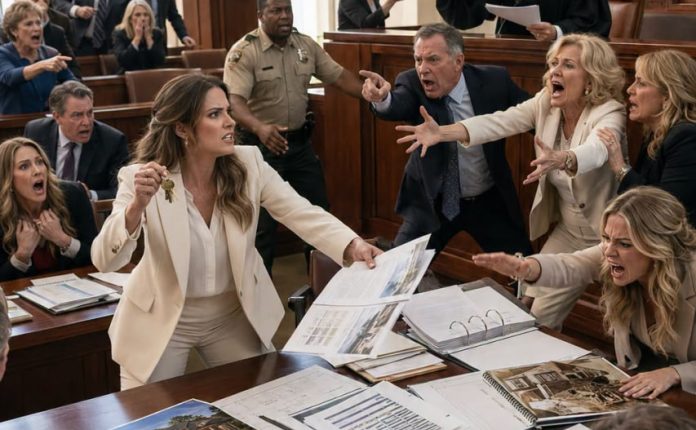
The state’s attorney stopped speaking. Miriam leaned toward the camera. “Your Honor, this child has produced physical evidence linking an alternate suspect to the crime scene on the night of the murder. If this execution proceeds now, the state may kill an innocent woman.”
The judge granted a temporary stay with eleven minutes remaining. I collapsed into the chair. Matthew sobbed against my shoulder. On the prison laptop, Mom lowered her head into her cuffed hands. For the first time in six years, I heard her cry loudly enough for someone else to hear.
But a stay was not freedom. The judge ordered a full evidentiary hearing within seventy-two hours. Police reopened the investigation and served a search warrant on Nathan’s home, office, vehicles, and financial records before dawn.
Nathan acted offended when detectives arrived. He told reporters Matthew was confused and that grief had created a false memory. He even called me. “Ava, think about what you’re doing to this family,” he said. I hung up without answering.
By afternoon, detectives found something more damaging than the cufflink. Dad’s old business files showed nearly eight hundred thousand dollars missing from Hale Construction during the eighteen months before his death. Transfers led to shell companies connected to Nathan.
The motive was suddenly clear, but detectives still needed to reconstruct the murder. The blood on Mom’s robe, once treated as proof of guilt, became the next piece to unravel. A modern blood-pattern expert reviewed the preserved photographs.
He concluded the stains were inconsistent with the person delivering the fatal wound. They were transfer stains from kneeling beside an injured person. Mom had always said she found Dad breathing and tried to lift him before calling emergency services.
At trial, the original expert had described the robe as “consistent with close proximity” during the stabbing. The prosecutor turned that careful phrase into certainty. Six years later, science finally gave Mom’s explanation the weight nobody had allowed it.
The knife created another problem for the state. It came from our kitchen block, so Mom’s fingerprints on the handle had seemed damning. New testing revealed a partial touch-DNA mixture beneath the guard that had never been analyzed.
Nathan’s DNA was a strong match. When detectives confronted him, Nathan changed his story. First he claimed he had used the knife during a family barbecue. Then he said Dad must have borrowed his cufflinks. Finally, he insisted Matthew had planted the cufflink after being manipulated by me.
None of those explanations fit the evidence. The evidentiary hearing lasted nearly nine hours. Matthew testified from a smaller room with a support counselor beside him. His voice shook, but he never changed his account. When asked why he stayed silent, he looked directly at me.
“I thought Uncle Nathan would kill my sister if I told,” he said. “I already lost my dad and my mom. I couldn’t lose Ava too.” I covered my mouth because the courtroom blurred through my tears.
Mom testified next. She described waking after midnight, hearing something downstairs, and finding Dad collapsed beside the kitchen island. She remembered touching the knife, then stopping when she realized moving it might hurt him more. That explained her fingerprints.
She also remembered hearing the back door close before she reached the kitchen. At the time, prosecutors said panic had distorted her memory. Now Nathan’s phone records showed his device connecting to a tower near the neighborhood minutes before Dad’s death. Nathan had claimed he was home twenty-seven miles away.
The judge did not immediately overturn Mom’s conviction, but he vacated the death sentence and ordered the district attorney to review the case. Two days later, the new district attorney announced that the original prosecution could no longer be defended. Mom’s conviction was dismissed pending reinvestigation.
The prison released her through a side entrance because hundreds of reporters were waiting at the front gate. I saw her step outside wearing plain gray clothes and carrying a clear plastic bag containing six years of letters.
For a moment, none of us moved. Freedom looked almost frightening on her. Then Matthew ran. Mom dropped the bag and opened her arms. He crashed into her so hard they nearly fell onto the pavement. I followed more slowly because guilt had weight.
When Mom looked at me, I started apologizing before I reached her. “I should have believed you. I should have answered. I should have kept fighting.” The words came out broken, years of shame packed into every breath.
She touched my face. “You were seventeen,” she said. “You were surviving.” I told her that did not erase what I had done. She nodded. “No. But love is not a courtroom, Ava. You don’t have to serve a sentence forever.”
Nathan was arrested three days later for Dad’s murder, evidence tampering, fraud, and witness intimidation. Prosecutors alleged he had confronted Dad in the kitchen, stabbed him during an argument, then used Mom’s robe and bedroom to frame her.
Investigators believed he smeared additional blood onto the robe after finding it over a chair. He planted the knife beneath the bed, threatened Matthew, and returned home before police secured the neighborhood. He nearly succeeded because every clue pointed where he wanted.
Nathan eventually accepted a plea agreement that guaranteed he would spend the rest of his life in prison. He admitted killing Dad after Dad threatened to expose the stolen money. He also admitted threatening Matthew in the hallway.
The confession should have felt satisfying. It did not. Nothing could restore Dad, return Mom’s six stolen years, or give Matthew back his childhood. Justice arrived, but it came carrying receipts for everything it had failed to protect.
We moved into a small house two towns away. Mom planted roses beside the porch because she said prison had taught her never to waste sunlight. Matthew started therapy and slowly stopped checking the locks three times before bed.
I finally answered every prison letter. I sat at the kitchen table and wrote responses to all two hundred and seventeen of them, beginning with the oldest. Sometimes I wrote only a paragraph. Sometimes ten pages. I told Mom what I had been too frightened to say.
She kept my replies in the same clear plastic bag she carried out of prison. One evening, nearly a year after her release, Mom handed me the first letter she had written after sentencing. I recognized the careful handwriting immediately. At the bottom was a sentence I had somehow forgotten.
“Truth can be buried, sweetheart, but buried things are not gone.” Matthew was sitting across from us doing homework. He looked up and smiled when Mom read it aloud. I thought about the knife beneath the bed, the cufflink inside a dinosaur bank, and the secret inside a frightened boy.
For six years, I believed evidence was the same thing as truth. I learned they are not always identical. Evidence can be planted, ignored, misunderstood, or hidden. Truth sometimes survives only because one terrified person eventually finds the courage to speak.
I still wish Matthew had spoken sooner. He wishes it too. But I no longer ask why he waited. A nine-year-old had been handed a burden that should have belonged to adults, and he carried it the only way he knew how.
As for Mom, she never became bitter in the way people expected. She testified before lawmakers about wrongful convictions, better forensic testing, and protections for child witnesses. She said anger might have kept her alive, but purpose taught her how to live.
Every year on the anniversary of Dad’s death, we cook his meal: roast chicken, mashed potatoes, and apple pie. We tell stories about him before Nathan, before the trial, before our family became evidence in somebody else’s case. And every year, Mom places one silver anchor cufflink beside Dad’s photograph.
The police returned it after Nathan’s conviction. Mom could have thrown it away, but she refused. “No,” she said. “That little thing brought me home.” To us, it became proof that even the smallest truth can outweigh a mountain of lies.
The last letter Mom wrote from prison ended differently from all the others. She had written it on the morning she believed she would die. I did not read it until months after she came home.
“If this reaches you after I’m gone,” she wrote, “please forgive yourself. Love Matthew. Remember your father before the worst day of our lives. And someday, if the truth finds you, don’t be afraid to follow it.” The truth did find us.
It came in the shaking voice of my little brother, minutes before we thought we would lose our mother forever. It came from a dinosaur bank, a silver cufflink, forgotten files, old blood, and a child’s memory.
Most of all, it came because Matthew finally understood that Nathan’s threat had power only while it stayed secret. The moment he whispered the truth into Mom’s ear, six years of lies began collapsing around us.
I used to think my greatest regret was doubting my mother. Now I understand regret is useful only when it changes what you do next. I cannot rewrite those six years, but I can spend the rest of my life believing people deserve to be heard.
Mom survived long enough to hear Matthew speak. Matthew spoke soon enough to save her. And I learned that sometimes the difference between death and freedom is not a miracle. Sometimes it is one frightened person finally saying the sentence everyone else was too certain to imagine.