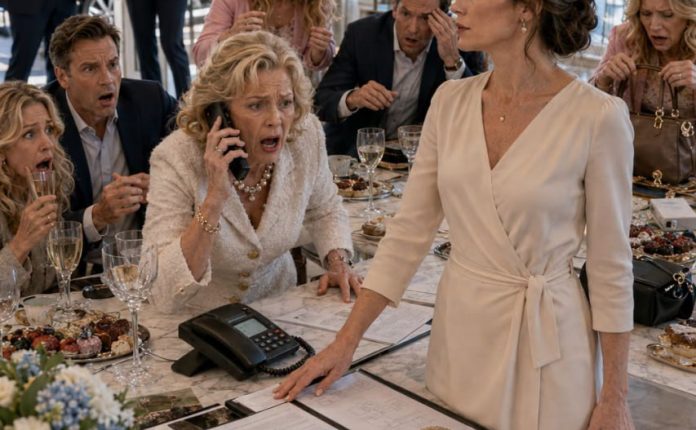
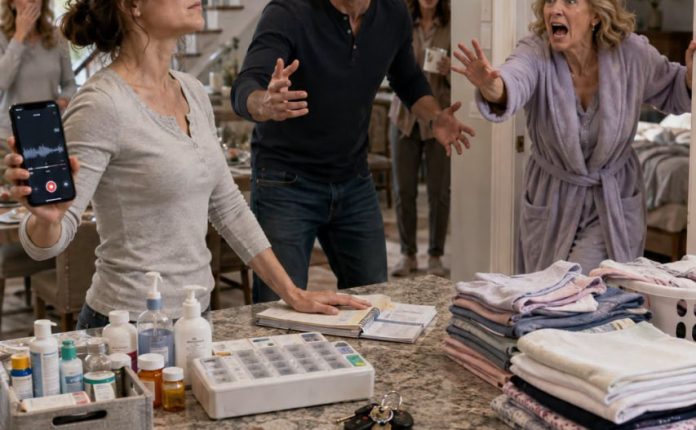
Valeria turned toward Sergio. “Frozen?” she whispered. Fear finally replaced calculation. I spread the Florida photographs across the table and asked Sergio whether he wanted to explain the house near Orlando. Valeria lifted one picture showing her husband holding a child beside another woman. Her hands began trembling. “Who is she?” Sergio said nothing. “Who is that child?” Still nothing. For one second, Valeria looked like a betrayed wife.
I refused to let her pain erase what she had done. I placed still images from Lucía’s security footage in front of her. One showed Valeria beside the bed. Another showed her holding her mother’s hand. The last showed Lucía’s thumb pressed against the ink pad. My voice broke when I said, “I watched you use your mother’s hand when she could not even open her eyes.”
Valeria began crying. She said Sergio told her the money belonged to them and that I would keep everything after Lucía died. I told her my wife did not owe her 620 million pesos. “I just—” she started. “No,” I said. “You made a choice.” Sergio slammed his fist against the table and shouted that we were family and could fix everything. The word family sounded obscene coming from him.
I looked at Sergio and said he intended to take Lucía’s money and disappear with another woman, so he had never been saving our family. Valeria stared at him. “You were going to leave me?” Sergio snapped at her to be quiet. I turned back to my daughter. “You wanted your father’s life without doing the work that built it.” She stopped crying and looked directly at me.
Then I lifted the medical paperwork. “Would you also like to explain Dr. Castañeda?” Valeria’s tears stopped. Sergio’s eyes moved toward my untouched plate. That tiny movement told me more than any confession. I explained that prosecutors already had their messages, payments to the doctor, prescription information, and the draft evaluation declaring me incompetent. “And they will be analyzing that food,” I said, pointing toward my dinner.
Valeria shook her head and insisted she never meant to hurt me. “You planned to drug me.” She said it was only so I could rest. “You planned to have me committed.” She called that temporary. “You wanted control over everything.” Then desperation stripped away caution. “We didn’t have another choice!” she shouted. “Sergio owed too much money!” The moment she realized what she had admitted, she covered her mouth.
I did not need to respond because a recorder beneath the counter had captured every word, and two federal agents were listening outside. Sergio understood before Valeria did. He moved toward me. Before he reached my chair, the dining room doors opened and officers entered with search warrants and arrest warrants. Sergio tried running toward the hallway, but two agents stopped him. Valeria remained frozen until an officer took her arm.
Then she lunged toward me, shouting, “Dad, please! Tell them this is a mistake! I’m your daughter!” Officers restrained her while memories struck me in succession: private schools, vacations, cars, apartments, credit cards, an extravagant wedding, every crisis Lucía and I had made disappear. Whenever Valeria faced consequences, we rescued her. We believed that was love. Watching her struggle, I wondered how much our rescuing had helped create this moment.
Valeria dropped to her knees and cried that Lucía had made me promise I would take care of her. I leaned close enough that she could hear clearly. “Taking care of you never meant letting you destroy us.” Then I pointed toward the passbook. “You called your mother’s things worthless. But the thing you threw away that day was my last reason to keep protecting you from what you chose.”
The officers led Valeria away, then Sergio in handcuffs. His suit could no longer make him powerful. Dr. Castañeda was arrested that evening after investigators searched his clinic and recovered medication records matching the plan. I remained at the dining table long after everyone left, staring at Lucía’s passbook beside the untouched steak. The house felt emptier than after the funeral because now grief had acquired names, signatures, recordings, and motives.
The investigation lasted months. Sergio’s financial network was larger than Miguel discovered. He used Valeria’s money to keep failing companies alive, repay private lenders, conceal losses, and support his second household in Florida. Several associates cooperated with prosecutors, turning over emails, contracts, bank records, offshore structures, and forged documents. Every new file confirmed the same truth: Sergio had treated people as accounts he could drain until another opportunity appeared.
Valeria cooperated eventually, but cooperation did not make her innocent. Prosecutors established that she knew the Cayman transfer was fraudulent, obtained Lucía’s fingerprint while her mother was unconscious, helped create false powers of attorney, and participated in the plan to drug me. Her lawyers emphasized Sergio’s manipulation and debts. I believed both things could be true. He used her greed, but the choices were still hers.
Sergio received a lengthy prison sentence after convictions and negotiated pleas involving fraud, forgery, money laundering, conspiracy, and related financial crimes. Valeria received a lighter sentence because she cooperated and provided evidence against him and Dr. Castañeda. The doctor lost his license and faced criminal penalties tied to the planned incapacitation scheme. Their consequences unfolded slowly, through hearings and filings, not the satisfying speed of television.
My own decisions happened faster. I changed my will, revoked every power of attorney, canceled Valeria’s cards, stopped monthly transfers, removed her access from family companies, and sold the apartment I had bought for her. I did not do those things for revenge. I did them because I finally understood that endless financing was not helping my daughter. It had helped teach her that my resources would always erase whatever choices she made.
Valeria sent letters from custody. The first arrived three weeks after sentencing. Then another came, followed by several more. I stored them unopened in a drawer. Perhaps one day I would read them. Perhaps I would forgive her privately. But forgiveness does not require restoring access, and grief does not create an obligation to trust someone who used her dying mother’s hand as a financial tool. I needed distance before understanding anything else.
Six months after the arrests, I returned to Lucía’s workshop in Coyoacán for the first time since her death. The room smelled of old paper, leather, wood, and bookbinding glue. Her tweezers rested beside the fine brush she used for delicate repairs. Her magnifying glass remained angled toward an unfinished binding. I sat in her chair and finally cried with the helplessness I had been holding back since the funeral.
Grief became different there. At home, I had mourned the wife who drank coffee beside me, reminded me about medications, and laughed whenever I lost my glasses. In the workshop, I mourned the private woman I had only begun discovering after she was gone. She had built 620 million pesos quietly, yet she never used money to measure herself. I realized her fortune should not become another monument to luxury.
I returned to Banco Metropolitano and met Jorge again. The frozen trust remained intact, protected by the investigation and Lucía’s governing documents. Her plans gave me authority over charitable distributions after her death. I spent weeks reading everything she had written about education, preservation, books, and community access. The more I read, the more obvious the answer became. Lucía had already told me what mattered to her without ever announcing it.
I bought the building that housed her workshop instead of allowing developers to replace it. Lucía’s memory was preserved in every old shelf, scarred table, and cabinet of tools. I restored the rooms using specialists who understood historic spaces. Then I created the Lucía Mendoza Foundation, placing a portion of her trust behind programs that reflected the woman Valeria had dismissed as someone who never possessed any real money.
The foundation began funding community libraries, scholarships for students from low-income families, book-restoration apprenticeships, and reading initiatives in public schools across several states. We partnered with universities and small cultural organizations instead of chasing prestige. I wanted every peso to have a purpose Lucía would recognize. The fortune Sergio saw as rescue money became exactly the opposite: something no single desperate person could quietly consume for himself.
On opening day, I placed the faded blue passbook inside a glass display case near the entrance. Visitors assumed it was there because it represented wealth. I knew better. It represented perception. Valeria saw an old notebook and treated it like trash because she believed value always announced itself with logos, prices, and status. Lucía had hidden immense intelligence behind a simple life because she never needed strangers to know what she possessed.
Standing beside the case, I remembered Valeria laughing less than four hours after burying her mother. That sound once filled me with anger. Later, it became something sadder. My daughter had lived near Lucía for decades without understanding her. Sergio saw the trust as money capable of saving him from ruin. I saw, too late, evidence of a woman who had always been more complex than any role our family assigned her.
The foundation’s first scholarship ceremony nearly undid me. Twelve students stood on a modest stage holding certificates with Lucía’s name printed across the top. One woman planned to study archival conservation because her public library had introduced her to damaged historical books. She thanked a benefactor she would never meet. I looked at Lucía’s photograph beside the podium and imagined telling her that her quiet investments had become somebody else’s beginning.
I began examining my own history with Valeria honestly. Blaming Sergio for everything would have been comforting, but false. Long before he appeared, Lucía and I had solved too many problems for our daughter. We paid, defended, replaced, negotiated, and forgave before she understood consequences. Generosity had become automatic. We thought protecting Valeria from pain proved how deeply we loved her. Sometimes protection can become another form of blindness.