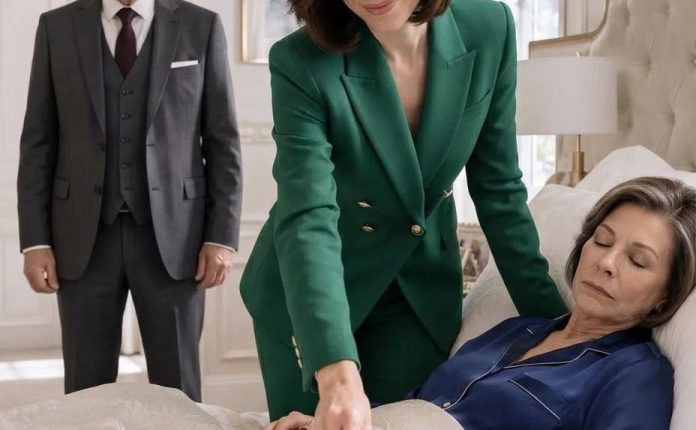
The laugh was what broke the spell. For eight months, I’d watched my mother-in-law, Vivian Mercer, forget how to hold a spoon, button a sweater, and remember my name. Then, before midnight on a cold October Tuesday, I passed her half-closed bedroom door carrying clean towels and heard a voice that was sharp, steady, perfectly focused. It belonged to the woman I thought I’d been nursing toward death.
“No, Grant, listen to me. Friday is the last step,” Vivian said. I stopped in the hallway while the dryer thumped downstairs. “She signed what mattered. Natalie thinks those papers were related to my care.” My mouth went dry. After a pause, Vivian gave a low, satisfied laugh I’d never heard during her supposed decline. “She still has no idea.” I pressed the towels against my ribs and listened.
My name is Natalie Harper. I was thirty-four and, before Vivian moved in, managed the front office of a busy dental practice in Kettering, Ohio. I handled insurance claims, payroll reports, vendor invoices, scheduling disasters, and terrified patients without losing track. Our accountant once joked that I could find a seven-dollar error in a six-month ledger before lunch. I wasn’t careless by nature. Exhaustion had made me careless.
I met Grant Mercer six years earlier at a cookout. He sold commercial kitchen equipment and had a gift for making anyone feel understood. He rarely argued. He tilted his head, smiled, and made his preferred conclusion sound like one we’d reached together. Two years later we married, and Grant moved into the brick house my grandmother June had left me before the wedding, mortgage-free and entirely in my name.
Grandma June raised me after my mother disappeared into a life too chaotic to include a child. Her house had squeaky oak stairs, a narrow kitchen, and an old maple covering the porch in helicopter seeds every June. When she died, the deed transferred to me. Grant contributed nothing because there was nothing to purchase. For years, that seemed unimportant. Then Vivian supposedly began losing her memory.
Grant first said she’d called him by his dead uncle’s name. A week later she supposedly left a burner on, got lost driving home from her usual grocery store, and called after midnight convinced someone was inside her house. Grant said a doctor suspected cognitive decline. When his eyes filled and he said he could never put his mother in a facility, I offered the sentence that changed my life: “She can stay here.”
Vivian moved into Grandma June’s downstairs sewing room three weeks later. I painted it yellow, installed grab bars, bought a shower chair, removed rugs, and locked cabinets Grant said might confuse her. At first we discussed professional caregivers, but Vivian rejected every aide. Grant took my hands and explained, “She only trusts you.” That became the answer to every problem, canceled plan, and responsibility that moved onto my shoulders.
I woke early to make oatmeal exactly the way Vivian liked it. I bathed her, dried her hair, helped her dress, prepared soft meals, washed sheets, sorted medication, and sat beside her through blank afternoons. When I tried leaving for coffee, Grant warned she might wander. When I asked him to feed her on weekends, he said she became agitated. Eventually my friends stopped inviting me anywhere because I always refused.
I quit my dental job because leaving Vivian alone seemed unsafe. Grant earned enough, he said, and Grandma had left me forty thousand dollars in savings. My manager hugged me and called my decision incredibly kind. For months I lived on that praise. My work clothes vanished behind T-shirts and leggings. Grant called me his angel. His sister Bethany visited twice and said she couldn’t imagine how I managed. Neither could I.
Meanwhile, Grant took over every financial task in our marriage, not with threats but tenderness. When bills arrived, he kissed my forehead and said, “You do enough. I’ve got this.” I believed he was protecting me from another burden. Standing outside Vivian’s bedroom, I understood the skill that could have protected me most—following paper trails—was exactly what Grant had kept away while praising my sacrifice.
Then I remembered the documents. Three weeks earlier, Grant brought a stack into the kitchen while I fed Vivian soup. He called them care paperwork and said I needed to sign as her primary caregiver. I’d slept almost nothing after Vivian called for me four times overnight. Grant placed tabs beside the signature lines. I signed four places, maybe five, without reading pages I normally would have examined.
Vivian had said Friday was the last step. Grant slept upstairs while I lay beside him until dawn, staring at the ceiling and resisting the urge to wake him. Confronting them might feel satisfying, but I knew nothing except what I’d overheard. Around four in the morning, I made the most important decision of my life: I’d say nothing until I knew what those signatures had actually been used to accomplish.
At six, I made oatmeal as usual. Vivian sat at the kitchen table in her bathrobe, face slack and hands resting in her lap. For eight months, I’d looked at her and seen illness. That morning I watched for mistakes. Before she noticed me, she reached toward the sugar bowl with a perfectly steady hand. Then she saw me. A tremor appeared instantly, like someone flipping a switch.
Grant came downstairs with his travel mug and said he’d be in Cincinnati until evening. He kissed my temple and asked whether I was good with his mother. I smiled and said of course. After his truck disappeared, I picked up the cordless phone and dialed my cell. When it rang on the counter, I turned away from Vivian and pretended the bank had frozen an important property transfer.
I made my voice loud. “They need Grant at the bank today? If he doesn’t come in, the transaction gets canceled?” I hung up and said I needed to call him. Behind me, a chair scraped across the floor. Fast footsteps crossed the kitchen, and strong fingers clamped around my forearm. Vivian stood inches away without a tremor or blank stare. “What account?” she demanded. “Did Grant finish signing it?”
For seconds neither of us moved. Vivian’s grip hurt. Then she saw my face and remembered she was supposed to be sick. Her fingers loosened, shoulders sagged, and confusion returned to her expression. “I don’t understand,” she murmured. I removed her hand from my arm one finger at a time. “There was no bank call, Vivian. I called my own phone. I only wanted to know whether you could run.”
The act disappeared. Vivian sat down, lifted her chin, and looked at me with cold, clear eyes. Then she smiled. “Grant was wrong about you,” she said. My heart hammered. “He said if we kept you tired enough, you’d never notice.” In one sentence, the woman I’d bathed for eight months vanished. The person across from me had studied my exhaustion, measured my guilt, and used both against me.
I demanded the truth. Vivian asked for black coffee first, like we were coworkers beginning a meeting. Then she said Grant had run out of money. His commissions collapsed, projects were delayed, and he covered old borrowing with new borrowing until personal loans, credit accounts, and debt against his truck reached nearly sixty thousand dollars. “How does that become my problem?” I asked. Vivian looked toward the window. “Your house.”
She said it without embarrassment. Three hundred thousand dollars of mortgage-free property sat in my name while Grant suffocated under debt. Of course they’d looked at it, she said. I reminded her Grandma June left me that house before marriage and Grant had no ownership rights. Vivian nodded. “Which was precisely the problem.” The casualness hurt more than the plan. My grandmother’s life’s work had become their solution to Grant’s failure.
I asked why pretending to have dementia helped. Vivian smiled. “A tired person signs things. A guilty person doesn’t admit she’s too exhausted to keep helping. An isolated person has fewer people asking questions.” She admitted wandering beneath the maple tree was staged because she knew I’d see her. So were the pantry tears, confused objects, trembling hands, and enough helpless moments to convince me quitting work was necessary.
“You watched me bathe you,” I said. Something flickered across Vivian’s face, but she replied, “You needed to believe you were necessary.” I told her she was sick, just not how she’d pretended. That silenced her because Vivian understood liability. She had worked as a bookkeeper. Records mattered. Consequences mattered. When I asked exactly what I’d signed, she stopped smiling and told me to get a lawyer.
The documents, she admitted, supported a sixty-thousand-dollar home-equity loan. There was a lender application, consent form, and ownership addendum designed to make Grant appear connected to Grandma’s property. He was supposed to finish the remaining paperwork Friday. When I demanded to know how my signatures had been notarized, Vivian hesitated for the first time. That pause told me a crime might exist inside the fraud, not merely a marriage betrayal.
I ordered Vivian to pack, then locked myself in the downstairs bathroom beside the shower chair I’d used caring for her. I called Samuel Avery, the attorney who handled Grandma June’s estate. I gave him facts: inherited house, suspicious loan, signatures obtained under false pretenses, possible false notarization, final funding scheduled Friday. Samuel told me not to sign anything else, not to confront Grant, and to come directly to his office.
Samuel pulled Grandma June’s estate file and placed the recorded deed before me: my name, my property, years before marriage. Together we called the lender. A home-equity application was pending, with funding expected Friday. The file contained a notarized ownership document dated a Saturday when I’d spent the entire day inside the house with Vivian. No notary had visited. Samuel disputed the loan immediately. By afternoon, the transfer was frozen.