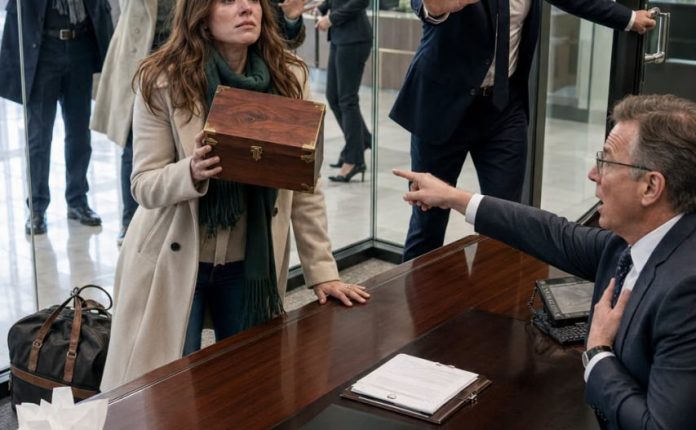
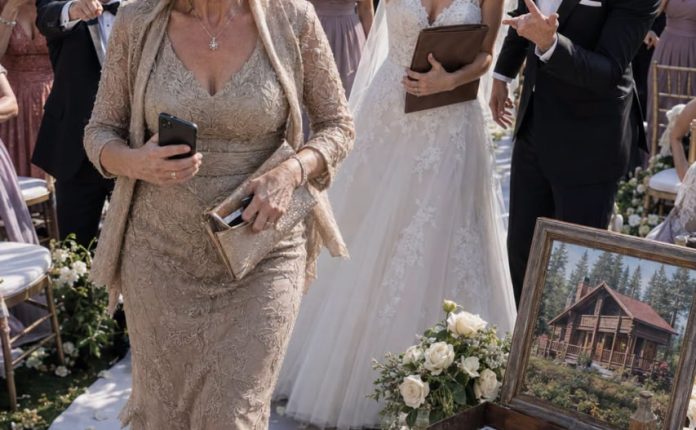
Part Three Police obtained an emergency order that afternoon and drove Rachel to Cedar Glen with an adult-protective-services investigator. Emma and Daniel were not permitted to accompany them, but Rachel called that evening.
For several seconds, she could not speak.
“She knew me,” she finally said. “Before I even reached her room, she knew my voice.”
Evelyn was thin and physically weaker than the photograph suggested, but she knew her name, her old address, the month, the president, and exactly why she had hidden papers inside the chair.
“She asked whether the roses survived,” Rachel said through tears.
Staff at Cedar Glen had been told Evelyn suffered severe dementia, became agitated around certain relatives, and sometimes invented accusations about money. Martin paid six months of fees in advance and instructed employees to use the name Eleanor Harris because, he claimed, an estranged family member had been stalking her.
The administrator admitted the arrangement was unusual.
It was also expensive.
Martin had paid in cash.
Investigators transferred Evelyn to a hospital for independent medical assessment. Doctors found mild age-related memory difficulties but no evidence supporting the profound incapacity described in Cedar Glen’s admission forms.
When Detective Ruiz later asked Evelyn why she went there, Evelyn remembered Martin saying she was being taken to another rehabilitation center for two weeks.
Instead, he drove her inland.
“He took my handbag,” Evelyn told investigators. “He said I kept losing things. Then he told the people there my name was Eleanor. I corrected them. They smiled at me as though correction proved I was confused.”
Emma felt anger rising simply hearing it.
The system designed to protect a vulnerable woman had been turned into evidence against her every time she protested.
Evelyn also explained the cash.
Forty-six thousand eight hundred dollars had been hidden in the metal box. Most came from an emergency fund she and her late husband maintained for decades. When strange withdrawals began, she removed the remaining cash from their safe because she feared Martin would find it.
“I intended Rachel to have access if I needed a lawyer,” she said.
She had not hidden treasure.
She had hidden an escape route.
Martin was questioned the same evening.
He insisted his mother had voluntarily transferred financial authority and agreed to move into memory care under a different name for privacy. He claimed Rachel had manipulated Evelyn into creating false accusations after learning she would receive little inheritance.
Then he learned about Emma and Daniel.
Within forty-eight hours, his attorney sent them a formal demand claiming the chair and everything inside belonged to the Harrow estate. The letter implied that cash might have been removed before police arrived.
Emma read that line three times.
“He is accusing us of stealing.”
Daniel’s face went red.
“We called police before opening the box.”
“I know.”
“Ortiz saw everything.”
“I know.”
But accusations were powerful even when evidence contradicted them.
News of Evelyn’s discovery reached reporters, and someone online identified Emma and Daniel as the couple who found the chair. Praise mixed with suspicion. Strangers asked whether they had kept money. Emma stopped reading comments after one accused them of stealing. Daniel reminded her that evidence mattered more than gossip.
Three days later, someone knocked after nine at night.
Daniel checked the peephole.
A young man stood in the hallway wearing a dark cap.
He was one of the men from the truck.
Daniel immediately called Ortiz.
The man raised both hands when Daniel spoke through the locked door.
“My name’s Kevin Moss. I’m not here for trouble. I need to tell you something about the chair.”
They did not open the door until police arrived.
Kevin was twenty-seven and worked occasional hauling jobs for Harrow Property Services. He said Martin hired him and another worker, Luis, to empty a storage unit containing Evelyn’s belongings.
Most furniture was taken to an auction warehouse.
The armchair was different.
“Martin told us to dump it,” Kevin said.
“Why?” Ruiz asked.
“He said it smelled like mold.”
Kevin had thought that was strange because several worse pieces went to auction. After the first news report about Evelyn’s recovery appeared, Martin called him repeatedly asking exactly where the chair had been discarded.
“That’s why we came back.”
“You told patrol officers you wanted an antique returned.”
“Martin told us to say that.”
Kevin looked ashamed.
Then he removed his phone.
“I recorded him yesterday.”
“Why?”
“Because he started blaming us. Said if anything was missing, he’d tell police we stole it.”
Kevin played the audio.
Martin’s voice was unmistakable.
“You were supposed to get rid of that chair. I told you specifically. If anyone asks, it went to the transfer station and got crushed.”
Kevin answered, “We dumped it behind Pine Court.”
A pause followed.
Then Martin swore.
“Find it before someone opens the back.”
No one spoke for several seconds after the recording ended.
Ruiz asked Kevin to surrender the original file for forensic preservation.
That recording changed the criminal investigation.
So did Luis’s statement the following morning.
Luis said that while moving Evelyn’s belongings from the house, he saw Martin searching drawers and cutting open the lining of two suitcases. When the armchair was loaded, Martin stopped them and examined its underside before telling them to dispose of it separately.
“He was looking for something,” Luis said.
The hidden box was no longer merely evidence Evelyn had preserved.
It was evidence Martin had actively tried to destroy.
A week later, Evelyn asked to meet Emma and Daniel.
They visited the rehabilitation hospital on a Sunday afternoon.
Evelyn was smaller than Emma expected. Her silver hair framed a narrow face, and a purple cardigan hung loosely from her shoulders.
She studied Emma for a long moment.
“You rescued Arthur’s chair.”
“Arthur?”
“My husband.”
Evelyn smiled.
“He hated that upholstery.”
Daniel laughed.
The tension in the room softened.
Emma told her they had planned to recover it.
“Then perhaps being thrown away saved it,” Evelyn said.
Her eyes filled with tears.
“And saved me.”
Emma shook her head. “Your records saved you. Rachel saved you. The investigators did.”
“You picked it up when everyone else walked past.”
The sentence stayed with Emma.
Before they left, Evelyn asked whether they wanted the chair when the case ended.
Daniel immediately said, “No hidden compartments.”
Evelyn laughed until she coughed.
For a moment, she seemed simply elderly rather than endangered.
Then Detective Ruiz entered with Samuel Greene, Evelyn’s new attorney.
His expression was serious.
“Forensic accountants finished tracing the house sale,” he said.
Rachel sat straighter.
The cheap sale to North Coast Residential had not merely benefited Martin’s business partner.
Bank records showed the company had transferred one hundred seventy thousand dollars back to Martin two days after closing.
The property had effectively been stripped of equity before resale.
But another transfer was worse.
The same day Evelyn was admitted to Cedar Glen under a false name, Martin moved three hundred twelve thousand dollars from her investment account into a private trust.
The named beneficiary was himself.
Evelyn stared at the document.
Then she whispered, “That account was for Rachel and the children.”
Greene nodded.
“And we found the form authorizing the transfer.”
He placed it on the table.
The signature was dated October tenth.
One day after Evelyn entered Cedar Glen.
Facility records showed that at the exact time she supposedly signed it, Evelyn was locked inside a secured memory-care wing ninety miles away with no phone, no identification, and no lawyer.