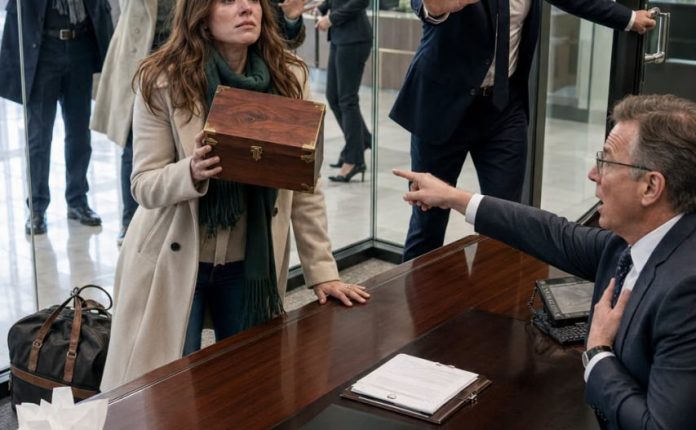
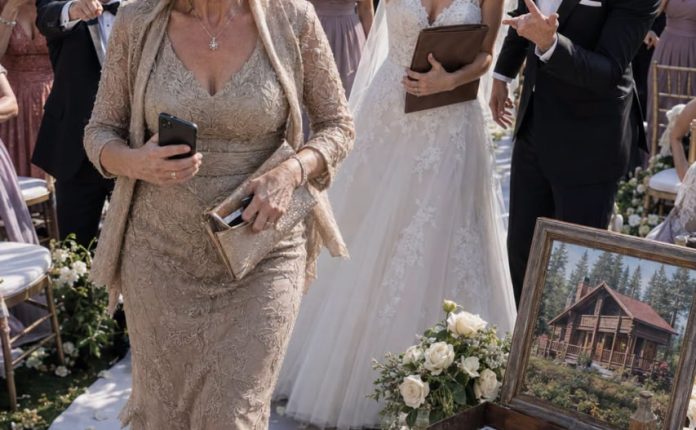
Part Two Officer Ortiz immediately told Emma and Daniel to move away from the window. Patel called for another unit while Ortiz switched off the room light. The two men crossed the courtyard, stopped beside the dumpsters, and began searching through the furniture pile. One kicked aside cushions. The other opened trash bags and looked toward the building between movements.
“They may only be looking for the chair,” Daniel whispered.
“That is exactly what worries me,” Ortiz said.
Patrol officers reached the courtyard before either man entered the building. From behind the curtain, Emma watched police speak to them. The man in the cap gestured repeatedly toward the dumpsters. After several minutes, officers photographed the truck and identification cards, then allowed the men to leave.
“Why let them go?” Emma asked.
“Because looking through discarded furniture is not a crime,” Ortiz replied. “But now we know who they are.”
The truck belonged to Harrow Property Services, a company registered to Martin Harrow.
The men claimed they had been hired to clear unwanted furniture from a storage unit and realized they accidentally discarded an antique chair Martin wanted returned.
They denied knowing anything was hidden inside.
Ortiz took the box, envelope, recorder, and loose documents as evidence. She asked Emma and Daniel not to contact Martin or anyone named in the papers. She also recommended they stop posting about the chair online and call immediately if anyone approached them.
After police left, the empty cavity in the chair felt more disturbing than the box itself.
Emma barely slept.
The next morning, Detective Mara Ruiz called. She worked in the county financial-crimes unit and had been assisting the missing-person investigation because Evelyn’s disappearance overlapped with unusual property transactions.
Ruiz asked Emma and Daniel to come to the station.
The red notebook turned out to be Evelyn’s handwritten financial diary. For nearly eighteen months, she had recorded transactions she did not recognize: withdrawals from savings, changes to investment accounts, checks supposedly signed by her, and payments to businesses associated with Martin.
The total already identified exceeded two hundred thousand dollars.
“Why didn’t she report it?” Emma asked.
“She tried,” Ruiz said.
A bank employee remembered Evelyn arriving with her granddaughter Rachel fourteen months earlier. Evelyn claimed her son had access to accounts without permission. Martin appeared later with documents showing he held financial power of attorney.
Rachel disputed the document.
Weeks afterward, Martin petitioned for guardianship, arguing his mother had dementia and was being manipulated by Rachel.
“Did she have dementia?” Daniel asked.
“That became the central question.”
Two doctors hired during the guardianship process reached different conclusions. One described mild cognitive impairment. Another found Evelyn capable of handling ordinary decisions with assistance.
The judge denied full guardianship but allowed a temporary financial conservatorship while further evaluations were arranged.
Martin became temporary conservator.
Within months, Evelyn’s house was listed for sale.
Rachel objected.
Then family conflict turned ugly.
Martin accused Rachel of trying to steal her grandmother’s estate. Rachel claimed Martin had isolated Evelyn, blocked calls, and moved her between facilities without telling relatives.
Three weeks before Evelyn disappeared, Rachel was removed from the visitor list at Rosewood Rehabilitation.
“Where is Rachel now?” Emma asked.
Ruiz slid the photograph across the desk.
“Seattle. We spoke to her last night.”
Rachel said she had spent months calling hospitals, shelters, police desks, and every care facility she could find. Martin always seemed one step ahead, telling people Evelyn wandered, confused names, and sometimes accused relatives unfairly. Eventually, even sympathetic officials began treating Rachel like a difficult granddaughter refusing to accept an old woman’s decline. She had started doubting herself until the chair appeared.
Rachel Harrow arrived that afternoon.
She was thirty-four, wearing jeans, a raincoat, and the exhausted expression of someone who had spent months explaining the same impossible story.
The moment she saw the photograph from the box, she began crying.
“My grandmother kept it.”
Emma did not know what to say.
Rachel explained that Evelyn had raised her for several years after Rachel’s mother died. Martin was Rachel’s uncle, not her father. He had always resented how close they were.
“My grandmother was stubborn,” Rachel said. “She could forget appointments, but she knew what she owned. She knew when money started disappearing.”
Rachel had helped Evelyn photocopy bank statements and contact an elder-law attorney. Before they could file a formal civil action, Martin produced the power-of-attorney document and accused Rachel of exploiting Evelyn.
“He made me sound like a criminal.”
“Was the power of attorney real?” Daniel asked.
Rachel shook her head. “Grandma said she never signed it.”
Forensic examination now supported her. The signature had likely been copied from an older document.
The deed found in the chair appeared similarly questionable.
Ruiz explained that North Coast Residential LLC, the company that purchased Evelyn’s home cheaply, was controlled through another company whose manager was Martin’s longtime business partner.
Three weeks after the purchase, the house was listed again for seven hundred ninety-five thousand dollars.
Emma felt sick.
“So he sold his mother’s house to himself cheaply.”
“That is one theory we are examining.”
“And she vanished three days before the sale?”
“Yes.”
Rachel leaned forward.
“I don’t believe she wandered away.”
Neither did anyone in the room.
The digital recorder provided the first direct explanation.
Technicians copied the files before playing them. Evelyn’s voice sounded weak but clear.
“My name is Evelyn Mae Harrow. I am recording this because Martin tells everyone I cannot remember anything.”
Emma looked at Rachel.
Tears ran silently down her face.
Evelyn described discovering false withdrawals. She said Martin repeatedly pressured her to sign documents and became angry when she refused. She hid records because papers disappeared from her desk after his visits.
Then her voice lowered.
“If something happens to me, Rachel did not do it. Rachel is the person who tried to help me.”
The recording continued.
Evelyn said she had sewn a compartment into her husband’s old armchair because Martin planned to clear her house while she stayed at rehabilitation. She placed documents and emergency cash there, intending Rachel to retrieve them.
But Rachel never got the message.
Martin changed Evelyn’s phone and visitor permissions before she could tell her.
The last audio file was dated October eighth, one day before the reported disappearance.
“I heard Martin talking to someone about Cedar Glen,” Evelyn said. “He thinks I was asleep. He said once I am moved, the house can close and nobody will listen to Rachel anymore.”
Ruiz stopped the recording.
“What is Cedar Glen?” Daniel asked.
“We didn’t know yesterday.”
She opened a folder.
“Now we do.”
Cedar Glen was a small private adult-care residence ninety miles inland. It had changed ownership twice and advertised memory-care services. Police had contacted the facility that morning.
A resident had been admitted on October ninth under the name Eleanor Harris.
The admission paperwork listed no Social Security number and said the woman’s identification had been lost during transfer.
The emergency contact was Martin Harrow.
Ruiz turned her laptop around.
A recent staff photograph showed an elderly woman sitting beside a window, silver hair brushed neatly, hands folded over a blue blanket.
Rachel stood so quickly her chair fell backward.
“That’s her.”
Evelyn Harrow had never disappeared.
For four months, she had been alive in a care home under another name.
And according to Cedar Glen’s records, someone had instructed staff that she suffered severe confusion and that no visitors were permitted without her son’s approval.