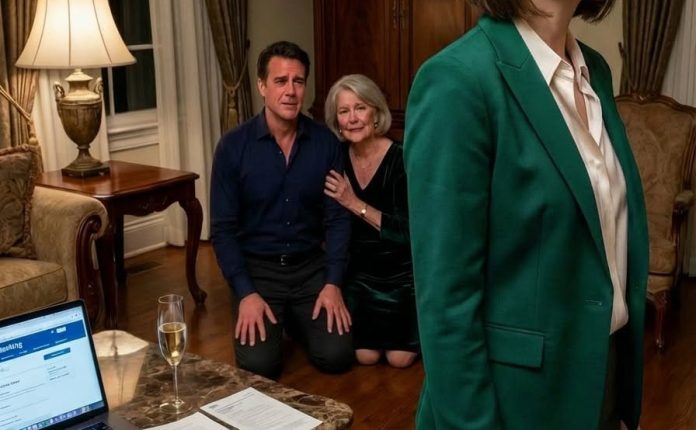
Part Three Vanessa’s attorney introduced herself as Diane Mercer and explained that her client intended to cooperate with the court and any lawful investigation. Daniel’s lawyer objected to turning a divorce hearing into a criminal proceeding. Judge Whitaker agreed that criminal issues belonged elsewhere but said relevant financial evidence still mattered to property and custody decisions.
Vanessa opened the red folder. “Daniel told me Emma had already agreed to leave the marriage,” she said. “He said they were staying together until after the baby because Emma was emotionally fragile. He told me the refinancing was legal and that she had signed the original documents.”
Emma listened without moving. She had heard the same excuse from other betrayed spouses: we were basically separated. It did not soften the affair. But Vanessa’s voice no longer carried triumph. She looked frightened, angry, and embarrassed by how completely Daniel had controlled the story.
Diane placed copies of text messages into evidence through the proper procedure. In one, Daniel told Vanessa that Emma’s signature “could be cleaned up” because spouses routinely authorized each other. In another, he wrote that once the divorce was final, Emma would surrender the house voluntarily because “she hates conflict more than she likes money.”
Emma closed her eyes.
Daniel knew her kindness well enough to weaponize it.
Vanessa admitted creating the electronic signature file. She insisted Daniel supplied a photographed signature and told her Emma had authorized its use. She also acknowledged notarizing paperwork she never watched Emma sign. “I knew that part was wrong,” she said. “I told myself it was paperwork between a married couple.”
Judge Whitaker’s face remained stern. “And the fireplace?”
Vanessa swallowed. “Daniel called me after Lily walked into the office. He said we needed to remove drafts because Emma was becoming suspicious. I burned them. Lily saw me. I told her she would get her mother in trouble if she repeated adult conversations.”
Emma’s breath caught. Vanessa looked toward her for the first time. “I am sorry.”
Emma could not answer.
Vanessa then produced the silver device Lily had described. It was a security token linked to Caldwell Restoration’s online banking. Vanessa said Daniel had given it to her after shifting funds into VDP Holdings. She had kept it because she feared he might later claim she acted alone.
Daniel leaned toward Mark. His face had become gray.
The records connected that token to transfers totaling more than one million dollars over eighteen months. Some payments went to VDP, but others went to businesses Vanessa said she did not own. Leo traced them to two shell companies controlled by Daniel’s college friend, Eric Saunders.
Those companies billed Caldwell Restoration for materials that were never delivered. Money then returned to Daniel through personal loans and credit-card payments. The apparent business success Daniel bragged about had partly been manufactured through borrowed money, false expenses, and concealed transfers.
Emma finally understood why Daniel wanted her to surrender his business shares. Caldwell Restoration was not simply an asset. It was the center of the financial investigation. If she walked away immediately, he could have argued she had voluntarily accepted his version of the company’s value before the records were examined.
Rachel whispered, “Your offer would have protected him.”
The realization hurt almost as much as the affair.
Daniel had watched his pregnant wife offer him everything because she wanted peace, and he had been willing to accept while knowing much of what she surrendered was encumbered, manipulated, or connected to fraud.
Judge Whitaker ordered that a receiver temporarily oversee extraordinary Caldwell Restoration transactions. She also appointed a guardian ad litem for Lily and the unborn baby’s future custody interests. Daniel was granted supervised parenting time only after an evaluator reviewed the family circumstances.
Outside the courthouse, reporters had begun gathering because Caldwell Restoration held several municipal contracts. Emma left through a private exit. Natalie drove her home and made soup while Lily colored at the kitchen table, unaware that adults across the city were now examining the words she had whispered near a vending machine.
That night Lily crawled into Emma’s bed. “Is Daddy bad?” she asked.
Emma’s heart broke.
“Daddy made some choices that hurt people,” she said. “But you do not have to decide what kind of person he is. You are allowed to love him and still tell the truth when something scares you.”
“Is the mean lady bad?”
Emma almost smiled at the impossible simplicity. “She made hurtful choices too. Adults have to be responsible for their own choices.”
Lily touched Emma’s stomach. “Does baby know?”
“Not yet.”
“Good. We can tell him when he’s bigger.”
Emma kissed her forehead and cried only after Lily fell asleep.
The financial case widened during the following months. State investigators and federal authorities reviewed lending documents, tax records, vendor contracts, and municipal invoices. Emma’s divorce remained in family court, but evidence from those investigations clarified the marital estate.
Daniel had hidden almost six hundred thousand dollars in personal debt. He had also pledged business equipment twice as collateral and diverted payroll-tax funds to cover short-term obligations. Caldwell Restoration still had legitimate value, employees, and contracts, but its finances were far weaker than he claimed publicly.
Vanessa negotiated immunity on certain document offenses in exchange for full cooperation, though she still faced civil liability and professional consequences. Her relationship with Daniel ended immediately. She sold the lake property, and the proceeds were placed into escrow while ownership claims were resolved.
Emma felt no friendship toward her. Cooperation did not erase cruelty. Vanessa had slept with her husband, mocked her in court, helped falsify documents, and threatened Lily into silence. But Emma also refused to build recovery around hating her. Hatred kept Daniel at the center of life.
The hardest family fallout came from Daniel’s parents. His mother, Patricia, called Emma and begged her to “stop destroying the father of your children.” Emma listened until Patricia suggested Lily had been confused by “women fighting over Daniel.”
Then Emma ended the call.
Daniel’s father, Robert, reacted differently. He asked to meet Emma with Rachel present. He brought old company records showing that Emma had invested thirty-eight thousand dollars from her grandmother’s inheritance when Caldwell Restoration nearly failed during its second year.
Daniel had always called that money a gift.
Robert had found the original agreement.
It stated that Emma’s investment purchased a twenty-percent ownership interest in the company.
Daniel had never transferred the shares.
Rachel read the document twice.
Emma stared at Robert. “Why do you have this?”
“Because I witnessed it,” he said. “And because my son asked me last month to say it never existed.”
Robert explained that he had stayed silent because Daniel promised to correct the ownership after the company became profitable. Every year, there was another excuse: taxes, investors, refinancing, paperwork. Robert admitted he had confused patience with loyalty until Daniel finally asked him to deny Emma had ever invested at all.
For Emma, that betrayal reached backward through the marriage. She remembered unpaid weekends at the kitchen table, invoices balanced while Lily slept nearby, and Daniel telling friends he had built everything himself. The company she was ready to surrender had partly been hers before Vanessa ever entered their lives. The omission had never been accidental bookkeeping.
The courtroom had exposed forged debt.
Now Daniel’s own father had produced proof that he had concealed Emma’s ownership for years.
And this time, there was no mistress left to blame.