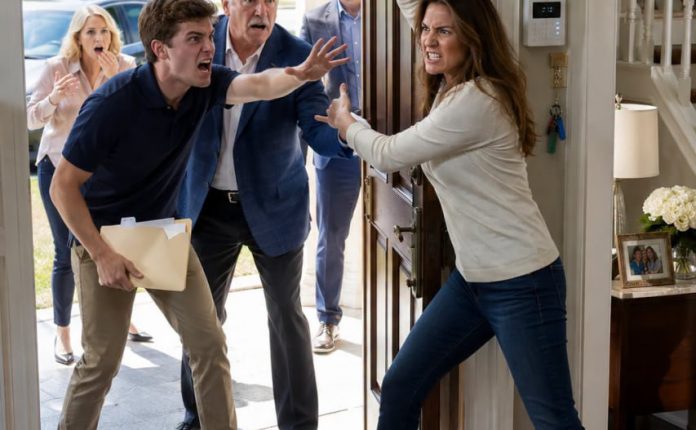
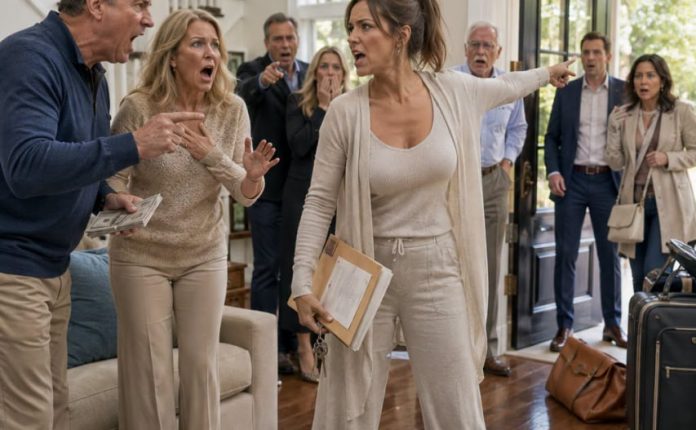
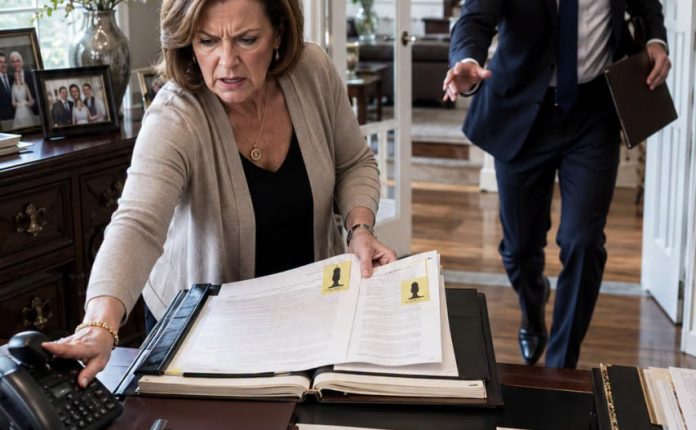
The board removed Grant first. Termination for cause. His company access ended immediately. His face turned purple. “This is ridiculous.” Nobody answered. He looked at my mother. “Evelyn, say something.” She couldn’t. Blake came next. Suspended pending completion of the fraud investigation. Company equipment surrendered. Accounts locked. His salary stopped. He stared at the table as though somebody had removed gravity from the room. Then came my mother. President removed for gross negligence, misuse of corporate assets, breach of fiduciary duty, and failure to protect employee funds. The vote was nearly unanimous. Nearly. One longtime family friend abstained. Nobody opposed.
My mother looked around the table. “You people wouldn’t have jobs without my husband.” One director, Sam Reynolds, had worked with my father since the first warehouse. He leaned forward. “Exactly.” She stared at him. Sam continued. “Richard gave us jobs. Vivian kept them.” That was the moment my mother finally looked at me differently. Not lovingly. Not respectfully. Accurately. She saw the person I had been while she was busy pretending I was nothing. “Vivian,” she whispered. I waited. “We can fix this.” “No.” “We’re family.” I almost admired how quickly she reached for that weapon. Family. The word she used whenever consequences arrived.
“Where was family when you hid Dad’s letter?” Her eyes flicked toward Thomas. “Where was family when you stole retirement money?” “I didn’t steal—” “Where was family when you canceled my flight?” Her voice cracked. “You humiliated me.” “In Paris?” “In front of everyone.” I stared at her. “Mom, you left me in a foreign country because I wouldn’t carry Blake’s suitcase.” She wiped tears from her cheek. “It got out of hand.” “No. It finally got honest.” Grant pushed his chair back. “This little performance is over.” Michael stood. “No, Mr. Mercer. Your employment is over.”
Grant pointed at me. “You think you’re ready to run this company?” I looked at him. “I’ve been running it for ten years.” He had no answer. The criminal investigation continued for months. There were interviews. Subpoenas. Asset freezes. Lawyers. More paperwork than revenge stories usually include. Real consequences are rarely cinematic. Mostly they look like fluorescent conference rooms, legal pads, stale coffee, and people finally being asked to explain numbers they assumed nobody would ever examine. Blake’s case was straightforward. He had created false business expenses and diverted company money for personal use.
Under advice from his attorney, he eventually agreed to a plea arrangement requiring restitution, cooperation, and strict financial conditions. He avoided the worst possible outcome, but his life changed completely. The sports car disappeared. Then the apartment. Then the club memberships. Months later, one of our warehouse managers told me Blake had taken a night job at a distribution center outside Dayton. Not ours. I didn’t ask which one. Grant and my mother faced civil liability tied to the retirement-fund misuse and property purchases. Raven Crest was sold. So was their primary house. My mother’s jewelry appeared through an auction service.
I recognized a bracelet Dad had given her on their twentieth anniversary. For a moment, I considered buying it. Then I closed the page. I didn’t want relics. I wanted distance. Six months after Paris, I became CEO of Hartwell Logistics. The first thing I did wasn’t move into my father’s old office. It was repair the employee retirement reserve. Every dollar was restored. Then I invited our longtime warehouse employees into the main conference room and told them exactly what had happened. Not every ugly detail. But enough. “I can’t undo the breach of trust,” I said. “I can only promise that nobody’s future will be treated like a private checking account again.”
Earl Donnelly raised his hand. He was sixty-three and had driven for us since before I learned multiplication. “Your dad would be proud.” I had prepared answers for financial questions. That one nearly broke me. I swallowed. “Thank you.” Only after that did I move upstairs. Not into Blake’s old office. Into Dad’s. The furniture had changed years ago. I restored only one thing. His old wooden desk. It had scratches along the edge where he’d tapped his wedding ring while thinking. The first morning I sat behind it, sunlight came through the windows. Actual sunlight. After ten years under fluorescent lights, I had forgotten what morning looked like from that side of the building.
My phone buzzed. Unknown number. I almost ignored it. Then I opened the message. Vivian, it’s Mom. Please don’t delete this. I have nowhere else to turn. I need to see you. I stared at the words for several seconds. Then another message appeared. I know I made mistakes, but I am still your mother. I put my phone down. For years, I’d imagined what I would say if she ever admitted she needed me. Now that the moment had arrived, I felt almost nothing. And that frightened me less than it should have. I didn’t answer my mother that day. Or the next.
By Friday, she had sent six messages. Some apologetic. Some defensive. One angry. They followed a pattern I had known my entire life. “I miss you.” Then: “You have punished me enough.” Then: “Your father would hate what you’re doing.” That last one almost earned a response. Almost. Instead, I printed it and placed it beside Dad’s letter. The contrast told me everything. My father had written: You do not owe anyone your destruction in exchange for their approval. My mother wrote: Your father would hate what you’re doing. One voice wanted me strong. The other wanted me obedient.
I deleted her messages. Not out of anger. Anger had kept me tied to her almost as tightly as love. I deleted them because I finally understood that my mother no longer deserved unlimited access to me. Hartwell improved faster than anyone expected. Once we stopped paying for Grant’s vanity projects and Blake’s fabricated vendors, our margins immediately strengthened. We rehired two managers Grant had pushed out. Renegotiated transportation contracts. Added internal approval systems requiring multiple signatures for major transfers. I created an employee oversight committee for retirement funds. Nobody—not even me—could access those reserves alone again. That mattered.
Power had destroyed my mother because she thought control meant freedom from accountability. I intended to learn the opposite lesson. About nine months after Paris, I returned there. Alone. Not because I needed closure. I had discovered closure rarely arrives as some grand emotional moment. Most of the time, it grows quietly while you’re busy living. I went because Hartwell had signed a new European distribution partnership, and I wanted to attend the negotiations myself. I booked a comfortable business-class ticket. A normal hotel room. One suitcase. No entourage. On my first afternoon, I walked past Hôtel Beaumont.
For a moment, I stood across the street watching taxis stop beneath the awning. Same revolving doors. Same polished windows. Same brass luggage carts. But I was different. I remembered standing inside with my canceled ticket. The humiliation my mother had imagined for me. The fear she expected. What I remembered most clearly, though, was the espresso. Warm ceramic cup. Bitter smell. My hands steady around it. That was the first moment I stopped waiting for permission to save myself. I crossed the street and entered the lobby. The chandeliers were still beautiful. I sat in almost the same velvet chair. Ordered an espresso.
When it arrived, I laughed quietly. The server smiled. “Something funny?” “A memory.” “A good one?” I looked around. “It became one.” My phone buzzed. A message from my mother. New number again. She had become persistent about finding ways around being blocked. Vivian, I heard you’re in Paris. I don’t know who told her. Maybe a former employee. Maybe one of the few social contacts she still had. The next line read: Please meet me when you return. I want my daughter back. I stared at the screen. Ten years earlier, those words would have shattered me.
Five years earlier, I would have traded almost anything to hear them. Even in Paris the first time, some buried part of me still wanted her to call and say she was sorry. But love offered only after power is lost is difficult to trust. I typed a response. Not because I wanted reconciliation. Because silence had already said most of what I needed, and I wanted to say the rest once. “Mom, you don’t want your daughter back. You want the version of me who absorbed every insult, fixed every mistake, paid every bill, and asked for nothing. She doesn’t exist anymore.”
I paused. Then continued. “I hope you build a life you can live with. I won’t finance it, repair it, or participate in it.” My thumb hovered above send. One final sentence. “I forgive myself for staying as long as I did. That’s the only forgiveness I need.” Send. Then I blocked the number. I didn’t feel triumphant. I felt light. There was no dramatic music. No applause. No crowd watching a villain collapse. Just Paris traffic moving beyond tall windows and steam rising from my coffee. That was enough. A year after becoming CEO, Hartwell Logistics posted the strongest results in its history.
We expanded carefully. Promoted from within. Created scholarships for employees’ children. I named the program after my father. The Richard Hart Opportunity Fund. My mother never stepped inside company headquarters again. Grant disappeared from my life almost completely. I occasionally heard stories through other people—cheaper apartment, smaller social circle, endless complaints about how unfairly they’d been treated. I stopped asking. Blake continued making restitution. Once, he emailed me directly. No excuses. No insults. Just: “I know you don’t owe me anything. I was awful to you for years. I’m sorry.” I read it. Then archived it.
Maybe he meant it. Maybe he didn’t. His growth was no longer my responsibility. I never became close to him. I never invited him back. An apology could acknowledge the past. It could not purchase a future with me. As for romance, I didn’t rush into some perfect relationship just because stories often end that way. For the first time in my adult life, I enjoyed being alone. I bought a smaller house than my mother thought a CEO should own. It had a back porch, a bright kitchen, and enough space for a garden. On Sundays, I cooked breakfast slowly.
No urgent vendor calls. No family demands. No one snapping fingers. Eventually, I began having dinner with Daniel, an architect I met through a local business redevelopment project. He was kind. Funny. Patient. But the most important thing about him was that my happiness didn’t depend on whether our relationship became permanent. I had already built a life I wanted. He simply fit inside it. Two years after Paris, I found my father’s old pencil in the bottom drawer of his desk. Yellow wood. Worn eraser. Tiny teeth marks near the metal band from one of his thinking habits.
I held it and remembered his voice. “Numbers tell stories.” He was right. The numbers had exposed fraud. But they had also exposed something else. For years, I measured my worth by how useful I could be to people who treated me badly. How many disasters could I fix? How many insults could I endure? How much could I sacrifice before someone finally noticed? Paris taught me the answer. Enough. My mother thought canceling my flight would force me to crawl back to her. Instead, it gave me the first quiet hour I’d had in years to realize I was holding every key I needed.
She told me to walk home. In a strange way, I did. I walked away from the family I’d spent years trying to earn. I walked toward the company my father had trusted me to lead. And eventually, I walked into a life where nobody needed to be afraid of me, and I didn’t need to be afraid of anyone else. Sometimes I still think about that original text. “Have fun paying the bill.” I did pay it. Just not the bill my mother expected. I paid for my freedom with the painful truth that some relationships cannot be repaired simply because the person who broke them becomes lonely.
And if you asked me whether I would change what happened in Paris, my answer would be no. Not one canceled ticket. Not one declined card. Not one bitter sip of espresso. Because the moment my mother tried to abandon me was the moment I finally stopped abandoning myself.
THE END!
Disclaimer: Our stories are inspired by real-life events but are carefully rewritten for entertainment. Any resemblance to actual people or situations is purely coincidental.