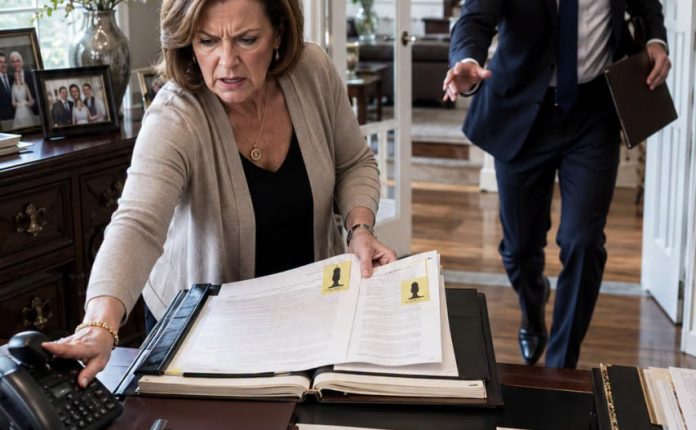
The first thing I noticed after my mother abandoned me in Paris was how beautiful the hotel lobby looked. That sounds ridiculous, considering I had just discovered my flight home had been canceled, but shock does strange things to your brain. Above me, crystal chandeliers threw white light across polished marble floors. Somewhere behind the concierge desk, soft piano music drifted through hidden speakers. A bellman rolled a brass luggage cart past me while tourists laughed near the revolving doors. And there I stood, thirty-five years old, thousands of miles from home, holding a phone that contained two messages from my mother.
“Have fun paying the bill, Vivian. Maybe washing dishes in France will teach you some respect.” Then another. “Walk home.” I read them twice. Then I laughed. Not loudly. Just one small, surprised breath. Because my mother, Evelyn Hart, believed she had finally taught me my place. She had no idea what place I actually occupied. To understand that, you have to understand my family. My father, Richard Hart, built Hartwell Logistics from one rented warehouse in Ohio into a regional supply-chain company handling contracts across half a dozen states. He started with three trucks, a folding desk, and a telephone that sometimes stopped working when it rained.
By the time I was twelve, Saturdays meant sitting beside him in the warehouse office while he explained invoices. “Numbers tell stories,” he used to say, tapping a ledger with his pencil. “People can lie. Numbers eventually get tired of lying.” I adored him. While other kids spent summer afternoons at swimming pools, I learned why one delayed shipment could wreck a month’s cash flow. By sixteen, I knew half our drivers by name. By college, I could read vendor agreements faster than most junior managers. Dad used to tell people, “Vivian sees the whole board.” Then, when I was twenty-five, he died from a sudden heart attack.
Everything changed before the flowers from his funeral had even wilted. My mother became company president. Evelyn had never cared about logistics. She cared about what logistics could buy. Designer handbags. Country-club memberships. Charity galas where photographers knew her name. A year after Dad died, she married Grant Mercer. Grant was handsome in the polished, aging-salesman sort of way. Silver hair. Expensive watches. Teeth a little too white. He spoke to everyone as though he were doing them a favor by allowing them to breathe his air. He also brought his son, Blake, into our lives. Blake was twenty-eight, arrogant, lazy, and strangely proud of both qualities.
Within six months, Blake became vice president of corporate development. His qualifications consisted mostly of golf. My old office—the sunny corner office Dad had once told me would be mine—went to Blake. I was relocated downstairs. No windows. Fluorescent lights. A desk beside shelves containing seven years of archived shipping records. Officially, I became “Director of Operations Administration.” In practice, I became the person who fixed everything. When Grant fired experienced managers because they questioned him, I quietly rebuilt their processes. When Blake forgot to renew a major transportation contract, I negotiated an emergency extension. When my mother spent company money on events that had nothing to do with business, I rearranged cash flow so payroll still cleared Friday morning.
They took the credit. I took the blame. One Tuesday, Grant walked into my basement office, snapped his fingers twice, and said, “Coffee.” I looked up from a contract worth nearly eight million dollars. “The kitchen is upstairs.” His expression hardened. “Don’t get smart with me.” Later that afternoon, my mother came downstairs. She didn’t ask why Grant had treated me like a waitress. She closed my door and sighed as if I were exhausting her. “Vivian, must you always create tension?” “I told him where the coffee was.” “Grant is your stepfather.” “He’s your husband.” Her lips tightened. “There it is again. That bitterness. Blake manages to be pleasant.”
Blake also managed to leave the office before three most days. I said nothing. Silence became my survival strategy. For ten years, I swallowed humiliation because Hartwell Logistics was my father’s life, and I refused to watch it collapse. That was why, four years before Paris, my mother dropped a thick stack of banking documents on my desk. “Handle these,” she said. I looked at the cover page. Corporate credit restructuring. International account authorization. Primary guarantor designation. “These require executive review.” She was already checking her phone. “You understand that boring stuff. Grant and I are leaving for Sedona tomorrow.”
“Mom, some of these documents transfer significant authority.” “Perfect. Then take the authority. Just make sure everything gets approved.” She grabbed her purse and walked out. I stared at the paperwork for a long time. Then I read every page. Twice. By sunset, I understood something my mother did not. She had just handed me legal control over the financial bloodstream of the company. And four years later, standing alone beneath a chandelier in Paris, I realized she had finally given me a reason to use it. I sat down in a velvet chair. Ordered an espresso. Opened my tablet. And typed three words back to her. “Check your bank.” Then I pressed send.
The trouble had started that morning with Blake’s suitcase. Technically, it was a trunk. Dark brown leather, brass corners, monogrammed initials, and apparently heavy enough to contain either several bricks or Blake’s entire sense of entitlement. He dropped it directly in front of me. “Take that to the car.” We were standing in the lobby of Hôtel Beaumont, the kind of Paris hotel where flower arrangements were taller than children and employees somehow remembered everyone’s name. Blake wore sunglasses indoors. I looked at the trunk. Then at him. “No.” He actually laughed. “What?” “I’m not carrying it.” He lifted his sunglasses.
Behind him, Grant stopped speaking to a concierge. My mother turned from the revolving doors. For seven days, I had managed their conference schedule while they treated the trip like a royal tour. The logistics conference itself had lasted three days. My mother attended one morning. Grant went to a networking dinner. Blake showed up only because he’d heard there would be complimentary champagne. I spent most of the week in my room managing problems back home. At night, I could hear room-service carts moving along the hallway while emails from angry vendors filled my screen. Meanwhile, Evelyn bought clothes on Avenue Montaigne. Grant booked spa appointments.
Blake purchased cases of wine he claimed were “investments.” Every charge landed on a corporate account I administered. I had spent years documenting their abuses. Not because I had some grand revenge scheme. At least, that was what I told myself. I simply kept copies. Receipts. Transfers. Authorization logs. Vendor complaints. Everything. My father had taught me that numbers eventually told the truth. That morning, apparently, I was done lying to myself too. Blake pointed at his trunk. “Pick it up.” “No.” Grant walked toward me. “What exactly is your problem?” “My problem is that I’m an executive employee, not your luggage handler.”
Grant gave a humorless smile. “You work for this family.” “I work for Hartwell Logistics.” “Same thing.” “No. It isn’t.” My mother reached us then. She wore a cream-colored designer coat and an expression I remembered from childhood—the one that said I had embarrassed her in public. “Vivian,” she said quietly. “Do not make a scene.” “I’m not making one.” Blake gestured toward the trunk. “She won’t carry it.” My mother stared at me. “Pick it up.” “No.” Her face changed. There was no dramatic shouting at first. That would have been easier. Instead, she stepped closer and wrapped her fingers around my upper arm.
Her manicured nails pressed through my sleeve. “You will do what you’re told.” A couple near the elevators glanced toward us. I smelled my mother’s perfume—orange blossom and something woody, the same fragrance she’d worn at Dad’s funeral. “You are here because I allowed you to come,” she whispered. “You have your position because I allow you to have it.” I looked down at her hand. Then back at her face. “I’m the reason your vendors still deliver.” She released me like she’d touched something dirty. Grant muttered, “Ungrateful little brat.” For once, I didn’t pretend not to hear him. “Carry your own bags.”
Blake’s cheeks reddened. My mother gave a strange little laugh. “Fine.” She turned toward the doors. “You want independence? Enjoy it.” I assumed it was another performance. They climbed into the black SUV. Blake left the trunk beside me for a bellman to handle. The SUV disappeared into Paris traffic. I checked out of my room, then walked to the reception desk. The woman behind it smiled. “Ms. Hart, there are remaining charges attached to the executive reservation.” “How much?” She hesitated. That hesitation told me enough. The total was more than twenty thousand dollars. Private dining. Spa treatments. Damaged minibar inventory. Additional shopping deliveries. Transportation.
I took a slow breath. “Of course.” My phone buzzed. Airline notification. My reservation had been canceled by the primary booking contact. Then came my mother’s messages. “Have fun paying the bill, Vivian. Maybe washing dishes in France will teach you some respect.” “Walk home.” For a few seconds, all I heard was the lobby. Suitcase wheels. Silverware from the restaurant. A child’s laugh. A door opening. Ten years of being told I was lucky to serve them compressed into those two messages. She hadn’t simply left me. She wanted me humiliated. She wanted hotel staff watching my card decline. She wanted panic.
She wanted me begging her. Instead, I ordered coffee. I opened the corporate banking portal. The platinum travel card listed four active users. Mine. Evelyn’s. Grant’s. Blake’s. I selected the administrative controls. Suspend secondary access. Confirm. Restrict international transactions. Confirm. Disable executive travel allowance. Confirm. The screen refreshed. Three names turned gray. A small green message appeared. Restrictions active. I stared at it. My hands weren’t shaking. That surprised me. I paid the hotel charges from personal savings, not because they deserved it, but because I wanted the property removed from the battlefield. I requested every receipt be emailed directly to me.
Then I sat back down. My espresso arrived. The cup was hot against my fingers. I took one sip. My phone started ringing. Mom. Decline. Again. Decline. Grant. Decline. Blake. Decline. Messages began appearing so quickly the screen barely stopped moving. “WHAT DID YOU DO?” “FIX THE CARD.” “CALL ME NOW.” “YOU’RE FIRED.” Then one from my mother. “This isn’t funny.” I looked at her words. For the first time in ten years, I agreed with her. It wasn’t funny. It was overdue. I finally answered on the sixteenth call. Not because I wanted to hear my mother scream. I wanted to know exactly how much they understood.
“Vivian!” Her voice exploded through the phone so loudly that I moved it away from my ear. Behind her, I could hear airport announcements and Grant arguing with someone. “The cards don’t work!” “I know.” “What did you do?” “I protected company funds.” “From what?” “Unauthorized personal spending.” There was a pause. A dangerous one. Then she lowered her voice. “You listen to me. Whatever little tantrum you’re having, it ends now.” I looked through the hotel’s tall windows. Rain had begun darkening the pavement outside. “You canceled my ticket.” “You were disrespectful.” “You stranded me in another country.” “You are thirty-five years old, Vivian. Stop acting helpless.”
That almost made me laugh again. “Then why are you calling me for help?” She inhaled sharply. Grant grabbed the phone. “Unlock the accounts immediately.” “No.” “You don’t have authority.” “Actually, I do.” “You’re an employee.” “I’m also the registered primary administrator and guarantor on the corporate credit facilities.” Silence. Grant had spent years pretending he understood contracts. Now I could almost hear him trying to remember one he’d never read. He recovered quickly. “We’ll terminate you.” “That would trigger mandatory review by the lender.” “What?” “Removing the primary guarantor requires immediate reassessment of the company’s credit agreements.”
More silence. Then Blake shouted somewhere in the background. “They’re saying my bags aren’t getting on the plane!” I closed my eyes. A ridiculous sense of peace spread through me. “Then I suppose he’ll have to travel lighter.” “You vindictive little—” I hung up. Then blocked all three numbers. But I didn’t celebrate. Because freezing cards was satisfying. It wasn’t enough. Six months earlier, I had noticed something that bothered me. A small vendor called North Bridge Consulting had begun receiving unusually large monthly payments. The invoices were vague. “Market analysis.” “Strategic sourcing.” “International development.” Blake approved them. Grant countersigned them.
Whenever I asked for supporting documents, Blake became hostile. “Stay in your lane.” So I did. Publicly. Privately, I started copying records. North Bridge had no meaningful online footprint. Its listed address led to a mail service outside Columbus. Its invoices always arrived late at night. Payments frequently appeared immediately before Blake took expensive weekend trips. I had mentioned the pattern quietly to our corporate attorney, Michael Trent. Michael had worked with my father for nearly twenty years. He didn’t accuse anyone. He simply asked me to preserve everything. “Don’t confront them,” he said. “Not until we know what we’re looking at.”
A forensic accountant began reviewing limited records. Nothing conclusive yet. But enough to make my stomach tighten. That was why I had brought my secure laptop to Paris. Not because I’d planned to overthrow anyone. Because I no longer trusted my own family. After leaving the hotel, I hired a car to a smaller airport outside the city. I didn’t charter some enormous private jet as an act of revenge. That would have been exactly the kind of waste I despised my mother for. Instead, I booked the fastest available business flight with a connection through London using my own money. I wanted home. I wanted records. I wanted answers.
Before boarding, I opened my laptop in a quiet lounge. Michael appeared on-screen. Behind him sat Lena Foster, the forensic accountant he’d recommended. “You gave the signal?” Michael asked. “I froze their cards.” His eyebrows rose slightly. “That’s a signal.” “They stranded me.” Lena didn’t smile. “Vivian, something changed this morning.” She shared her screen. Rows of payments appeared. North Bridge Consulting. Again and again. “What am I looking at?” “We found a second account.” My exhaustion vanished. “Whose?” “We don’t know yet. But money from North Bridge is moving almost immediately after receipt.” “Moving where?”
Lena enlarged a series of transfers. “A private account connected to a limited liability company.” I leaned toward the screen. The company name meant nothing to me. “What does it own?” “We’re still checking.” Michael’s expression had become grim. “There’s more.” He held up a document. “Your mother authorized a transfer from an employee retirement reserve last year.” My mouth went dry. “That isn’t possible without board approval.” “It shouldn’t be.” “How much?” He told me. I sat completely still. My father had been obsessive about protecting employee retirement money. There were warehouse workers who had been with us since I was a child.
Drivers who had attended his funeral. People who trusted our name because Dad had spent decades making sure they could. “Where did the money go?” Lena looked at Michael. Then back at me. “That’s the part we’re still tracing.” A boarding announcement echoed over the lounge. I gathered my things. “Freeze any discretionary executive spending. Preserve every server log. Don’t accuse anyone until I’m back.” Michael nodded. “Vivian.” I stopped. “Yes?” “If this is what it looks like, this is no longer a family dispute.” I looked down at the last text my mother had sent before I blocked her. “This isn’t funny.” No. It wasn’t.
By the time I boarded my flight, I understood that Paris might not be the story of how my mother abandoned me. It might be the story of what she accidentally forced me to discover.