The message arrived at 8:17 on a quiet Thursday morning. “Claire, Vanessa needs a proper home for her new family. We need you to transfer the property to her before the wedding. Please don’t make this difficult. Family takes care of family.” I read it three times, not because I didn’t understand the words, but because exactly one month earlier, I had come home after spending forty-five days in intensive care, and the woman who sent that message—my mother—had not visited me once. The mug in my hand was still warm. Outside the kitchen windows, November sunlight stretched across the gardens surrounding the house I’d bought after fifteen years of working myself half to death.
Five hundred thousand dollars. That was roughly what the property was worth. My mother apparently considered it a wedding gift. My name is Claire Bennett. I was thirty-nine then, and for most of my adult life, I’d occupied a strange position in my family. I wasn’t exactly the unwanted daughter. Unwanted daughters get ignored. I was useful. There is a difference. I owned GreenStone Ecological Design, a landscaping company specializing in sustainable commercial properties. I had twelve full-time employees, three trucks, enough equipment to fill a warehouse, and a waiting list of clients every spring. None of it came easily.
At sixteen, I spent summers laying sod until the skin peeled from my palms. At twenty-three, I bought my first used utility trailer with cash. At thirty, I was still waking before dawn to inspect drainage systems because I couldn’t afford mistakes. My younger sister, Vanessa, had followed a different philosophy. Vanessa believed inconvenience was something that happened to other people. At thirty-two, she described herself as a lifestyle creator. Her online photographs showed rooftop dinners, designer handbags, boutique hotels, flowers arranged beside expensive coffee. What those photographs didn’t show was my mother paying her rent, my father quietly covering her credit card balances, or me being told every few months that Vanessa was “going through a difficult season.”
When she totaled her SUV, Dad called me. “Claire, she’s your sister.” When she wanted twelve thousand dollars to launch a jewelry business that lasted four months, Mom called me. “Claire, successful people help family.” The jewelry business disappeared. So did the twelve thousand dollars. Vanessa remained. My mother, Lorraine, sold luxury homes and treated appearances like a second religion. My father, Richard, worked as an internal auditor and had a voice that could turn any family discussion into a courtroom. He rarely shouted. He didn’t need to. “Don’t be petty.” “Stop keeping score.” “You’re older. Act like it.” Those sentences had cost me more money than I wanted to calculate.
Still, none of that prepared me for the Tuesday morning when my body collapsed. I had been standing at a commercial redevelopment site outside Columbus, Ohio, checking measurements near a row of newly planted maples. The air smelled like wet dirt and diesel exhaust. A concrete saw whined somewhere behind me. Then something tore through my abdomen. Not pain exactly. More like my body had split open from the inside. My clipboard fell. I remember one of my foremen, Luis, shouting my name. Then gray sky. Then nothing. When I opened my eyes again, fluorescent light burned above me. There were tubes. Machines. A pressure in my throat.
A doctor stood near the bed explaining that my appendix had ruptured, infection had spread through my body, and multiple organs were showing signs of distress. Words drifted past me. Sepsis. Emergency surgery. Critical. Before they took me back into the operating room, a nurse asked whether there was someone I wanted called. “My mother.” The nurse held the phone beside my face. Lorraine answered on the fourth ring. In the background, I heard music, women laughing, the delicate clink of glasses. “Mom,” I whispered. “I’m in the hospital. They’re taking me into surgery.” Silence. Then irritation. “Claire, where are you?”
“St. Andrew’s.” “What happened?” “I don’t know. They said sepsis. Mom… they said it’s serious.” Another voice floated through the phone. Vanessa. “Mom, come look at this veil!” Lorraine sighed. Actually sighed. “Claire, I’m at Vanessa’s bridal appointment. We already paid a nonrefundable consultation fee.” I thought I had misunderstood her. “Mom, I could die.” “Don’t say things like that. The doctors know what they’re doing.” “Please come.” There was a pause. Then the sentence I would remember more clearly than anything the surgeon said afterward. “Your sister only gets one wedding, Claire. Stop making everything about you.” The line went dead.
The nurse beside me didn’t say anything. She simply squeezed my hand. Forty-five days later, when they finally discharged me, rain was hammering the hospital entrance. Families waited beside wheelchairs with umbrellas and coats. A little boy hugged his grandfather. A woman cried into her husband’s shoulder. My nurse rolled me beneath the awning and asked gently, “Is someone picking you up?” I looked toward the empty curb. “No.” I ordered a cab. That evening I sat on my kitchen floor because walking upstairs hurt too much. The house smelled stale. Dead leaves had blown against the glass doors. Dust coated the dining table.
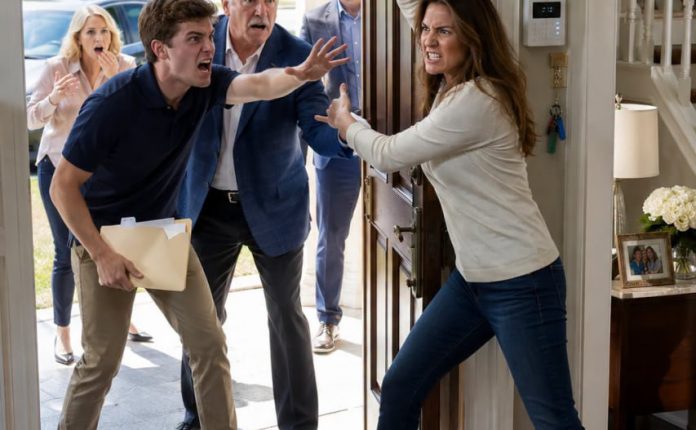
For forty-five days, the visitor chair beside my hospital bed had remained empty. No mother. No father. No sister. And now, one month after I had dragged myself home alone, Lorraine wanted my house. I stared at her message until something inside me became very still. Then I ordered the cheapest large cardboard moving box I could find online. I sent my mother the product photo. “This is the only property Vanessa will be getting from me.” I blocked her. Then Dad. Then Vanessa. For the first time in years, I smiled. Three hours later, someone began pounding on my front door. Not knocking. Pounding.
As I slowly crossed the hallway, one hand pressed against the scar beneath my sweater, I realized my family had never handled the word “no” well. The pounding stopped just before I reached the door. I checked the security monitor first. The man standing outside wasn’t my father. It was my uncle Martin. Richard’s older brother had spent most of his adult life working as a freelance architect, usually overseas. He had designed hotels in Singapore, museums in Europe, and once sent me a birthday card from a construction site in Morocco. I hadn’t seen him in almost a year.
When I opened the door, rain blew across the porch. Martin’s expression changed the second he saw me. “My God, Claire.” He stepped inside without waiting for an invitation. “You look like you’ve lost thirty pounds.” “Closer to twenty.” “What happened to you?” I stared at him. “You don’t know?” His forehead creased. “Know what?” That was when the first crack appeared in the story my family had apparently been telling. I led him into the living room. He smelled like rain and airport coffee. His leather overnight bag remained beside the door while he sat across from me, studying my face.
“I’ve been in Madrid for three months,” he said. “Your mother told everyone you had some kind of emergency procedure, but that you were recovering privately.” “Privately?” “She said you didn’t want visitors.” I laughed. It came out ugly. Martin leaned forward. “What?” I picked up my phone. “I almost died.” The room went quiet. I showed him pictures Luis had taken during my hospitalization because I’d needed documentation for the company’s insurance records. In one, my face was barely recognizable beneath oxygen lines and tape. In another, machines crowded the bed like metal sentries. Then I showed Martin the dates. Forty-five days. His face slowly emptied of color.
“Your mother said you requested no contact.” “I begged her to come before surgery.” “Richard too?” “He never called.” “Vanessa?” “No.” Martin rubbed both hands over his face. For a while, the only sound was rain tapping the windows. Then I showed him Lorraine’s message about the house. He read it once. Then again. “She’s asking you to give Vanessa this house?” “Apparently I’m selfish if I don’t.” Martin muttered something under his breath. I expected anger. Instead, I saw fear. It was subtle—a tightening around his eyes, the way his thumb began rubbing the edge of my phone case. “Why are you here?” I asked.
He looked toward the hallway. “I stayed with Richard and Lorraine last night.” That made sense. Martin always stayed in their guest room when he was in Ohio. “They were fighting.” “My parents fight all the time.” “Not like this.” I waited. Martin lowered his voice even though there was nobody else in the house. “Vanessa has been spending money like she’s already married into Grant Holloway’s family.” Grant was her fiancé, the son of a regional construction developer. Vanessa had met him at a charity event nine months earlier and immediately redesigned her entire personality around his family’s wealth. Suddenly she cared about equestrian events, European wine, private clubs, anything that looked expensive in photographs.
Martin continued. “Your parents have been helping her keep up.” “Of course they have.” “No, Claire. I mean really helping.” My stomach tightened. “How much?” “I don’t know exactly.” He hesitated. “Enough that your father was screaming about refinancing their house.” That surprised me. Lorraine and Richard lived in a six-bedroom home in an exclusive neighborhood and loved reminding people that the mortgage was nearly paid off. “What does that have to do with me?” Martin’s eyes met mine. “That’s the part I didn’t understand.” A cold sensation crawled over the back of my neck. He stood and walked toward the fireplace, then turned around.
“I heard Richard say your company name.” “GreenStone?” “Yes.” “What did he say?” Martin looked genuinely sick. “He said, ‘If Claire cooperates, we can cover the loan before anyone notices.’” I stopped breathing for a second. “What loan?” “I don’t know.” He shook his head quickly. “I didn’t hear everything. Lorraine was crying. Richard kept telling her Vanessa couldn’t find out how bad things were before the wedding.” “Why would Vanessa care?” “I don’t think they’re worried about Vanessa.” Martin looked toward me. “I think they’re worried about Grant’s family.” That made sense. Vanessa’s entire engagement had become a performance.
Lorraine had spent months telling everyone Grant came from “one of the most established families in the state.” Losing him would be social catastrophe. I stood too quickly. Pain pulled sharply beneath my ribs. Martin reached for me. “I’m fine.” “Claire—” “I’m fine.” I wasn’t. My heart was racing. I walked to the office at the back of the house and opened my laptop. Bank accounts first. Nothing obvious. Business account. Operating account. Payroll. Credit line. Everything looked normal. Then I checked my credit monitoring service. A new inquiry appeared. Three weeks earlier. While I was still hospitalized. I clicked it. Midwest Commercial Trust.
My fingers went cold. I had never applied for anything through Midwest Commercial Trust. Martin stood behind me. “What is it?” “I don’t know yet.” I called my accountant. No answer. Then I called Lena Ortiz, a financial consultant who had helped restructure GreenStone when I’d expanded two years earlier. She answered immediately. “Claire? How are you feeling?” “Better. Lena, I need you to check something.” My voice sounded strangely calm. “I have a commercial credit inquiry I don’t recognize.” “What kind?” “Midwest Commercial Trust.” There was silence. Then keyboard sounds. “Give me your authorization code.” I did. Another minute passed.
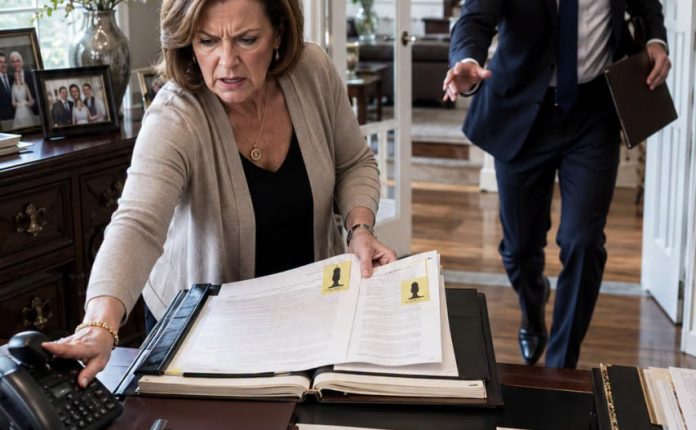
Lena stopped typing. “Claire.” Something in her voice made Martin straighten. “What?” “There’s an active commercial loan attached to GreenStone Environmental Holdings.” My company. “How much?” More typing. Then Lena said, “One hundred fifty thousand dollars.” My knees nearly gave way. “I never borrowed that.” “I know.” “How do you know?” “Because I’m looking at the application date.” I gripped the desk. November 12. I knew that date. Everyone in my company knew that date. On November 12, I hadn’t been signing contracts. I hadn’t been answering emails. I hadn’t even been conscious. I had been lying in intensive care with a machine breathing for me.
And somebody had signed my name.