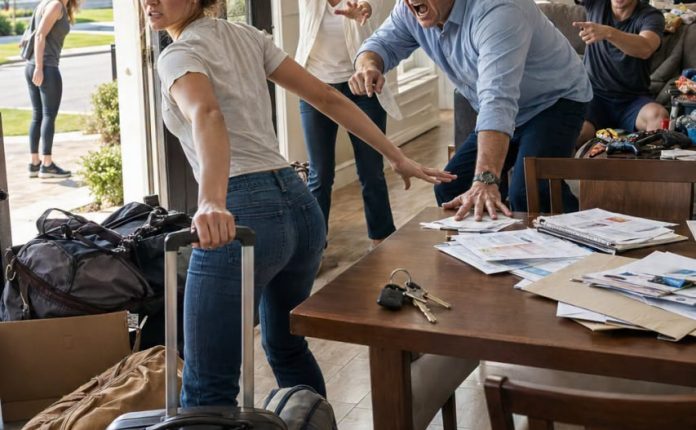
By the time I got home from work, I knew Lily had been crying for hours. Her eyes were swollen almost shut, her nose was raw and pink, and she was still wearing the navy skirt and white polo from school. She stood in the upstairs hallway with her backpack hanging from one shoulder and both hands clenched into fists. “Mom.” Her voice cracked on the word. I dropped my purse onto the bench by the stairs. “What happened?” She didn’t answer. Instead, she turned toward her bedroom. That was when I saw the sheet of white printer paper taped to her door.
The message had been written in thick black marker, every letter pressed so hard into the page that I could see dents around the words. WE GAVE YOUR DOG AWAY. YOUR COUSIN DIDN’T WANT IT AROUND. DON’T MAKE A SCENE. For a few seconds, I couldn’t understand what I was reading. My mind kept trying to turn it into something else. A cruel joke. A misunderstanding. Then I noticed how quiet the hallway was. Usually, when I came home, Rosie heard my keys from downstairs. Her nails would tap across the hardwood, followed by the soft jingle of the brass tag on her collar.
There was nothing. I ripped the note off the door. “Where’s Rosie?” Lily’s chin trembled. “Gone.” “What do you mean, gone?” Her face folded. “Grandma said she’s not coming back.” I pushed open the bedroom door. Rosie’s bed was gone. Her water bowl was gone. The little basket of toys beside Lily’s dresser was gone. Even the faded green blanket Rosie slept on during thunderstorms had disappeared. All that remained were two pale circles in the carpet where her bowls had rested for years. Lily wrapped her arms around herself. “I came home and the note was there. Grandma was downstairs.”
“What did she say?” I asked. Lily swallowed. “She said, ‘We did what we had to do. Don’t you dare start crying about it.’” My stomach tightened. “And then she said if I made a scene, I’d go to my room without dinner.” That was when Lily finally broke. “But Rosie isn’t here, so what’s the point of being in my room?” I pulled her against me. She shook so hard I could feel every breath through my work blouse. Rosie wasn’t just a dog. She had belonged to my mother before she belonged to us.
Rosie was a small red-and-white spaniel mix with silky ears, one cloudy eye, and a way of pressing her body against someone when she sensed they were scared. After my mother died, Rosie had spent two days waiting beside her front door. When I finally brought her home, she walked into Lily’s nursery, curled beside the crib, and apparently decided my daughter was her new person. Lily had grown up with her. Bedtime stories. Backyard forts. Stomach flu nights. Thunderstorms. First days of school. Bad dreams. Rosie had been there through all of it.
When Lily was three, she climbed onto a toy chest, lost her balance, and fell toward the sharp corner of a dresser. I was too far away. Rosie wasn’t. She threw herself underneath Lily and broke the fall. That memory lived inside me like a photograph. My daughter crying. Rosie trembling. And me kneeling on the floor with my arms around both of them. Now someone had erased her from Lily’s room while Lily was at school. “It’s okay,” I whispered. It wasn’t. But sometimes a mother lies because the truth is too sharp for an eleven-year-old. “I’ve got you.”
Lily wiped her face against my shoulder. “Can you make them bring her back?” I looked at the note again. “I’ll find out where she is.” “You promise?” “I promise I’ll try.” I sent Lily into my bedroom with her pillow, then walked downstairs. My mother-in-law, Marjorie, was sitting at the kitchen table with a cup of tea. My father-in-law, Walter, had the newspaper open in front of him. Neither looked guilty. Marjorie glanced up. “Rachel. You’re home.” “Where is Rosie?” Walter lowered his newspaper. Marjorie sighed. “We found her another home.”
“Where?” I demanded. “With people who actually want her,” Walter said. I stared at him. “She was wanted here.” “Not by everyone,” Marjorie replied. “Chloe is afraid of that animal.” Chloe was Lily’s cousin, four months younger than Lily, and apparently far more important. “Chloe doesn’t live here.” “She’s our granddaughter,” Marjorie snapped. “She shouldn’t feel uncomfortable visiting her grandparents.” “You have two granddaughters.” Marjorie’s lips tightened. “You know what I mean.” “No. I don’t.” Walter folded the newspaper carefully. “It’s our house, Rachel.” “And Rosie was my dog.”
“Not anymore.” I looked from one face to the other. “Who did you give her to?” “People from church,” Marjorie said. “Names?” No answer. “Address?” Walter’s jaw hardened. “That’s none of your concern.” Something cold slid through me. “Did you tell them Rosie wasn’t yours?” Marjorie stood and carried her cup to the sink. “We’re not discussing this all night.” “Did you?” “She’s gone,” Walter said. “End of story.” I should have yelled. Instead, I went completely calm. “Okay.” Marjorie’s shoulders relaxed. “Good. I’m glad you’re finally being reasonable.” She misunderstood me.
For years, they’d mistaken my silence for surrender. That night, I sat beside Lily while she held Rosie’s old collar—the one thing my in-laws had apparently forgotten to remove. The brass tag caught the lamplight. Lily whispered, “Grandma said if I keep crying, I’m selfish.” I took the collar from her shaking hands and turned it over. My phone number was engraved on the back. Not Walter’s. Not Marjorie’s. Mine. And for the first time since I walked through the door, I wasn’t wondering whether I was overreacting. I was wondering exactly how much trouble my in-laws had just created for themselves.
People like to imagine betrayal arrives with a slammed door. Mine arrived slowly, one small compromise at a time. Daniel and I had moved into his parents’ house when Lily was still in diapers. We were twenty-something, exhausted, and convinced temporary meant temporary. Daniel was finishing school. I was working long shifts at a dental office. Our rent had jumped, our savings had evaporated, and Marjorie had offered the downstairs guest room with the kind of smile that made gratitude feel mandatory. “We’ll help you get back on your feet,” she said. At first, she did.
She watched Lily while I worked. Walter fixed our old car. We bought groceries and paid toward utilities. Then six months became a year. A year became three. By the fifth year, Daniel had a good job and I had steady income. We could have left. Every time I brought it up, Marjorie found another reason we shouldn’t. “Rent is throwing money away.” “Lily needs stability.” “You’re lucky to have family.” Walter preferred numbers. “Do you know what houses cost now?” Daniel hated conflict. Whenever I pushed, he’d rub his forehead and say, “Maybe one more year.”
One more year became the phrase that swallowed most of my thirties. The funny part was that we weren’t freeloading. We bought groceries. Paid the electric bill. Covered internet. Contributed toward the mortgage. Daniel repaired the furnace, replaced bathroom tile, cleaned gutters, and rebuilt the back steps. I cooked dinner four nights a week, did laundry when Marjorie’s arthritis “acted up,” and drove Walter to appointments after he stopped liking city traffic. Yet whenever we disagreed, Walter used the same sentence. “This is our house.” It was his trump card. Then there was Daniel’s sister, Vanessa.
Vanessa arrived like a television commercial. Perfect hair. Expensive perfume. Shoes that clicked across the floor like she had somewhere more important to be. Marjorie adored her. And Marjorie adored Vanessa’s daughter, Chloe, even more. If Chloe mentioned being hungry, Marjorie started cooking. If Lily mentioned being hungry, Marjorie pointed toward the fruit bowl. Chloe’s birthday meant balloons, catered food, and a rented inflatable castle. Lily’s meant grocery-store cake because “eleven-year-olds don’t need all that fuss.” Lily noticed. Of course she noticed. Children understand favoritism long before adults admit it exists.
Rosie noticed something too. Whenever Chloe visited, the dog avoided her. Rosie was old by then. Her hearing wasn’t perfect, and the cloudy eye made her cautious around sudden movement. She preferred lying beside Lily’s chair or sleeping in a patch of afternoon sun. But Chloe hated her. “She’s looking at me.” “She has one bad eye,” I explained the first time. “She’s trying to see you.” “It’s creepy.” Another afternoon Chloe squealed because Rosie walked into the living room. “Get her away from me!” Rosie froze, then quietly backed out. Marjorie rushed immediately to Chloe.
“You shouldn’t feel unsafe here, sweetheart.” I nearly laughed. Rosie was so gentle that once a rabbit had wandered into our yard and eaten grass three feet from her nose while she watched like a bored security guard. Still, I compromised. I kept Rosie upstairs during visits. I took her on long walks. I put a gate across the hallway. Nothing satisfied Marjorie. “Chloe shouldn’t have to think about the dog being somewhere in the house.” One evening, I finally said, “Rosie lives here. Chloe doesn’t.” Marjorie’s expression changed. Not anger. Something colder.
“Be careful, Rachel.” “About what?” “About forgetting whose house you’re standing in.” Daniel heard her. He said nothing. Later in our bedroom, I confronted him. “Did you hear your mother threaten me over a dog?” “She wasn’t threatening you.” “What would you call it?” He sat on the edge of the bed. “Mom likes control.” “That’s not an answer.” He looked tired. “Can we not do this tonight?” That had always been Daniel’s gift. Postponing uncomfortable things until everyone else became too exhausted to continue. I looked toward Lily’s room. Rosie was curled at the foot of her bed.
“I don’t like this.” “I know.” “We should move.” “We will.” “When?” He didn’t answer. A week later, I came downstairs and heard Marjorie talking to Vanessa in the kitchen. Neither knew I was standing in the hallway. “Chloe refuses to visit while that dog is here,” Vanessa said. “Then Rachel needs to make a choice,” Marjorie replied. “What if she won’t?” There was a pause. Then Marjorie said something so softly I almost missed it. “Not every choice needs her permission.” I stepped into the kitchen. Both women went silent.
Marjorie smiled. “Coffee?” I stared at her. “What were you talking about?” “Nothing important.” I should have pushed harder. Instead, I went upstairs. Two weeks later, I came home to find the note on Lily’s door. And after my confrontation with Marjorie and Walter, that whispered sentence returned to me. Not every choice needs her permission. That night, while Daniel slept beside me, I got out of bed and pulled Rosie’s records from a plastic storage box. Vet receipts. Vaccination history. Training paperwork from my mother’s old dog trainer. Microchip registration. Every document had one thing in common. My name.
I checked them twice. Then I found something else. A photocopy of the original adoption record. Across the bottom, in my mother’s handwriting, she’d added one sentence years earlier: If anything happens to me, Rosie goes to Rachel. I sat on the floor holding that paper until my legs went numb. My mother had trusted me with Rosie. Lily had trusted me to bring her home. And downstairs, the people who had taken her were sleeping peacefully. I opened my phone. There was one question I suddenly needed answered. If Marjorie and Walter had truly given Rosie to “nice people from church,” why were they so determined to hide who those people were?
The next morning, I called in sick. “Family emergency,” I told my supervisor. For once, I didn’t care whether she believed me. Lily stayed home too. She had barely slept. She sat at the breakfast table wearing Daniel’s oversized sweatshirt, twisting the cuff around her fingers. Marjorie was unloading the dishwasher. Walter had already left. Daniel stared into his coffee. I placed Rosie’s paperwork on the table. “I’m asking one last time. Who has Rosie?” Marjorie didn’t turn around. “We already answered you.” “No, you didn’t.” “A family from church.” “What family?” “Rachel, enough.”
Daniel finally looked at his mother. “Mom.” Marjorie closed the dishwasher harder than necessary. “Don’t start.” “Just tell us where the dog is.” “The dog is fine.” “Then give us the address.” Marjorie faced him. “I will not have you dragging innocent people into your wife’s hysterics.” I almost admired the sentence. In one breath, she had made herself reasonable, me unstable, and whoever had Rosie a victim. Lily stood up. “I’m not hysterical.” Marjorie froze. Lily’s voice was small, but steady. “Rosie is my dog.” Marjorie sighed as if Lily had disappointed her.
“Sweetheart, grown-ups sometimes have to make decisions children don’t understand.” “You didn’t ask Mom either.” “That’s enough.” “No.” Every person in the room looked at Lily. My daughter rarely challenged adults. Marjorie had trained that instinct out of her years ago. Lily’s eyes filled, but she continued. “You say Chloe matters because she’s family. I’m family too.” Marjorie’s expression tightened. “Go upstairs.” “It’s my house too.” “No, Lily. It isn’t.” The words fell into the kitchen. Daniel went still. Even Marjorie seemed to realize she’d gone too far. But she didn’t apologize.
She turned back to the sink. That was the moment something changed in Daniel. Not completely. But I saw the first crack. I gathered the paperwork. “Lily, come with me.” We went upstairs. I called Rosie’s veterinarian first. The receptionist knew her immediately. “Sweet old red spaniel?” “That’s her.” I explained what happened. There was a pause. “Rachel, are you saying someone transferred possession without your permission?” “Yes.” “We’ll flag her account right now.” Next I called the microchip company. Rosie was registered to me. They marked her as missing and noted that any attempted ownership change should be treated as unauthorized.
Then I called the non-emergency police number. The dispatcher explained I could make a report, though recovery might depend on where Rosie had gone. It wasn’t enough. So I opened the neighborhood Facebook group. I typed: My older dog Rosie was removed from my home and rehomed without my permission. She is a red-and-white spaniel mix with one cloudy eye. She is microchipped and belonged to my late mother before coming to my daughter and me. If you saw any recent post offering an older, trained dog, please message me.
I attached a photo of Lily lying on the living room carpet reading Charlotte’s Web while Rosie slept with her chin across Lily’s ankle. Then we waited. That was the worst part. Waiting. Every notification made Lily sit upright. Most messages were kind but useless. Someone had seen a similar dog near the grocery store. Not Rosie. A woman thought her neighbor adopted a spaniel. Wrong color. Another person sent a shelter listing. Different dog. By lunchtime, Lily stopped asking. That scared me more than the crying. She sat quietly beside Rosie’s empty bed.
Around midafternoon, Daniel came upstairs. “Any luck?” “No.” He leaned against the doorframe. “I talked to Dad.” “And?” “He won’t tell me anything.” “Did you ask why?” “He says I’m letting you turn this into a war.” I laughed once. “Daniel, your parents took our daughter’s dog.” “I know.” “Do you?” His face tightened. “Rachel—” “No. I’m done protecting you from uncomfortable sentences. Do you understand what they did?” He looked at Lily. “Yes.” “Then act like it.” He left without answering. Twenty minutes later, my phone buzzed.
A Facebook message. The sender was a woman named Carol Mercer. Hi. Someone shared your post with our church group. I don’t know if this is your dog, but this was posted yesterday. There was an image attached. My thumb hovered over it. Then I opened it. The picture showed Rosie sitting on a porch I didn’t recognize. Her ears hung low. Her cloudy eye caught the sunlight. Beneath the photograph was an advertisement: Older trained companion dog. Calm temperament. Excellent with children. Rehoming fee applies. Serious inquiries only. My heart started pounding.
Lily leaned against my shoulder. “That’s her.” “I know.” Then I saw the phone number beneath the advertisement. I knew that number. I had called it hundreds of times. It wasn’t Marjorie’s. It belonged to Walter. And suddenly the phrase “nice people from church” sounded very different. I enlarged the screenshot. At the bottom, almost cut off, was one more line. Rehoming fee: $2,500. Lily read it before I could hide the screen. Her face changed. “They sold Rosie?” I didn’t answer immediately. Because for the first time, I realized this hadn’t just been cruelty. Someone had made money from my daughter’s grief.