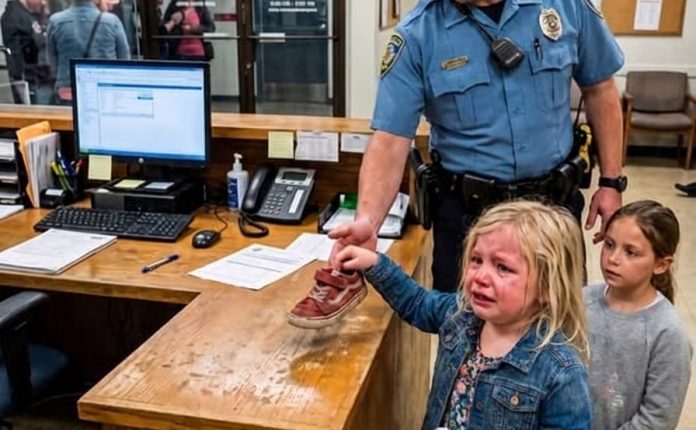
“I can’t sit down, Mr. David. It hurts way too much.” Those were the first words six-year-old Lily Carter whispered when she entered my classroom at Oakwood Elementary that Monday morning. Twenty-two other first-graders argued over crayons and window seats, but Lily remained by the door, backpack hanging from one shoulder, eyes fixed on the floor.
I had taught first grade for eleven years, long enough to recognize ordinary reluctance. Children complained about stomachaches before spelling tests, scraped knees after recess, and mysterious headaches when math worksheets appeared. Lily’s stillness was different. Her fists were clenched, her breathing shallow, and every movement seemed carefully measured, as though she was trying not to attract attention.
I approached slowly and lowered myself to her eye level without touching her. “Did you fall, kiddo?” I asked. “Did something happen on the playground or at home?” Lily gave a tiny shake of her head. Her lips moved before any sound came out. “It just hurts,” she murmured, and then looked quickly toward the classroom door.
The way she glanced behind me changed everything. She was not simply embarrassed about being uncomfortable. She looked afraid that someone might hear her talking. I told her she did not have to sit and offered the quiet reading corner, where she could stand beside the bookshelf. She nodded once, but her shoulders stayed rigid.
While the class began morning work, I asked my teaching assistant, Nora, to supervise and stepped into the corridor. My hands were shaking when I called the child-protection hotline, then the police, exactly as our mandated-reporting training required. I gave only what I had observed and what Lily had said, resisting every temptation to guess at anything more.
Two officers arrived without sirens fifteen minutes later. Before they reached my classroom, Principal Margaret Sterling intercepted them in the lobby. Through the open doorway I heard her bright, strained voice insisting there must be a misunderstanding. “Children can be dramatic,” she said. “We should be very careful before turning a small complaint into a crisis.”
Margaret had run Oakwood for nearly nine years and spoke constantly about reputation. Test scores, parent reviews, fundraising totals, district rankings—she tracked all of them like market prices. I had disagreed with her before, but never about a child’s safety. Hearing her minimize Lily’s words made something harden inside me that morning.
A female officer named Ruiz met with Lily privately while the school counselor stayed nearby. No one pressured her. No one asked leading questions. Lily stared at the carpet, rubbed the sleeve of her gray sweater between two fingers, and finally whispered, “It doesn’t hurt anymore.” The sentence landed in the room like something much heavier than six words.
Officer Ruiz did not look convinced, but she explained that they had limited information and would document the concern. Child services would receive the report, and we were to call again if Lily disclosed anything further or showed signs of immediate danger. Before leaving, Ruiz quietly told me, “Keep writing down what you directly observe. Dates, exact words, nothing speculative.”
The moment the patrol car disappeared, Margaret summoned me into her office. She shut the door with more force than necessary. “You have placed this school in an extremely delicate position,” she said. “If parents hear police were called because a first-grader said sitting hurt, rumors will explode. You cannot make reckless accusations based on intuition.”
“I didn’t accuse anyone,” I replied. “I reported a child saying she was in pain and acting frightened. That is my legal and professional responsibility.” Margaret’s expression tightened. She told me responsibility also meant judgment, discretion, and protecting families from unnecessary humiliation. I asked her whose humiliation mattered more than Lily’s safety. She had no answer.
The next day I gave the class a familiar art assignment: draw a place you know very well. Most children produced bedrooms, playgrounds, kitchens, or grandparents’ houses. Lily filled her page with one chair in the center and jagged red strokes surrounding it. I did not ask what the red meant. I simply sat nearby and said she could tell me anything she wanted.
For a long time she said nothing. Then she looked directly at me for the first time that week. “I like the way you talk to me, Mr. David,” she whispered. There was no dramatic disclosure, only that small sentence. It hurt more than I expected because it sounded like kindness itself had become unusual in her world.
I wrote the exact words in my incident notes after school. I also documented the drawing, the refusal to sit, the officers’ visit, and Margaret’s instructions. I made copies and stored them according to district policy. I was careful because I understood the difference between protecting a child and conducting my own investigation. My job was to notice, report, and preserve facts.
By Wednesday Lily seemed almost cheerful during reading time. She stood at a high table while the other students sat on the rug, and I adjusted the lesson without drawing attention to her. Yet whenever footsteps sounded in the hallway, her eyes lifted instantly. When the office intercom crackled, she flinched hard enough to drop her pencil.
At lunch Nora told me something else. Lily had been bringing less food each day: first a sandwich and apple, then crackers, then nothing but a juice box. When Nora gently asked whether she had forgotten lunch, Lily said, “Marcus says food costs money and I already cost too much.” We documented that statement too and submitted another report.
That afternoon Margaret appeared in my doorway with a printed email from the district office. She claimed child services had acknowledged the reports and that further action was “outside our scope.” Then she added, almost casually, “You should stop questioning Lily about home.” I reminded her I had not questioned Lily at all. Margaret’s face flushed before she walked away.
The distinction bothered me. Someone was trying to create a record suggesting I had overstepped when I had done the opposite. I checked the school’s safeguarding policy that evening and found a sentence I had read dozens of times in training: staff must not discourage, delay, or obstruct a mandated report. I printed the page and placed it beside my notes.
Friday afternoon arrived gray and cold. Parents crowded the gate beneath umbrellas while buses idled along the curb. Lily walked beside me with her coat zipped to her chin. The moment she saw the man waiting near the fence, she stopped so abruptly that another child nearly bumped into her. Her entire posture seemed to fold inward.
He was tall and broad, wearing a dark winter coat despite the mild weather. “Hurry up,” he called. Lily did not move. I asked whether he was her father. His mouth curled into a humorless smile. “Stepfather. Marcus Hale. And you must be the teacher who keeps making phone calls about things that don’t concern him.”
That sentence told me more than he intended. My reports were confidential. A caregiver could learn that an inquiry existed, but Marcus’s tone suggested he knew exactly who had called and why. I introduced myself and said I had concerns about Lily’s well-being. His eyes narrowed. “Teach the alphabet,” he said. “Leave my family alone.”
He took Lily firmly by the arm and guided her toward the parking lot. She looked back once. She did not cry or call out; she simply stared at me with a flat, silent fear I would remember for years. I stood at the gate until their car disappeared, feeling the sickening distance between recognizing danger and having authority to stop it.
That night I spread every document across my dining table. Lily’s exact words. Nora’s lunch note. The officer’s card. The safeguarding policy. My report receipts. A copy of the drawing. Margaret’s warning email. I kept returning to Marcus’s remark about my phone calls and wondering how he knew enough to sound personally offended by them.
I called Officer Ruiz and left a detailed voicemail. Then I used the district’s independent safeguarding line, which bypassed the principal’s office, and reported my concern that confidential information might have been improperly shared. I also emailed the superintendent’s child-safety coordinator, attaching my factual timeline and asking that Lily’s case receive immediate review.
It was not dramatic. There was no secret rescue plan, no heroic trespass into someone’s home. I knew those actions could endanger Lily and compromise an investigation. My decision was simpler and, professionally, more dangerous: I would refuse to let Margaret bury the record. Every instruction, every disclosure, every contradiction would go to the people legally required to see it.
On Saturday morning I received a reply from Deputy Superintendent Alan Pierce asking me to attend a confidential meeting Monday before school. He requested that I bring my notes and tell no one else. Ten minutes later Margaret texted me: “Mandatory staff conference Monday, 7:00 a.m. Come to my office first.” The timing made my stomach tighten.
Sunday evening, Lily’s mother called my personal number. I had never given it to her. Her voice was thin and hurried. “Mr. David, this is Elena Carter. Please stop making reports about my husband.” Before I could answer, I heard a man speaking in the background. Elena abruptly added, “Lily is clumsy. Everything is fine,” and ended the call.
I stared at the dark phone screen. My number was unlisted in the parent directory, which meant someone with school access had probably provided it. I forwarded the call details to Officer Ruiz and the district coordinator. Ruiz responded within minutes: “Do not contact the family directly. We’re reviewing this. If they approach you, stay in public and call us.”
Monday morning Margaret was waiting inside her office with the blinds closed. She did not offer me a chair. “You went over my head,” she said. I told her I had followed district safeguarding procedure. She pushed a document across the desk—an administrative leave notice accusing me of boundary violations, inappropriate escalation, and conduct creating reputational harm.
I read the page twice. My employment was suspended effective immediately pending investigation. I was ordered not to contact students, families, or staff. “You are making yourself the center of a situation you do not understand,” Margaret said. “Oakwood cannot function if every teacher decides instinct is more important than leadership.”
I placed the notice back on her desk. “This isn’t about instinct anymore. A caregiver knew confidential details. A parent got my private number. A frightened child has made repeated concerning statements. If you believe I should ignore that, put the instruction in writing.” For the first time, Margaret looked less angry than afraid.
At 7:30, Deputy Superintendent Pierce arrived with the district safeguarding director and a lawyer. Margaret’s confidence faltered when she realized the meeting was not hers to control. I handed over my notes. Pierce read silently, then asked one question: “Did Principal Sterling ever direct you not to file additional reports?” I answered yes.
Margaret interrupted. “I advised proportionality.” The safeguarding director asked whether she had contacted Marcus Hale after the first police visit. Margaret said she had made a routine family notification. The lawyer immediately asked what information she disclosed. Margaret’s answer changed twice in less than a minute, and the room became very quiet.
Then the front-office secretary knocked urgently. Marcus Hale was in the lobby demanding to remove Lily from school. He was shouting that teachers were poisoning his family against him. Margaret stood so quickly her chair struck the wall. Pierce told her to remain seated and instructed the secretary to place the school on controlled access.
My suspension meant I could not go to Lily, and that helplessness was almost unbearable. Through the office window I saw Officer Ruiz’s patrol car turn into the driveway, followed by another vehicle marked Child and Family Services. Marcus’s voice carried down the corridor. “Where is she?” he demanded. “She’s my daughter. You can’t keep her from me.”
Ruiz entered the lobby while a caseworker met Lily in a separate room. Elena arrived moments later, pale and trembling, with Marcus’s sister, Denise, beside her. Marcus tried to move toward Elena, but Ruiz asked him to remain where he was. The scene felt less like a confrontation than a structure finally closing around months of hidden fear.
From inside Margaret’s office, I heard Elena say, “I need to tell you about the money too.” The words were soft, but everyone heard them. Marcus stopped arguing. Margaret’s face changed. Pierce looked toward the safeguarding director, then back at me. Until that moment, I had known nothing about money.
Elena was taken into a conference room with investigators. I remained under administrative restriction and could not participate, but later that day Officer Ruiz asked me to confirm when Lily had first mentioned Marcus by name. I told her: Friday at the gate. Ruiz nodded and said the family situation was now broader than the original welfare concern.
By noon, Lily left school with a child-services caseworker and her maternal aunt, Rachel, under an emergency safety arrangement approved by the appropriate authorities. Marcus was told he could not remove her. Elena left separately to speak with investigators. I watched from a distance, still suspended, while Lily carried her purple backpack against her chest.
Before getting into Rachel’s car, Lily spotted me through the glass doors. I was not permitted to approach her, so I simply lifted one hand. She lifted hers too. It was the smallest gesture imaginable, yet it gave me enough strength to walk back into Margaret’s office and sign the paperwork acknowledging my suspension.
I drove home believing I had probably lost my career. Eleven years of lesson plans, parent conferences, field trips, reading circles, and handmade Christmas cards suddenly felt as fragile as paper in rain. Still, when I pictured Lily at the gate, I knew I would make the same reports again. A job could be rebuilt. Silence could not be undone.
That evening Pierce called. He could not discuss the child-protection investigation, but he told me the district had opened a separate inquiry into confidentiality breaches and administrative conduct. My leave would remain in place. “Preserve everything,” he said. “Emails, texts, voicemail records, notes. Do not delete anything, even if it seems irrelevant.”
I opened my school email from the district’s secure archive and noticed something I had overlooked. Three months earlier, the nurse had documented Lily complaining of repeated stomach pain and asking to stand during an assembly. The record was marked “resolved by parent contact.” The parent-contact field contained one name: Marcus Hale.
A second entry, from the previous semester, showed that Lily had arrived at school without lunch money for six consecutive days. The counselor had requested a family support referral. That referral was later closed with the notation “family declines assistance.” Again, the response had been recorded after a call with Marcus, not Elena.
I did not investigate further on my own. I forwarded the records to Pierce and Ruiz because they were already within my lawful access from prior classroom documentation. Then I logged out. The pattern was becoming clearer: concerns had surfaced before, but each one had been treated separately, and Marcus had repeatedly positioned himself as the family’s only voice.
On Tuesday, Rachel called the district and asked that a message be passed to me. She thanked me for reporting what I saw and said Lily was safe. That was all. I did not ask where she was staying. I did not ask what she had disclosed. I understood that the healthiest thing I could do was let trained investigators work.
The financial story emerged slowly through official proceedings weeks later. Elena had married Marcus three years after Lily’s biological father, Daniel Carter, died unexpectedly from a heart condition. Daniel had left a modest life-insurance policy and a protected account intended for Lily’s education. Elena had also inherited partial ownership of her mother’s small house.
Marcus entered their lives when Elena was grieving and overwhelmed. At first he appeared practical and generous. He handled bills, repaired the car, organized insurance papers, and told relatives he was helping Elena “get back on her feet.” Within a year, he had taken control of nearly every password, statement, and financial decision in the household.
He convinced Elena that her credit was poor and that banks would not speak with her directly. He began bringing documents home for signature, often saying they were routine refinancing forms or insurance updates. Some were legitimate. Others were not. Investigators later found altered applications, forged authorizations, and accounts Elena had never knowingly opened.
The most devastating discovery involved Lily’s protected education money. Marcus had used copied documents and false statements to gain access to funds that were supposed to remain untouched until she was older. Money disappeared through transfers disguised as household expenses, contractor payments, and debt consolidation. Several payments ultimately moved into an account controlled solely by Marcus.
He had also opened credit in Lily’s name using identifying information stored in family records. The balances were not enormous individually, but together they created a trail of debt attached to a child who could not possibly have authorized it. Financial investigators called the pattern systematic, deliberate, and sustained.
Elena told investigators she had discovered one suspicious statement months earlier. When she confronted Marcus, he insisted it was a bank error and accused her of being irresponsible. Then he showed her a spreadsheet claiming she had caused the family’s financial problems. She believed him because he had spent years convincing her she was incapable of managing money.
That manipulation spread beyond finances. Marcus discouraged Elena from speaking privately with Lily’s teachers, saying school staff judged single mothers. He answered calls, intercepted mail, and insisted on attending medical appointments. When relatives questioned his control, he described Elena as anxious and forgetful, slowly teaching everyone around her to doubt her before she even spoke.
Rachel had challenged him once. The argument ended with Marcus banning her from the house and telling Elena that Rachel wanted to steal Lily’s inheritance. Elena stopped returning her sister’s calls. Family holidays became smaller, then disappeared. By the time I met Lily, Marcus had spent nearly three years building a household where every path outward ran through him.
What tied the school into the scandal was not that Margaret had participated in the financial fraud. Investigators found no evidence of that. Her failure was different and still serious. Marcus had become a prominent fundraiser for Oakwood, donating equipment, sponsoring two school events, and cultivating Margaret’s trust with charm, money, and relentless praise.
When earlier concerns about Lily reached the office, Margaret repeatedly contacted Marcus before following through on recommended support. She accepted his explanations, closed internal concerns, and warned staff against “stigmatizing a generous family.” In one email, she wrote that Oakwood could not afford conflict with parents who supported major fundraising goals.
The most damaging evidence was an email she sent Marcus after my first report. “Mr. Bennett appears overly concerned and may contact outside agencies again,” she wrote. She also provided my work schedule and, through an attached staff directory export, exposed the personal number I had asked the school to keep private.
Marcus’s angry Friday confrontation no longer looked accidental. He had known who reported the concern because Margaret told him. The betrayal hit me harder than the suspension. Schools ask teachers to notice subtle signs, follow procedure, and trust the safeguarding chain. I had done exactly that, only to discover someone above me had quietly broken the chain.
Pierce called me to the district office the following Thursday. A union representative sat beside me while two investigators reviewed the allegations against my conduct. They asked whether I had interviewed Lily, visited her home, contacted reporters, posted online, or shared confidential information. I answered no to every question and provided records supporting each answer.
Then they showed me Margaret’s written complaint. She claimed I had become emotionally fixated on Lily and had “created panic without evidence.” The wording was humiliating. For several minutes I could barely speak. My representative finally said, “Concern is not misconduct when the policy explicitly requires reporting. Show us where he violated procedure.” No one could.
The district still refused to reinstate me immediately. They said the investigations were intertwined and required time. My classroom was assigned a long-term substitute. Parents began asking where I had gone, but I was legally and ethically unable to explain. Rumors filled the silence, and some were cruel enough to make me stop checking social media entirely.
One anonymous post claimed I had been removed for frightening children. Another said I had fabricated a scandal because I disliked the principal. A third accused me of trying to “break up a family.” The school issued a bland statement about personnel privacy. Margaret remained at work for three more days before the district finally placed her on leave.
Losing my classroom hurt in ways I had not expected. I missed the ordinary rhythm: pencils rolling under desks, children sounding out difficult words, the daily argument over whose turn it was to feed the class fish. Without those routines, my apartment became unnaturally quiet, and I began wondering whether doing the right thing always had to feel so much like punishment.
My father, a retired mechanic, came over one evening with takeout and found me sitting among boxes of teaching materials I had brought home. He listened without interrupting. Then he pointed at a stack of handmade cards from former students. “Your career is what you do for children,” he said. “A building and a principal don’t get to define the whole thing.”
I wanted to believe him. Yet I also knew that professional reputation could be damaged by accusation alone. Teaching depended on trust. Even if the district cleared me, I wondered whether parents would look at me differently. For the first time since college, I opened job listings outside education and imagined a future where I never entered a classroom again.
Two weeks after my suspension, Officer Ruiz called to ask whether I could identify Marcus’s exact words at the gate. I read directly from my notes. She thanked me and said prosecutors were reviewing multiple potential charges related to financial conduct, intimidation, and obstruction. She did not discuss Lily’s private disclosures, and I did not ask.