At eight years old, I thought being sent to Aunt June’s house for the summer was a prize. She lived in a yellow bungalow outside Cedar Falls, with raspberry bushes along the fence, wind chimes on the porch, and a kitchen where nobody complained if I read during breakfast.
My parents called it my “special summer.” Mom said Aunt June missed having children around. Dad said my older brother, Adam, had a sports camp that would be boring for me. I believed them because I was eight, and eight-year-olds rarely imagine that adults can build rejection out of cheerful words.
Aunt June welcomed me with strawberry lemonade and a room she had painted pale green. There were library books stacked beside the bed and glow-in-the-dark stars on the ceiling. I remember thinking my brother would be jealous. For three days, I told everyone who asked that I was lucky.
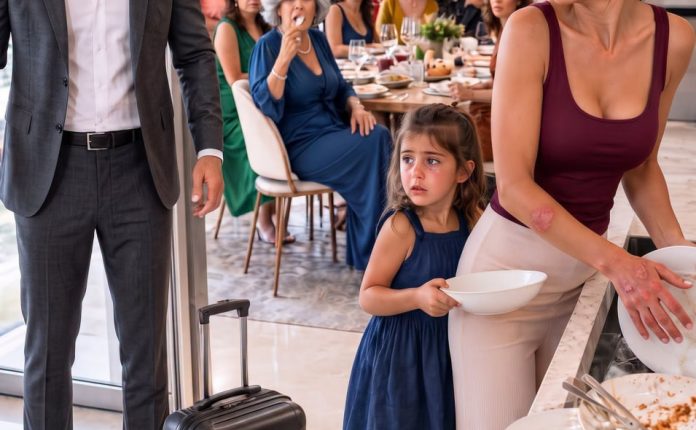
Then I found the photograph. June’s phone had buzzed while she was outside hanging towels. I picked it up because Mom’s name was on the screen. The preview showed my parents, Adam, and Mickey Mouse standing in front of a castle under a cloudless blue sky.
For a moment, I did not understand what I was seeing. Dad had told me Adam’s camp was in northern Wisconsin. Mom said they would spend most of the week working from the hotel. Yet there they were at Disney World, all three wearing matching red shirts.
I carried the phone outside. “Aunt June?” She turned, saw the screen in my hand, and stopped smiling. Adults often believe children do not understand silence. We do. We simply lack the authority to force grown people to fill it honestly.
“Why are they there?” I asked. June took the phone slowly. “Your parents decided to make a little trip after Adam’s camp changed.” “Why didn’t I go?” Her mouth opened, then closed. “It happened quickly.” I looked at the matching shirts again. They had my brother’s name printed across the back.
There was no shirt for me. I knew that because I zoomed in on a second photograph and counted the shopping bags. Even at eight, I could count absence. I asked June whether my parents were coming to get me. She hugged me. I stood stiffly inside her arms.
That evening, Mom called. I waited for her to mention Florida. She asked whether I was behaving, whether I had remembered to brush my teeth, whether Aunt June had taken me swimming. I answered everything. Then I asked, “How is Wisconsin?” There was a pause.
“Hot,” she said. I learned two things in that pause. My mother was lying, and she expected me to help her do it. I said goodnight. Then I crawled beneath the green quilt and cried as quietly as I could because I did not want Aunt June to hear.
The next morning, June made pancakes shaped like hearts. I hated them for being kind. Kindness made my parents’ absence sharper. She did not force me to talk. That was one of the first reasons I eventually trusted her. She understood that silence can be shelter when nobody is using it to hide something.
I went home three weeks later with a seashell necklace June bought at a craft fair. Adam brought me a plastic key chain from Disney. “We would’ve taken you,” he said, “but Mom said you get carsick on planes.” I stared at him. “Planes don’t have roads.” He shrugged.
He was ten. I do not blame ten-year-old Adam for accepting an explanation designed for him. Children in favored positions rarely know the architecture holding them up. They think the floor is level because nobody has asked them to stand where someone else is sinking.
The next summer, Mom called Aunt June before school ended. “Wouldn’t it be wonderful if Leah spent July with you again?” I was nine by then. I had spent months waiting to see whether Disney had been a mistake or a pattern. My stomach hurt the moment I heard June’s name.
I asked where the family was going. Dad said nowhere special. Adam had a baseball tournament. “You hate baseball,” Mom reminded me. I did hate baseball. That was how the lie worked. It contained one true piece, just large enough to make everything around it seem reasonable.
They went to San Diego. I found out because Adam returned sunburned with a zoo sweatshirt and forgot which story he was supposed to tell. “The pandas were boring anyway,” he said at dinner. Mom’s fork stopped halfway to her mouth. Dad looked at him. I looked at all three.
“Was the baseball tournament at the zoo?” I asked. Adam’s face changed. Mom said, “Leah, don’t be sarcastic.” Dad told me there had been a schedule change. I asked why nobody called Aunt June. He said airfare had been too expensive by then.
I stopped eating. Mom sighed. “This is exactly why traveling with you is difficult. Everything becomes a production.” I was nine years old. I had not packed a suitcase, purchased a ticket, or chosen a destination. Yet somehow the problem with family vacations had become my personality.
After that, the summers formed a calendar of exclusions. At ten, I spent six weeks with June while my parents and Adam went to Yellowstone. At eleven, they took a Caribbean cruise. At twelve, Paris and London. Each year the explanation changed. Each year the photographs eventually surfaced.
Sometimes I found them accidentally. Sometimes cousins showed me. Once Grandma Ruth mailed a Christmas card containing a family photo taken on a beach in Hawaii. She had written, “Such a beautiful trip with all of you!” I stared at the four words all of you until the ink seemed cruel.
I began asking less. That confused my mother. She preferred my begging because begging let her frame refusal as discipline. When I stopped asking whether I could come, she occasionally offered explanations nobody had requested. “Europe would overwhelm you.” “Cruises are crowded.” “You hate long flights.”
By thirteen, I understood that the reason did not matter. If I suddenly loved baseball, hated crowds less, stopped getting motion sick, or learned French, they would simply invent another reason. The destination changed. The conclusion never did. There were three people in my parents’ idea of family travel, and I was the removable piece.
Aunt June never pretended the trips were not happening after the second summer. She also never insulted my parents in front of me. At the time, I sometimes resented that. Years later, I understood she was trying to give me one adult who did not demand that I hate anyone in order to be believed.
She gave me work instead. We gardened. I learned to make bread. She took me to the public library every Tuesday and let me check out more books than I could carry. At fourteen, I began helping at the library’s summer reading desk in exchange for volunteer hours.
Books became useful because they showed me lives could have exits. Children left villages, crossed oceans, won scholarships, changed names, built homes in cities where nobody knew which seat they had been assigned at the family table. I stopped fantasizing about being invited. I started fantasizing about leaving.
The first concrete piece of my escape appeared when I was fifteen. Aunt June received a bank envelope addressed to our grandmother, Ruth Mercer, who had died two years earlier. June almost threw it away, assuming it was junk from an old account. Then she noticed my name beneath the forwarding sticker.
She opened it because she had been named secondary trustee on one of Grandma Ruth’s education accounts. I knew nothing about any account. June read the statement twice, then sat at the kitchen table so abruptly that the chair scraped the floor.
“What?” I asked. She folded the paper. “Nothing you need to worry about today.” I had heard versions of that sentence all my life. Adults used it when they wanted to keep children calm and themselves comfortable. “Please don’t do that,” I said.
June looked at me. Something in my voice must have changed, because she unfolded the paper again. Grandma Ruth had created education trusts for Adam and me when we were little. My parents were primary trustees. June would become successor trustee only if they could not serve.
The original contribution to each account had been almost identical. Adam’s still held more than eighty thousand dollars. Mine held twelve thousand three hundred and seventeen. I stared at the numbers. “Did college cost money already?” June closed her eyes.
“No.” “Then where did it go?” She did not know. The statement listed years of distributions described as enrichment, travel, educational exposure, family cultural programs, and minor beneficiary support. Some dates matched summers when I had been living in June’s spare room.
I felt cold. “They used my college money for trips?” June said, “We don’t know that yet.” I pointed to one distribution. FAMILY CULTURAL TRAVEL, $8,640. The date was three weeks before the Caribbean cruise. Another preceded Europe. Another was issued the month before Hawaii.
Adam’s trust showed smaller withdrawals for sports camps, equipment, and school tuition. Mine had financed something while I was being told airfare for me was too expensive. I began laughing. June looked frightened. “Leah.” I could not stop.
All those years, my parents had excluded me from vacations partly funded through money left for me. The absurdity was so clean it almost felt mathematical. My absence had helped subsidize their togetherness. They were not merely leaving me behind. They were making me pay for the privilege.
June contacted a trust attorney named Miriam Cole without telling my parents. I sat in her office two weeks later wearing a borrowed blazer because I thought lawyers only believed children who looked serious. Miriam read the statements and asked me one question. “Do your parents know you have these?”
“No.” June said, “I don’t think so.” Miriam leaned back. “Then don’t confront them yet.” I was furious. “Why?” “Because you’re fifteen, they control most of your financial and educational decisions, and if they are misusing trust funds, warning them before we have records gives them time to rewrite the story.”
That phrase stayed with me. Rewrite the story. My parents had been doing that since Disney. Miriam requested records through June’s successor-trustee rights and advised us to preserve every statement. She also told me scholarships mattered now for more than pride. “Assume the money may not be there when you need it.”
From that day, my escape became a project. I studied as if grades were doors. I joined debate because travel fees were covered by the school. I worked weekends at the library and deposited half my pay into an account June helped me open at a local credit union.
I stopped buying things unless they fit into one suitcase. That sounds dramatic. At sixteen, it felt practical. I owned three pairs of jeans, notebooks, books, a winter coat, and a chipped blue mug June gave me. The less I owned, the easier leaving would be.
At home, my parents interpreted my distance as maturity. Mom told relatives I had “finally grown out of the difficult phase.” Dad praised me for becoming independent. Adam was away often by then, traveling with baseball teams and friends, and our relationship became polite rather than close.
He occasionally asked why I never came on trips anymore. “You know Mom says you don’t like them.” I would answer, “Mom says many things.” He would frown, then change the subject. Part of me wanted him to investigate. Another part resented that I had to need him to.
At seventeen, I applied to eleven universities. None was within five hundred miles of home. My first choice was North Coast University, 1,936 miles away. It offered a full scholarship for students combining academic achievement with public-service work.
I wrote my essay about libraries. Not my family. I refused to make pain perform before strangers if I did not need to. When the acceptance email arrived, I was shelving biographies at work. I read the first line and sat on the floor between two carts.
Full tuition. Housing. Meal plan. Books stipend. Travel grant. Four years if I maintained grades. I pressed both hands over my mouth. My supervisor thought somebody had died. In a way, somebody had. The version of me waiting to be chosen finally stopped breathing.
I told June first. She cried. Then she opened a drawer and gave me an envelope containing copies of every trust statement Miriam had obtained. The accounting showed more than sixty thousand dollars from my trust had been used for expenses that appeared unrelated to me.
Some transactions were labeled family travel. Others household reimbursement. One paid a private-school deposit for Adam. Another helped purchase the SUV Dad drove. The records were ugly, but Miriam advised waiting until I turned eighteen before deciding whether to pursue anything formally.
“You need to get out safely first,” June said. I nodded. That had already become my rule. I did not tell my parents about North Coast. I told the guidance counselor I wanted all correspondence sent electronically. I used June’s address for scholarship paperwork.
My graduation arrived on a humid Friday evening. Mom complained that the ceremony conflicted with Adam’s engagement dinner two towns away. Adam had proposed to his college girlfriend that spring. The dinner was not even on graduation night originally. His future mother-in-law rescheduled it.
Dad suggested I skip the ceremony. “You already know you graduated.” I stared at him. Then I laughed. “Sure.” He looked relieved. That was the moment I knew I would not tell them I was leaving. They had made absence ordinary. I would use the habit they taught me.
I attended graduation anyway. Aunt June sat in the third row and screamed my name loudly enough to embarrass three nearby families. My parents did not come. Adam texted congratulations at 9:14 p.m. Beneath his message was a photograph of champagne glasses at the engagement dinner.
After the ceremony, June drove me to her house. My suitcase was already packed. Miriam had helped arrange electronic copies of my birth certificate, school records, and identification. I had turned eighteen two months earlier. Legally, there was nothing my parents could do.
At 11:40 that night, June pulled into the downtown coach station. My bus would travel overnight to Chicago, then west. She gripped the steering wheel. “You can still tell them.” I looked through the windshield at the waiting bus. “They’ve had ten years to notice when I’m missing.”
June started crying. I did too. I handed her a sealed letter. “Give them this tomorrow.” “What does it say?” “That I’m safe. That I don’t want contact. That anything about Grandma’s trust goes through Miriam.” June laughed through tears. “Very lawyerly.” “I’ve been influenced.”
She hugged me so tightly my ribs hurt. Then she whispered, “You were never the removable child.” I closed my eyes. “Maybe not to you.” “Not to anyone who deserved you.” I wanted to believe her. I was not there yet.
I boarded the coach carrying one suitcase, a backpack, $1,842 in savings, a scholarship letter, and copies of financial records showing my parents had spent money meant for my future while telling me I was too difficult to take anywhere.
As the bus pulled away, June stood beneath the station lights until I could no longer see her. I did not know what my parents would say when they discovered my room empty. I did not know whether Adam would care. I only knew one thing.
For the first time in ten summers, I was the one leaving.
North Coast University sat on a hill above a city where nobody knew my parents’ names. The first morning, I woke in a dorm room with cinder-block walls, a roommate named Priya who snored softly, and three missed calls from numbers I had blocked before boarding the bus.
For the first week, freedom felt less like happiness than vertigo. Nobody knew where I was supposed to be. Nobody told me which version of myself would cause the least inconvenience. I kept expecting Mom to appear outside the dining hall and announce I had misunderstood everything.
She did not. Aunt June called on Sunday. “They got the letter.” I sat on a bench overlooking the river. “What happened?” June hesitated. “Your father was furious.” “About me leaving?” “About the trust attorney.” That answer hurt exactly as much as I expected.
Mom said I had been manipulated by June. Dad threatened to report Miriam for interfering with a minor, then discovered I had been eighteen for two months and stopped. They demanded my address. June refused. Adam called her twice. She told him only that I was safe.
“Did he ask why I left?” I said. June went quiet. “Not exactly.” I laughed once. “Of course.” “Leah.” “It’s fine.” It was not. But college taught me quickly that a sentence could be untrue and still useful enough to get through a day.
I studied economics and accounting because numbers had once told me the truth before people did. At first I hated that connection. I wanted a field untouched by my family. Then a professor explained forensic accounting as the study of where money goes when stories and records disagree.
I changed my major the next morning. Priya said it was the most dramatic academic decision she had ever witnessed. She became my first friend who knew everything. Not immediately. For months, I told classmates my parents lived far away and I spent summers with my aunt. Both statements were true.
Truth can hide things too. The difference is whether you are hiding to survive or hiding to control somebody else. I did not understand that distinction until therapy, which I started during my second year after having a panic attack when my financial-aid portal showed a temporary hold.
The hold was a clerical error. My body reacted as if my parents had found me. I could not breathe. Priya sat on the floor beside me and called campus counseling. The therapist, Dr. Bell, listened to my childhood and said, “You learned that belonging could be withdrawn without warning.” I stared at her.
“I wasn’t thrown out.” “No.” “I had a home.” “Yes.” “They fed me.” “Yes.” She waited. “So why does this count?” Dr. Bell answered carefully. “You are allowed to be injured by something even if someone else had a worse injury.” I cried for the rest of the appointment.
That sentence helped me stop prosecuting my own pain. My parents had not starved me. They had not abandoned me on a roadside. They had repeatedly chosen family experiences that excluded me, lied about them, used money intended for me, then treated my reaction as the problem.
The damage did not require a competition. I could name it without making it larger or smaller than it was. Once I understood that, I became less interested in making my parents admit they were monsters. I wanted something harder. I wanted to stop organizing my life around whether they understood me.
During my junior year, Miriam contacted me. She had completed a preliminary reconstruction of Grandma Ruth’s trust. My parents had withdrawn approximately seventy-one thousand dollars attributable to my share. Some expenses could arguably qualify as beneficiary support. Many could not.
A Caribbean cruise I did not attend had been charged partly to my trust as “cultural enrichment.” So had airfare to Paris, hotel rooms in London, and a Hawaii resort. The records listed me as a participating beneficiary on two trips. That was not merely unfair. It was false.
Miriam asked whether I wanted to bring a formal claim. I was twenty-one. I had finals, two jobs, and a nervous system still learning that an unexpected email did not mean danger. “Not yet.” “That’s allowed,” she said. “Do the records disappear?” “No.” “Then not yet.”
I expected postponing the fight to feel cowardly. Instead, it felt like ownership. For once, waiting was my decision. I graduated with honors three years after leaving home. Aunt June attended. Priya’s parents attended and somehow adopted both of us for the weekend.
My parents sent nothing. Adam sent an email through an old account I had forgotten to block. Congratulations. Mom says June poisoned you against us. I hope someday you realize we loved you. I read it twice. Then deleted it without answering. At twenty-one, that was the best I could do.
Graduate school came next, funded by a fellowship. I moved even farther west. I built a career investigating financial misconduct for nonprofit organizations and family businesses. The irony was not lost on me. I became very good at recognizing transactions people hoped affection would make nobody question.
I also became good at ordinary life. That mattered more. I learned which grocery store stayed open late. I hosted Thanksgiving. I ruined soup without anyone calling it a character flaw. I bought a sofa nobody else approved. I traveled, at first with friends, then alone.
The first vacation I took purely for pleasure was to Vancouver. I stood beside the harbor on the second morning and realized nobody had decided I was too difficult to bring. I had bought my own ticket. Reserved my own room. Packed badly. Missed a ferry. Nothing about the mistakes threatened my membership in anything.
I sent Aunt June a photograph. She replied, ABOUT TIME. Then another message arrived. Your mother called again. I stared at the screen. June never forwarded details unless I asked. I did not. “Tell her I’m safe if you want. Nothing else.” June respected that.
At twenty-four, I met Ben Alvarez at a friend’s birthday dinner. He was a civil engineer with terrible handwriting and an irritating ability to notice when I answered personal questions with technically true evasions. Our third date ended with him asking whether I had siblings.
“One.” “Older?” “Two years.” “Close?” I nearly said no. Then I said, “We used to live in the same house.” Ben waited. “That sounds complicated.” “It is.” He did not ask for the story. That was one reason I eventually told him.
He never said my parents were terrible people. He never asked why I had not forgiven them. He never called my escape brave in a way that turned eighteen-year-old me into a character instead of a frightened girl on a bus. He asked what I needed now.
At twenty-six, I married him at a courthouse with Aunt June, Priya, and six friends present. There were no matching dresses, no family speeches, no empty chairs reserved for people I wished had been different. I did not tell my parents. I did not tell Adam.
A year later, our daughter, Ruby, was born. Holding her rearranged some things and clarified others. I understood for the first time how young eight was. How completely dependent. How absurd it had been to call a child difficult because she noticed being excluded.
I also understood that parenthood did not automatically make people wise. Loving Ruby fiercely did not grant me moral perfection. It simply made my parents’ choices harder to excuse as something adults had no control over. Every summer had required reservations, tickets, packing, photographs, and a plan for where I would go instead.
Exclusion that organized does not happen accidentally. I stopped needing a better explanation. Then, on a rainy Tuesday eight years after I boarded that coach, my brother walked into the reception area of my office.
I was twenty-six when I married and twenty-seven when Ruby was born. Adam found me when I was twenty-eight. He was thirty. I had not seen him in ten years. Yet I recognized him before the receptionist finished saying someone was asking for me.
He looked like Dad. Taller than I remembered. Thinner. A little gray at the temples already. He stood beneath the glass conference-room wall holding his coat with both hands. When I stepped into the lobby, his face went completely blank.
“Leah?” I stopped six feet away. “Adam.” He stared at me. “You’re alive.” The words irritated me instantly. “That was generally the plan.” He flinched. “I didn’t mean—” “What are you doing here?” His eyes moved across my face as if verifying details.
“You look…” He stopped. “What?” “I don’t know.” “Alive?” Shame crossed his face. “I deserve that.” I folded my arms. “You flew nearly two thousand miles. Why?” He looked toward the receptionist. “Can we talk somewhere private?” “You had ten years to email.”
“I did.” “Once.” “More after.” “They went to an account I stopped using.” He nodded. “I know that now.” Something in that sentence bothered me. “How?” He looked down. “I searched for you.” “Why now?” Another hesitation. I nearly walked away.
Then he said, “Mom and Dad need your signature.” I laughed. Of course. Ten years of silence, and suddenly paperwork had discovered me. “Tell them no.” “You don’t even know what it is.” “That has never stopped them from using my signature before.” His head snapped up.
“What does that mean?” I studied him. He genuinely did not know. “Nothing.” “Leah.” “Do not use Dad’s tone on me.” He recoiled as if I had slapped him. Good. Then he said, “Please. I didn’t come only because of them.”
I took him to a small conference room. He sat across from me. For several seconds, we said nothing. Then he noticed the framed photograph on my desk. Ben holding Ruby at six months, both wearing ridiculous paper hats. Adam stood and moved closer.
“Is that your daughter?” “Yes.” His face changed. “I have a niece.” The tenderness in his voice made me angry. “You have a biological relationship to a child you’ve never met.” He nodded slowly. “Fair.” “Her name is Ruby.” Tears filled his eyes.
“Are you married?” “Yes.” “How long?” “Two years.” He sat again. “Mom said you were unstable.” I stared. “What?” “After you left.” His voice shook. “She said Aunt June had filled your head with things and you were having some kind of breakdown.”
“Did you believe her?” “At first.” “For ten years?” “No.” He looked down. “I believed different versions at different times.” Dad told him I had taken money from them and disappeared. Mom said I was ashamed. Later they claimed June no longer knew where I was.
“When I asked to hire an investigator, Dad told me to respect your wishes.” Adam laughed bitterly. “I thought that meant they were finally being reasonable.” I stared. “They knew June could contact me whenever necessary.” “I know that now.” Again.
“What changed?” He took a folder from his bag. “Dad’s selling the house.” “Congratulations.” “There are problems with Grandma Ruth’s trusts.” My body became still. “What problems?” “The bank won’t close yours.” “Why are they trying?”
“Mom says the trust terminated when you turned twenty-five.” Miriam had explained that. Any remaining funds should have distributed to me with a final accounting. I had never received one. “There shouldn’t be much left.” “There isn’t.” Adam’s face tightened. “Four thousand dollars.”
I almost laughed. “Sounds right.” “The bank requested a beneficiary release before closing.” “And?” Adam opened the folder. “Mom gave them one.” Something cold moved through me. “Signed by whom?” He slid a page across the table.
My name appeared at the bottom. LEAH RUTH MERCER. The signature looked close to the one on my driver’s license from high school. The document stated that I had received a complete accounting, approved all trustee transactions, released my parents from liability, and acknowledged final distribution.
The date was two years after I boarded the bus. I had been a sophomore at North Coast, 1,936 miles away. I stared at the signature. “I didn’t sign this.” Adam closed his eyes. “I know.” “How?” “Because the notary block says it was signed in Cedar Falls.” I looked up.
“And because that week Aunt June posted a picture of you at some university event after Mom accidentally left her tablet logged into Facebook. I remembered the date.” I had not known June posted anything. It had probably been limited to friends.
Adam continued. “The bank rejected the release because the notary commission number is invalid.” My pulse quickened. “Who notarized it?” “Nobody real, apparently.” “Where did they get my signature?” Adam swallowed. “I think from the scholarship forms you left at home.”
I remembered drafts in my bedroom desk. My parents had not simply spent the trust before I left. They had tried to erase my right to question it afterward. Adam pushed another document toward me. “There’s more.” “Of course.” “Dad wants the bank to accept a corrected release.”
“Why would I sign one?” Adam looked at me. His face changed from shame to something closer to fear. “Because if you don’t, the bank says it may refer the old document for fraud review.” Silence filled the room. “Is that why you found me?” “It’s why Dad asked me to.”
“And why did you actually come?” He stared at me. Then reached into the folder and removed a stack of old photographs. Disney. San Diego. Yellowstone. The cruise. Paris. Hawaii. All the summers I had spent at June’s house.
“I found these with the trust statements,” he whispered. “And for the first time, I understood who paid for my childhood.”
For several seconds, neither of us spoke. Adam’s hand rested on the vacation photographs as though touching them might somehow return the summers in a form he could refuse. I looked at Disney first. He was ten beneath mouse ears. I was eight, planting tomatoes behind Aunt June’s yellow house.
“Did you know the trust paid for those trips?” he asked. “Not until I was fifteen.” His face tightened. “Why didn’t you tell me?” I almost laughed. “When? Between Paris and Hawaii?” “I would have listened.” “Maybe. I didn’t have the luxury of testing it.”
That hurt him. I could see it, but pain was not automatically cruelty. Adam had benefited from the arrangement, yet the boy in those photographs had been a child too. Favored children rarely design the system beneath them. Adults do.
He told me our parents had described one beach trip when I was seven as proof I hated travel. I remembered the trip only after he mentioned it: a crowded rental, our parents fighting, and me vomiting through a fever. “They said vacations were easier without you,” Adam whispered.
“Easier.” The word landed more cleanly than every elaborate excuse my parents had given. Europe would overwhelm you. Cruises are crowded. You hate flying. Beneath all of them had been one decision: family pleasure became simpler when I was somewhere else.
Adam showed me a trustee note in Dad’s handwriting. “Leah’s placement with June allowed the family cultural opportunity to proceed.” My absence had literally been recorded as a benefit to me. I read it twice, then called Miriam.
“The bank found a forged beneficiary release,” I told her. Silence. Then her professional voice arrived. “Send everything. Do not contact your parents directly.” “Adam is here.” Another pause. “Is he safe for you?” I looked at my brother. “I don’t know yet.” He heard and nodded.
That mattered more than begging would have. Adam booked a hotel and did not ask where I lived. The following morning we met Aunt June by video. When his face appeared, she stared for several seconds, then said, “Well. You got tall.” He laughed and cried simultaneously.
He apologized for believing she had stolen me from the family. June’s expression hardened. “I couldn’t steal someone they delivered to my doorstep every summer.” Then she surprised me. “But I should have challenged them sooner.”
She admitted Mom had threatened to stop my visits if June interfered. “I thought giving you somewhere safe was enough,” she said. “Sometimes it let me pretend I was braver than I was.” Tears filled her eyes. I had spent years making June the uncomplicated good adult.
Her apology did not reduce what she gave me. It made her real. “I wish you had spoken sooner,” I said. “Me too.” “I’m still grateful.” She cried harder. Gratitude and anger could occupy the same room. I was finally learning not to evict one truth for another.
Miriam formally demanded a complete trust accounting. Two days later, my parents called from an unfamiliar number. I answered because I was tired of imagining their voices. Dad spoke first. “Leah.” Ten years disappeared from my body. My shoulders tightened automatically. “Robert.” Silence. He had expected Dad.
“Your mother and I need to understand what you’re doing.” “Requesting records.” “There’s no reason to involve lawyers.” “There’s a document carrying my forged signature.” He exhaled. “That was administrative.” I felt Ben’s hand settle beside mine on the kitchen table.
“Did I sign it?” Dad did not answer. Mom seized the phone. “We managed that money as your parents.” “I was an adult when the release was dated.” “You disappeared.” “I left a letter.” “You humiliated us.” “You missed my graduation.”
She tried to revise the sequence, claiming Adam’s engagement dinner had already been fixed. It had been rescheduled after my graduation date was known. I said so. Silence followed. For once, memory refused to move simply because she wanted it rearranged.
“We could not organize the entire family around your sensitivity,” Mom snapped. There she was. “You organized the family around removing me.” “That is melodramatic.” “You sent me away every summer and charged vacations I never attended to my trust.”
“Family money paid family expenses.” “Grandma’s trust named me.” Dad took the phone again. “These accusations could damage us.” “Then the accounting should clear you.” He changed tactics and mentioned Mom’s blood pressure. I told him future communication would go through Miriam and disconnected.
My hands shook afterward. Ruby, three years old, wandered into the kitchen carrying a stuffed rabbit. “Did they use mean voices?” she asked. “A little.” She handed me the rabbit. “Bunny helps.” I laughed and cried into its worn ears.
The audit took five months. My parents had used $78,430 from my trust for expenses unrelated to my education or direct support. More than forty thousand financed vacations I never attended. Other withdrawals paid Adam’s school tuition, helped buy Dad’s SUV, and covered household expenses.
The forged release had been traced from an old scholarship form left in my bedroom. The false notary block came from a template in Dad’s business records. It stated I had received a full accounting and waived every claim. I had never seen it until Adam placed it on my desk.
Adam read the final report beside me. “I benefited from this.” “You were a child for most of it.” “They gave me money later too.” “Did you know where it came from?” “No.” “Then don’t manufacture guilt because certainty feels cleaner.”
He looked offended. “You don’t get to tell me what to do with my money.” I stared at him, then smiled slightly. “Correct.” He realized what he had said and groaned. We were learning how siblings could disagree without somebody being exiled.
The mediation was the first time I saw my parents in ten years. Dad’s hair had turned white. Mom looked smaller. Age complicated my anger but did not erase it. Adam sat beside me. Mom noticed immediately. “So she got you too.”
“Nobody gets adults, Mom,” I said. “June poisoned you against us.” “June spent years refusing to insult you.” “She always wanted a daughter.” “And you always wanted an easier one.” The room went completely still.
Dad looked down. Mom stared at me. “Is that what I was?” I asked. “The child you could remove whenever family life was supposed to be enjoyable?” She began with the old words. Sensitive. Easily overwhelmed. Difficult when plans changed.
“I was eight.” Adam spoke quietly. “She was a child, Mom.” Mother looked at him as if he had betrayed her. Dad finally said, “Vacations were easier when you stayed with June.” No euphemism. No medicalized personality flaw. Easier.
I swallowed. “So every year, you chose easier.” Dad’s eyes filled. “We thought you liked June’s house.” “I loved June. That did not make exclusion a gift.” Mom whispered, “Adam appreciated travel.” “I asked to come.”
She looked toward the window. “You noticed everything. If I was irritated, you asked why. If plans changed, you wanted explanations. Adam just went along.” Her voice shook. “With him, things felt easy. With you, I felt judged by my own child.”
The deepest truth of my childhood arrived without drama. I had not been unlovable. I had been observant. My mother experienced questions as criticism, and instead of becoming more honest, she removed the person asking them. “So you removed the mirror,” I said.
Mom covered her face. Dad started discussing the trust, perhaps because money felt safer than emotion. He insisted they never intended theft. I asked why records claimed I attended trips I never took. “The trust permitted cultural enrichment,” he said.
“Whose?” “The family’s.” Miriam corrected him. “It did not.” I asked who created the false release. Dad stared at the table. Finally he said, “I prepared it.” “The signature?” “I copied it.” Mom whispered his name.
I turned to her. “Did you know?” She wiped her face. “I knew the bank needed closure.” “Did you know he used my signature?” “I knew you would never cooperate.” Permission disguised as prediction. That answer told me enough.
Dad began crying. “We were ashamed. The records looked terrible.” “They were terrible.” “I know.” Mom snapped, “Robert.” He shook his head. “No. They were.” Then he looked at me. “We used what was available and kept justifying it.”
“And leaving me behind?” He closed his eyes. “That started separately. Then it made the trips cheaper, and we told ourselves you were happy with June.” I felt physically sick. My absence had become financially convenient after it was emotionally convenient.
Mom stood. “I will not sit here while you make us monsters.” I looked at her. “I don’t need you to be monsters. I needed you to be parents.” She froze.
The mediation ended with my parents agreeing to repay the losses, interest, and most forensic costs. They sold the large house and downsized. The bank referred the forged release for review. Dad accepted responsibility for falsifying it, repaid the money, and received probation and financial penalties rather than incarceration.
I did not feel victorious. Repayment could fund Ruby’s future and replace savings I had struggled to build, but it could not return the years when I worked two jobs while money intended for my education financed photographs from places I had never seen.
My parents asked to meet Ruby. I said no. Understanding was no longer required before a boundary could exist. For nearly two years, contact remained limited to letters. Dad’s improved first. “We repeatedly chose convenience and called it your temperament,” he wrote. “I am sorry.”
Mom kept explaining until I stopped reading for six months. Then one envelope arrived with a single honest paragraph. “I made you the child who could be removed because removing you made my life easier. I loved you and still did that. I am sorry.”
I cried at my kitchen table. Ben asked what I wanted to do. “Nothing today.” So we did nothing. Weeks later I answered, “I believe you are sorry. I am not ready for a relationship. Both statements are true.”
Adam returned to my life slowly. The first time he met Ruby, she was five. He brought no extravagant gift. He sat on the floor while she explained a game she had invented and lost three times without complaining. Afterward she asked why Uncle Adam had not known her before.
“Because the adults in our family had things to repair,” I said. “Did he break them?” I thought carefully. “Some. Some were broken before he was old enough to understand them.” That became true for all of us. Responsibility did not require pretending every person carried equal blame.
Years later, Adam and I took Aunt June to Vancouver. On the final morning, Ruby insisted on a family photograph beside the harbor. For one second, photographs still felt like evidence of where I was missing. Then Ruby grabbed my hand. “Everybody has to be in it.”
I stepped closer. Nobody wore matching shirts. Nobody had purchased my absence. Nobody needed to beg for a place in the frame. A stranger took the picture while June laughed because Adam complained about the wind.
My parents eventually met Ruby under boundaries I chose. There was no dramatic reunion and no erased ledger. Some apologies became relationships. Others remained apologies. That was enough.
At thirty-six, I finally took Ruby to Disney World. Ben wore mouse ears unwillingly. Adam joined us and complained about lines until Ruby threatened to leave him at the hotel. In front of the castle, I drifted toward the edge of our photograph without noticing.
Ruby pulled me back. “No removable moms,” she said, meaning only that I was halfway outside the picture. I laughed so hard I cried.
That night, I sent the photograph to June. She replied, “You finally bought your own ticket.”
She was right. My childhood had been spent waiting for someone to say, Come with us. My escape began when I stopped waiting.
Years later, when I looked at that photograph, I no longer saw the girl missing from old vacations. I saw the woman who learned belonging was something she could choose for herself.
I finally understood leaving had taught me belonging.
For years, my parents chose the destination, the story, and which child was easiest to leave behind. At eighteen, I boarded a coach without permission. They called it disappearance.
I called it the first trip that was truly mine.