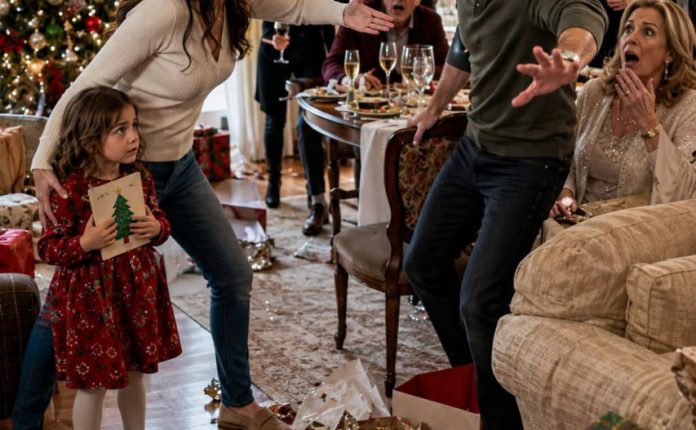
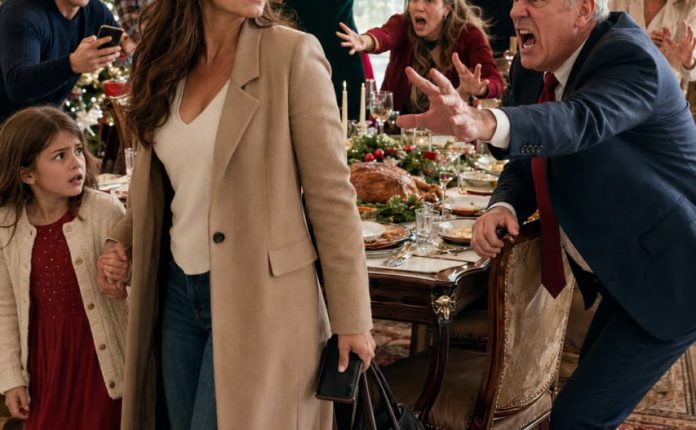
The baby’s scream reached me before I opened the front door. It was sharp, frantic, nothing like the irritated cries Leo made when he wanted a bottle. This sound had panic inside it. I dropped my keys in the hallway and ran toward the living room without even closing the door.
Our home looked like a disaster somebody had tried to disguise as an ordinary afternoon. A pot had boiled over on the stove. Laundry sat half folded across the floor. Three bottles stood beside the sink. A cutting board was covered in vegetables. The smell of roast chicken filled the room. My wife, Clara, lay motionless on the sofa.
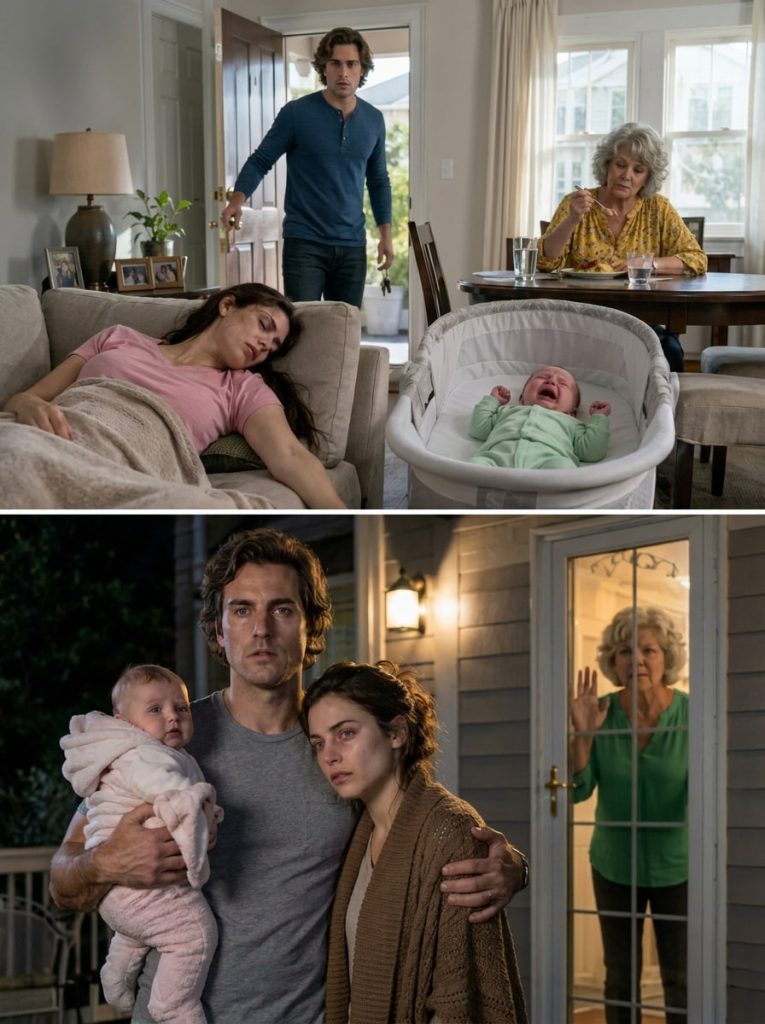
One arm hung toward the carpet. Her skin was gray-white, her lips dry, and her hair was stuck to her forehead with sweat. Our six-week-old son screamed in the bassinet beside her, his tiny fists trembling beside his face. My mother sat at the dining table eating.
Margaret Hale had a full plate in front of her. Roast chicken, rice, vegetables, gravy. The same meal Clara had promised me that morning she would not cook because she had barely slept and said standing made her dizzy. Mother lifted her fork, glanced toward Clara, and said, “Drama queen.” Something inside me became completely silent. Not explosive. Not heroic. Silent.
I lifted Leo first. His little body shook against my chest as I tucked him beneath my chin. Then I knelt beside Clara and touched her cheek. “Clara. Baby, wake up.” Her eyelids fluttered. She tried to speak, but only a breath came out. Mother sighed behind me. “Don’t encourage her. New mothers are always theatrical.” I turned my head.
She took another bite. “I raised two boys without collapsing every five minutes.” For thirty-four years, I had described my mother as strong. Difficult, yes. Controlling, certainly. But strong. She called cruelty honesty, obedience respect, and fear discipline. I believed those definitions because children believe the adults who feed them, punish them, and tuck them into bed afterward. “You made her cook?”
Mother dabbed her mouth with a napkin. “She offered.” Clara’s fingers weakly closed around mine. “No.” One syllable. Mother’s face tightened. “She needed to learn, Evan. The house is filthy. The baby cries constantly. She lies around all day as though giving birth made her disabled.” I stared at my mother.
Clara had delivered Leo after thirty-one hours of labor and an emergency procedure that left her weak for weeks. Her doctor told us repeatedly that recovery was not optional. We hired help for three afternoons each week. Mother persuaded me to cancel it. “Why pay strangers?” she had asked. “I’m here.” I had called that generous. Now my stomach turned.
“I’m taking them out of here.” Mother laughed. “Don’t be ridiculous. This is my son’s house.” I stood slowly with Leo against me. “No.” Her smile twitched. “It’s mine.” I called emergency medical services. By the time the paramedics arrived, Clara could answer questions but could not stand without shaking. Mother hovered in the hallway telling them Clara had always been “high-strung.” One paramedic finally asked her to stop answering questions for the patient.
Mother looked offended. I carried Leo’s diaper bag to the ambulance. Clara caught my sleeve. “Don’t leave him.” “I won’t.” Her eyes filled with tears. “Don’t leave him with her.” That sentence entered me like ice. I had no idea how long my wife had been afraid to say it.
At the emergency department, the doctor diagnosed severe exhaustion, dehydration, dangerously low blood sugar, and an infection beginning around Clara’s incision. None was catastrophic alone. Together, after weeks without proper rest, they had pushed her body beyond what it could manage. “How much sleep are you getting?” the doctor asked. Clara looked at me. I answered automatically. “Maybe four hours in pieces.”
She began crying. The doctor turned toward her. “Mrs. Hale?” Clara whispered, “Sometimes two.” I stopped breathing. “What?” She stared at the blanket. “Your mother wakes me if Leo cries during the day.” I frowned. “He needs feeding.” “Even after I’ve just fed him.” Her voice shook.
“She says I’m creating bad habits if I pick him up too quickly, then she tells me I’m neglecting him if I don’t.” I sat beside the bed. “Why didn’t you tell me?” Clara looked at me with an expression I deserved. “I did.” Three words. Every defense disappeared. She had told me. Mother criticizes everything I do.
Your mother keeps waking me. She says I’m lazy. She took Leo from me when I was feeding him. She threw out the meal-prep containers because she said reheated food was shameful. Each time, I softened it. She means well. She’s old-fashioned. Let me talk to her. She raised us differently. I had mistaken explaining my mother for protecting my wife.
The doctor asked another question. “When was the last time you ate?” Clara closed her eyes. “Breakfast.” It was after six in the evening. “Why?” Tears ran sideways into her hair. “Margaret said if I wanted lunch, I should finish cleaning the kitchen first.” My vision blurred. “Clara.” “She said you work all day and shouldn’t come home to a dirty house.”
I stood because sitting had become impossible. The doctor looked at me. “Mr. Hale, your wife needs protected rest. Not advice. Not pressure. Rest, hydration, nutrition, follow-up care, and help with the baby.” Protected rest. I had promised Clara that my mother moving in would give her exactly that. Instead, I had brought the threat into our home.
We did not return that night. I booked a suite at a hotel fifteen minutes from the hospital because Clara refused to go anywhere near the house while Mother remained there. I did not argue. I stopped at a pharmacy, bought formula, medications, bottled water, and enough prepared food to feed us for days. Clara slept for fourteen hours.
I fed Leo every two hours. Between bottles, I sat in the dark hotel living room listening to his breathing and replaying every warning sign I had explained away. Mother criticizing Clara’s weight two weeks after birth. Mother telling relatives Clara “couldn’t cope.” Mother insisting she move in temporarily. Mother calling our paid caregiver wasteful.
Mother smiling whenever Clara apologized for something that did not require apology. At dawn, Leo fell asleep against my chest. I looked at his tiny face and remembered being eight years old, standing in our kitchen while Mother told my father I was manipulative because I cried after she slapped me. Dad had looked at me. Then at her.
Then said, “Evan, apologize to your mother for raising your voice.” I did. Children learn survival before they learn vocabulary. I had called my childhood strict. Clara had called it something else once. “Your mother scares you.” I became furious. Not because she was wrong. Because she had seen it. My phone had seventy-three missed calls by morning. Mother.
My older brother Daniel. Three aunts. Two cousins. A family friend. Then the messages started. You embarrassed me. You kidnapped my grandchild. Your wife is turning you against your blood. Come home before I change the locks. That last one almost made me laugh. The house was mine.
More accurately, it was ours. Clara and I had purchased it seven years earlier. Both names were on the deed. We paid the mortgage. Mother had moved into the downstairs guest suite six weeks before Leo’s birth after telling everyone she wanted to help. She had apparently mistaken temporary access for sovereignty. At ten, Daniel called. “Mom says Clara attacked her.”
I stood beside the hotel window. “Did she?” Silence. “Look, I know Mom can be intense.” “Clara fainted while Mom ate the food she forced her to cook.” Daniel exhaled. “Mom says Clara was pretending.” I closed my eyes. That was Mother’s oldest trick. She never needed truth.
She only needed to speak first, confidently enough that everyone else began doubting what they had seen. “Daniel, did you call to ask whether Clara is alive?” Another silence. “I assumed she was okay.” “Why?” “Mom said—” “Exactly.” He went quiet. “I’ll call you later.” “No.” “What?” “Don’t call until you’ve decided whether you’re asking me questions or collecting information for her.”
I ended the call. Then I remembered the cameras. Clara had insisted on installing interior cameras after a baby monitor malfunctioned during her pregnancy. Mother mocked us for being paranoid. She never asked where the cameras were. Kitchen. Nursery. Living room. Front hall. Everything saved automatically to encrypted cloud storage under my account.
I was a contracts attorney. Documentation was almost a reflex. For once, that habit might matter more than words. I opened the first recording. At 10:14 that morning, Clara stood at the kitchen counter holding herself with one hand. Mother entered. “You’re still in pajamas?” “I didn’t sleep.” “Neither did I when Evan was a baby.” “Margaret, I feel dizzy.”
“You always feel something.” Clara reached for water. Mother took the glass from the counter. “Finish cutting the vegetables first. You leave everything half done.” I stopped the video. My hands were shaking. I forced myself to continue. At 11:03, Leo began crying. Clara moved toward the bassinet. Mother blocked her. “Leave him.” “He’s hungry.” “You fed him.” “Two hours ago.”
“He needs a schedule.” “He’s six weeks old.” Mother’s expression hardened. “You think reading three books makes you a mother?” Clara stared. “I am his mother.” Mother laughed. That laugh made my stomach turn. At 12:22, Clara asked to lie down. “After the kitchen.” “I can’t.” “Then what exactly do you contribute?” Clara looked at her. “I gave birth six weeks ago.”
Mother lowered her voice. “And Evan works twelve-hour days because one of you has to be useful.” I stopped again. I had been working long days. Partly because of a major case. Partly because Mother kept telling me everything at home was under control. Go work. I’ve got them. Clara needs to stop depending on you.
Every reassurance had been a door closing behind me. At 2:47, Clara stood over the stove crying silently while Mother sat at the table scrolling through her phone. At 3:16, Leo cried. Mother did not move. At 3:28, Clara carried a plate to the table. Mother inspected it. “The rice is overdone.” At 3:31, Clara swayed. Mother looked directly at her.
“Don’t start.” Clara tried to reach the sofa. She collapsed. For thirteen seconds, Mother did nothing. Then she looked toward Clara’s body, took another bite, and muttered, “Drama queen.” Leo began screaming. Mother kept eating. I watched the clip twice. The second time, I felt something inside me separate from the woman who raised me. Not hatred. Not yet. Recognition.
At noon, I called our real-estate manager and changed the smart-lock access codes remotely. Mother’s personal code stopped working. I authorized a locksmith to replace the physical cylinder after she left. Then I called the private care agency she had convinced me to cancel and booked overnight help for the next week. Then I called Leah Saunders, a family attorney I trusted.
“Evan?” “I need advice about removing a family member from my home and protecting my wife and newborn.” Her voice changed. “Are they safe now?” “Yes.” “Then start from the beginning.” I did. By the third day, Mother changed tactics. She posted online.
Heartbroken. My son has abandoned his mother for a manipulative woman who weaponizes my grandson. I gave everything to that family and have been thrown away for telling uncomfortable truths. Relatives swarmed the comments. Poor you. Clara always seemed fragile. A mother deserves respect. Evan will regret this. Family is forever. Mother called me that evening. Her voice was sweet.
“Everyone knows what she is now.” Clara sat beside me on the hotel sofa holding Leo. She was pale but stronger. I put the call on speaker. “Bring my grandson home,” Mother continued, “and I may forgive her.” Clara’s face changed. Mother said, “My grandson. My house. My family.” I looked at Clara. Her eyes were wet. Steady.
“You’re right about one thing,” I told Mother. “What?” “Everyone should know.” I ended the call. Then I uploaded the first video. Not the collapse. Not yet. I uploaded the clip of Clara saying she was dizzy and Mother taking away her water until she finished preparing food. I added one sentence.
This is why my wife and son are no longer staying in the same house as my mother. Within fifteen minutes, three relatives deleted their comments. Within an hour, Daniel called six times. I ignored him. Mother posted that the clip had been “selectively edited.” So I uploaded the uninterrupted eleven-minute segment. She deleted her original post. Then she called. I declined.
A voicemail arrived. “You think humiliating me makes you a man? That woman has poisoned you. I sacrificed my entire life for you.” Sacrifice. Another family word that had always meant debt. That afternoon, Clara watched the video with me. I did not want her to. She insisted. When Mother’s voice said, “Then what exactly do you contribute?” Clara flinched.
I paused it. “We can stop.” “No.” “You don’t need to prove anything.” “I need to see that it happened.” I understood. Abuse mixed with denial makes memory feel unreliable. We watched. When it ended, Clara stared at the screen. “I thought maybe I was weak.” My chest hurt. “You weren’t.” “She kept saying normal women could handle it.” “She lied.”
Clara looked at me. “You believed her.” There was no defense. “Yes.” Tears filled my eyes. “I did.” That hurt her. I saw it. “I’m sorry.” She looked toward Leo. “I don’t need you to say sorry tonight.” “What do you need?” “I need you not to explain her.” I nodded. “Okay.”
“And I need you to believe me before there’s video next time.” That sentence changed something. “I will.” She looked at me. “Don’t promise fast.” Fair. I corrected myself. “I’m going to learn how.” The next morning, a courier arrived at the hotel. He carried a letter from an attorney representing my mother.
The first page demanded restoration of her access to the house. The second claimed she possessed a substantial equitable interest in the property because she had contributed $240,000 toward its purchase and renovation. I stared at the number. Impossible. Mother had given us forty thousand dollars when we bought the house. A gift. She insisted on it after selling a rental property.
I had the gift letter. The attorney’s packet included something else. A document titled Family Property Agreement. It stated that Mother’s contribution entitled her to forty percent of the home’s appreciation and permanent occupancy rights. At the bottom was my signature. I had never signed it. Beneath mine was Daniel’s as witness. My stomach turned. Clara stared at me. “Evan?”
I handed her the page. She read it. Then whispered, “Did you sign this?” “No.” Her eyes searched my face. “No?” “No.” I looked at the date. Four years earlier. The same month my father died. The signature looked convincing. Not perfect. Close enough to frighten me. Then I saw the witness line again. Daniel Hale. I picked up my phone.
He answered immediately. “Evan.” “Did you witness a property agreement between Mother and me four years ago?” Silence. My skin went cold. “Daniel.” “I need to explain.” “Did you sign it?” “Yes.” The room disappeared. “Did you see me sign?” “No.” Clara covered her mouth. I stood. “What did she tell you?” “That you already agreed.” My voice became quiet.
“And you signed as witness without seeing me sign.” “Yes.” “Why?” “She said Dad’s estate couldn’t close until the family property transfers were documented.” I stared at the wall. “That makes no legal sense.” “I know that now.” “You were forty.” “I know.” “You own a business.” “I know.” “And you signed.” His voice broke. “She had just buried Dad.” No.
We had buried Dad. Mother had controlled every detail. The funeral. The accounts. The stories. The grief. “Where did two hundred forty thousand come from?” “I thought she gave it to you.” “She gave forty.” Silence. Daniel whispered, “That’s not what she told me.” My stomach tightened. “What did she tell you?”
“That you got two hundred forty from Dad’s estate early because you needed the house.” I stopped breathing. “I received nothing from Dad’s estate before probate.” Daniel went quiet. Then said, “Evan, we need to look at the estate accounting.” I closed my eyes. For the first time, Mother’s words from the phone sounded different. My grandson. My house. My family. Maybe control had never been only emotional. Maybe she had been keeping books too.