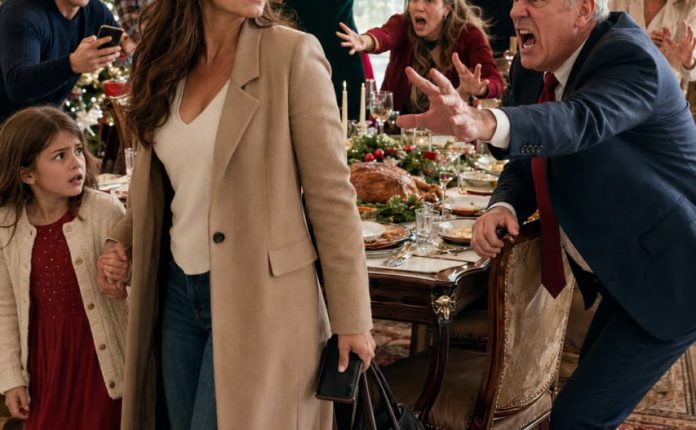
“You could give us the house.” My knife stopped halfway through a red pepper. I turned slowly. “Excuse me?” Vanessa leaned against the kitchen island as if we were discussing paint colors. “Think about it. You have millions. You don’t need a house this size.” I said nothing, and she mistook my silence for interest.
“Ethan and I could take over the property. It could be an early inheritance.” I stared at her. “And where exactly would I live?” Her smile brightened. “That’s the best part. We could renovate the basement for you.” For a moment, I genuinely wondered whether I had misheard her.
The basement. In my house. The house Daniel and I had bought after years of saving. The house where I had raised Ethan. The house I had continued paying taxes, insurance, repairs, utilities, and maintenance on after my husband died. Vanessa wanted me downstairs so she could inherit my life while I was still alive.
“We’d take care of everything,” she added. That made me laugh. Her smile faltered. “What?” I set the knife down. “Vanessa, in eight months, you haven’t consistently taken care of your own dishes.” Her face tightened. “That’s unfair.” “No. What’s unfair is that I gave you thirty days and you responded by planning how to remove me from my own house.”
“We’re talking about the future.” “I am too.” I wiped my hands. “You now have ten days.” She blinked. “What?” “To leave.” “You said thirty!” “I changed my mind.” “You can’t just—” “I can. And I did.” Her face went pale. “Ethan is going to lose it.” “That sounds like Ethan’s problem.”
She stormed upstairs. Seconds later, the guest-room door slammed so hard the hallway pictures rattled. I went back to chopping peppers. That night, I sat alone at the kitchen table with a legal pad and, for the first time, wrote down everything I had been paying for them.
Electricity. Water. Gas. Internet. Car insurance. Streaming services. Groceries. Household products. Various charges Ethan had once described as “temporary.” The number at the bottom irritated me more than I expected, not because I couldn’t afford it, but because I suddenly understood how completely they had built their comfort around my willingness to keep giving.
The next morning, I started making calls. I removed Ethan from the car insurance policy I had been paying. I canceled subscriptions used mainly by him and Vanessa. I secured my financial records and changed passwords. Then I booked myself a week at a quiet resort a few hours away.
By then, Ethan and Vanessa had convinced themselves I was bluffing. They made almost no effort to pack. Boxes did not appear. Apartment listings were not discussed. Vanessa continued leaving dishes in the sink, and Ethan still disappeared into the garage area whenever he wanted something from his tool bins.
Every night I heard them talking upstairs. Sometimes their voices were low, sometimes angry, but they behaved as though if they ignored the deadline long enough, I would forget it. I didn’t. Thursday evening, I packed a suitcase, placed jewelry in the safe, and moved personal papers into secure storage.
Family photographs went inside my locked bedroom closet. Nothing dramatic. Nothing destructive. I simply stopped assuming they would respect things because they belonged to me. Friday morning, Ethan came downstairs dressed for work and glanced at my suitcase beside the staircase. “Going somewhere?” “Yes.” “Where?” “Away.” “For how long?” “A while.”
He frowned. “Are you seriously leaving your own house because of this?” I almost smiled. “No, Ethan. I’m leaving because I want a vacation.” Vanessa appeared behind him. Neither said goodbye when they left. I watched their car disappear, then walked slowly through the house.
The kitchen clock ticked. The refrigerator hummed. Sunlight stretched across the hardwood floor. I had arranged to suspend several nonessential household services while the property was effectively being vacated, and I had already made clear in writing that their thirty-day stay was ending. I wasn’t interested in trapping anyone or creating some dangerous stunt.
I wanted one simple thing: for two capable adults to finally make arrangements for themselves. I took my suitcase to the car and drove away. That evening, I sat on the balcony of my resort room watching orange light spread across the hills when my phone began buzzing.
Ethan. I ignored it. Then another call came, followed by messages. “Mom, where are you?” “We need to talk.” “Call me.” “Vanessa says this is insane.” “You can’t just disappear.” I placed my phone face down while a server brought my dinner, and I ate slowly.
For the first time in years, someone else cooked while I sat quietly. Later that night, another message appeared. This one was different. “Mom. We’re looking for an apartment. You win.” I read it twice, but I didn’t feel victorious. I felt tired. Then relieved.
After weeks of arguing, Ethan had finally accepted one fact: he was leaving. What I didn’t yet know was how quickly reality would destroy the lifestyle he and Vanessa thought they deserved. Finding an apartment should have been simple. They both had jobs and had lived without paying rent for eight months.
They had repeatedly told me they were saving for a house, so I assumed they had built a respectable cushion. I was wrong. Two days after Ethan’s message, he called. I almost ignored it. Then I answered. “What?” His voice was unusually subdued. “Mom, can we talk?” “You’re talking.”
“We’ve looked at four places.” “And?” “They’re expensive.” I waited. When I didn’t rescue him from the silence, he continued. “Vanessa doesn’t like any of them.” “That happens.” “She says one is too small, another is too far from her office, and one has a terrible kitchen.” “That also happens.”
“Mom…” There it was, the tone he used when approaching the real request. “Could you help us with the deposit?” “No.” A long silence followed. “What?” “You heard me.” “Just until we get settled.” “No.” “You have millions.” “And you have two incomes.” “That’s not fair.”
“What isn’t fair?” I asked. “We’re being forced to move suddenly.” “You had thirty days.” “You shortened it.” “After your wife suggested I move into my own basement so you could inherit my house early.” He went quiet. Finally, he muttered, “That was Vanessa’s idea.”
“And you didn’t object strongly enough for her to think it was ridiculous.” “That doesn’t mean I agreed.” “Then tell her that. It has nothing to do with me.” He exhaled. “I can’t believe you won’t help your own son.” “I have helped my son for thirty-two years.” Then I ended the call.
My hands shook afterward. That bothered me. Saying no was getting easier, but it wasn’t painless. That was something nobody tells you about boundaries. You can know you’re right and still feel guilty. You can protect yourself and still miss the person who benefited from your lack of protection.
The next morning, I walked through the resort garden before breakfast. The air smelled like pine and fresh coffee from the dining terrace. I sat on a bench and thought about Ethan as a little boy: his scraped knees, his missing front tooth, and the year he insisted he could sleep in a tent in the backyard.
He came inside after twenty minutes because he heard an owl. For years, I had measured motherhood by usefulness. If he needed me, I was doing my job. If I could fix something, I fixed it. If a consequence could be softened, I softened it. I had never considered what happened when helping stopped helping.
By the end of the week, Ethan sent another message. “We signed a lease. It’s a one-bedroom. Vanessa hates it.” I stared at those three sentences. Then I typed, “I hope you make it a home.” I didn’t add money. I didn’t offer furniture or ask whether they needed groceries.
When I returned home a week later, the Mustang was gone. The driveway looked strange without it. I opened the front door and immediately noticed the silence. No television upstairs. No shoes in the hallway. No perfume drifting from the guest room. No half-empty glasses on the coffee table.
The kitchen counters were clear. Their bedroom was empty except for faint marks where furniture had rested. Two keys sat on the kitchen island. I picked them up and, for a long moment, simply stood there. Then I locked the door. That evening, Ethan called. “We’re out.” “I know.”
“Our apartment is tiny.” “You’ll adjust.” There was a pause. “Are you happy now?” I looked around my kitchen. The window above the sink was open, and outside, wind moved through the leaves. “I’m at peace.” He went silent before asking, “Mom, can I borrow a thousand dollars?”
I actually closed my eyes. Of course. “What for?” “Moving expenses. We had deposits, furniture, some car stuff. I’ll pay you back after payday.” “No.” “Mom.” “No, Ethan.” “It’s only a thousand.” “Then it shouldn’t be difficult for two working adults to manage.”
“You’re really doing this?” “Yes.” His voice turned cold again. “You’ve changed.” “I know.” He hung up. I stood in the quiet entryway and looked at the front door. A few days earlier, I had purchased a new smart lock, although part of me had hesitated to install it.
Changing the lock felt harsh to the version of me who still believed boundaries required apologies. That evening, I opened the package and replaced the old lock myself. When the final screw tightened, I stepped back. There would be no emergency key under a flowerpot. No spare access “just in case.”
My son could visit. He could knock. But he would never again enter my home as though my permission were optional. Then I went upstairs and opened the guest-room door. The empty space smelled faintly of carpet cleaner and Vanessa’s perfume. For years, that room had existed for other people.
I stood in the doorway and realized I had no idea what I wanted it to become. That question should have frightened me. Instead, it felt like freedom. Eventually, I turned the guest room into an art studio, fulfilling an idea that had been waiting inside me for nearly twenty years.
Before Daniel got sick, I used to paint. Nothing professional. Landscapes. Old houses. Flowers. Once, I painted Ethan asleep on the couch when he was sixteen, one sneaker still on his foot. After Daniel died, painting disappeared from my life beneath estate documents, repairs, investment decisions, Ethan’s college expenses, work, his wedding, and one request after another.
My brushes dried out in a box somewhere. I told myself I would start again “when things settled down.” Things never settle down by themselves. You have to decide what no longer gets permission to occupy your life. So I hired a contractor to remove the worn carpet and repaint the room a clean, soft white.
A heavy wooden worktable went beneath the window. I added shelves for canvases, paints, brushes, sketchbooks, and the art books I had collected over the years. The first afternoon I sat there, sunlight spilled across the floor in a wide rectangle. I opened a box of new paints.
The smell of linseed oil hit me so suddenly I almost cried. Not from sadness. Recognition. I remembered myself. I also reclaimed the garden. The roses had always been mine, but now I expanded the beds and planted rosemary, basil, lavender, and mint.
I put a small iron table beneath the maple tree. Every morning, I carried my coffee outside. Sometimes I read. Sometimes I painted. Sometimes I did absolutely nothing. At first, doing nothing felt irresponsible. Then it became luxurious. Meanwhile, Ethan’s life became considerably less comfortable.
I knew only what he told me. I did not ask Vanessa. She never called. According to Ethan, their apartment overlooked a noisy parking lot. The kitchen was barely large enough for two people. Their building charged extra for storage, and his Mustang had to be kept in a rented garage several miles away.
Their grocery spending shocked them. So did utilities. So did insurance. So did the endless parade of little expenses I had quietly absorbed for years. One evening, about two months after they moved, Ethan called. “Do you know how much laundry detergent costs?” I nearly laughed. “Yes.”
He was quiet. “You knew I was going to say that, didn’t you?” “I had a suspicion.” Another pause followed. “Vanessa says I spend too much on the Mustang.” “Do you?” “That’s not the point.” “It sounds like exactly the point.” He sighed.
Then, unexpectedly, he said, “I didn’t realize how much you paid for.” I looked through the studio window at my garden. “No. You didn’t.” For a second, I thought an apology might follow. It didn’t. Not yet. Still, it was the first sign that reality was beginning to reach him.
Six months passed. I traveled with two old friends to the coast and joined a local painting group. One of my landscapes was displayed at a community arts event. I upgraded the garden irrigation system, donated to a literacy program Daniel had supported, and began taking myself to lunch once a week.
I did it simply because I liked sitting somewhere with a book and no one expecting anything from me. I didn’t spend recklessly. Having money had never been the point. Using my life deliberately was. Then, on a warm spring afternoon, my doorbell rang. I checked the camera.
Ethan stood on the porch. He looked thinner. His hair was longer, and faint shadows rested beneath his eyes. He had not called first. For a moment, my old instincts returned. Something must be wrong. Does he need money? Is Vanessa sick? Did he lose his job?
I stopped myself, then opened the door. “Hi, Mom.” “Hello, Ethan.” His eyes moved toward the smart lock. “You really changed it.” “Yes.” He nodded. “I understand.” That surprised me. I stepped aside. “You can come in.”
He walked slowly through the hallway, his eyes moving around the house—the new arrangement, the clear surfaces, the painting hanging beside the staircase, the flowers on the kitchen table. “This place looks… different.” “It is.” “Better.” “Thank you.” We went to the patio, where I poured coffee.
For several minutes, Ethan simply held his cup. Then he looked at me. “I owe you an apology.” I waited. “I was awful,” he said quietly. “I treated your house like it belonged to me. And I treated you like your job was to make my life easier.”
I said nothing. He swallowed. “What I said that night was disgusting.” “Yes.” He blinked. Apparently, some part of him expected me to protect him from the truth even while he apologized for it. I didn’t. “I called you a burden,” he continued, “while I was living in your house for free.”
“Yes.” His eyes dropped. “I’m sorry.” I believed him, but belief and trust are not the same thing. Then Ethan said something I had not expected. “Vanessa and I may be separating.” I set down my coffee, and suddenly the apology became more complicated.