“Maybe you should get a job and stop being such a burden.” My son’s words landed in the middle of dinner with the sharpness of a plate hitting tile. For a second, all I could hear was the soft ticking of the clock above the dining-room archway and the refrigerator humming from the kitchen.
I looked up slowly. My son, Ethan Mercer, sat across from me with his jaw tight and his cheeks red, as if I had been the one insulting him. Beside him, his wife, Vanessa, lifted her wineglass and tried to hide the smile curling at the corner of her mouth. She wasn’t fast enough. I saw it.
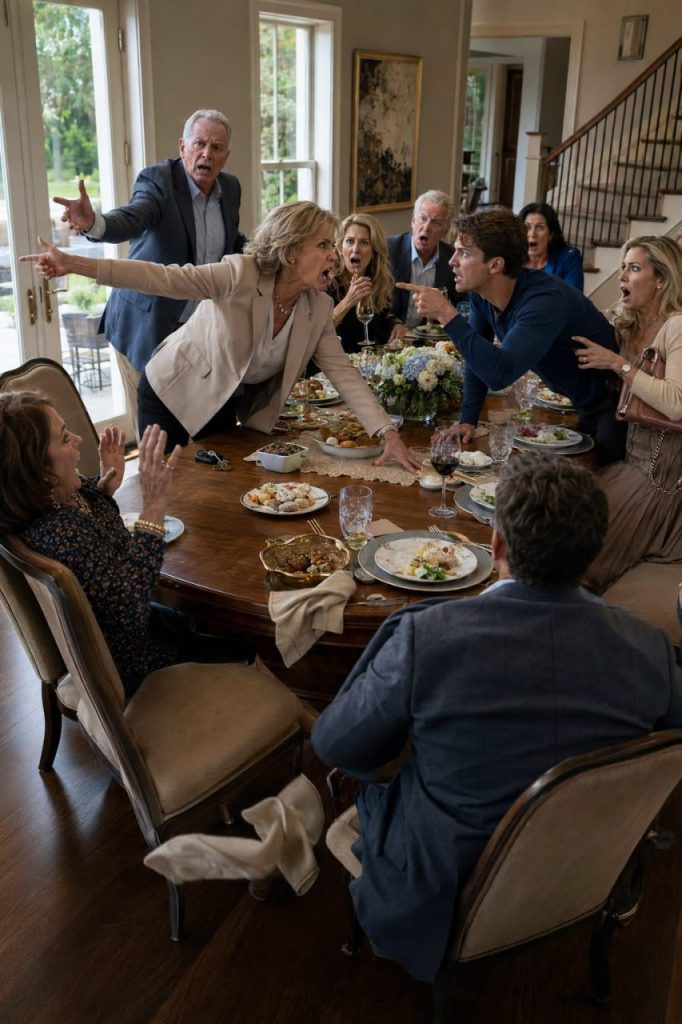
Ten minutes earlier, Vanessa had complained that the roast I’d spent most of the afternoon preparing was “dry.” I had smiled and said, “Then maybe you can cook tomorrow.” That was apparently an outrageous suggestion. Ethan slammed his fork down. “Seriously, Mom. You’re home all day. The least you could do is make dinner without acting like it’s some huge sacrifice.”
That was when he called me a burden. I stared at him. Then, unexpectedly, I laughed. Not because it was funny, but because there are moments when reality becomes so ridiculous your body chooses laughter before anger. Ethan frowned. “What’s funny?” I dabbed my mouth with my napkin. “Oh, honey,” I said. “You really have no idea, do you?”
Vanessa lowered her glass. “No idea about what?” I looked around the dining room. The oak table had belonged to my late husband, Daniel. The chandelier had been something we saved for during the first years of our marriage, and the framed watercolor near the window came from a vacation we’d taken before Ethan was born.
Every inch of that house carried something I had worked for, protected, paid for, cleaned, repaired, or loved. For eight months, Ethan and Vanessa had been living there. Temporarily. That was the word they had used. They wanted to save for a down payment, and I had been delighted to help because Ethan was my only child.
When he called and admitted rent on their downtown apartment had become too expensive, I said yes before he finished asking. “No rent,” I told him. “Save everything you can.” In the beginning, they thanked me constantly. That lasted maybe three weeks. Then something changed, slowly at first, until their gratitude seemed to disappear completely.
Their laundry began appearing in the hallway. Their dishes stayed in the sink. Vanessa started writing grocery requests on my shopping list as if I ran a hotel kitchen. Ethan’s car insurance came due during a “tight month,” so I paid it. Then I paid it again. And again. Their friends began coming over on weekends without warning.
Sometimes I learned we were hosting people only when strangers appeared in my kitchen opening bottles I had purchased. I cooked. I cleaned. I paid the utilities. I stocked the pantry and replaced toiletries Vanessa used without asking. I even moved my car onto the driveway because Ethan wanted the garage for a classic Mustang he was restoring.
Somehow, after eight months of living almost completely at my expense, my thirty-two-year-old son had decided I was the burden. I placed my fork beside my plate. “You have thirty days to move out.” The silence that followed felt almost physical. Ethan blinked. “What?” “You heard me.” Vanessa stared. “Move out where?”
I smiled. “That sounds like something two employed adults should figure out.” Ethan pushed his chair back. “You’re kicking out your own son because I made one comment?” “No.” I stood. “I’m asking you to leave because of eight months of comments. Eight months of disrespect. Eight months of being treated as your cook, maid, bookkeeper, grocery service, and emergency fund.”
Vanessa crossed her arms. “We live here too.” “You stay here,” I corrected. “There’s a difference.” Ethan stared at me like he expected the familiar version of his mother to return—the woman who always softened first, apologized simply to end an argument, and fixed things. I could almost see him waiting for her.
I picked up my plate. “Starting tomorrow, I won’t cook for either of you. I won’t do your laundry. I won’t pay your insurance. I won’t buy your groceries. And thirty days from now, I expect your keys on this table.” Ethan stared at me. “Mom, stop acting crazy.”
I stopped at the kitchen doorway. The old me would have turned around. Instead, I said, “The crazy part was letting this go on for eight months.” Then I walked away. The next morning, I woke before sunrise and, out of habit, opened the refrigerator and reached for eggs. Ethan liked them with cheddar. Vanessa preferred avocado toast and berries.
My hand hovered over the carton. Then I smiled. I made one egg, one piece of toast, and one cup of coffee from the expensive beans I usually saved for weekends. I carried everything into the garden. The roses were damp with morning dew, and the air smelled like wet soil and jasmine. For the first time in months, breakfast tasted peaceful.
At around seven-thirty, the patio door slid open. Vanessa appeared wearing a silk robe. “Claire?” That was my name. Not Mom. Not Mrs. Mercer. Just Claire. “Where’s breakfast?” I took another sip of coffee. “The kitchen is behind you.” She stared at me. “Ethan has work.” “So?” “He needs to eat.” “I imagine he’ll figure it out.”
She disappeared inside. Five minutes later, Ethan came outside holding his phone. “The Wi-Fi’s down.” “No, it isn’t.” He looked at me. “I changed the password.” His face darkened. “What’s the new one?” I clipped a dead rose from the bush beside me. “A secret.” “Mom.” “Yes?” “Give me the password.” “No.”
He looked genuinely stunned. For eight months, Ethan had believed my kindness was permanent access. That morning, for the first time, he discovered it had an expiration date. Judging by the look on his face, thirty days suddenly felt much shorter. “You’re seriously going to play games with the Wi-Fi?” he demanded, standing on the stone garden path in his work clothes.
I kept trimming my roses. “It isn’t a game.” “I need the internet.” “You have mobile data.” “That’s not the point.” I glanced up. “Then set up your own service.” He gave a bitter laugh. “In your house?” “For the next twenty-nine days.” His expression hardened. “You’re being ridiculous.”
“Maybe. But when you schedule installation, make sure the technician knows where your new apartment is.” The patio door slammed hard enough to rattle the glass. Oddly, I felt no guilt. Only relief. By Wednesday, the consequences became more noticeable, beginning with the laundry basket I had kept near the upstairs hallway for years.
Somewhere along the way, Vanessa had decided anything placed inside it became my responsibility. That afternoon, I found two silk blouses, a designer dress, workout clothes, and what looked like half her closet piled beside the machine. I carried everything upstairs and placed the entire pile neatly on her side of the guest-room floor.
That evening, I was sitting at the kitchen island with a novel and a mug of chamomile tea when Ethan and Vanessa returned home. Neither greeted me. Ethan went straight to the walk-in pantry. I heard the handle turn, then again, then harder. “Mom.” I turned a page. “Yes?” “The pantry is locked.” “I know.”
He walked into the kitchen. “Why is the pantry locked?” I looked over the top of my book. “Because the food inside belongs to me.” Vanessa dropped her handbag on the counter. “You locked up food?” “I locked up my food.” “We need groceries.” “There are two empty shelves in the refrigerator. You’re welcome to fill them.”
Vanessa stared at me like I had suggested she hunt for dinner with a spear. “What about the truffle oil?” I almost laughed. “What about it?” “I was planning to make pasta.” “There’s a grocery store four minutes away.” Her mouth fell open, but I felt no urge to rescue her from the inconvenience.
That pantry was one of my favorite parts of the house. Daniel and I had renovated the kitchen shortly before he died. I had designed the pantry myself: dark wood shelves, labeled glass jars, baskets for baking ingredients, a small wine rack, specialty coffee, imported olive oils, and ingredients I bought because cooking once brought me genuine joy.
Vanessa treated it like a free boutique supermarket. She opened wines I had saved and took boxes of specialty chocolates to friends’ homes. Once, I overheard her tell someone she had personally bought an imported bottle of oil I knew had cost nearly seventy dollars. I said nothing then. I had said nothing about a lot of things.
Not anymore. Ethan folded his arms. “We live here too.” “No. You’re staying here temporarily.” “You keep saying that.” “Because apparently repetition is necessary.” “You’re being petty.” “Possibly.” I closed my book. “But here’s what interests me. Neither of you has asked whether I need help with anything. You only get angry when something I usually provide disappears.”
Vanessa flushed. “We’re family.” “Family does not mean unlimited access to another person’s money, time, house, or patience.” Neither answered. I checked the small calendar beside the refrigerator. “You have twenty-six days.” Then I picked up my tea and went upstairs, leaving them to contemplate a house that no longer functioned like a free hotel.
Saturday brought the next confrontation. When I entered the kitchen that morning, a bright yellow sticky note waited on the counter: “Friends coming at eleven. Please stay out of the living room.” I read it twice, then laughed softly. Apparently I had progressed from unpaid servant to unwanted guest in the house I owned.
Vanessa loved keeping the house so cold in summer that I sometimes wore socks indoors. She insisted seventy degrees was “comfortable.” I preferred something warmer, so I walked to the thermostat, adjusted it to seventy-eight, and locked the controls. Then I took my purse, drove to a day spa, switched off my phone, and enjoyed several peaceful hours.
When I returned, Ethan was pacing in the driveway. “Where have you been?” “At the spa.” “The air conditioning stopped working.” “No, it didn’t.” “Vanessa’s friends were sweating all afternoon.” “The air conditioning works perfectly.” He stared at me. “What did you set it to?” “Seventy-eight.” “You did that deliberately.” “Of course.”
“You embarrassed Vanessa.” I closed my car door. “No, Ethan. Vanessa embarrassed herself when she invited people into my home and instructed me to stay out of my own living room.” His face tightened. “You’re tearing this family apart.” I stopped halfway to the front door and looked directly at him.
“No. I’m refusing to hold it together by letting you walk over me.” Then I added, “Twenty-one days.” For the first time, his anger faded for a fraction of a second. Behind it, I saw something else. Concern. Not remorse. Not yet. But concern, because Ethan was beginning to realize I wasn’t waiting for his approval.
What he did next proved he was no longer trying to change my mind. He was looking for leverage. Ethan’s pride and joy was a dark blue 1968 Mustang. He had spent months restoring it, but he had also spent months turning my garage into a repair shop while my own sedan remained outside.
Wrenches covered the workbench. Boxes of parts lined the walls. Oil stains spread across the concrete. My car sat outside through rain, heat, and falling branches because Ethan claimed the Mustang “couldn’t be exposed to the elements.” Tuesday morning, after he and Vanessa left for work, I stood in the garage with my coffee and looked around.
Then I called a towing company. I made one thing very clear. “The vehicle is not being impounded. I simply need it moved from my private garage to the legal parking space in front of my house. Carefully.” The driver handled it professionally, and I watched the Mustang roll down the driveway and settle safely along the curb.
Then I gathered Ethan’s tools into several large storage bins and placed them beside the side entrance. Finally, I pulled my own sedan into my garage. The simple sound of the garage door closing behind my car felt ridiculously satisfying. At six that evening, I heard tires squeal outside before the front door flew open.
“What did you do?” I was sitting on the porch with iced tea. “Hello to you too.” “My Mustang is in the street.” “Yes.” “You moved my car?” “It was in my garage.” “You know how valuable that car is.” “Then I suggest you store it somewhere appropriate.” He marched toward me. “Put it back.” “No.”
His eyes widened. “Mom, my tools are in there.” “They’re boxed beside the side door.” “You can’t lock me out of the garage.” “I can. I own it.” Vanessa stepped from their car. “Ethan, forget it.” “No!” He pointed toward the house. “She keeps treating us like children.”
I set down my glass. “No, Ethan. I’m treating you like adults. That’s why this is so upsetting to you.” Vanessa looked away. Ethan’s jaw clenched. “You keep saying I have to leave like I’m actually going somewhere.” “You have sixteen days.” “You think I’m joking?” “No,” I said. “I think you’re in denial.”
He stood there waiting for me to become uncomfortable. I didn’t. Eventually, he walked away, but the garage incident changed him. I noticed him watching me differently afterward. He asked questions about property taxes, mentioned the cost of maintaining the house, and casually wondered whether I ever worried about retirement. I knew exactly what he was doing.
Ethan had convinced himself there had to be another explanation for my behavior. Surely his mother couldn’t simply be tired of being disrespected. There had to be money trouble. A hidden mortgage. A financial crisis. Something that would eventually force me to need him. And if I needed him, he could regain control.
A few days later, I left my office to water the plants in the sunroom. I was gone less than ten minutes. When I returned, the office door stood slightly open. I immediately knew someone had been inside. The room smelled faintly of Ethan’s aftershave. I pushed the door wider and found him beside my desk.
He was holding a financial statement, and his face had lost all color. For several seconds, neither of us spoke. Then he looked down at the paper again. “Five million dollars?” I closed the door behind me. “Put that down.” He stared at me. “You have five million dollars?” “Yes.”
“Since when?” “Since your father died, plus what I built afterward.” He stared at the statement as though it were evidence of a crime. “You never told me.” “You never needed to know.” “You’ve been sitting on millions?” “I’m not sitting on anything. Those are investments.” “And you’re arguing over groceries?”
“I never argued over groceries.” “You locked the pantry.” “Because you and your wife treated my groceries as if they belonged to you.” He stepped closer. “So you’re throwing us out when you have more money than you could possibly need?” I took the statement from his hand. “This was never about whether I could afford to support you.”
“Then what is it about?” “Whether I should.” The room became quiet. Ethan shook his head. “Dad would’ve wanted me to have some of that.” That hurt more than I expected, not because I doubted my husband, but because Ethan was using a dead man to justify his entitlement.
“Your father left his estate to me.” “He was my father.” “And you’re thirty-two.” His expression darkened. “I’m your son.” “I know exactly who you are.” I placed the document into a folder and reminded him of everything I had already done for him throughout his life.
“I paid for college. I helped with your first car. I helped with your wedding. I’ve paid expenses you should have been paying yourself. I gave you eight months of free housing. Helping you become an adult does not mean financing your entire adult life.” He said nothing.
“So you’re just keeping everything?” he finally asked. “Yes.” The answer came out so easily that it surprised even me. His eyes narrowed. “You have more than you need.” “That still doesn’t make it yours.” He stormed out, and I locked the office after him.
I thought the discovery would make Ethan worse. Instead, the immediate change came from Vanessa. The following evening, she entered the kitchen smiling more sweetly than she had in eight months. “Claire?” I was slicing vegetables. “Yes?” “I’ve been thinking.” I glanced at her. “That can be dangerous.”
She ignored me. “Ethan told me about the money.” I continued chopping. Then Vanessa said something so breathtakingly entitled that I finally understood exactly what they believed I was worth to them. Not as a mother. Not as a person. As an asset.