“And now,” the host announced, her voice trembling with genuine excitement, “the Team Gold Trophy for the most outstanding minds of this year’s tournament goes to the duo who achieved a perfect, unblemished score never before seen in our history: Julian and Miles Holloway!” The auditorium exploded beneath the vaulted ceiling of the Ashbourne Institute’s grand hall.
Applause thundered through a building usually reserved for Nobel laureates, heads of state, and children whose parents paid obscene tuition so they could someday pretend intelligence had been inherited along with money. I heard none of it. From the illuminated finalists’ row, two thirteen-year-old boys stepped into the aisle, and the enormous LED screens behind the stage magnified their faces.
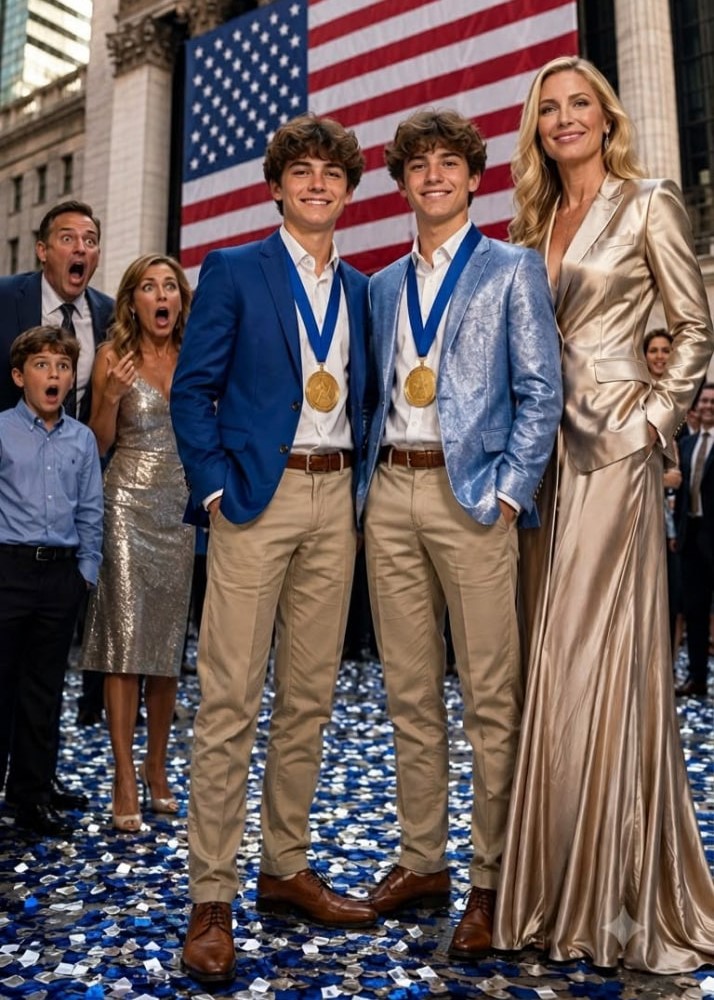
My heart stopped. I was looking at myself. Not vaguely. Not in the sentimental way adults sometimes imagined resemblance where none existed. These boys had my face: the same narrow cheekbones I had inherited from my father, the same high bridge of the nose, the same sharp line around the mouth, even the slightly uneven left eyebrow I had spent forty-six years ignoring.
But their eyes belonged to Evelyn. Dark. Steady. Impossible to fool. “Holloway,” I whispered. Her surname. My wife turned toward me. “What?” I could not answer. Thirteen years disappeared. I saw a rainy apartment window, a half-packed suitcase, and Evelyn standing barefoot on cheap hardwood, one hand resting protectively over a stomach that had only just begun to show.
I heard myself saying words I had spent more than a decade refusing to remember. “I can’t throw my future away.” She had not screamed. That made it worse. She simply looked at me. “Our future?” I had looked away. Then I left. I told myself I was choosing stability, opportunity, a life I could build.
Three weeks later, I married Victoria Ashcroft, daughter of billionaire industrialist Conrad Ashcroft, beneath twelve thousand white roses in a cathedral filled with people whose approval had once seemed more valuable than oxygen. Evelyn disappeared from my life. I let her. Now two boys carrying her surname were walking toward a stage under a storm of applause, and every one of my excuses was turning to ash.
Victoria leaned toward me. “How do fatherless nobodies even get into an event like this?” My stomach tightened. “Victoria.” She barely heard me. Her attention was fixed on the stage where her own son, Preston, sat among the remaining competitors. Preston was fourteen, the child from Victoria’s first marriage, though I had raised him since he was eleven months old.
He had my surname, my schools, my tutors, my connections—everything Julian and Miles apparently never had. Yet Preston was staring at the floor. The host raised one hand. “Before we award the trophy, the judges have requested that the winning team’s project be presented publicly.” The applause softened, and behind the boys, the screen changed.
A title appeared: CROWNGLASS: AN OPEN-SOURCE FORENSIC MODEL FOR DETECTING CONTRACT FRAUD, PROCUREMENT COLLUSION, AND HIDDEN BENEFICIAL OWNERSHIP. My mouth went dry. Ashcroft Meridian Holdings specialized in government infrastructure contracts, defense logistics, renewable-energy financing, and municipal redevelopment—the kinds of sectors Crownglass had apparently been designed to examine.
Victoria frowned. “What is that?” I already knew. A weapon. Not the violent kind. The worse kind. A machine for finding secrets. Julian stepped toward the microphone, his posture composed, while Miles remained half a pace behind him holding a tablet. They looked similar enough to unmistakably be twins, but they were not identical in manner.
Julian carried stillness like armor. Miles watched everything. “These systems usually fail,” Julian began, “because public procurement information exists across disconnected databases.” His voice was calm, without nerves or hesitation. Miles continued, “So we built Crownglass to map companies, directors, subcontractors, donors, trusts, consultants, addresses, and contract amendments into a single relationship graph.”
The screen filled with lines. Thousands of them. Companies connected to people. People connected to shell corporations. Shell corporations connected to government payments. A murmur ran through the auditorium, and one judge leaned forward. Miles tapped the tablet. “What makes the model different is that it doesn’t assume corruption looks like theft.”
Julian glanced at the audience. “Sometimes corruption looks perfectly legal until you examine who keeps benefiting.” I felt Victoria stiffen beside me. The screen changed again, and a familiar logo appeared: ASHCROFT MERIDIAN HOLDINGS. The auditorium inhaled as one body. Victoria shot to her feet. “What is this?!” Heads turned. I remained seated.
Crownglass spread the Ashcroft corporate network across the entire wall: subsidiaries, vendors, consultants, political foundations, offshore trusts, companies I recognized, and companies I did not. Red lines appeared between them. Julian did not look toward me. “Our demonstration used only public records available through corporate registries, procurement disclosures, election-finance databases, court filings, land records, and archived websites.”
Miles tapped again. “Crownglass identified thirty-seven high-risk relationships within one corporate group.” Victoria’s face turned white. I stared at the screen as one company flashed: Harbor North Advisory. I knew that name. I had approved eleven million dollars in payments to it over five years. Julian continued explaining what the model had found.
“Harbor North Advisory has no employees listed, no conventional office, and no public operating history before receiving its first Ashcroft Meridian subcontract.” A line appeared. Harbor North connected to another company, then another. Eventually the chain ended at a trust: Davenport Family Settlement. The beneficiary name appeared beneath it: PRESTON ASHCROFT VALE.
Victoria screamed. “This is defamatory!” The host froze. Security glanced toward our balcony. Everyone else began whispering. Preston lifted his head, his face gone gray. Victoria slammed both palms onto the velvet railing. “Where is Preston’s project?” The host attempted diplomacy. “Mrs. Vale, individual scores will be displayed after—” “Display them now.”
“Victoria,” I said. She ignored me. “I donated three million dollars to this institute.” The auditorium became completely silent. Even I turned toward her. Victoria realized too late what she had said. The host stared. “My apologies?” Victoria’s eyes widened. “I mean my foundation donated.” Then the scoreboard appeared, perhaps because someone backstage had decided transparency was preferable to prolonging disaster.
Julian Holloway: 100. Miles Holloway: 100. A sequence of high scores followed. At the very bottom appeared PRESTON VALE: 0. DISQUALIFIED — EXTERNAL INTERFERENCE. Victoria made a strangled sound. “No.” A notation expanded beneath Preston’s name: UNAUTHORIZED CONTACT WITH JUDGING PANEL UNDER INVESTIGATION. People gasped. Victoria looked toward me.
“This is rigged.” I said nothing. “I paid top dollar.” My head snapped toward her. “What?” She seemed not to realize she was speaking loudly enough for half the balcony to hear. “I said fix it.” She grabbed my lapel. “Sue them. Shut down the presentation. Have those kids arrested.”
“Victoria.” “They’re defaming your company.” Her nails dug through the silk of my jacket. “Crush them.” Something changed inside me. Maybe it was seeing my own thirteen-year-old face on the screen. Maybe it was hearing Evelyn’s surname spoken before thousands of people. Maybe it was realizing Victoria’s first instinct toward two children who threatened her prestige was destruction.
Whatever remained of my obedience to her died. I caught her wrist. Her eyes widened. I removed her hand from my jacket. “Shut your mouth.” She stared at me. I had never spoken to her that way. Not once in thirteen years. “Richard—” “Shut it right now,” I said, lowering my voice.
“Or I swear to God I will dismantle your entire life before we reach the parking lot.” For once, Victoria had no answer. I stepped into the aisle. The suit I wore cost more than Evelyn and I once paid in rent for an entire year. It suddenly felt like chains. I walked toward the stairs, toward backstage, toward the reckoning I had postponed for thirteen years.
Behind me, Victoria called my name. I did not turn. The presentation continued through hallway speakers. Miles was explaining Crownglass’s false-positive controls. Julian was answering questions about data integrity. They sounded brilliant. Not brilliant for thirteen. Brilliant. Period. I reached the backstage corridor, where a young event coordinator stepped in front of me.
“Sir, finalists only.” “I need to see Julian and Miles Holloway.” “After the ceremony.” “It’s urgent.” “Mr. Vale?” I recognized the voice behind me. Preston stood beside the curtain, his competition blazer rumpled, his face pale with humiliation. For thirteen years, I had called him my son. He usually called me Richard in public because Victoria insisted his biological father’s surname carried more prestige.
Tonight he looked younger than fourteen. “Preston.” He stared toward the stage. “Did you know?” “Know what?” “That Mom bribed them.” I glanced toward the corridor. “No.” “She told me I was going to win.” His jaw trembled. “I thought she meant because she believed in me.” The sentence struck harder than I expected.
“Preston—” “I didn’t ask her.” “I know.” “She hired somebody to make my project too.” My breath stopped. “What?” He swallowed. “I changed some parts.” “How much did you actually do?” His eyes filled. “Not enough.” For all Victoria had given Preston materially, she had never tolerated imperfection.
When he got ninety-four percent on an exam, she demanded to know where the missing six points went. When he finished second in fencing, she fired the coach. When he painted a landscape at eleven, she criticized the perspective until he never painted again. I had watched. I had told myself intervention would cause unnecessary conflict. That phrase had become the anthem of my cowardice.
“I’m sorry.” Preston laughed bitterly. “For what?” “For not stopping this years ago.” His eyes shifted toward the screen displaying Julian and Miles. “Are they yours?” The question landed cleanly. I could have lied. Old Richard would have. “I think so.” Preston stared at me. “You think?” “Their mother and I were together before I married Victoria.”
His face changed. “Before?” “Yes.” “How long before?” I looked away. “Three weeks.” He understood instantly. Kids always understand more than adults hope. “You left her for Mom.” “Yes.” “She was pregnant?” My silence answered. Preston stared toward the stage. “Jesus.” “Preston.” “No. Don’t tell me not to swear.” “I wasn’t.”
“Did you know about them?” “I knew Evelyn was pregnant.” “That isn’t what I asked.” “No,” I said, and my voice sounded pathetic even to me. “I didn’t know she had twins.” Preston’s mouth hardened. “But you knew there was a baby.” “Yes.” “And you just left?” “Yes.” The word nearly tore my throat.
He looked at me differently. Not with hatred. Something worse. Disappointment. “I thought you were better than Mom.” He walked away. I stood beneath the fluorescent backstage lights while applause erupted again. The host announced the twins as champions. I had spent thirteen years building an empire. In less than thirty minutes, three children had shown me what it was actually worth.
The ceremony ended, and contestants flooded backstage. I saw Julian first, carrying the gold trophy under one arm while speaking to a judge. Miles followed. Then Evelyn appeared, and my entire body forgot how to move. She was forty-one now. Time had changed her. Not diminished. Changed. Her dark hair was shorter than I remembered, falling just below her shoulders.
Fine lines touched the corners of her eyes. She wore a simple black dress without visible jewelry except a thin silver chain. Thirteen years ago, she had been beautiful. Now she was formidable. Julian spotted her, and his entire face softened. “We broke the scoring system.” Evelyn smiled. “You did not break it.”
Miles joined them. “Technically, we created an edge case they failed to anticipate.” “That sounds like breaking it politely.” Miles grinned. Then Evelyn saw me. The smile vanished. No shock. No confusion. Recognition. She had known I was there. Of course she had. My name was printed across banners as one of the tournament’s major corporate sponsors.
Her eyes moved over me, then stopped. “Richard.” I could barely speak. “Evelyn.” Julian looked between us. Miles did too. Neither boy appeared surprised. That hurt in a new way. They knew who I was. “You told them.” Evelyn’s face became still. “I don’t lie to my children.” My children.
Julian’s expression cooled. Miles simply studied me. I tried to step closer. Evelyn moved between us, not dramatically but instinctively. The gesture cut deeper than anger. “I need to talk to you.” “No.” “Please.” Her eyes flashed. “Thirteen years ago I begged you to talk.” I flinched. “You had somewhere more important to be.”
“I know.” “No. You remember.” “I know.” “You don’t get to turn memory into remorse and expect access.” Julian touched her arm. “Mom.” She looked at him. “It’s okay,” he said with astonishing composure. “We knew this could happen.” I looked at him. “You knew I was here?”
Julian met my eyes. “We knew your company sponsored the tournament.” “Then why enter?” Miles answered, “Because our work qualified.” No drama. No accusation. The simplicity humiliated me. “You built Crownglass because of Ashcroft Meridian?” Julian tilted his head. “Do you think everything is about you?” The words landed almost gently.
Evelyn looked away, hiding what might have been satisfaction. Miles said, “We started Crownglass after Mom lost a municipal research contract.” My eyes moved to Evelyn. “You’re still an economist?” Her laugh contained no warmth. “You remember.” Of course I remembered. We met during graduate school. Evelyn specialized in public-finance modeling. I studied corporate strategy.
She believed markets needed sunlight. I believed markets rewarded those willing to move faster than everyone else. At twenty-eight, she was offered a research fellowship. At thirty-three, I became chief operating officer of Ashcroft Meridian. We had once imagined building something together. Instead, she apparently built two sons, and I built what they were now exposing.
“What happened to your contract?” Evelyn’s expression tightened. “A bidder connected to Ashcroft Meridian won it.” I stared. “What contract?” “The Northbridge Transit Integrity Review.” Recognition hit. Harbor North Advisory. The shell company shown onstage. “That was five years ago.” “Yes.” “Why didn’t you contact me?” Her face hardened.
“To ask my former boyfriend who abandoned me pregnant whether his corporation might kindly stop interfering with my livelihood?” “I didn’t know.” “You never wanted to know anything about our lives.” The truth had no defense. Julian shifted the trophy. “We should go.” “Wait.” I looked at both boys. “I don’t expect anything.”
“That’s convenient,” Julian said. “I mean it.” “You expected Mom to raise us alone.” My breath caught. Miles watched his brother. Julian continued. “She worked nights when we were babies.” “Julian,” Evelyn warned softly. “No, Mom. She should know what you did.” “She?” I turned. Victoria stood at the end of the corridor. Of course.
She had followed me. Her face was composed again, but rage lived beneath it. Security hovered behind her uncertainly. Victoria looked at the twins, then Evelyn. Something cruel entered her smile. “So this is the famous abandoned girlfriend.” Evelyn’s shoulders stiffened. I stepped forward. “Victoria, leave.” “No.”
She approached. “I would like to understand why two children from nowhere were allowed to publicly attack my family.” Miles glanced at Julian. Julian handed him the trophy, then stepped in front of Evelyn. He was thirteen. He should not have had to protect his mother from anyone. Yet the sight of him doing it exposed every year I had not been there.
Victoria looked down at him. “Move.” Julian did not. “Mrs. Vale,” he said politely, “I recommend you stop talking.” Victoria laughed. “You recommend?” “Yes.” “Do you know who I am?” Julian nodded. “Victoria Ashcroft Vale. Chairwoman of the Ashcroft Family Foundation, vice chair of Ashcroft Meridian Holdings, trustee of four educational charities, and beneficial owner of Davenport Family Settlement.”
Victoria’s expression changed. Julian continued. “You are also the person whose private foundation paid two tournament judges through a consulting intermediary three weeks before scoring began.” The hallway froze. Victoria stared at him. “You little liar.” Miles raised his tablet. “We have the transfer records.” “You hacked me.”
“No,” Julian said. “Your foundation publishes annual disclosures.” “My lawyers will bury you.” Evelyn stepped forward. “That’s enough.” Victoria looked at her. “Now the mother speaks.” I felt rage rise. “Victoria.” She ignored me. “You should be grateful.” Evelyn’s expression did not change. “For what?” “For Richard leaving.”
Victoria smiled. “You clearly managed.” I saw Evelyn’s hand tighten at her side. Then Victoria delivered the sentence that finally stripped away whatever illusion remained of our marriage. “Besides, if he had stayed, those boys might have grown up mediocre instead of desperate.” Silence. Julian’s face went white. Miles’s eyes darkened. Evelyn took one step forward.
I moved faster and stepped between them. Victoria blinked. “Richard.” “You’re done.” She laughed. “You’re choosing them?” “No.” The answer surprised everyone. I looked at her. “I’m choosing not to protect you anymore.” Her face changed. “You wouldn’t have anything without me.” “I know.” “And you think these people will welcome you because you suddenly discovered a conscience?”
I looked toward Evelyn. “No.” That answer hurt, but it was true. Victoria lowered her voice. “You walk away from me tonight and I will remove you from every board, freeze every family trust, destroy your reputation, and make sure your little bastards never work anywhere respectable.” Evelyn inhaled sharply. Julian stepped forward.
I raised one hand. “Don’t.” Not to him. To Victoria. She smiled. “There he is.” For thirteen years, I had let her threats work because everything I owned was entangled with Ashcroft money: the houses, the planes, the shares, the board seats, the invitations, the reputation. Then I looked at Julian and Miles.
Neither had any of those things, and they stood straighter than I did. “Do it.” Victoria’s smile disappeared. “What?” “Remove me.” “You’re bluffing.” “Try me.” “Richard.” “Freeze whatever you control.” I unfastened the platinum Ashcroft board pin from my lapel. “You were right about one thing.” I placed it in her hand.
“I built my life using your family.” Her fingers closed reflexively around the pin. “But you were wrong if you thought that meant I had to spend the rest of it being your accomplice.” She stared, then smiled again—cold and dangerous. “You’re going to regret this.” “Probably.” “You’ll lose everything.”
I looked at Evelyn. “No.” I finally understood. “I already did that thirteen years ago.” Victoria slapped me. The sound cracked through the corridor. Security stepped forward. I raised one hand. “Don’t touch her.” Victoria’s eyes filled with furious tears. “You pathetic man.” “Yes.” The word stopped her. “I have been.”
I looked at Preston standing farther down the hallway. He had heard everything. “So let’s see what happens when I stop.” Victoria followed my gaze. “Preston.” He looked at her. “Come here.” “No.” She froze. “Excuse me?” “I said no.” “You’re upset.” “No. I’m humiliated.”
Her face tightened. “I did everything for you.” “You bribed judges.” “To protect your future.” “You bought my project.” “To help.” “You made me look stupid in front of the smartest kids in the country.” Preston’s voice shook. “And you keep calling that love.” Victoria stepped toward him. He backed away.
Then, unexpectedly, Miles moved beside Preston. Not touching him. Simply standing there. Victoria noticed. Her face twisted. “Get away from my son.” Preston looked directly at her. “They’re not the problem.” The words seemed to physically wound her. A woman appeared at the corridor entrance. Dr. Celeste Rowan, the tournament director. Two security officers followed.
“Mrs. Vale.” Victoria straightened. “This event is over.” “For you,” Dr. Rowan said. She held out one hand. “Your credentials have been revoked pending investigation into attempted interference with the judging process.” Victoria stared. “You cannot revoke my credentials.” “I just did.” “My foundation funds this institution.” “Not anymore.”
“What?” Dr. Rowan’s expression remained professional. “The institute’s board voted fifteen minutes ago to suspend your foundation relationship.” Victoria laughed. “You think you can survive without Ashcroft money?” Dr. Rowan looked toward the two thirteen-year-old champions. “We intend to try.” Security escorted Victoria toward the exit.
She turned toward me. “You are coming home.” “No.” Her eyes narrowed. “Think carefully.” For the first time in thirteen years, I did. “No.” She disappeared around the corner. Nobody spoke. Then Preston sat down on an equipment case and covered his face. I went toward him, but he pulled away. “Not now.”
I stopped. Evelyn watched, and her expression softened slightly. Not for me. For him. “You can sit with us,” she said. Preston looked up. Confusion moved across his face. After everything Victoria had said, Evelyn was offering her son kindness. “Why?” “Because none of this was your decision.” Preston blinked hard.
Julian glanced at his mother, then moved aside. Miles sat on the floor. After a moment, Preston joined him. I remained standing. Outside the corridor, the auditorium continued buzzing with scandal. Inside, my abandoned sons sat beside the boy I had raised, and I understood something devastating. Children had spent the evening behaving with more grace than every adult who had shaped their lives.