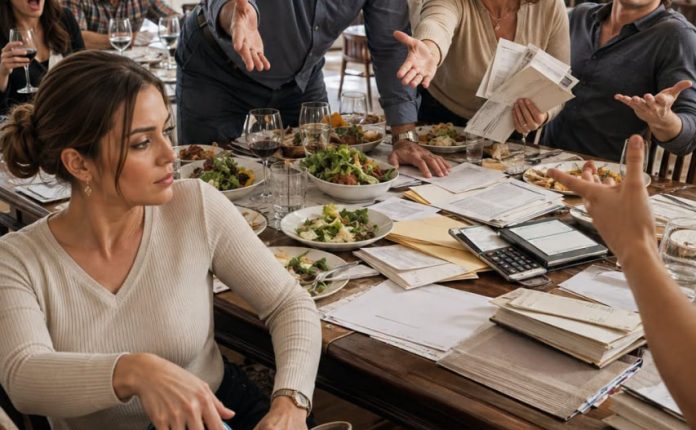
Dinner was crowded. Our dining table wasn’t large enough, so Marcus unfolded a cheap card table beside it. The chairs didn’t match. Mr. Bennett sat on a folding chair that squeaked every time he moved. Noah and his friend argued about who got the bigger dinner roll. Leah dropped a spoon. Marcus nearly spilled gravy reaching across the table. It was imperfect. It was loud. It was one of the best holidays of my life.
Halfway through dinner, Noah leaned toward me. “Dad.” “What?” “This is way better than pizza.” I pretended to be offended. “You said pizza was perfect Thanksgiving food.” “I was younger then.” “That was one year ago.” He shrugged. “I’ve changed.” I laughed. Later, when everyone was leaving, Mr. Bennett stood at the doorway with his coat buttoned crookedly.
“Thank you,” he said. “For dinner?” “For not letting me sit alone today.” I didn’t know what to say. So I shook his hand. After everyone left, the house looked destroyed. Plates everywhere. Crumbs under the table. A half-eaten pie on the counter. Two toy cars under the couch. I was loading the dishwasher when my phone buzzed.
Dad. Happy Thanksgiving. Hope you and Noah had a good day. Love you both. That was all. No guilt. No invitation designed to make me feel bad. No mention of Vanessa. I looked at it for a long moment, then replied. Happy Thanksgiving. We had a great one. Hope you did too. I put the phone down. That was the extent of our holiday conversation.
And strangely, it felt healthier than almost every Thanksgiving we’d spent in the same room. Mom also sent a message. Happy Thanksgiving, Daniel. Please tell Noah I love him. I replied: I will. Nothing more. Months earlier, I would have felt obligated to offer something bigger. A call. A visit. An emotional reassurance. Now I understood that kindness didn’t require surrender.
Before bed, I walked through the living room collecting cups. On the bookshelf sat a construction-paper turkey Noah had made at school. Each feather had something he was thankful for written in crooked marker. Pizza. Video games. My friends. Our house. Dad. I stopped. That final word hit me harder than I expected. For most of my life, I’d been asking whether I was good enough for my parents.
Successful enough. Helpful enough. Patient enough. Forgiving enough. I had measured myself against Vanessa so often that comparison had become automatic. Then Noah came along. And somehow I had almost repeated the same mistake from the opposite direction. I had become so focused on being accepted by my old family that I sometimes forgot I was building a new one.
I picked up the paper turkey. “Dad?” I turned. Noah stood at the bottom of the stairs rubbing one eye. “Why are you awake?” “Water.” I handed him the cup I’d just filled. He noticed what I was holding. “You found my turkey.” “I did.” “It’s good, right?” “The finest turkey ever created.” He grinned. Then I pointed to the largest feather. “You wrote me.”
“Obviously.” “Obviously?” He looked confused. “Yeah. You’re my dad.” Like that explained everything. Maybe it did. He started upstairs again. “Goodnight.” “Goodnight, buddy.” At the top of the stairs, he turned. “Dad?” “Yeah?” “Can we invite everybody again next Thanksgiving?” I looked around at the disaster in my living room. “Definitely.” He disappeared upstairs. I stood there smiling.
The following year, my relationship with Dad improved slowly. Not back to normal. I no longer wanted the old normal. He visited occasionally, but always asked first. He began taking Noah for breakfast once every couple of months. I stayed cautious. Trust isn’t rebuilt because somebody says sorry. It is rebuilt when their behavior becomes boringly consistent.
Mom changed more slowly. She still slipped sometimes. She still compared people without realizing it. Whenever she did, I ended the conversation. Not angrily. Just firmly. Over time, she learned. I never gave her the full access she once had. Maybe someday I will. Maybe I won’t. I’m no longer in a hurry to decide.
Vanessa and I never reconciled. A few relatives tried to intervene. They told me life was short. They told me siblings shouldn’t stay angry forever. They told me I should be the bigger person. My answer was always the same. “I wish Vanessa well. That doesn’t mean she gets access to me.” Eventually, people stopped asking.
I heard through Dad that she was doing fine. Her children were growing. Her marriage survived the financial problems. She still apparently believed I had overreacted. That was okay. She didn’t need to understand my boundary for it to exist. I didn’t forgive her in the way my family wanted. I didn’t invite her back. I didn’t pretend that time erased what happened.
Most importantly, I never again let anyone treat Noah like the lesser grandchild and expect me to smile through dinner. That Thanksgiving had begun with one sentence. “No kids. We want a quiet dinner.” For years, I thought family love was supposed to mean endurance. You swallowed insults. You accepted favoritism. You showed up. You helped. You forgave. You kept the peace.
Now I understand something different. Love without respect becomes obligation. Family without fairness becomes hierarchy. And peace purchased by making yourself smaller isn’t peace at all. The night of our second Thanksgiving, after the dishes were done and Noah was asleep, I turned off the kitchen light and stood for a moment in the darkness. The house was silent.
But it wasn’t the heavy silence I’d felt after leaving my parents’ house the year before. This silence was warm. Safe. Mine. I hadn’t destroyed my family. I had stopped participating in the version of it that required me and my son to accept less. Dad had chosen to rebuild something healthier. Mom was learning that access came with responsibility. Vanessa chose not to change, so she remained outside my life.
And I was finally okay with all three outcomes. I checked on Noah before going to bed. He was asleep diagonally across the mattress, one foot sticking out from under the blanket. I pulled the blanket over him. Then I stood there thinking about that first Thanksgiving. The babysitter. The drive. The children’s laughter behind my parents’ door. Mom saying Vanessa’s kids knew how to behave. Vanessa smiling. Me leaving.
For months, I had wondered whether that moment had cost me my place in the family. Now I knew better. I had never needed to beg for a place where my son and I were treated as optional. I hadn’t lost my seat at their table. I had simply stopped begging for one. Then I went home and built a better table of my own.
THE END!
Disclaimer: Our stories are inspired by real-life events but are carefully rewritten for entertainment. Any resemblance to actual people or situations is purely coincidental.