My mother called me four days before Thanksgiving and said, “No kids this year, Daniel. Your father and I want a quiet dinner.” I remember looking across the kitchen at my eight-year-old son, Noah, who was sitting at the table carefully separating the marshmallows from his cereal like he was performing surgery. “No kids?” I repeated.
“Just adults,” Mom said. “No running around, no yelling, no toys under the table. We thought it might be nice to have one peaceful holiday.” I should have questioned it. Instead, I swallowed the little sting in my chest and said, “Okay.” I was thirty-three, divorced, and raising Noah most of the week.
He was energetic, sure, but he wasn’t some uncontrollable tornado. He loved dinosaurs, hated mashed potatoes, and had recently discovered knock-knock jokes, which meant I heard approximately forty of them a day. But he knew how to behave at dinner. Still, my mother had always had opinions about my parenting.
My younger sister, Vanessa, apparently raised children according to some invisible royal standard. Her three kids could smear frosting across a wall and Mom would laugh about how “creative” they were. Noah could drop a fork and she’d look at me like I’d released a raccoon into the dining room. Vanessa had always been the favorite.
Nobody in our family said those exact words, of course. Families like mine rarely do. Instead, favoritism showed up in smaller things. Vanessa’s college graduation got a restaurant reservation, balloons, and a professional cake. Mine got pizza at my parents’ house because Dad had to work early. When Vanessa bought her first house, Mom spent two weeks helping her decorate.
When I moved into mine after my divorce, Mom said, “You’re independent. You’ll figure it out.” That sentence had followed me through most of my life. You’re independent. You’ll figure it out. For years, I’d treated it like a compliment. Eventually, I realized it was permission for them to give me less.
The night before Thanksgiving, I called Mom again. I was standing in my bedroom folding one of Noah’s little blue sweaters while rain tapped against the window. “I’m confirming tomorrow,” I said. “No kids, right?” Mom laughed lightly. “Yes, Daniel. You already asked me.”
“I just need to know because I’ll have to pay Rachel to watch Noah.” Rachel was Noah’s regular babysitter, a college student who lived two streets over. “I understand.” “So Vanessa’s kids won’t be there either?” There was the smallest pause. Maybe half a second. At the time, I ignored it. “It’s an adult dinner,” Mom repeated. “All right.”
After the call, I told Noah he was having a special Thanksgiving evening with Rachel. “Can we order pepperoni pizza?” “On Thanksgiving?” He grinned. “That’s why it’s special.” I laughed and promised him pizza. Before leaving the next afternoon, I knelt beside him in the living room.
“You okay without me for a couple hours?” He barely looked away from the plastic spaceship in his hands. “Dad, I’m eight.” “Right. Practically forty.” He rolled his eyes. I kissed the top of his head anyway. Driving to my parents’ house, I actually felt optimistic. Maybe without children around, Mom and I could talk. Maybe Dad and I could watch football.
Maybe Vanessa and I could get through one meal without her turning everything into a competition. The sky was pale gray, and dry leaves scraped across the road as I pulled into the neighborhood where I’d grown up. My parents’ house looked exactly the same as always: white siding, green shutters, a wreath on the door, and warm yellow light spilling through the front windows.
When I opened my car door, I could already smell smoke from somebody’s fireplace. For a moment, it felt like coming home. Then I stepped onto the porch. Before I even touched the doorknob, I heard pounding footsteps inside. Then laughter. High-pitched laughter. Children’s laughter. I stopped with my hand suspended over the brass handle.
The door suddenly flew open. A little boy came racing out wearing socks and nearly collided with me. “Uncle Daniel!” I stared at him. It was Vanessa’s oldest son. Behind him, his younger brother ran through the hallway carrying a plastic sword. Then Vanessa’s daughter shrieked from somewhere near the kitchen.
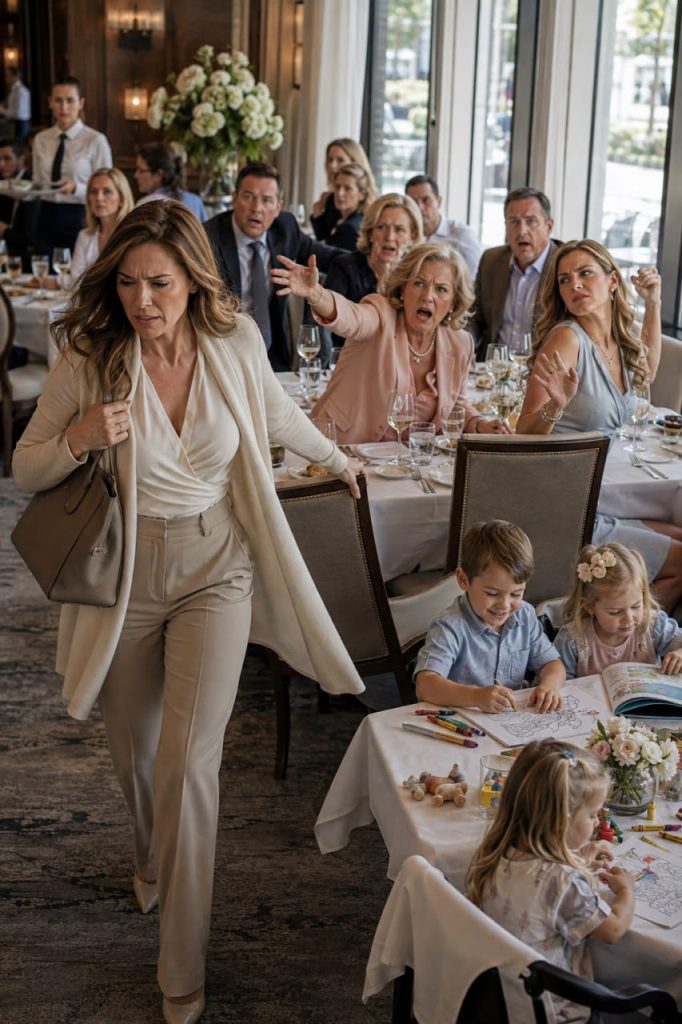
Three children. All three of them. Inside the supposedly child-free Thanksgiving dinner. And before I even asked a question, I saw my sister standing behind them with a glass of wine in her hand. Vanessa looked directly at me. Then she smiled. Not surprised. Not embarrassed. Smug. That was when I understood. The “no kids” rule had never been about kids. It had been about mine.