It was a bright afternoon when Daniel Carter noticed the homeless woman sitting alone on the sidewalk, clutching a torn backpack against her chest. For several seconds, he simply watched as people moved around her as though she were part of the pavement rather than a human being.
She sat near the entrance of a busy shopping street, her dirty gray coat hanging loosely from thin shoulders. Tangled hair fell across a tired face, and her worn shoes looked barely capable of protecting her feet from the concrete beneath them.
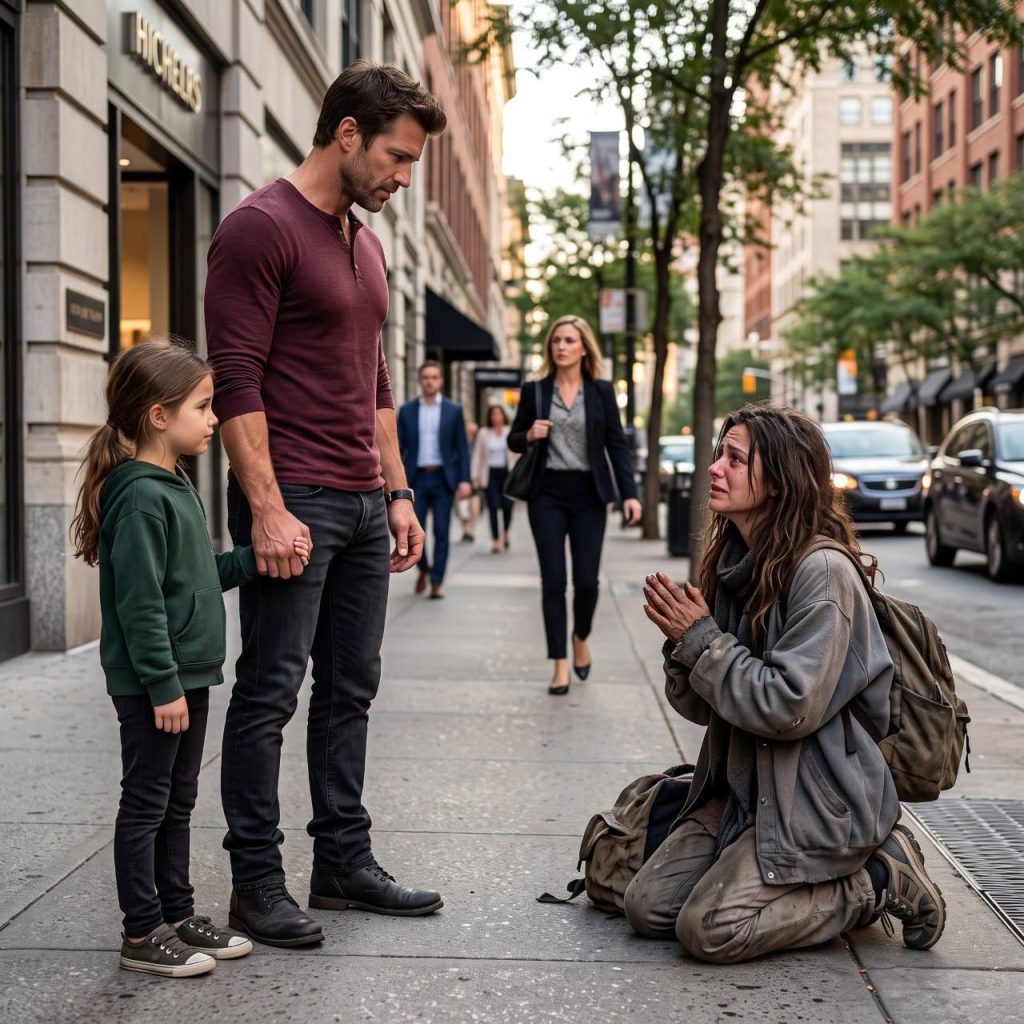
Cars rolled through the intersection. Shoppers carried expensive bags. Businessmen hurried toward meetings. Young couples laughed while walking past. Yet almost nobody looked toward the woman who seemed to have been forgotten in the middle of a crowded city.
Daniel was walking beside his nine-year-old daughter, Lily, holding her hand as they headed home after school. He already had more than enough problems occupying his thoughts. Rent was overdue, his truck needed repairs, and his wallet contained exactly twenty dollars until his next paycheck.
Then Lily stopped. She looked toward the woman and asked, “Dad, why isn’t anybody helping her?” Daniel looked at his daughter, then at the stranger, and understood immediately that whatever he did next might become a lesson Lily remembered for the rest of her life.
He could have told her they were late. He could have said somebody else would eventually help. He could have kept walking because he was struggling too. Instead, Daniel squeezed Lily’s hand and led her toward the woman.
He had no idea that before the following morning, that one decision would change his life completely. The homeless stranger sitting before him was not who she appeared to be. She was hiding a secret worth hundreds of billions of dollars.
By sunrise, Daniel would learn that the woman he invited into his modest home was Eleanor Voss, founder and majority owner of one of the most powerful corporate empires in the world—and, according to financial estimates, the richest woman alive.
Daniel Carter was thirty-eight years old and had spent the previous three years learning how to survive without the woman he once believed would grow old beside him. His wife, Emily, had died after a sudden illness that took her far faster than anyone expected.
He still remembered the final night in the hospital: quiet machines beside Emily’s bed, Lily sleeping in a chair outside the room, and Emily looking at him with exhausted eyes while asking him to promise her one thing.
“If I can’t be there to raise her,” Emily whispered, “make sure Lily grows up believing the world still has good people in it.” Daniel promised. At the time, he had no idea how difficult keeping that promise would become.
After Emily died, Daniel became everything Lily needed. He packed school lunches, learned how to braid hair badly enough to make Lily laugh, attended parent meetings after overnight shifts, cooked simple dinners, repaired broken toys, and sat beside his daughter whenever nightmares woke her.
He worked wherever work existed. During weekdays, he repaired heating and cooling systems. On weekends, he delivered appliances. Whenever money became especially tight, he accepted overnight maintenance jobs.
Daniel was not poor because he was lazy. He was poor because life had taken pieces from him faster than he could replace them. His apartment was small, filled with old furniture, and heated by a unit that made strange noises whenever winter became too cold.
Still, it was clean. On the refrigerator hung a drawing Lily made years earlier. It showed a father and daughter standing beneath an enormous yellow sun. Daniel kept it because it reminded him that no matter what had disappeared from his life, he still had something worth protecting.
That afternoon, twenty dollars was all he had. Payday was five days away, and he still needed milk, bread, eggs, cough medicine for Lily, and several other necessities. He was already mentally calculating how far twenty dollars could stretch when Lily stopped beside him.
She wore a yellow hoodie and carried her schoolbag over one shoulder. Looking toward the woman on the pavement, Lily asked quietly, “Why is she sitting there?” Daniel said maybe she had nowhere else to go.
“Is she hungry?” Lily asked. Daniel looked toward the stranger. “I don’t know.” Lily tugged gently at his hand. “Can we ask?” Daniel nodded.
When they approached, the woman slowly lifted her head. Her eyes were exhausted, but Daniel immediately noticed something unusual. She did not appear drunk or confused. She looked frightened.
Her gaze kept drifting toward passing cars and nearby windows, as if she expected somebody to be watching. Daniel crouched several feet away. “Ma’am, are you okay?”
The woman tried answering, but her voice barely emerged. Eventually, she admitted she had not eaten since the previous morning. Daniel’s stomach tightened because he knew exactly how little money remained inside his wallet.
Before he decided what to do, Lily unzipped her lunch bag and removed the granola bar she had saved for later. She held it toward the stranger. “You can have mine.”
The woman stared at Lily for several seconds. Then she accepted the granola bar with trembling fingers. Her expression changed. Tears gathered in her eyes.
“Thank you,” she whispered, holding that tiny wrapped bar as though it were something priceless. Daniel looked away briefly because he did not want Lily to see how emotional he had become.
He had always told his daughter kindness mattered, but he had never expected such a small act to affect a stranger so deeply. Daniel entered the nearby store and bought the woman a hot meal—soup, bread, fruit, and water.
It cost almost everything he had. When he returned, the woman ate slowly at first, clearly embarrassed by her hunger. Then she began eating faster as hunger overcame embarrassment.
Afterward, she tried standing, but her knees buckled beneath her. Daniel caught her before she hit the pavement. Her body felt freezing through the gray coat.
“Where do you live?” he asked. The woman stared at him for a moment and then answered quietly, “I don’t have anywhere to go.” Daniel immediately began searching for shelters.
He called one nearby. No beds. Another was full. He contacted a church, but nobody answered. Lily stood beside him listening to each failed call.
Finally, she looked at the woman and then up at her father. “Can she sleep somewhere warm?” Daniel knew exactly what the sensible answer should have been.
He was a single father responsible for a nine-year-old child. Bringing an unknown adult into his home was dangerous. He should have called authorities, continued searching for another shelter, or found some other solution.
Yet when Daniel looked at Lily, he remembered Emily’s final request. He could not teach his daughter that compassion mattered only while it remained convenient.
Finally, he said, “You can stay on our couch tonight.” He explained that Lily lived with him, that there would be strict boundaries, and that in the morning they would need to find another arrangement.
The woman nodded gratefully. “Thank you.” She introduced herself as Elena. The walk home was quiet. Lily remained close to Daniel while Elena followed several steps behind them, still holding her battered backpack tightly.
Daniel noticed something strange during the walk. Despite Elena’s appearance, she moved with unusual awareness. She checked reflections inside storefront windows, watched passing vehicles, and repeatedly glanced behind them.
“Are you in some kind of trouble?” Daniel finally asked. Elena hesitated before answering, “I made some mistakes. I just need somewhere safe tonight.”
Daniel did not press her. When they reached the apartment, he gave Elena a clean towel, an old sweatshirt, and a pair of sweatpants.
Lily placed a blanket on the couch without being asked. Daniel made tea and watched Elena hold the warm mug between both hands as though she had forgotten what warmth felt like.
Eventually, Elena noticed the photograph of Emily attached to the refrigerator. “Who is she?” Daniel followed her gaze.
“My wife.” Elena studied the photograph. “She looks happy.” Daniel smiled faintly. “She was. Especially when Lily was around.”
He admitted losing Emily had been the hardest thing he had ever survived. Elena looked down at her tea and said quietly, “Sometimes people become hard because life teaches them that kindness is dangerous.”
Daniel frowned slightly. “What do you mean?” Elena stared into the cup. “When you’ve been betrayed enough times, even help starts feeling like a trap.”
Daniel did not fully understand what she meant, but the way she spoke convinced him the words came from experience. Later that evening, Lily fell asleep quickly.
Daniel carried her to bed, pulled the blanket over her shoulders, and kissed her forehead. When he returned to the living room, Elena remained on the couch.
“Do you need anything?” he asked. Elena shook her head. Then she surprised him with a question of her own. “Why did you help me?”
Daniel smiled faintly. “I don’t have some heroic reason. My daughter was watching me. I want her to grow up believing that when somebody is hurting, you stop if you can.”
Elena studied him for a long moment. “You’re a rare man.” Daniel laughed. “You’re giving me too much credit.” She shook her head.
“No. You have no idea how much credit you deserve.” Daniel eventually went to bed, though sleep did not come easily.
He checked the front door twice, checked Lily’s room, and listened for movement from the living room. Eventually, exhaustion won.
At 4:16 in the morning, Elena opened her eyes. The frightened homeless woman Daniel met on the sidewalk seemed to disappear as she sat upright and reached for the battered backpack beside the couch.
Inside were no empty cans, spare clothing, or ordinary belongings associated with someone living on the streets. Instead, the bag contained an encrypted phone, several sealed documents, a diamond ring wrapped in cloth, and a passport bearing an entirely different name.
Elena stared at the passport for several minutes. Tears rolled slowly down her face. Her real name was Eleanor Voss.
Eleanor Voss was not homeless. She was not poor. She was founder and majority owner of Voss Global, an enormous technology and investment empire with holdings across energy, artificial intelligence, finance, real estate, and telecommunications.
Her personal fortune was estimated at more than three hundred billion dollars. That made her not merely wealthy, but the richest woman in the world.
Six months earlier, Eleanor uncovered evidence that several of the highest-ranking executives inside Voss Global were secretly stealing billions through interconnected shell corporations.
The operation was so sophisticated that even internal auditors had been manipulated. False charities were established, investment reports altered, money moved through accounts spanning several countries, and people inside Eleanor’s own security organization were paid to monitor her.
When Eleanor confronted the executives, they made a far more dangerous move. They began creating evidence designed to make it appear that she herself had orchestrated the fraud.
Her reputation started collapsing almost overnight. Then came threats. Private information was leaked. Anonymous messages were sent to members of her family.
One night, Eleanor’s vehicle was forced off the road. She survived the crash and finally accepted that she could no longer trust many of the people surrounding her.
So she disappeared. She abandoned her official identity, stopped using credit cards, separated herself from her security team, and began living under the name Elena.
Part of the decision was survival. Another part was something more personal. Eleanor wanted to know who would help her if nobody knew her name or her fortune.
She wanted to discover whether kindness existed when money could offer nothing in return. For months, she slept inside shelters, church basements, abandoned buildings, and on sidewalks.
She had been ignored by people who once begged for minutes of her attention. Strangers insulted her. Expensive cars passed while she sat in the cold. Yet she also found unexpected compassion.
A restaurant worker once gave her leftover soup. An elderly bus driver allowed her to remain aboard for an extra route when she had nowhere warm to sleep.
A teenage boy handed her his umbrella during a storm. But none of those moments affected Eleanor as deeply as Daniel and Lily.
Daniel possessed almost no money, yet he spent nearly everything in his wallet buying food for her. Lily had only one granola bar, yet gave it away without hesitation.
Eleanor had spent months searching for proof that humanity remained worth believing in. Without knowing who she was, a struggling father and his little girl had given her exactly that.
At 5:02 in the morning, Eleanor activated the encrypted phone and placed a call. She told her legal team she was safe.
Then she gave them Daniel’s address and instructed them to arrive at sunrise. She warned them not to reveal her identity until she was ready.
After ending the call, Eleanor sat quietly on the couch and watched the sky beyond the apartment windows slowly change color.
At 6:41, Daniel woke and walked into the kitchen. He found Elena standing near the window. Something about her had changed.
She no longer looked helpless. Her shoulders were straight. Her eyes were focused. Her expression carried the quiet authority of somebody used to making decisions that affected thousands of people.
“Did you sleep?” Daniel asked. Elena answered, “Enough.” Before he could ask anything more, somebody knocked on the apartment door.
Daniel froze. Another knock followed. He moved toward the peephole and saw two black vehicles parked outside.
Several sharply dressed people stood near the entrance. One man was speaking urgently into a phone. Daniel turned toward Elena.
She remained perfectly calm. “It’s safe,” she told him. “You can open the door.” Daniel hesitated, then unlocked it.
A woman wearing a dark suit stepped inside. The moment she saw Elena, tears filled her eyes. “Eleanor.” Daniel stared at the woman, then at Elena.
His mind refused to assemble what he was hearing. The woman introduced herself as Eleanor Voss’s chief legal counsel.
Then she told Daniel that the woman he had brought home the previous night was one of the most powerful and wealthy people on Earth.
Daniel initially believed there had to be some mistake. The attorney opened a tablet and showed him a photograph.
It was the same face, though polished and professionally styled, standing in an elegant black suit beside presidents, billionaires, political leaders, and global business figures.
Daniel slowly sat down. Lily appeared in the hallway wearing pajamas and rubbing sleep from her eyes.
She looked at the unfamiliar visitors, then at Eleanor. “Is Elena famous?” Eleanor walked toward her and knelt.
She smiled through tears. “A little.” Then she became more serious. “But you did something more important than knowing somebody famous.”
Lily looked confused. “What?” Eleanor took her small hand. “You reminded me kindness still exists.” Lily looked around at the people filling the apartment.
“Is that why everybody came?” Eleanor nodded. “Yes.” Daniel was still trying to process everything.
“I don’t care whether you’re rich or poor,” he finally said. “I helped because you needed help.” Eleanor looked at him steadily.
“That is exactly why I came back.” Daniel shook his head. “I only gave you a couch.” Eleanor replied, “When somebody has nothing, a couch can feel like a palace.”
But Eleanor’s return brought danger with it. The people who had tried destroying her remained inside Voss Global.
The moment word leaked that Eleanor Voss was alive, financial markets reacted immediately. Investors panicked. News organizations reported both her disappearance and her unexpected return.
Reporters surrounded Daniel’s apartment building. Cameras appeared outside the laundromat. Helicopters circled above the neighborhood.
Daniel hated every second of it. He did not want fame. He did not want money. He wanted Lily to have a normal life.
Eleanor offered to move Daniel and Lily into secure housing. Daniel refused. “If you really want to help me, help me find stable work.”
That answer surprised her. “You don’t want anything else?” Daniel shook his head. “I don’t want charity. I want dignity.”
Eleanor studied him with renewed respect. Then she asked, “What would you do if money weren’t the problem?”
Daniel thought about it. He had spent years repairing machines, heating systems, and equipment. He had also met countless single parents who worked relentlessly and still remained trapped financially because they could not afford training or childcare.
“I’d build something for people like me,” he said. “A place where single parents could learn skilled trades and get connected to stable jobs.”
Eleanor listened carefully. Daniel explained that many hardworking people did not need lectures about motivation. They needed practical training, childcare, apprenticeships, and a real opportunity.
“How much would you need?” Eleanor asked. Daniel laughed. “I never got that far. I never had enough money to make the question useful.”
Eleanor smiled slightly. “Figure out the number.”