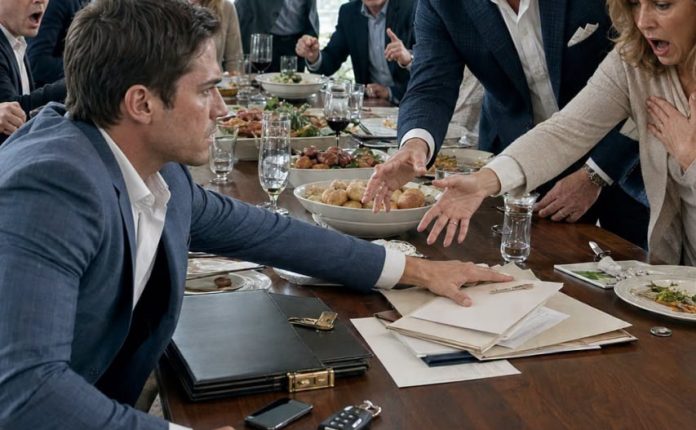
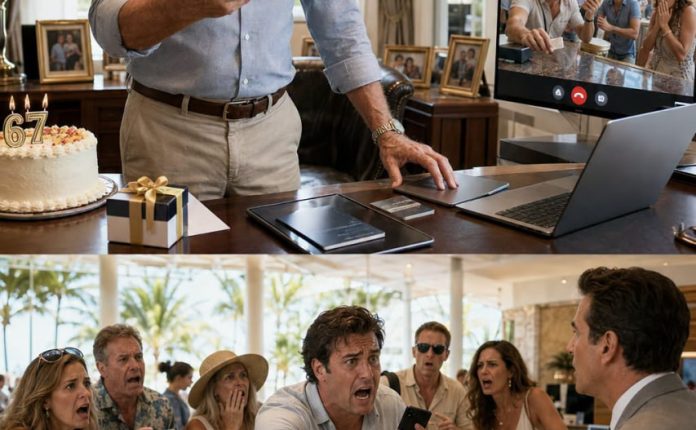
The third email from my daughter-in-law arrived while I was sitting forty-eight floors above her. I had just finished reviewing quarterly projections when my computer chimed. The subject line read: URGENT — REQUEST FOR MEETING WITH CEO. Vanessa Whitmore had somehow managed to make the word urgent look offended.
I leaned back in my chair and looked through the glass wall of my corner office. Downtown Chicago shimmered beneath a pale afternoon sky. Cars looked like colored beads threading between buildings. Inside, the only sounds were ventilation and the soft clicking of my assistant’s keyboard outside.
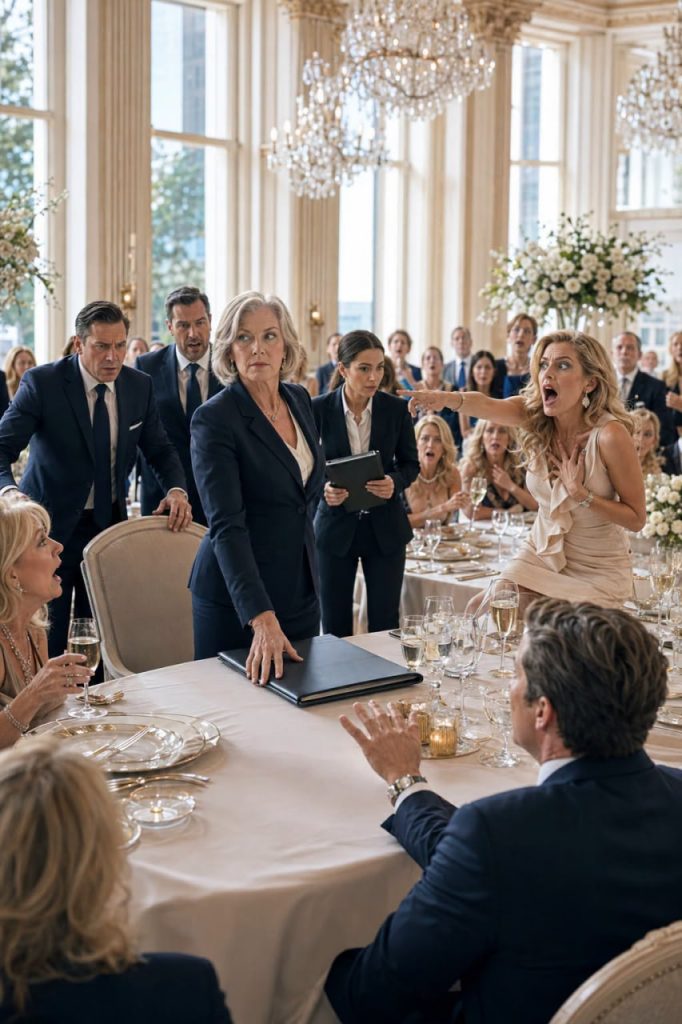
Then Grace Patel stepped through my doorway carrying a cup of tea. “Your daughter-in-law is downstairs again.” I looked up. “Again?” Grace nodded. “Lobby reception says she’s insisting she has an appointment with the CEO.”
“Does she?” Grace gave me the expression of a woman who had worked beside me for fourteen years and had long ago stopped being surprised by wealthy people inventing reality. “No.”
I opened the security feed. There she was. Vanessa stood beneath the enormous Meridian Group logo in our marble lobby wearing a cream designer suit, pointed heels, and the expression of someone convinced inconvenience existed only because other people were incompetent.
She paced near reception. Even without audio, I recognized the movements: phone raised, hand slicing through the air, head shaking while a receptionist listened patiently. Vanessa had married my son, Nathan, two years earlier.
In those two years, she had never once asked what I actually did at Meridian. She thought she knew. I had allowed her to. “How long has she been downstairs?” I asked.
“Long enough to ask reception whether they understand who her husband is.” I smiled despite myself. Nathan was a successful project architect with his own firm.
After college, he had refused every offer I made to bring him into Meridian because he wanted to build something without my name attached. Vanessa somehow interpreted that independence as another form of prestige.
“Should security remove her?” Grace asked. “No.” I stood. “Turn my nameplate around.” Grace glanced toward the silver plate sitting on my desk.
EVELYN HART
CHIEF EXECUTIVE OFFICER
She grinned. “Oh, this is going to be educational.” I slipped into the plain navy cardigan I kept behind my office door and removed my executive badge.
From my bottom drawer, I pulled out another credential.
EVELYN HART
EXECUTIVE ADMINISTRATION
It was not fake. Years earlier, after watching employees become artificially polite whenever an executive suit entered a room, I began making unannounced rounds through Meridian facilities without displaying my CEO credentials.
Those rounds had taught me more about my own company than dozens of board reports. Vanessa had seen that badge several times. Apparently, she had never read beyond the word administration.
By the time the elevator doors opened into the lobby, her voice was carrying across the marble. “I’ve emailed three times. This gala could bring enormous visibility to Meridian.”
The receptionist noticed me and wisely said nothing. I approached carrying a stack of folders beneath one arm. “Vanessa?” Her shoulders dropped.
Not in relief. In disappointment. “Oh. Evelyn.” She glanced quickly toward the elevators as though embarrassed the wrong relative had appeared.
“Visiting Nathan?” I asked. “I’m here on foundation business.” “How exciting.” Vanessa lowered her voice. “It’s actually very important. I’m trying to meet your CEO.”
My CEO. I adjusted my glasses. “Do you have an appointment?” Vanessa frowned. “There seems to be some confusion about that.”
I glanced toward reception. “There isn’t.” Her mouth tightened. “I’m hosting the Whitmore Foundation Gala next month. There will be investors, philanthropists, civic leaders. Meridian would benefit enormously from being associated with our family name.”
“Would it?” She missed the question completely. “Absolutely.” She pulled a glossy brochure from her handbag. Gold lettering. Formal gowns. Champagne glasses. The ballroom received more visual attention than any human being the charity supposedly served.
I already knew the financial figures behind that brochure. The previous year’s gala had spent more money creating the appearance of generosity than it had spent helping anyone.
Vanessa tapped the cover. “If you could just walk this upstairs and put it on the CEO’s desk, that would save everyone a great deal of trouble.”
“I can submit it through the normal review process.” She laughed softly. “Evelyn, I don’t need it stuck in some administrative pile. I need the CEO to see it.”
“I understand.” “Good.” She pressed the brochure into my hands. Then she leaned closer. “And maybe don’t mention we’re related.”
I looked at her. “Why?” Vanessa’s smile became uncomfortable. “No offense. I’m just trying to maintain a certain professional image.”
I remembered the dinner party three months earlier when she had introduced me to a table full of her friends. “This is Nathan’s mother. She works as a secretary at some corporate office.”
Some corporate office. My corporate office. Nathan’s face had tightened that evening. I squeezed his hand beneath the table before he could correct her.
I wanted to discover how far Vanessa would go if nobody protected her from her own assumptions. Apparently, she intended to go much farther.
“You understand how these rooms work,” she said. “People make judgments.” I smiled faintly. “Yes, Vanessa. They do.” She relaxed, believing we finally agreed.
Then she turned toward the entrance and stopped. “Oh, Nathan’s birthday dinner is next Friday.” “I remember.” Vanessa said, “We’re keeping it small. Just people from our circle.”
The marble beneath my shoes suddenly felt colder. “So I’m not invited?” She made a sympathetic face that irritated me more than cruelty would have.
“You’d probably feel uncomfortable.” I nodded once. “I see.” Then she added, “And I need the Hart family pearls.” Of course she did.
Those pearls had belonged to my grandmother. Vanessa liked my jewelry considerably more than she liked me. “I’ll have them delivered.”
“Could you leave them with Rosa? The service entrance would be easier.” For several seconds, I simply stared at my daughter-in-law.
She had just asked the woman whose company employed thousands of people to deliver a family heirloom through the service entrance so her dinner guests would not have to see her.
I smiled. “Of course.” Vanessa walked away, her heels clicking against marble. When the doors closed, the receptionist looked toward me.
Grace had come downstairs and stood near the elevator. Neither woman said anything. I looked down at the glossy gala brochure in my hands. “Pull the Whitmore Foundation financials,” I told Grace.
Her smile disappeared. “Everything?” I nodded. “Everything.” Until that moment, Vanessa’s snobbery had merely been a family irritation.
Now she wanted my company attached to her name, and before Meridian gave her one dollar, I intended to discover exactly what that name was buying.
The first thing I noticed in the Whitmore Foundation accounts was not fraud. It was vanity. That almost made it worse.
By six that evening, Grace had covered my conference table with expense reports, vendor contracts, event proposals, and public filings. The office smelled faintly of coffee and printer toner.
I stood beside the windows while she read figures aloud. “Venue rental. Floral installation. Photography. Luxury transportation. Entertainment consultants.” I asked, “Programs?” Grace turned another page.
“Very little.” The Whitmore Foundation was not stealing money. It was doing something more socially acceptable and, in my opinion, more insulting. It was spending enormous sums pretending to care.
Vanessa’s proposal talked about “uplifting underserved families” in language polished enough to belong in a perfume advertisement. Yet not one representative from those families had been invited to the gala.
The people supposedly being uplifted were not guests. They were decorations in the brochure. I sat down. “How much of the planned budget reaches actual beneficiaries?” Grace slid a sheet toward me.
“Less than twenty percent.” I rubbed my thumb along the paper. Meridian’s charitable arm had one nonnegotiable policy: if our name appeared beside a project, the work had to matter.
Not look like it mattered. Actually matter. Grace studied me. “Standard rejection?” I almost said yes. Then my phone buzzed.
Nathan.
Mom, whatever Meridian sent Vanessa has her pacing around the kitchen like she’s preparing for war. Please tell me you aren’t about to destroy my marriage for entertainment.
I laughed and typed back: Your marriage is safe. Her assumptions may not be. Three dots appeared immediately.
Mom.
I ignored him. “Draft a conditional response,” I told Grace. Her eyebrows lifted. “Conditions?” I dictated slowly.
“Meridian will consider partnership if at least seventy-five percent of raised funds go directly to programs or beneficiaries.” Grace typed.
“Community representatives must participate in planning and attend the event. Administrative and entertainment costs must be fully transparent.” Grace looked up. “She’s going to hate this.”
“I’m not finished.” I smiled. “All primary organizers must complete Meridian’s community outreach orientation.” Grace stopped typing. “For how long?”
“One week.” Her smile returned. “And who will supervise Vanessa?” I picked up the administrative badge beside my laptop. “I will.”
The response went out from the Office of the CEO that evening. Vanessa called me before eight the next morning. I was barefoot in my kitchen making toast.
That was the strange thing about power. People imagined it came with background music. Mostly, it came with crumbs on the counter and unanswered email.
“Evelyn, I need a favor.” I spread jam on my toast. “What kind?” Vanessa said, “Meridian agreed to reconsider the gala.”
“Wonderful.” “No, not wonderful. They want me to do volunteer training.” I replied, “That sounds reasonable.” “It’s ridiculous.”
“Why?” “I’m the foundation chair.” I said, “Then perhaps you should understand the communities your foundation serves.” Silence followed.
I could almost hear Vanessa trying to decide whether I was intelligent enough to be sarcastic. Finally, she sighed. “They assigned you as my supervisor.”
“They did?” “Evelyn.” I said, “I suppose we should both try to make the best of it.” Vanessa exhaled. “This is humiliating.”
The word caught my attention. “Working with me?” “That’s not what I meant.” It was exactly what she meant.
She recovered quickly. “I simply have important responsibilities.” I replied, “So do the people at the community center.” Another pause.
“Fine. I’ll be there Monday.” Monday morning, Vanessa arrived at Meridian Community House in shoes that had probably never touched a floor they could not scratch.
The center occupied a renovated brick building on Chicago’s west side. Sunlight poured through tall windows. Folding tables filled the main room. Shelves held backpacks, books, winter coats, donated laptops, and boxes of school supplies.
Children’s artwork covered one wall. Someone had burned coffee in the staff kitchen. The building smelled like cardboard, detergent, dry-erase markers, and possibility.
Vanessa stepped inside and stared around. “This is Meridian?” I answered, “This is part of Meridian.” Grace handed her a volunteer apron.
Vanessa looked at the apron, then at me, then back at the apron. “You’re really supervising this?” “I’ve worked with these programs for twenty-three years.”
Her eyebrows rose. “Twenty-three?” “Yes.” She tied the apron reluctantly. “And you never advanced?” The volunteer standing beside me nearly dropped a box.
I kept my face neutral. “Some positions are more advanced than they appear.” Our first task involved sorting donated school supplies.
Vanessa picked up a used backpack. “People donate these?” “People donate what still has value.” She frowned. “Wouldn’t it be easier to buy everything new?”
“Sometimes.” I unzipped the front pocket and found a folded note. I handed it to her. Vanessa read silently.
This backpack got me through four years of college. I hope it carries someone else somewhere good.
Vanessa stared at the handwriting. Something in her expression changed for only a second. Then she carefully folded the note and returned it to the pocket.
By noon, one of her nails was chipped. By two, she had stopped checking her phone every few minutes. By four, I noticed she was reading every note attached to every donation.
She did not know I was watching. For the first time since she married Nathan, I began wondering whether Vanessa was merely shallow—or whether nobody had ever forced her to look beneath the surface.
On Tuesday, Vanessa arrived wearing flats. I noticed immediately and said nothing. She wore tailored pants, a simple blouse, and no jewelry besides her wedding ring.
Her hair was still immaculate, but she no longer looked dressed for a magazine shoot. Eventually, I said, “You changed shoes.” She looked down.
“The other ones were stupid.” I smiled. “Your word, not mine.” Vanessa gave me a narrow look and then surprised me by laughing.
It was the first genuine laugh I had ever heard from her. Most of that morning was spent working through distribution records.
The Whitmore Foundation claimed to serve several of the same neighborhoods Meridian had supported for years, which meant Vanessa finally had to look at names instead of statistics.
She traced one finger down a list. “These are actual families?” “Yes.” “I mean, you’ve met them?” “Many of them.”
Vanessa looked toward volunteers assembling school kits. “Why weren’t any of these people suggested for our gala?” I answered, “That’s a question for the person who created the guest list.”
Her mouth tightened. She had created it. Before lunch, Nathan arrived carrying two large boxes of donated computer equipment. Vanessa froze.
“What are you doing here?” Nathan looked at her, then me. “Hello to you too.” “No, seriously. Why are you here?”
He set the boxes down. “I volunteer here.” Vanessa stared. “Since when?” Nathan replied, “Years.” “What do you do?” “Whatever needs doing.”
A group of teenagers noticed him across the room. “Nate!” Nathan raised one hand. One boy hurried over and immediately started asking him about an engineering project.
Vanessa watched her husband crouch beside a table and examine a homemade robot built from cheap components and stubborn optimism. Her expression became almost wounded.
“You never told me.” Nathan looked up. “I did.” “When?” “Several times.” Vanessa shook her head. “No, you didn’t.”
“I said I volunteer with the Meridian STEM program every month.” Vanessa replied, “You said you had a community thing.”
Nathan answered quietly, “Because whenever I tried to explain it, you changed the subject.” Her face reddened.
“I don’t do that.” Nathan said nothing. That silence did more damage than an argument. I turned away and started stacking folders to give them privacy.
A few minutes later, Vanessa joined me. She was unusually quiet. “You knew he came here.” “Yes.” She sighed. “Of course you did.”
“He started volunteering when he was seventeen.” Vanessa looked toward Nathan again. “I thought he spent weekends networking.” I said, “He does.”
Her eyes moved back to me. “With children?” “With people.” That seemed to bother her more. After lunch, a young woman came rushing through the doors.
“Evelyn!” I turned just before she wrapped both arms around me. “Talia!” Talia Brooks first walked into Meridian Community House at twelve years old with a backpack held together by duct tape and a reading level two grades behind.
Now she was twenty-four, and she was crying. “I got in.” I stepped back. “Got in where?” Her smile was so wide she could barely speak.
“Medical school.” I grabbed her hands. “You did it.” Talia shook her head. “We did it.” “No. You did it.”
Vanessa stood several feet away. Talia noticed her and wiped her cheeks. “Sorry. I’ve been working toward this forever.” Vanessa smiled. “Congratulations.”
Talia turned back to me. “My mom is going to lose her mind. She still talks about you sitting at our kitchen table helping me fill out scholarship forms.”
“I remember her feeding me enough food for six people.” Talia laughed. “She still does that.” Vanessa looked between us.
“How long have you known each other?” Talia answered, “Twelve years. Mrs. Hart basically watched me grow up.” I saw Vanessa flinch at Mrs. Hart.
Not Evelyn the secretary. Not Nathan’s mother. Someone with a complete existence Vanessa had never bothered to investigate.
Talia continued, “The Meridian CEO even approved my first scholarship personally.” Vanessa’s attention sharpened instantly.
“You’ve met the CEO?” Talia blinked. “Of course.” “Recently?” “She’s around all the—” I stepped between them.
“Talia, could you show Vanessa our healthcare internship program?” Talia looked at me and understood immediately. “Sure.” Vanessa followed her down the hallway but glanced back twice.
Nathan appeared beside me. “You’re playing with fire.” “I’m giving her room to notice.” He replied, “She almost noticed.”
“Almost isn’t the same as understanding.” Nathan folded his arms. “How long are you going to keep pretending?” I answered, “I’m not pretending.”
“You wear a different badge around her.” “Because she decided what it meant without asking.” Nathan sighed. “Mom.”
I watched Vanessa through the glass wall of the internship office while Talia showed her photographs from a summer program. For once, Vanessa was not looking at her phone or checking her reflection.
She was listening. Nathan said quietly, “She told me your job embarrassed her.” I did not answer.
“I told her she owed you an apology.” I said, “I don’t want an apology she gives because you ordered it.”
“What do you want?” I thought about that. “Evidence.” Nathan asked, “Of what?”
“That she can respect someone before knowing what that person can do for her.” Nathan studied me for several seconds, then nodded.
Before leaving that evening, Vanessa found me near the supply shelves. “Can I ask you something?” “Of course.”
“Why does the CEO come here so often?” I continued stacking notebooks. “Maybe she knows where the important work happens.” Vanessa studied my face. This time, she did not laugh.
I realized the lesson was beginning to work. What I did not realize was that the following morning, Vanessa would overhear something that almost exposed everything.