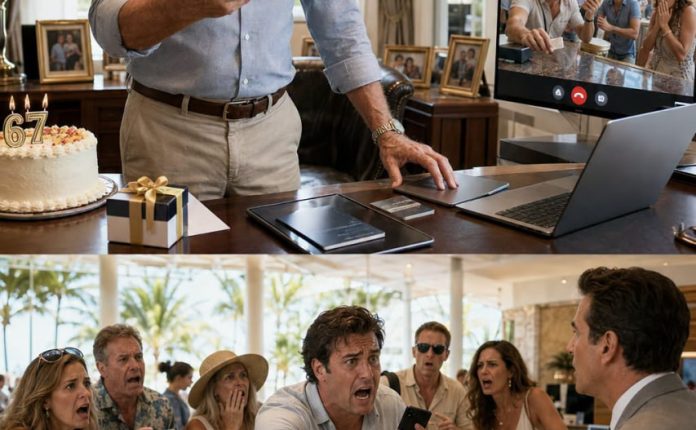
Mason stepped between us and told me to calm down before I turned everything into something enormous. I stared at him. “I am calm.” His eyes moved toward Dad too quickly, too nervously, before returning to me. “This isn’t all about you.” I had never claimed it was.
Dad suddenly snapped at Mason to stay out of it. That was the second warning. My father usually dragged Mason into every argument because Mason automatically defended him. Now Dad desperately wanted his favorite son silent. I looked from one man to the other.
“What is the $22,000 for?” Dad’s face hardened. “I told you.” “No. You told me not to ask.” He insisted it did not matter. I reminded him that it had mattered enough for him to humiliate me in front of twenty-four relatives.
Aunt Patricia quietly told him he should probably answer. Dad turned toward her and called it family business. Patricia glanced around the crowded room. “We are the family you just made it everybody’s business in front of.” Several people shifted uncomfortably.
Dad glared at her, then at me. Mason rubbed the back of his neck, something he had done since childhood whenever he was caught lying. I pointed at him. “Does this involve you?” “No.” The answer came too quickly. Dad stepped forward and ordered me to drop it.
Now I knew. I laughed once without humor. “You called me for twenty-two thousand dollars because Mason has a problem.” Mason told me I knew nothing. “Then tell me I’m wrong.” Silence answered. Natalie, Mason’s wife, stared at him. “Mason?”
His reaction interested me. Apparently Natalie did not know either. Dad declared that everything had gone far enough. I reminded him he had publicly announced that I refused to help the family, so now everyone deserved to know what I had supposedly refused to pay for.
Mason finally whispered, “I made a mistake.” Dad immediately snapped, “Stop talking.” Every head turned. Mason’s jaw tightened. “For once, Dad, maybe I should.” I had never heard him speak to our father that way. Mom slowly sat down and asked Mason what had happened.
He admitted he had fallen behind on something. Natalie asked what kind of something. Mason avoided her eyes. Dad insisted it was handled. I almost laughed. “With my $22,000?” Dad stepped closer and said he had planned to pay me back.
I reminded him he had not even intended to tell me what I was lending him money for. He accused me of making everything sound worse. “How can I make it sound like anything? You still haven’t explained it.” Mason finally admitted he borrowed money for a business opportunity.
Natalie’s face went blank. “What business opportunity?” Mason called it a small investment. She asked how much. He would not answer. Dad told Natalie this was neither the time nor place. She turned toward him. “You knew?” Dad looked away, which answered her question.
The room transformed. Minutes earlier, everyone had been watching the selfish son. Now the attention shifted toward Mason and Dad. I expected that moment to feel like justice after years of being blamed for everything. Instead, it felt like standing in the wreckage of a building I always knew was unstable.
Dad pointed toward me. “This is what you wanted.” I stared at him. He accused me of wanting everyone against him. The claim was so absurd I almost admired it. “You called the meeting,” I said. He argued that dinner was not a meeting.
“You stood up holding a glass and told everybody to remember what I did,” I reminded him. “You didn’t ask privately. You didn’t explain. You wanted an audience. Now you have one.” His face tightened. Mom started crying quietly, and that stopped my anger.
I walked toward her. “Mom.” She shook her head. “I just wanted one dinner. No fighting. No money. No secrets.” Dad immediately interrupted and told her not to pretend I had not caused the problem. Mom looked at him, and something changed.
For most of my life, she softened every sharp edge Dad created. That night she did not. “No, Richard.” He blinked. Mom wiped her cheek. “You caused this.” Dad stared at her as though she had spoken another language, then pointed toward me again.
“He was going to take the house away the second I didn’t do what he wanted.” I shook my head. “You still don’t understand.” Dad demanded to know what he had missed. I raised the folder. “I didn’t take anything away. It was never yours.”
The anger that flashed across his face revealed something important. He had already begun thinking of my gift as an entitlement. He had not thanked me. He had not apologized. In less than twenty minutes, he had mentally claimed the house as something I owed him.
I walked toward the front door. Dad followed and asked where I was going. “Home.” He demanded to know whether that was it. “For tonight.” Then he accused me of punishing Mom because I was angry with him. My hand stopped on the doorknob.
That accusation had controlled me for years. I turned around. “I’m not punishing Mom.” Dad said if I took the house away, she would suffer too. I looked at her face, and it broke my heart. Still, I said the sentence I should have learned years earlier.
“I can love Mom without financing you.” Then I stepped outside. My phone began vibrating before I reached the car. Dad. Mason. Dad again. Aunt Patricia. Natalie. I ignored every call. Twenty minutes into the drive, however, one message made me pull onto the shoulder.
It was from Mom. Please don’t give him the house. There’s something else you don’t know. I called immediately. She did not answer the first time or the second. Headlights swept across my windshield while cars passed. Then my phone finally rang.
Mom’s voice was barely above a whisper. She told me Dad had known about Mason’s money problem for months. Since spring. I said, perhaps too quickly, “Good.” Mom became silent, so I explained that I did not mean Mason’s problems were good.
“What I mean is that it confirms Dad only called me when he wanted my money.” She understood. I asked what else had happened. Mom exhaled. “Your father promised Mason he would help.” I asked with what money. “That’s the problem.”
Dad had been moving money around. Their savings. My stomach dropped. I asked how much. Mom did not know. “How do you not know?” I asked before regretting the sharpness in my voice. “Because he handles the accounts.” Of course he did.
Dad had always insisted finances were his responsibility. Mom knew enough to buy groceries and pay small household bills, but major decisions belonged to him. I had assumed she accepted that arrangement. Now I wondered how much actual choice she had ever possessed.
“Mom, do you have access to the accounts?” She did. “Then look.” She hesitated. I softened my voice. “Not for me. For you. You need to know what you have.” Mom was quiet before admitting, “I’m scared to.”
That sentence hurt more than anything Dad said during dinner. My mother was sixty-two. She had worked on and off throughout adulthood, raised two sons, managed the house, cared for her own mother near the end of her life, and she was frightened to open a bank account containing her own money.
“Whatever is there is already there,” I said. “Not looking won’t change it.” She promised to check in the morning. I returned to my hotel because I had an early flight. Around midnight, Dad left a voicemail that began wounded and ended furious.
“Caleb, I don’t know what you think you proved tonight.” Then his voice hardened. “You made your mother cry.” Not I made your mother cry. Me. He said I embarrassed Mason and made him look like some kind of monster.
Finally, he said, “I hope that house is worth losing your family over.” I listened twice, not because I enjoyed hearing it, but because every few sentences I felt myself wondering whether I had been too harsh. That was the conditioning Dad had built inside me.
He could insult me in front of twenty-four relatives, demand thousands without explanation, conceal Mason’s financial mess, and I would still lie awake wondering whether my tone had been respectful enough. So I saved the voicemail. The next afternoon, I landed in Atlanta and found six missed calls from Mom.
I called immediately. Her voice sounded hollow. “There’s almost nothing left.” I sat inside an empty row of airport seats. She meant their savings. My parents had spent years building a modest cushion, not enough to make them wealthy, but enough for emergencies and medical bills.
Most of it was gone. “Mason?” I asked. Yes. Dad had given him some directly. The rest had disappeared into late payments, fees, and more attempts to rescue him. I closed my eyes as the real purpose behind the twenty-two-thousand-dollar demand became obvious.
Dad had not called because the family suddenly needed money. He had already drained most of their financial safety net rescuing Mason and needed me to refill the hole before Mom discovered what he had done. The house I bought was supposed to eliminate their housing insecurity.
Instead, Dad nearly turned it into the final piece of his bailout plan. Mom whispered, “I feel so stupid.” I told her not to. I asked her to move whatever remained into an account only she could access. She hesitated because Dad would be furious.
“I know.” She asked what happened after that. I said, “Then you decide what you want your life to look like.” A long silence followed. Finally, Mom said, “Caleb, I don’t think I want it to look like this anymore.”
For the first time, I realized the house might still save one of my parents, just not the parent I had originally intended. Yet I did not immediately offer it to Mom. That surprised even me because the older version of myself would have rushed to fix everything.
Old Caleb would have solved the problem before she finished explaining it. New Caleb had begun learning that rescuing people too quickly could become another method of taking choices away. So I asked Mom only one question. “What do you want to do?”
She did not know. That was okay. Three days later, Dad texted me: We’re ready to move. Send the address. I stared at the message in disbelief. There had been no apology, no discussion, and no explanation. He had simply decided the house belonged to him anyway.
I typed, There is no move. The house is not for you. His reply came immediately. So you are punishing your mother. I ignored him and called Mom instead. She confirmed Dad had told her I would eventually come around. She knew I had not.
I asked whether he had apologized. Mom actually laughed, but it was a sad sound. “You know your father.” I told her, “That sentence is the problem.” She went quiet. “I know that too.” Dad called next. I nearly ignored him but answered.
“You think you’re funny?” he demanded. I said no. He accused me of humiliating him in front of the family, waving a house in his face, and then yanking it away. I reminded him I had brought the documents because I originally planned to give him the house.
“Then give it,” he said. I sat very still. “You really believe you’re entitled to it.” Dad answered that a son should honor his parents. I asked whether a father had any obligation to honor his son. Silence followed before he dismissed the question as “therapy nonsense.”
I laughed because I had never mentioned therapy. Dad started mocking words such as boundaries and respect as things people used when they wanted to avoid responsibility. I reminded him that he had demanded $22,000 to cover Mason’s mistakes. “I was protecting your brother,” he replied.
“With Mom’s savings.” Dad answered, “He’s family.” I asked, “And Mom isn’t?” He inhaled sharply and told me to watch myself. Something broke loose inside me. “No. You watch yourself.” My own voice surprised me because I had spent my entire life lowering it around him.
Not that day. I told him exactly what he had done: emptied the savings Mom thought she had because Mason kept making mistakes, called me to fill the hole, refused to say why, then publicly labeled me selfish when I did not obey immediately.
“You have money,” Dad answered. “That sentence right there is why you’ll never live in that house.” He went quiet. I told him he did not see the twelve-hour duty days, delayed flights, missed holidays, airport hotels, exhaustion, or responsibility of carrying hundreds of people through the sky.
“Poor Caleb,” he said sarcastically. The sarcasm was automatic. I answered, “Exactly.” He seemed confused. I explained that his reaction was precisely what I was finished tolerating. I was done trying to convince him that my work, time, success, and needs counted.
Dad called me dramatic. “No,” I said. “I’m unavailable.” Then I hung up. My hands shook afterward. Boundaries sound clean when people describe them abstractly. In reality, they often feel like guilt or grief, like you are doing something terrible simply because you stopped allowing somebody else to do something terrible to you.