Evelyn approached me near the cake. “You walked in.” “I almost didn’t.” “But you did.” “Why did that matter?” She glanced toward the crowded room. “Your grandfather needed you to show up to your own life.” “What happens Monday?” “Bring the envelope.” “I’ve earned an answer.” Evelyn almost smiled. “Your grandfather thought you’d say that.”
That night, the envelope lay beside the watch on my nightstand. I kept my promise. I waited until Sunday morning. Then I opened it. Grandpa’s handwriting wobbled across three pages. I read the letter once. Then again. Then I sat on the edge of the bed and cried without making a sound.
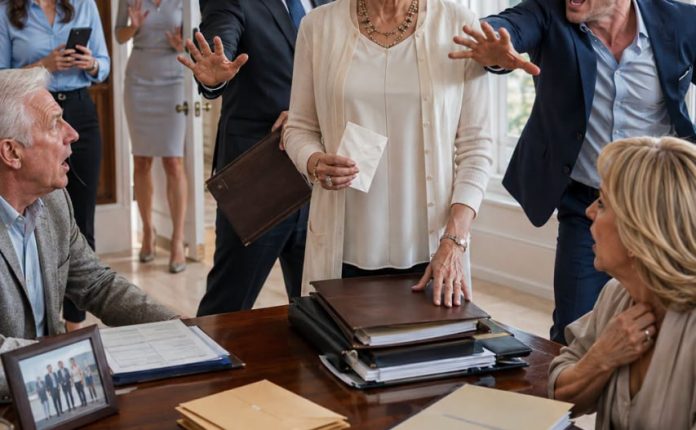
Monday morning, Caleb and I entered the offices of Mercer & Holt above Millbrook’s main square. Dad came too. He sat beside me without being asked. Across the table sat Mom, Denise, and Raymond. Three siblings. Three separate lawyers. Three expressions built from different versions of fear. Evelyn entered carrying her portfolio.
“Before I read Samuel Whitaker’s will,” she said, “he instructed me to explain something.” My mother crossed her arms. Evelyn continued. “Samuel executed this will more than a year before his death. His physician documented his mental capacity. Independent witnesses signed it. Any challenge based on incapacity is unlikely to survive.” Raymond shifted.
Evelyn looked directly at the three of them. “Your father believed that once he was dead, his children would fight over what he left.” No one spoke. “He was particularly concerned that the fighting would be directed toward Claire.” My mother’s jaw tightened. “So Samuel constructed his estate plan in two parts.”
Evelyn opened the document. “The farmhouse, surrounding land, and controlling interest in Whitaker Building Supply are left to Claire Bennett.” Raymond half stood. Denise gasped. My mother didn’t move. “The combined valuation is slightly above four million dollars.” I held Grandpa’s watch inside my pocket. I had suspected.
Still, hearing it felt unreal. Evelyn continued. “Samuel also left each of his three children one hundred thousand dollars.” Mom finally breathed. Then Evelyn added, “Subject to one condition.” My mother closed her eyes. She already knew. I realized that immediately. Evelyn began reading Grandpa’s words.
“How my children treat my granddaughter after I am gone and unable to protect her shall reveal more about their character than any promise made while I lived.” My skin prickled. “Any child of mine shown through clear evidence to have deliberately isolated, publicly humiliated, defrauded, intimidated, or sabotaged Claire shall forfeit that bequest.”
The room became completely still. Evelyn looked toward my mother. “Patricia, your bequest has been forfeited.” Mom shot to her feet. “This is insane.” Evelyn calmly removed a sheet of paper. My wedding website login history. Eighty-eight RSVPs. One device. One session. My mother’s account. Then came signed statements.
The venue coordinator’s report. Witness accounts from the rehearsal dinner. Messages from relatives. My mother’s own group-chat posts. She had spent months building a case against me. Without knowing it, she had actually been building the case against herself. My mother stared at the documents as though they had personally betrayed her.
“This is entrapment.” “No,” Evelyn said. “Your father did not require you to do anything.” “He knew!” “He suspected.” “He set me up to fail.” Evelyn’s expression barely changed. “He gave you one hundred thousand reasons not to torment your daughter.” Mom turned toward me. “You knew.” “No.”
“You sat beside him for two years while he planned this.” “I sat beside him because he was dying.” “You poisoned him against us.” That finally made me speak. “I changed his sheets.” My mother stopped. “I cleaned him when he couldn’t clean himself. I read him baseball scores.”
“I sat beside him when he was scared.” My voice stayed surprisingly steady. “You were in the kitchen asking what the farmhouse was worth.” Raymond jumped in. “Undue influence. She controlled his care.” Evelyn didn’t even look surprised. “Samuel predicted you would use those exact words.” Raymond’s face reddened.
“His physician documented capacity. Two independent witnesses observed the signing. Claire did not know the contents of the will.” Evelyn flipped another page. “And for twenty-six months, Claire refused payment for nursing services that would have cost the estate a substantial amount through an agency.” Raymond sank back into his chair. Denise began crying.
“Patricia dragged me into this.” I turned toward her. “You were sitting beside her when she canceled the invitations.” “I didn’t understand—” “You laughed.” Denise’s tears stopped. “You told her she was terrible like it was a compliment.” Evelyn added, “There is also the matter of the anonymous nursing-board complaint.”
Denise went pale. “We have requested that the source be preserved. If the complaint proves deliberately false, you may want separate counsel.” Denise stopped speaking entirely. Interestingly, Grandpa’s conduct provision had not been triggered against Denise or Raymond based on the evidence Evelyn had formally verified by the reading. Their individual bequests remained.
Only Mom lost hers. I watched the realization spread between the three siblings. It was almost surgical. Raymond looked at Mom like she’d personally burned his inheritance. Denise looked at Raymond. Mom looked at both of them and understood that the alliance holding them together had always been made of money.
Then I removed Grandpa’s letter from my bag. “I opened this yesterday.” Mom stared at it. “Grandpa told me I could after the wedding.” I unfolded the pages. “There’s something he wanted me to hear after I knew who everyone had chosen to be.” Then I read.
“Claire, if you’re reading this, you’re married. I hope the room was full. If it wasn’t, I hope you walked in anyway. The money isn’t the gift. Money is only money. The gift is certainty. You spent your life wondering whether you were difficult to love because the people who should have loved you easily made it feel difficult.”
“I want you finished with that question. You stayed when there was nothing to gain. You sat beside me when I could give you no good days back. The others counted what I owned. You counted the hours I was comfortable. That is why I chose you.”
“If my children failed the provision I wrote, do whatever you want with what they lost. Keep it. Give it away. Use it to build a bonfire. But don’t become them. Be kinder than they were, not because they deserve kindness, but because you deserve to leave this room without carrying them inside you.”
“You were the one who stayed. Now leave when you need to. Love, Grandpa.” Nobody spoke for several seconds. Then I looked at my mother. “Your hundred thousand dollars passes to me.” Her face twisted. “I don’t want your stolen money.” “It’s not stolen.” “Give it back.” “No.”
For the first time, she looked hopeful. Maybe she thought no meant I intended to keep it. Instead, I said, “I’m putting it into a restricted trust.” Her expression changed. “It will pay necessary housing and medical expenses for you as long as you live.” “What?” “You won’t control the principal.”
Her mouth fell open. “You’ll be safe. You’ll be provided for.” I folded Grandpa’s letter. “And you will never use money as a reason to contact me.” Her face hardened. “You think you’re better than me.” “No.” I stood. “I think I’m finished with you.” My mother didn’t apologize.
That matters. People love stories where the cruel parent finally collapses, sees the truth, begs forgiveness, and becomes the mother her child deserved thirty years too late. That wasn’t my mother. Patricia stood in Evelyn’s office furious because she had lost, not because she had hurt me. “You can’t cut me out.”
“I can.” “I’m your mother.” “That’s a biological fact. It isn’t permission.” Dad stared at the table. Mom pointed toward him. “Martin, tell her.” For most of my life, that would have worked. My father had spent forty years surviving my mother by becoming quiet. That morning, he looked at her.
“No.” One word. His voice shook, but he said it again. “No, Patricia.” She stared at him like he’d spoken another language. Then she turned back to me. “You’ll regret this when I’m old.” “You’ll have the trust.” “When I’m sick.” “The trust covers care.” “When I’m dying?”
That one hit me because she knew exactly where to aim. I was a hospice nurse. Dying people were my weakness. But Grandpa’s letter was still in my hand. Now leave when you need to. “I won’t be your nurse.” Her face went white. “I’ll make sure you’re treated properly.”
“I won’t be there.” For the first time all morning, she had no reply. I picked up my watch. Caleb took my hand. And I left. I did not forgive my mother later. I did not secretly reconcile with her over Christmas. I did not decide that blood deserved one more chance.
Grandpa’s final gift wasn’t the company. It was permission to stop auditioning for people who had already decided what role they wanted me to play. Caleb and I moved into Grandpa’s farmhouse that autumn. I kept working hospice. People assumed inheriting millions would make me quit. It did the opposite.
For the first time, I could work because the work mattered and not because I was terrified one bad month would ruin me. We hired experienced leadership to operate Whitaker Building Supply rather than pretending I suddenly knew how to manage a company because I inherited one.
Hank and Walter advised us. Marjorie stayed on. The employees received better retirement contributions and a profit-sharing plan Grandpa had once mentioned wanting but never finished setting up. I didn’t turn into him. I simply tried to protect what he had spent his life building. The nursing complaint was eventually dismissed.
Once investigators reviewed the records, there was nothing to support the accusation. I had documented everything. Hospice nurses live by documentation. Dates. Visits. Care notes. Physician instructions. Ironically, the profession my family mocked had taught me exactly how to survive people who depended on lies. Denise stopped speaking to Mom.
Raymond stopped speaking to Denise. Apparently, each of them decided the others were responsible for losing something. I hear about their arguments occasionally through distant relatives. I never ask for details. Some houses burn perfectly well after you stop feeding the fire. Dad visits most Sundays. Our relationship isn’t magically repaired.
There are decades of silence between us. But sometimes he sits at Grandpa’s long oak table with a cup of coffee and says things he should have said years ago. “I saw what she did.” “I should have stopped it.” “I was afraid of her.” I don’t tell him it’s okay.
It wasn’t. But I let him tell the truth. That’s the only beginning I’m willing to offer. My mother’s trust pays what it’s supposed to pay. She has never thanked me. I never expected her to. She has tried sending messages through relatives. I send them back unopened.
Once, she mailed a six-page letter explaining why everything she had done was actually Grandpa’s fault. I gave it to Evelyn without reading past the first paragraph. A late explanation is not the same thing as accountability. And love that arrives only after consequences isn’t the kind of love I want anymore.
The brass watch still sits on my nightstand. Every morning, I wind it. Click. Click. Click. Sometimes I remember sitting at my kitchen table addressing eighty-eight envelopes, imagining all the people I thought would fill those chairs. Most of those exact people didn’t. Not at first. But every chair still filled.
That became important to me. The people whose names you write on the seats are not always the people who belong in them. Sometimes blood empties the room. Sometimes a retired lumberman fills it. Sometimes it’s a bookkeeper with a work glove in her purse, or a cousin who comes back ashamed.
Sometimes it is a husband walking down the aisle to meet you halfway or a lawyer keeping a promise to a dead man. Family is not merely the person who can prove they share your blood. Family is the person who sees an empty chair beside you and chooses to sit down.
My mother wanted me standing in that chapel surrounded by emptiness because she believed abandonment would make me weak enough to control. Instead, she showed me exactly who I could live without. Grandpa spent my entire childhood saving the seat beside him for me.
When he realized he wouldn’t live long enough to attend my wedding, he did something bigger. He saved every seat in the room. And the morning after everything was over, I finally understood what he meant years earlier when he told me I had no idea how rare it was to want nothing from him.
He wasn’t talking about money. He was talking about love that doesn’t keep score. That was the inheritance. Everything else was paperwork. And the church my mother emptied to break me became the exact place where I stopped waiting for her to love me.
I walked in as the daughter she believed no one would claim. I walked out as a wife surrounded by people who had chosen me. And I never went back.
THE END!
Disclaimer: Our stories are inspired by real-life events but are carefully rewritten for entertainment. Any resemblance to actual people or situations is purely coincidental.