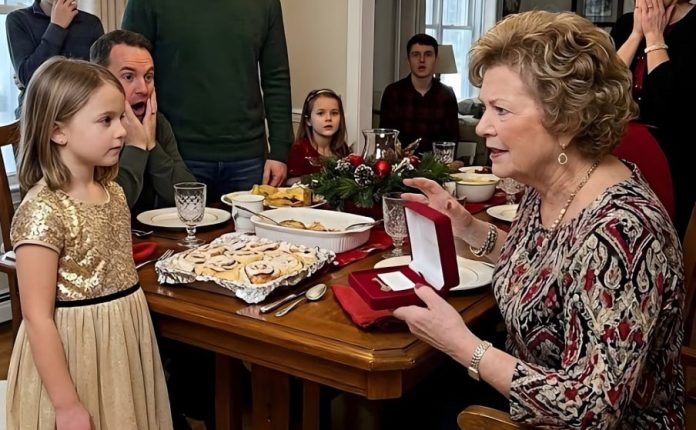
Patricia shook her head and insisted I could have handled everything privately. I reminded her that I had tried privately every time I asked Daniel whether something was wrong, every time I questioned his late nights, every time he told me I was insecure, and every time Vanessa smiled in my kitchen while lying directly to my face.
Vanessa whispered, “I never wanted to hurt you.” I looked at the emerald bracelet around her wrist. “You wore the bracelet.” She looked confused. I reminded her that she had knowingly worn a gift from my husband into my house and lied to my face about where it came from.
“That wasn’t an accident,” I said. Vanessa began crying again and claimed she did not know why she had done it. I told her she did. Somewhere inside herself, she had wanted me to notice. She wanted the secret satisfaction of knowing something I did not.
Sometimes cruelty wants an audience. Some people are not satisfied merely to betray you. They need the strange power of standing beside you, smiling, while carrying a secret they believe makes them superior. That was Vanessa’s addiction more than either man: power without consequence.
Sophie came toward me and asked whether we were leaving. Daniel immediately said the house was still her home. I almost laughed at how quickly “my house” had become “your home.” I wrapped my arm around Sophie and told her yes.
Daniel stood. “You’re taking my daughter?” I reminded him Sophie was seventeen. He turned toward her and ordered her to stay. She shook her head. “I’m going with Mom.” His voice cracked when he asked her to reconsider.
“You don’t know everything,” Daniel said. Sophie looked at him with tears in her eyes. “I know enough.” That was when Daniel finally began to cry. Not loudly. His shoulders simply lowered, and for one moment I saw the man I had once loved beneath everything he had become.
I almost felt sorry for him because I remembered the young father from the hospital photographs, holding our newborn daughter against his chest. I remembered the husband who danced with me in the kitchen and stayed awake beside my mother during her final illness.
Maybe those versions of Daniel had been real. People are rarely only one thing. Maybe he had loved me and still betrayed me. Maybe the contradiction was what made the loss so painful. But memories could not erase eighteen months of choices.
I went upstairs. My suitcase was already packed. Daniel followed me into our bedroom and asked whether I had planned to leave that night. I told him I had planned for possibilities. He stood in the doorway while I opened the closet and gathered the few remaining things I needed.
“Please look at me,” he said. I did. His eyes were wet. “I’m sorry.” It was the apology I had once desperately wanted. Now it felt almost meaningless. I asked how long he would have continued the affair if I had never discovered it.
He looked down and said he did not know. I asked whether he planned to leave me for Vanessa. “No,” he answered immediately. Somehow that hurt more. He had been willing to risk our marriage, our daughter’s trust, our home, and our family for someone he did not even intend to choose.
“I was confused,” he said. I told him confusion was forgetting an appointment. Confusion was taking the wrong highway. Renting an apartment, buying jewelry, hiding money, deleting records, and creating eighteen months of cover stories required planning.
His head snapped up when I mentioned the apartment. “You know about that?” I told him I knew about the missing money too. “How much?” he asked quietly. “Ninety-four thousand dollars.”
Daniel sat on the edge of the bed and covered his face. For several seconds, neither of us spoke. Then he said something I still remember because it revealed more than any apology. “I didn’t think you would ever find out.”
There it was. Not that he could not stop himself, not that he loved Vanessa, not that our marriage was failing. He simply believed he could betray me without facing consequences. He believed my ignorance would allow him to keep everything he wanted.
“That’s the problem,” I said. “You didn’t think I deserved the truth unless I discovered it myself.” He told me he loved me. I said he loved what I provided: stability, home, loyalty, parenting, organization, and someone reliable to return to after visiting chaos.
Daniel insisted it was not true and promised he could fix everything. He offered counseling, transparency, complete access to his phone, and an end to every relationship with Vanessa. I lifted my suitcase and told him the marriage was already over.
He stepped closer. “Rachel, please.” I walked past him. Downstairs, Patricia and Vanessa had already left. Sophie waited beside the door with a backpack over one shoulder. I picked up my coat and walked outside with my daughter.
Together, we left the house Daniel had threatened to throw me out of. We stayed at a hotel that night, and the irony was impossible to miss. For eighteen months hotels had represented Daniel’s secret life. Now a hotel room became the first place I slept after choosing my own.
Sophie finally fell asleep around two in the morning. I did not. I sat beside the window watching cars move along the highway and felt strangely empty. People imagine liberation as something triumphant, but freedom does not always arrive with fireworks.
Sometimes freedom arrives as numbness. Sometimes it is simply the moment you understand there is nothing left to negotiate. At nine the following morning, Dana filed my divorce petition. By noon, Daniel knew. By evening, his attorney had contacted mine.
The family collapse moved quickly. Claire filed for separation four days later. Eric filed for divorce within a week. Three marriages, one Thanksgiving dinner, and eighteen months of lies finally exposed in a matter of minutes.
The consequences, however, lasted much longer. Vanessa moved into Patricia’s house. Within two weeks, Patricia began calling everyone, asking them to forgive her daughter. She said Vanessa was emotionally vulnerable, that she had made mistakes, and that she never meant for any of this to happen.
I stopped answering Patricia. Claire did too. Eric blocked her entirely. Daniel tried contacting me constantly through texts, emails, flowers, letters, and even an uninvited visit to my office before Dana warned his attorney that those appearances had to stop.
Daniel’s messages followed a predictable pattern. First came apology. Then explanation. Then nostalgia. Then anger. Then bargaining. He said Vanessa had manipulated him, claimed he was going through a crisis, reminded me we had once been happy, and accused me of throwing away twelve years.
That final message was the only one that made me respond. I wrote, “You threw them away one Thursday at a time.” He did not contact me again for three days.
Michael responded differently. He denied parts of the affair, then minimized them, then tried to blame Vanessa for seducing him. Claire later told me that was the moment she knew reconciliation was impossible.
“If he had simply said, ‘I did something horrible,’ maybe I could have respected the honesty,” she told me over coffee. “Instead, he kept trying to negotiate how much responsibility belonged to him.”
Claire and I became close in a way neither of us had ever wanted. We were not simply sisters-in-law anymore. We were two women rebuilding our lives after discovering that the same family had expected us to absorb betrayal quietly in order to preserve everyone else’s comfort.
Eric surprised everyone. He did not explode publicly or threaten Daniel and Michael. He quietly dismantled the life he shared with Vanessa. He removed her access to business accounts, canceled joint credit cards, consulted his attorney, and stopped shielding her from consequences.
That was what Vanessa hated most. For years, everyone had rescued her. When Eric stopped, she began unraveling. She called me once several weeks after Thanksgiving. I almost ignored the call, but curiosity made me answer.
“Rachel,” she said quietly. I asked what she wanted. She said she needed to talk. I corrected her: she wanted to talk. She apologized, then admitted she knew I probably did not believe her.
“I believe you’re sorry now,” I said. Vanessa called that unfair. I almost laughed. Fairness was an extraordinary thing for her to mention after everything that had happened.
Eventually she admitted Daniel would no longer speak to her. Both he and Michael blamed her for what happened. For the first time, I understood the particular loneliness she had created for herself. Each man had participated willingly, yet once exposed, both tried to place the contamination entirely on Vanessa.
She asked whether I hated her. I thought carefully before answering. “No.” She sounded genuinely surprised. I told her hate would require me to keep carrying her inside my life, and I did not want to do that anymore.
Vanessa began crying and said she had ruined everything. I simply said yes. I did not comfort her. Not every confession deserves immediate absolution. Sometimes accountability means allowing someone to sit beside the consequences of what they deliberately destroyed.
Before hanging up, Vanessa whispered, “I think there’s something wrong with me.” For the first time in the conversation, she sounded sincere. I told her to get help and ended the call.
The divorce took eleven months. Daniel fought hardest over the house, not because he needed it, but because losing it represented defeat. His attorney argued that his recent income entitled him to a larger share.
Dana produced records documenting my inheritance, down payment, mortgage contributions, renovation expenses, consulting income, and Daniel’s undisclosed spending. His hidden transfers and affair expenses did not help his position.
Eventually, Daniel agreed to sell. That part hurt more than I expected. I had imagined Sophie returning from college to that house. I had pictured grandchildren running through the backyard. I had chosen the kitchen tiles, painted walls, planted the maple tree, and filled every corner with ordinary memories.
But a home is not simply the building that witnessed your life. A home is where you are safe enough to live truthfully. We sold the house for considerably more than we had paid, divided the assets according to our settlement, and went separate ways.
I bought a smaller home fifteen minutes away. It had three bedrooms, wide windows, a garden, and no dining room large enough to seat twelve people. That felt appropriate. Sophie helped me choose it.
“This house feels lighter,” she said on moving day. She was right. Daniel and Sophie eventually began repairing part of their relationship. I encouraged that carefully. He had failed me as a husband, but I did not want that failure to automatically erase him as her father.
Sophie established her own boundaries. For months, she refused overnight visits. She would meet Daniel for lunch, watch a movie with him, or have coffee, then come back home. He slowly learned that forgiveness does not restore automatic access.
Michael and Claire divorced as well. Claire returned to full-time work. A year after the disastrous Thanksgiving dinner, she rented a cottage near the coast and took her sons there for Christmas. She sent me a photograph of the three of them smiling beside the ocean.
Her message contained five words: “First peaceful Christmas in years.” Eric kept his contracting business and finalized his divorce from Vanessa nine months after ours. I later heard Vanessa had moved to another state and started therapy.
Patricia continued insisting everyone had been too harsh. Eventually, even Daniel stopped discussing the situation with her. Some people cannot accept reality when accepting it would require admitting they helped create the conditions that allowed everything to happen.
Patricia had spent decades teaching her children that consequences were cruelty. She protected them from discomfort, excused bad decisions, and treated accountability as betrayal. Then she seemed shocked when they became adults who believed desire mattered more than responsibility.
Two years after Thanksgiving, I ran into Daniel unexpectedly outside a bookstore café. He looked older—not dramatically, but enough. There was gray near his temples, his face was thinner, and the certainty that had once defined his posture was gone.
We stopped awkwardly. He asked whether I had a minute, and instead of walking away, I agreed to sit outside. He ordered coffee while I kept the tea I already had. For several moments, neither of us knew what to say.
Finally, Daniel said he owed me something: a real apology. He admitted he had spent a long time blaming Vanessa, then Michael, then work stress, then our marriage, and eventually everything except himself.
“I did it because I wanted to,” he said. “I thought I could have stability with you and excitement somewhere else.” It was the first explanation he had ever given that sounded completely true.
He admitted something else too. When I started noticing inconsistencies, he had deliberately made me feel irrational so I would stop asking questions. “I’m ashamed of that more than almost anything,” he said.
“You should be,” I replied. He nodded without defending himself. Then he said he did not expect forgiveness. I told him I had already forgiven him a long time earlier.
Hope briefly appeared on his face, so I clarified. “Forgiveness is not reconciliation.” He nodded slowly. I told him I had forgiven him because I did not want our dead marriage occupying space inside me forever.
Before we stood to leave, Daniel said the worst thing he had ever said to me happened on Thanksgiving. I knew immediately what he meant: “Say sorry or leave my house.”
He admitted that calling it his house haunted him. I told him the sentence had actually done me a favor. He looked confused and asked how.
“Because I finally heard how you saw me,” I said. “You thought home was something you could revoke the moment I stopped cooperating.” Daniel told me he had only said it because he was angry.
“I know,” I said. “You meant it for the five seconds you needed it to control me.” He closed his eyes because that truth landed exactly where it needed to.
I stood to leave. Daniel asked one final question. “Are you happy?” I considered it carefully. Not constantly. Not perfectly. But yes, I was happy. He nodded and said he was glad. For once, I believed him.
Three years have now passed since that Thanksgiving dinner. Sophie is in college. Claire has slowly begun dating again. Eric remarried last spring to someone he met through a construction project. Michael, according to Claire, has spent a great deal of time in therapy and is trying to become a better father.
Vanessa eventually sent me one letter. She did not ask for forgiveness or defend herself. She simply acknowledged what she had done and the people she had hurt. I never responded. I kept it for a while, then threw it away.
Some chapters do not need replies. Patricia still sends Christmas cards. I do not send any back. Daniel lives about forty minutes away, and we speak when necessary about birthdays, college plans, emergencies involving Sophie, or important family decisions.
Our conversations are civil, sometimes even warm. Twelve years cannot be erased completely, nor should they be. There were real memories inside our marriage—vacations, ordinary Sundays, Sophie’s childhood, my mother’s last Christmas, and evenings when Daniel and I laughed together until midnight.
Those memories were not fake simply because the ending became ugly. Betrayal does not automatically rewrite every moment that came before it. It changes what comes next.
My life after Daniel became quieter than I expected. At first, I thought quiet meant lonely. Eventually, I realized how much noise I had mistaken for love: explaining myself, managing moods, protecting reputations, avoiding conflict, ignoring my instincts, and accepting small humiliations so everyone else could remain comfortable.
Silence without fear is different. These days I wake early, make coffee, work from the room overlooking my garden, travel when I want, call Claire most Sundays, and wait for Sophie’s visits home from college.
Sometimes Sophie brings friends who raid my refrigerator, leave shoes by the front door, play music too loudly, and fill the house with laughter. I love every second of it.
My dining table seats six. At first, it seemed small compared with the enormous table in our old house. Now it feels perfect. Last Thanksgiving, Claire and her sons came over, Sophie was home from school, and Eric stopped by with dessert because he happened to be visiting someone nearby.
There were no crystal glasses or polished silver. Claire burned the rolls. One of her sons spilled cranberry sauce. Sophie laughed so hard she cried. Nobody criticized the turkey, monitored the conversation, disappeared to answer secret messages, or needed to pretend everything was perfect.
Sometime after dessert, I looked around that smaller table and realized something. People still describe the old Thanksgiving as the night my sentence destroyed three marriages.
But my sentence did not destroy those marriages. The affairs did. The lying did. The hidden money did. The manipulation did. The arrogance did. The belief that spouses could be betrayed indefinitely as long as nobody said anything did.
My sentence simply turned on the lights. People often blame the person who reveals a disaster because revelation is louder than deception. But silence is not peace.
A marriage is not healthy simply because nobody speaks about what is killing it, and a family is not intact merely because everyone agrees to protect the people doing harm.
I learned that the night my husband demanded an apology. Daniel believed my greatest fear was being ordered out of the house. He was wrong. My greatest fear had always been losing the family I thought I had.
What I did not understand until that evening was that I had already lost it. The moment I realized that, Daniel’s threat lost all its power.
For months, some part of me had continued negotiating with myself. Maybe I should wait. Maybe Sophie needed stability. Maybe divorce would destroy everything. Maybe Daniel would eventually confess. Maybe keeping quiet was mature. Maybe protecting everyone else was love.
Then the man I had protected for twelve years looked me directly in the eye and told me I could preserve my place in our home by apologizing to the woman he had been secretly sleeping with.
Suddenly, there were no more maybes.
So yes, I stood up. Yes, I walked across that dining room. Yes, I looked Vanessa directly in the eyes. And yes, I said the sentence everyone remembers.
But the most important thing I did happened afterward.
I picked up my suitcase. I took my daughter’s hand. I walked through the front door. When Daniel called my name behind me, I did not turn around.
Because sometimes the strongest ending is not revenge. It is not humiliation. It is not watching everyone who betrayed you suffer. It is not making them regret losing you.
Sometimes the strongest ending is simply understanding that the door someone threatens to throw you through can become the same door you use to save yourself.
And once I understood that, leaving was no longer the punishment Daniel intended.
It was freedom.