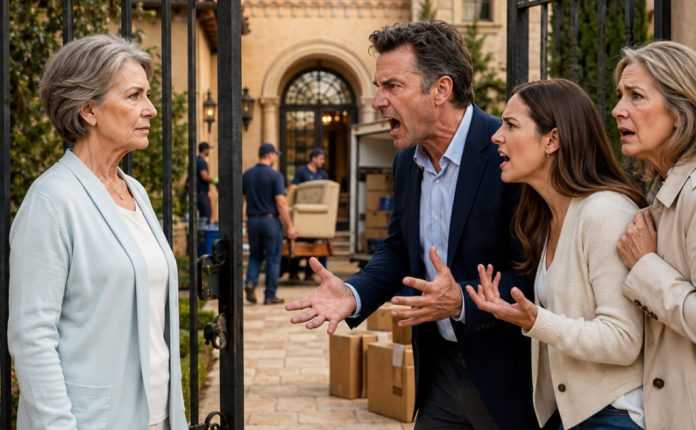
My sister waited eleven days before coming to my house. She arrived alone, with no makeup, her hair in a ponytail, and without her enormous engagement ring. I noticed that immediately. Adrian answered the door. I heard her ask whether I was home and whether she could speak to me. Adrian looked toward me. My choice. I nodded.
Allison stepped inside and stared around at the art, photographs, books, and evidence of an entire life she had never seen. On the console beside the stairs was a framed photograph from my wedding day. Adrian stood beside me while Naomi laughed in the background. Allison touched the frame. “You really did it.” “Yes.” “You look happy.” “I was.” “Was?” “I still am.”
We sat in the living room. For once, Allison did not seem to know how to perform. “I left Brad.” I blinked. “What?” “Temporarily.” She explained that his family’s financial problems were much worse than she had known. His father had used part of Brad’s trust as collateral through a family partnership, and Brad had believed the Vale acquisition would solve everything.
His father had told him the deal was basically finished. “But it wasn’t,” I said. “No.” I told her I was sorry. She stared at me. “You’re sorry?” “For you. Yes.” She seemed surprised that I did not celebrate her trouble. “I thought you would enjoy this.” I asked why. “Because my perfect marriage lasted nine days before I moved into a hotel.”
“I don’t want you miserable.” She looked at me for a long time. “I wanted you miserable.” There it was. Small. Ugly. True. Then she confessed something worse. Before the speeches at the wedding, Dad had asked her whether he should make a joke about me coming alone. She had told him yes. The room seemed to contract around us.
“Why?” I asked. She said she was angry because I had missed the wedding events. I reminded her that I had been working. “I know,” she whispered. That stopped me. She admitted that she knew my job prevented me from discussing certain things. “Then why?” Her face twisted. “Because everything was supposed to be about me.”
For once, she wanted a day where no one talked about complicated Meredith and my mysterious work. The irony was that nobody had been talking about me until she gave Dad permission to turn me into a joke. She started crying. “Dad always compared us.” “Yes.” “And I liked winning.” I said nothing. “God, that sounds horrible.” “It is horrible.”
She flinched but continued. She admitted that as children she always knew what Dad did when I achieved something. He made it smaller. If my grades were better, he said she was more social. If I earned a scholarship, he dismissed the school. If I succeeded at work, he called the job boring. “I thought you believed him,” I whispered.
“I did,” she said, then shook her head. “No. I chose to believe him. I needed to believe him because if you weren’t the failure, then maybe someday I would be.” There it was—the architecture of our childhood. Our father had built a house with one pedestal. Allison spent her life terrified of falling off it. I spent mine beneath it.
Then she admitted that she had laughed after Dad pushed me. “Why?” I asked. “Because everyone else did.” She hesitated. “And because for one second, I felt relieved.” My breath stopped. “Relieved?” She covered her face. “He was still attacking you.” I stared at my sister, horrified by how clearly one sentence explained our entire family.
She cried harder and said she hated herself for admitting it. I told her Mom had said something similar—that she thought I could handle the abuse. Allison looked devastated. I asked whether she had believed that too. “Yes.” I stood and walked toward the window because I needed distance. Behind me, she whispered, “I’m sorry.”
“I don’t know what to do with that yet.” She said she understood. “No, you don’t.” She nodded. “You’re right.” I told her the apology did not erase anything and that I did not trust her. I reminded her that she had encouraged Dad to humiliate me and then laughed when he pushed me. Each time, she answered quietly, “I know.”
Part of me wanted to throw her out. Another part remembered thunderstorms and the six-year-old girl who used to crawl into my bed. I asked why she had come. She said Brad had asked whether she would still love him if his family lost everything, and she had not known how to answer. That uncertainty terrified her more than the financial crisis itself.
“All my life, I thought love meant being proud of someone. Being impressive. Being the right kind of person.” She looked toward my wedding photograph. “Then I saw Adrian look at you when he came into the ballroom.” He had not looked around first. He had not cared who was watching. He had not been angry that I had hidden who he was.
Allison admitted she had spent her entire relationship with Brad thinking about how they looked—the houses, names, schools, photographs. Dad had been more excited about marrying into the Wellington family than she had been about marrying Brad. “I don’t know if I married him because I love him or because being Mrs. Bradford Wellington meant I finally won.”
“That is something only you can answer.” She looked frightened. “Do you think I’m like Dad?” The question hung between us. “Yes.” She flinched. “But I think you know it.” She asked whether that mattered. “It can. Knowing what you became doesn’t change it. What you do next might.” She nodded slowly.
At the door, I stopped her. “I’m not ready to forgive you.” “I know.” “But I don’t want you to become him.” Tears filled her eyes again. “Neither do I.” She left, and for the first time in my life, I watched my sister walk away without knowing whether we would ever truly be sisters again. Somehow, that uncertainty felt healthier than pretending.
My father did not apologize immediately. Instead, he hired a public relations consultant. Two weeks after the wedding, a statement appeared through his attorney describing the fountain incident as “a regrettable family misunderstanding during an emotionally charged celebration.” He claimed no harm had been intended and emphasized that he loved both daughters equally.
That last sentence almost impressed me, not because it was true, but because he managed to fit a lie that large into six words. His firm removed him from the management committee. Several clients left, though not all. Life is rarely as clean as stories make it sound. Powerful men do not always lose everything because people discover they are cruel.
Some colleagues defended him. Some called the incident private. Some said the internet had gone too far. Others implied I should have handled everything inside the family. Dad remained wealthy, licensed, and connected. Consequences did not magically turn him into a different person. The criminal case moved slowly until his attorney offered a resolution.
The proposed deal included a plea to a lesser charge, probation, anger-management counseling, community service, and no jail. Naomi warned me that I might hate it. I did not. I had never wanted Dad in prison. What I wanted was reality acknowledged. I wanted the world outside our family to use ordinary language for behavior my family had spent decades renaming.
Not teasing. Not discipline. Not frustration. Not a misunderstanding. Assault. Dad accepted the deal. Three days later, he asked to see me. I almost said no, then agreed to meet in a private conference room at Naomi’s firm. My father arrived ten minutes early. Of course he did. Robert Campbell believed punctuality was a moral virtue.
When I entered, he stood. For the first time, I saw age in his face. He looked smaller than I remembered, not physically but symbolically. That frightened me because I had spent so much of my life imagining him as enormous. He was just a man—a difficult, proud, damaged man who had been given too much power inside one family.
“I’ve had considerable time to think,” he began. Then he said, “I regret what happened.” Almost. I asked what exactly he regretted. “The fountain.” “What about it?” “I shouldn’t have pushed you.” My breath caught. It was the first time he had said it plainly. Then he ruined it. “But you must understand I was under extraordinary pressure.”
I almost laughed as he began explaining the Wellington problems, Allison’s stress, and my supposedly difficult behavior. “So you pushed me.” He insisted he had already said he should not have. “Without a ‘but,’” I told him. “Say it without explaining why I caused it.” He accused me of ignoring context. I stood. “Where are you going?” “This isn’t useful.”
“Sit down.” The command was automatic. My body reacted before my mind did. My shoulders tightened and my stomach dropped. For one second, I was sixteen again. Then I saw what was happening. I looked at him. “No.” He blinked. “No?” “I’m not sitting down because you told me to.” He called me childish, and I walked toward the door.
“Meredith.” I stopped. My father stood too, looking desperate. “I’ve lost enough.” There it was. The real reason. Not I hurt you. Not I miss you. I’ve lost enough. I told him he believed I had done this to him when all I had done was stop protecting him from consequences. He insisted everything could have been handled privately.
“Like every other time?” His mouth closed. “I protected you for thirty-two years,” I said. He called that absurd. “I protected you from consequences every time I stayed quiet.” His face hardened. Then he told me Mom believed Adrian had poisoned me against the family because I had never been this cold before. “No,” I said. “I was scared before.”
My father stared. The words surprised even me. “I was scared of you.” His expression changed. “I never hit you.” I felt something like pity. “That’s your standard?” He reminded me that he had provided excellent schools, travel, and financial security. “You never wanted for anything.” I swallowed. “I wanted you to like me.”
He called that nonsense, but my eyes filled. “I wanted my dad to like me. I spent years trying to become someone you might enjoy being around. Eventually, I realized you enjoyed me most when I was failing.” He denied it. I told him he needed to believe I was a disappointment, because otherwise the way he treated me would say something about him instead of me.
Then I told him what he had actually lost. Not merely clients, reputation, his management role, Mom’s trust, or Allison’s admiration. “You lost access to me.” His face changed. I explained that he no longer automatically received phone calls, holidays, or access to the people I loved just because he was my father. “I’m your father,” he whispered.
“Yes. And that used to mean everything to me.” I opened the door. Behind me, his voice cracked. “Meredith.” I stopped because, for one second, hope betrayed me. Maybe now. Maybe finally. I looked back. My father swallowed. “I am sorry.” No explanation. No but. Just four words. Then he added, “I don’t know how to fix this.”
The twelve-year-old inside me wanted to run toward him. The thirty-two-year-old woman knew better. “You don’t fix it with one apology.” He nodded slowly. “What do I do?” It was the first genuine question I could remember him asking me. “I don’t know,” I said. “That’s the truth, Dad. I don’t know.” Then I left.
Allison stayed separated from Brad for nearly three months. The Wellington family did not collapse overnight. They sold assets, restructured debt, and closed one division. Bradford resigned from his father’s company and accepted a job at an investment firm in New York. For the first time in his life, he worked for someone whose last name was not Wellington.
Allison moved into a small apartment in Boston. By small, I mean small by Allison’s standards. It still had marble counters. Growth is relative. She started therapy and texted me to say she was seeing someone about Dad and herself. She said I did not need to reply. I didn’t. Two weeks later, she sent another message.
She had apologized to Brad for treating his family problems as embarrassing rather than frightening. Again, she told me I did not need to respond. I stayed silent. A month later, another message appeared: I found the birthday card you made me when I turned seven. I kept it. I don’t remember why I stopped being your little sister. I’m sorry.
That one hurt. I replied with three words: I remember too. She did not push. That mattered. Eventually, we met for coffee, then lunch, then a walk. Trust returned in grains of sand rather than waves. Allison stopped asking for forgiveness and started behaving differently when relatives tried to pressure me into forgiving Dad.
When Aunt Vivian said I had humiliated my father by allowing the video to spread, Allison replied, “Dad humiliated himself.” That sentence reached me through three cousins. I pretended it did not matter. It did. Six months after the wedding, Allison and Brad decided to stay married. There was no second wedding, no magazine-style photographs, and no announcement.
They moved to New York and started over in a rented apartment. Brad sent me a handwritten letter apologizing for laughing during Dad’s speech. He said he had not seen the push clearly until the video surfaced and admitted he had spent too much of his life measuring people by surnames. He said both he and Allison needed to learn what family was supposed to mean.
Eventually, Adrian and I invited them to dinner. No parents. No performance. Brad washed dishes afterward. I almost fainted. “You look shocked,” he said. “I assumed a Wellington touching dish soap would trigger an alarm somewhere.” He laughed. “Don’t tell my father.” From the living room, Allison shouted, “I’m recording this.”
For one moment, I heard my sister laugh. Not at me. With me. I remembered thunderstorms. Forgiveness had not arrived completely, but I could see it somewhere far ahead. Not as an obligation. As a possibility. Mom took longer. For months, she stayed with Dad, then left, then returned, then left again. I refused to participate.
Adrian once asked whether I felt guilty. “Yes.” “About what?” “Everything.” He nodded. “That seems efficient.” I laughed and asked what he meant. “You have found a way to feel responsible for every adult in your family.” I threw a pillow at him. He caught it. “See? Progress. Physical aggression.” I told him to shut up, then became serious.
“What if Mom stayed with Dad because I cut her off?” “Then she made a choice.” I worried about what would happen if Dad became worse. Adrian reminded me that Mom needed professional help and a safety plan, not a daughter to absorb him. I knew that. Knowing and believing are different things.
Eight months after the wedding, Mom asked to meet me. We walked through the Public Garden in early spring while the trees were beginning to bloom. My mother wore flat shoes, which alone felt like evidence that something had shifted. “I moved out,” she said. I stopped. “Permanently?” “I don’t know.” Then she told me Dad had started therapy.
“Voluntarily?” “No.” “That sounds more believable.” She laughed, a real laugh that surprised both of us. Then she told me she had started therapy too. She had discussed what I said about using me as a shield. Her therapist asked whether she thought it was true. “And?” I asked. Mom looked at me. “I said yes.”
We walked in silence. She said she did not expect forgiveness and admitted that in the past, every time she apologized, she wanted me to reassure her. She wanted me to say, “It’s okay, Mom,” so she could stop feeling like the person who hurt me. “But it wasn’t okay,” she said. “No.” “And you shouldn’t have had to make me comfortable about what I did.”
Then she stopped and said, “Your middle name is Claire.” I looked at her. She smiled sadly. “I know that doesn’t repair anything.” She had remembered immediately after I left the café. Then she told me something I had almost forgotten: my grandmother Claire held me before Mom did because I was born six weeks early and Dad was away in New York on a case.
Grandmother Claire had sat beside the incubator for almost eight hours because Mom was still recovering. “She said you had the angriest little face she had ever seen.” I laughed. “That sounds right.” Mom said Grandmother predicted I would be stubborn. “Definitely right.” Then Mom whispered, “And I told her I hoped so.” That broke something open.
We sat on a bench. Mom reached into her handbag and pulled out an envelope filled with photographs of me as a child—me at four, on my first day of school, holding Allison as a baby, missing my front teeth, wearing a paper crown. I asked why she had kept them hidden in a box. She looked ashamed. “Your father liked the professional photographs.”
Of course. I held one picture where I was laughing so hard my eyes were closed. “When did I stop laughing like this?” Mom cried. “I don’t know.” I did, but I did not say it. She reached toward my hand, then stopped before touching me. That mattered too. “May I?” I nodded. She held my hand carefully.
“I can’t change your childhood,” she said. “No.” “I can’t ask you to trust me because I finally understand something I should have understood twenty years ago.” “No.” Then she looked at me. “But I would like to know you.” Not reclaim you. Not have my daughter back. Know you. I asked what she wanted to know. She cried, then laughed. “Everything.”
I smiled slightly. “That might take a while.” “I have time.” For the first time in years, I hoped she did. Meanwhile, my family’s discovery of my marriage created another unexpected problem. Suddenly, everyone became fascinated with Adrian. Relatives who had mocked my “little government job” wanted introductions, investments, internships, dinners, and invitations.
Uncle Harold emailed about an investment opportunity. I deleted it. Aunt Vivian invited us to dinner three times. No. A cousin wanted Adrian to help her son secure an internship. No. Another relative wanted us at a charity gala. No. The strangest request came from my father nine months after the wedding, when his assistant emailed mine.
Dad wanted to know whether Adrian might attend a legal foundation dinner where he was receiving an award. I stared at the email. Adrian read it over my shoulder. “Are we going?” I turned. “You’re enjoying this.” “A little.” “Absolutely not.” He kissed my forehead. “Excellent.” I deleted the invitation.
That night, I finally asked whether he had ever resented being a secret. “No.” “Really?” “Really.” I asked whether it bothered him that my family thought I was single. He said that part had been funny. “They insulted you without even knowing you existed.” Adrian smiled. “Meredith, strangers insult me online daily. Your Aunt Vivian was not going to finish the job.”
Then I asked the real question. “You never wanted them to know?” He put down his book. “I wanted you to want them to know.” I realized there was an important difference. “Why?” “Because I didn’t marry your family.” My chest tightened. “I married you.” I told him that was annoyingly healthy. He claimed he had received coaching.
“From whom?” “You.” I stared. He explained that I thought I had only learned safety from him, but I had taught him something too. “That love isn’t access.” His parents loved through involvement, questions, advice, and sometimes too much attention. I knew that; his mother still called weekly and mailed him socks.
“You taught me that loving someone sometimes means standing outside a locked door without demanding the key.” My eyes filled. “You did that for me.” “Yes.” “For three years.” “I would have done it for thirty.” I moved closer to him. “I’m glad you came to the wedding.” “So am I.” But I needed him to understand something important.
“You didn’t rescue me.” He smiled. “I know.” “I was already leaving.” “I know.” “You just had excellent timing.” “That,” he said, “I will take credit for.” On the first anniversary of Allison’s wedding, I woke before dawn. My body remembered before my mind did—the fountain, the cold, the applause, the camera.
I went downstairs and picked up the framed photograph from my own wedding. There I was at twenty-nine, smiling, safe, loved. Adrian appeared behind me and understood immediately what day it was. He led me outside, where two mugs of coffee and an envelope waited on the patio table. “You planned this?” “I suspected today might be difficult.”
Inside the envelope was a photograph of me on a beach in Maine, my hair wild from the wind, laughing while trying to stop our friend’s dog from stealing a sandwich. I had not known anyone took it. Naomi had. On the back, Adrian had written four words: This is how I see you. My eyes filled.
I told him that for years I thought the goal was to prove my family wrong. I wanted to become so successful that Dad could not call me a failure, so happy that Mom could not pity me, and so well married that Allison could not look down on me. “But if I need them to know I’m winning, I’m still playing their game.” Adrian smiled. “Yes.”
“I think I’m done playing.” He joked that all those therapy bills had finally taught me I did not need to impress Aunt Vivian. I laughed. Then my phone rang. Allison. She knew what day it was too. She reminded me that a year earlier, she had watched Dad push me into the fountain and had laughed. “I will regret that for the rest of my life.”
“I can’t change what I did,” she said. “No.” “But today I wanted you to know that I remember.” My eyes filled. She reminded me that I had told Dad to remember that moment. “I do too,” she said. Then she added that she also remembered what came after. I walked out. I came back in. I told the truth.
“You stopped letting us decide who you were,” she said. “So I don’t want that fountain to be the only thing today means.” I asked what it should mean. At first, she called it the day I left them. Then she corrected herself. “No. The day you stopped leaving yourself.” I cried quietly while Adrian reached across the table and held my hand.
Two months later, Adrian and I hosted dinner. No wedding, anniversary, press, photographers, or important business contacts. Just people: Naomi, Adrian’s brother and his wife, two friends from my agency, Allison and Brad, my mother, and after months of thought, one more person. My father. It was the first time Robert Campbell had entered my house.
He arrived alone, carrying no assistant or expensive bottle of wine. Instead, he carried wildflowers for me. “I wasn’t sure what you liked.” At least he admitted it. “These are nice.” He said Mom had told him I hated roses. I looked at her. She smiled. “See? Learning.” Dad shifted awkwardly. “Thank you for inviting me.” “I almost didn’t.” “I know.”
He had been in therapy for eleven months. Was he transformed? No. He still became defensive, interrupted, and preferred being right. But he had started doing something I never remembered him doing when I was a child. Stopping. Sometimes he began criticizing and stopped himself. Sometimes he apologized without being cornered.
Sometimes he asked a question and actually listened to the answer. Small things. Ordinary things. Miraculous things. Dinner went well, though not perfectly. Brad and Dad almost argued about finance until Allison stopped them. Naomi deliberately asked Dad whether anger management had improved his golf game. I nearly choked on my wine.
My mother laughed so hard she had to leave the table. After dessert, Dad found me alone in the kitchen. He looked through the doorway at Adrian, Allison, Mom, and the life that had continued without his permission. “I’ve been thinking about something.” “That sounds dangerous.” He almost smiled. “Your sixteenth birthday.”
I froze. He remembered the cake. Chocolate with raspberries. He had ordered it but never brought it out because he thought Allison’s news was more important. “I was wrong.” For some reason, that small apology hurt more than the enormous ones. I had forgotten that he ordered the cake. I had spent years remembering only that it never came out.
His therapist had told him apologies should be specific. I laughed through sudden tears and said his therapist sounded exhausting. “He is.” Then Dad said, “I was proud of you that year.” I went completely still. “You never said that.” “I know.” I asked why, and he admitted that I had been difficult in the sense that I questioned him, challenged him, and refused to care about the things he valued.
“And I treated that like a defect.” My eyes filled. He told me the truth was that he had not known what to do with a child he could not control. “So I made you believe control was love.” I could not speak. “That was wrong.” Tears ran down my face. Old Robert would have told me not to cry. This version simply stood there.
Then he asked, “May I hug you?” The question shattered me. Not the hug. The question. May I? My father had finally learned that being my father did not give him automatic access to my body. I nodded. He hugged me carefully. I did not become twelve again or suddenly forgive thirty-two years. I simply experienced what was happening.
A flawed father was holding his adult daughter in a kitchen, and for the first time in her life, he had asked permission. That was enough for one night. Two years after Allison’s wedding, I returned to the Fairmont Copley Plaza for a cybersecurity conference. I had avoided the hotel since the wedding, and when I saw the courtyard, my stomach tightened.
The fountain was still there. Of course it was. Stone does not remember what humans do beside it. I walked toward it alone. The water sparkled in the afternoon light while tourists passed. A little girl dipped her fingers into the water as her father pretended not to notice. I stood beside the same stone rim and almost heard the laughter again.
“She couldn’t even find a date.” I remembered falling, emerging, and saying, Remember this moment. I had believed I was speaking to Dad, but maybe I had been speaking to myself. Remember—not so you can stay angry or punish, but so you never again confuse endurance with love. Remember so you recognize humiliation even when it comes wrapped in family tradition.
Remember so you never make yourself small enough to keep someone else comfortable. Remember so you never need a powerful husband, impressive job, expensive house, perfect body, prestigious degree, or anything else to prove that cruelty toward you is wrong. A voice behind me said, “You okay?” I turned and saw Allison a few feet away.
She was meeting me for lunch. She followed my gaze toward the fountain. “Oh.” “Yeah.” She approached slowly. “I hate this fountain.” I smiled. “It’s an innocent fountain.” “I have irrational feelings.” “You’ve always been dramatic.” She stared at me, then laughed. I laughed too. After a moment, she became serious.
“I meant what I said last year. I remember.” I nodded. “So do I.” She asked whether it still hurt. “Yes. But differently.” For a long time, I had remembered everyone laughing. Now, when I thought of the fountain, I remembered something else. “I remember climbing out.” Her eyes filled. “That’s the part I keep.”
Allison took my hand. Years earlier, I might have needed that moment to mean everything was repaired. It was not. Our childhood still happened. The wedding still happened. Dad still pushed me. Mom still watched. Allison still laughed. Nothing could rewrite that. Healing was not rewriting. It was refusing to spend the rest of my life trapped inside one page.
We walked toward lunch. At the entrance, Allison told me Mom had warned her that Dad was practicing a speech for my upcoming birthday. She had made him promise not to mention career achievements, Adrian, marriage, or money. “He says that leaves him with nothing.” I laughed so loudly several people turned. “Sounds like Dad.”
The cake came out after dinner on my thirty-fifth birthday. Chocolate. Raspberries. I knew immediately. I looked at my father, and he looked nervous. Thirty-five years old, and I had never seen Robert Campbell nervous about giving me a birthday cake. He lit the candles himself while Allison stood beside Brad, Mom held plates, and Adrian leaned against the doorway.
Naomi was already filming despite my threats. Dad cleared his throat. “I was told I’m not allowed to give a long speech.” “Correct,” I said. Everyone laughed. “So I’ll make this short.” He looked at me. No microphone. No ballroom. No audience he needed to impress. Just us. “When Meredith was born, my mother-in-law told me she would be stubborn.”
I looked at Mom. She smiled. Dad said he had once believed stubbornness was something a child should outgrow. “I was wrong.” My throat tightened. “Sometimes stubbornness is what allows a person to remain herself when everyone around her keeps telling her to become somebody else.” No one moved. Dad swallowed.
“Meredith did not become the daughter I expected.” My eyes filled. “She became herself.” I looked down. “And I am very proud of the woman she became.” For one second, the entire room disappeared. I was sixteen again. A chocolate raspberry cake waiting in the kitchen. My father raising a glass. Hope rising. Then disappointment.
Except this time, he said my name. This time, he saw me. My eyes overflowed. Dad looked alarmed. “Was that wrong?” I laughed through tears. “No.” “Too much?” “No.” Naomi shouted, “Don’t ruin it, Robert.” Everyone laughed. Even Dad. I looked across the table at Adrian. He smiled at me. He knew. He always knew.
The old hunger inside me had not vanished completely. Maybe some childhood wishes never do. But it was no longer starving. I stood and walked toward my father. I hugged him, not because his words erased anything, not because forgiveness meant forgetting, and not because biology demanded it. I hugged him because in that moment, I wanted to.
And choice made all the difference. After we cut the cake, Adrian came beside me and asked whether I was happy. I looked around the table at my mother, who now asked about my work even when she knew I could not answer, and Allison, who had slowly and imperfectly become my sister again. Brad had learned to make excellent pasta and terrible jokes.
Naomi would probably send me the video before midnight. My father still had a long way to go and finally seemed to understand that the distance was his to walk. Then I looked at Adrian. “Yes.” He kissed my forehead. “Good.” I smiled. “But you know what’s strange? For years, I thought this was what I wanted.” “What?” “Dad saying he was proud.”
Adrian waited. “It matters,” I said. “But not the way it used to.” His eyes softened. “Why?” I looked around the room again. “Because I already knew.” I used to believe the most important moment of my sister’s wedding was when those ballroom doors opened and Adrian Vale walked through them.
For a long time, that was the story everyone wanted to hear—the secret husband, the shocked family, the powerful man, the security detail, the Wellingtons going pale, and my father discovering that the daughter he had mocked had married someone he respected. It made a satisfying story. But it was not the truth.
Adrian entering that ballroom did not change my worth. It only changed what other people knew about me. The important moment happened ten minutes earlier. I was soaking wet. My dress was ruined. My makeup was running. My family had laughed. No one had defended me. No one knew my husband was coming.
No one knew about his money. No one knew about my career. No one knew anything that might make them suddenly decide I deserved respect. And still, I climbed out of that fountain alone. I looked at my father and said, “Remember this moment.” That was the moment. Not when Adrian arrived. Not when my family learned my secret.
Not when my father faced consequences. Not when my mother apologized. Not when Allison changed. Not even when my father finally told me he was proud. The moment that changed my life was the moment I stopped waiting for someone else to announce that I mattered. Because I already did. I had always mattered.
Single or married. Successful or struggling. Admired or mocked. At table one or table nineteen. In silk or soaking wet. Chosen or rejected. Applauded or laughed at. The people who truly loved me had never made me prove that I deserved a place beside them, and the people who demanded proof had never been qualified to judge me in the first place.
I understand that now. Sometimes families change. Sometimes they do not. Sometimes apologies arrive. Sometimes they never do. Sometimes forgiveness grows. Sometimes distance is healthier. Sometimes the person who hurt you becomes better. Sometimes the only person you can save is yourself. But there is one thing I know with certainty.
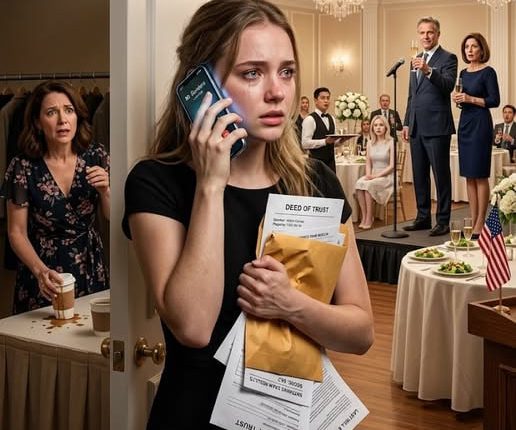
If anyone ever tries to convince me again that humiliation is love, cruelty is humor, control is concern, or silence is the price of belonging, I will remember a fountain beneath crystal chandeliers. I will remember cold water. I will remember laughter. I will remember my father holding a microphone and everyone waiting for me to break.
And most of all, I will remember what happened next. I stood up. I climbed out. And I never went back to being the woman they pushed in.