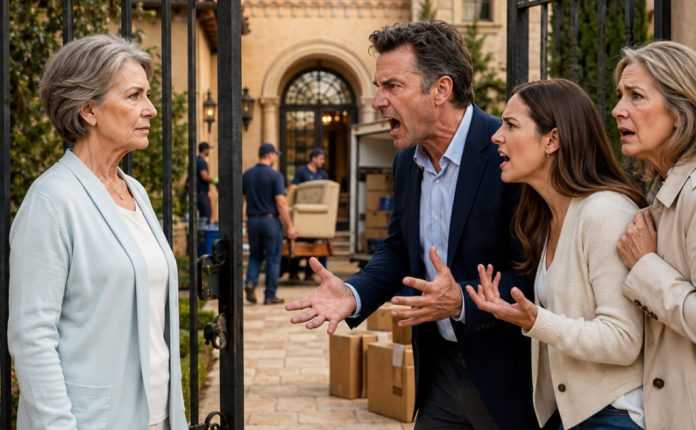
The worst part was not the freezing water. It was not my silk dress sticking to my skin, my makeup running in dark lines down my cheeks, or the sharp pain in my side where I had struck the stone rim before falling backward. The worst part was the applause. For several seconds, I stood waist-deep in the courtyard fountain at my younger sister’s wedding while people I had known most of my life laughed as though my humiliation had been scheduled entertainment.
Someone whistled. Someone shouted, “Oh my God!” A woman near the terrace covered her mouth while laughing, and then there was the photographer, actually lifting his camera toward me as water streamed from my hair. Click. Click. Click. Across the courtyard, my father still held the microphone. Robert Campbell looked pleased with himself. Not shocked. Not ashamed. Pleased, as though pushing his thirty-two-year-old daughter into a fountain had proven something important.
My mother, Patricia, stood beside the bride with one hand pressed against her pearls. She did not move toward me. Neither did my sister. Allison simply stared at me in her beautiful white gown, trying not to smile, but I saw the corner of her mouth twitch. I had seen that expression before—at Christmas when I was fourteen and Dad read my diary aloud because he had found a page where I wrote that I hated living with him, and at twenty-one when he announced that I had “chosen mediocrity.”
At twenty-six, my mother told everyone at Thanksgiving that I was “still struggling socially” because I had not brought a boyfriend home. My family had made an art form out of turning my private life into entertainment. Only this time, something had changed. Me. Cold water ran down my face while the music stopped. The laughter slowly weakened as people realized I was not going to smile, apologize, or pretend that what had happened was funny.
I pushed wet hair away from my eyes and looked directly at my father. “Remember this moment.” The courtyard became quiet. My voice did not shake, although almost every other part of me was trembling from the cold. “Remember exactly how you treated me tonight.” Dad lowered the microphone slightly. For the first time all evening, uncertainty crossed his face. “Meredith, don’t be dramatic,” he said, as if humiliation were still mine to explain.
I climbed onto the edge of the fountain. No one offered me a hand. I looked around at the aunts, uncles, cousins, friends, and respectable people who had laughed. Most of them suddenly found the floor fascinating. “You pushed your own daughter into a fountain because you thought humiliating me would make you look powerful.” His face hardened. “You were embarrassing your sister.” I stared at him. “I was walking toward a door.”
“You were making a scene,” he snapped. “You had a microphone,” I replied. A few guests shifted uncomfortably while my father searched the room for support and found much less than he had expected. “You always do this, Meredith. You twist everything.” That sentence had controlled me for most of my childhood. Whenever he insulted me, I misunderstood. Whenever he frightened me, I exaggerated. Whenever I defended myself, I was disrespectful.
I had spent years wondering whether he might be right. That night, dripping wet beneath a chandelier, I finally stopped wondering. “No,” I said. “Not anymore.” My father stared at me as if he did not recognize the woman standing there. “What is that supposed to mean?” he demanded. “It means remember this moment.” Then I turned and walked away, leaving a trail of water across the expensive carpet while my mother hissed behind me, “Robert, fix this.”
There are some things you cannot fix with a polished speech. There are some doors that, once opened, cannot be closed again, especially when the truth is already on the other side, walking steadily toward you. My name is Meredith Campbell. I grew up in a three-story brick house in Beacon Hill where everything looked beautiful from the street. The brass door knocker was polished every Friday, flowers changed by season, and Christmas wreaths were always real pine.
Our dining table seated fourteen, and my mother arranged framed photographs so perfectly that visitors often stopped to admire them. Cape Cod. Allison’s graduation. My parents’ anniversary. My father receiving another professional award. If you looked carefully, though, you might notice something. In almost every photograph, Allison stood in the middle. I stood at the edge. That was my place in the Campbell family. The edge.
Robert Campbell was the kind of attorney whose reputation entered a room before he did. He represented corporations, executives, wealthy families, and occasionally public figures whose names appeared in newspapers. Professionally, he rarely raised his voice. At home, he did not need to. He could destroy you quietly. “I’m disappointed in you.” “You’re embarrassing yourself.” “Why can’t you learn from Allison?” “People notice these things, Meredith.”
My mother specialized in softer weapons. “Your father only wants what’s best.” “Why provoke him?” “You know how he is.” “Couldn’t you just smile?” “Your sister understands how to handle him.” Allison understood because Allison learned early that being loved by our father meant staying on the winning side. She was four years younger than I was, beautiful in the effortless way my mother valued above almost everything else.
Blond hair. Blue eyes. Perfect teeth. Outgoing, charming, popular. She learned to ski at five, played tennis, joined the right clubs, dated the right boys, went to Yale, and entered luxury brand marketing. Eventually, she became engaged to Bradford Wellington IV, whose family name appeared on buildings, charitable foundations, and old brass plaques all over New England. My parents were ecstatic.
When Bradford proposed, Dad opened a bottle of wine he had been saving for almost twenty years. When I received one of the highest security clearances available in my federal division, he sent me a thumbs-up emoji. That difference used to hurt. Eventually, it became useful. Being underestimated gave me privacy, and privacy gave me room to build a life they could not contaminate.
I met Adrian Vale in Washington, D.C., three years before Allison’s wedding. It was raining, not romantic rain, but cold February rain that came sideways and made umbrellas almost useless. I had just left an eighteen-hour emergency briefing and was carrying terrible government-building coffee when a black SUV splashed water over my shoes. I shouted something inappropriate. The SUV stopped.
I expected an angry driver. Instead, a man stepped out of the back. Tall, dark coat, no umbrella. He looked around forty, although I later learned he was thirty-eight. “Did we do that?” he asked. I looked at my soaked shoes. “What do you think?” He glanced at the puddle, then toward the driver. “Sam.” A horrified voice came from the front seat. “Sir, I am so sorry.”
I started walking, but the man followed me. “Please let me replace the shoes.” “No.” “At least let me buy you coffee.” I held up my paper cup. “I have coffee.” He studied it. “That appears to be a violation of the Geneva Conventions.” I laughed before I could stop myself. That was the beginning. His name meant nothing to me, which amused him more than I expected.
Adrian Vale was the founder and executive chairman of Vale Systems, a technology and infrastructure company whose software supported ports, power grids, financial networks, and logistics systems around the world. I had heard of Vale Systems. I simply had not known what its founder looked like. My work had trained me not to be impressed by titles. Apparently, Adrian found that refreshing.
“You really don’t know who I am?” he asked during our second coffee. “I know who you are now.” “And?” “And your espresso order is unnecessarily complicated.” He smiled. “You wound me.” “I’m sure you’ll recover.” He did. So did I. Slowly. Adrian never pushed. That mattered. He was the first man I dated who could hear the word no without turning it into negotiation.
He was the first who did not mistake silence for permission, the first who noticed that I apologized before asking for ordinary things, and the first who paid attention to what frightened me instead of using it. One night, six months after we met, he was cooking pasta while I stood beside the counter answering work email. I dropped a glass. It shattered. I froze. Actually froze.
Adrian turned, and I started apologizing immediately. “I’m sorry. I’m so sorry. I wasn’t paying attention. I’ll replace it.” He stared at me. “Meredith.” I crouched. “I’ll clean it.” He crossed the kitchen. “It’s a glass.” “I know.” “You look terrified.” “I’m not.” “You are.” Something old tightened in my chest. “My father hated accidents.”
Adrian said nothing, so I continued. “He used to say accidents were what careless people called consequences.” Adrian crouched and began picking up the larger pieces. “He was wrong.” I looked at him. “It was expensive.” He held up one broken piece. “It was twelve dollars. And even if it were twelve thousand dollars, I would still care more about whether you cut your hand.”
No one had ever said anything like that to me. I cried in his kitchen. Not beautifully. I sat on the floor beside broken glass and cried like someone had opened a door inside me that I had been holding shut for twenty years. Adrian sat beside me. He did not tell me to calm down. He did not tell me my father probably meant well. He simply stayed.
Fourteen months later, we married. There were twelve people present: my closest friend Naomi, Adrian’s brother, his longtime assistant, two friends from my office, a judge, and a few people who had become family by choice. I did not invite my parents. I did not invite Allison. At first, Adrian did not understand. “They’re going to find out eventually.” “Maybe.” “You don’t want them there?” “No.”
He studied my face and asked the question no one in my family ever asked. “Why?” I swallowed. “Because I want one important day in my life that they cannot ruin.” That was enough. He never asked again. We kept our marriage private, not secret from everyone. Our closest friends knew. His legal department knew. My agency knew. People who needed to know knew.
But Adrian was intensely private about his personal life, and I never used his surname professionally. There were no magazine spreads, society announcements, or carefully staged photographs. To my family, I remained Meredith Campbell. Single. Difficult. Average. For three years, I let them believe it because their lack of curiosity had become its own strange protection.
Allison’s wedding invitation arrived on a Tuesday. Cream paper, gold leaf, embossed initials. Mr. and Mrs. Robert Campbell request the pleasure… My name appeared on the inner envelope. Meredith Campbell. No guest. Adrian read it over my shoulder. “No plus-one?” I laughed. “My mother thinks I don’t have anyone to bring.”
“She thinks you’ve been single for three years?” “She also thinks I make fifty thousand dollars a year filing government paperwork.” He raised an eyebrow. “How much does she think your car costs?” “She assumes it’s leased.” “The house?” “She doesn’t know about the house.” He stared at me. “Meredith.” I smiled. “My family doesn’t ask questions unless they already know what answer they want.”
They knew I worked “for the government.” They did not know I had become deputy director of a federal cyber-threat coordination unit handling attacks against critical financial infrastructure. They did not know my name appeared in briefings reaching powerful offices in Washington, or that I had spent nights inside secure facilities helping prevent attacks capable of freezing billions in transactions.
I was not allowed to discuss most of it. My family interpreted confidentiality as insignificance. Over time, that became almost funny. The morning of the wedding, Adrian was supposed to return from Tokyo, but a major infrastructure acquisition had run into last-minute complications. “I can postpone,” he told me. “You absolutely cannot.” “I can.” “You have six governments and three boards waiting for signatures.” “Seven governments.” “See?”
“I hate that you’re going alone.” I smiled. “I’ve survived them for thirty-two years.” He adjusted the strap of my emerald dress. “That is not the reassuring argument you think it is.” I promised I would be fine. He kissed my forehead and said he would try to get there before the reception ended. “Call me if you need me.” “I won’t.” “I know,” he said. “That’s why I’m saying it.”
The Fairmont Copley Plaza glowed when I arrived. Everything had been chosen to communicate old money: white orchids, crystal, gold, a string quartet, waiters in white gloves. My mother had spent nearly a year talking about the wedding. Not Allison and Bradford’s marriage. The wedding. The flowers. The photographs. The guest list. The dress. The Wellington name.
I entered the ballroom alone. My cousin Rebecca saw me almost immediately, and her eyes moved to the empty space beside me. “Meredith.” “Rebecca.” “You came alone.” “I did.” “How brave.” I looked at her. “For attending a wedding?” She gave me the embarrassed smile people use after saying something rude when they hope you will save them from acknowledging it.
At my table, the place card read nineteen. Immediate family sat at table one. Table nineteen was near the service doors. I laughed softly when I saw it. A man beside me looked confused. “Something funny?” I sat down. “Only something predictable.” The ceremony had already taken place in a historic church, and the reception began with champagne and photographs.
Allison looked beautiful. Whatever existed between us, she was my sister, and for one painful second I remembered a six-year-old girl climbing into my bed during thunderstorms. She used to hold my hand. She used to call me Mere. That was before our father taught us that affection had winners and losers. When Allison passed my table, I stood and said, “Congratulations.”
She paused. “Thank you.” I told her she looked beautiful, and her expression softened. For half a second, I saw my little sister. Then my mother appeared beside her. “Allison, the photographer needs you.” The softness disappeared. Mom looked me over, stopping at my dress. “That shade is very unforgiving.” I smiled thinly. “Hello, Mother.”
“Why didn’t you wear the navy dress I suggested?” “Because I’m thirty-two.” She accused me of being hostile. I almost laughed. “I said six words.” Then she lowered her voice. “The Wellingtons are very important people. Please make an effort tonight.” “To do what?” “Fit in.” I looked around the ballroom. “I’ll try to contain myself.”
I checked my phone after she walked away. Adrian had messaged me: Landing soon. Heavy traffic from airport. ETA forty-five minutes. For the first time all afternoon, I breathed easier. Aunt Vivian noticed me smiling and immediately asked whether I was seeing anyone. For one wild moment, I considered telling her, then pictured that information reaching my mother before dessert.
“No,” I said. Her face filled with theatrical concern. “You know, sweetheart, some women wait too long.” “For dessert?” “For marriage.” I nodded. “Oh.” She told me a career was fine, but companionship mattered. Uncle Harold soon joined us and asked what exactly I did again. “Federal cybersecurity.” He nodded vaguely. “So computers.”
“In a manner of speaking.” He told me government work must be comfortable, though probably not well paid. I smiled. “Enough.” He patted my shoulder and said that was what mattered. I could have explained that my compensation had nothing to do with why I worked, or that Adrian and I had more money than we could reasonably spend. Instead, I stayed silent.
I had learned something after meeting Adrian. People who need you to know they are powerful usually are not. The truly powerful rarely explain themselves. I made it through dinner. Then the speeches began. My father took the microphone beneath the chandeliers beside an ice sculpture of two swans and said, “My beautiful daughter has never disappointed us.”
Applause filled the room. I lowered my eyes toward my champagne glass. Never disappointed us. He did not say my name. He did not need to. He praised Allison’s education, elegance, career, taste, and judgment, then welcomed Bradford Wellington IV. “Two exceptional families,” he said, “coming together.” More applause followed while I sat there feeling not angry, but tired.
That was when I stood and headed toward the terrace. Two minutes. That was all I wanted. Two quiet minutes. My hand had almost reached the door when Dad’s voice rang behind me. “Leaving so soon, Meredith?” Every head turned. I stopped. “Just getting some air.” He smiled into the microphone. “Running away, more like it. Classic Meredith.”
People laughed. Something cold moved through my stomach. “Dad, not now.” “It’s exactly the right time.” He had been drinking, which explained some of it, but not nearly enough. “You’ve missed nearly every event connected to your sister’s wedding.” “Because of work.” “Of course. The mysterious government job.” Another ripple of laughter moved across the room.
“You arrive late, sit in the back, barely speak, and now you’re leaving during my toast.” “I am standing ten feet from the room.” He stared at me. “You couldn’t even make the effort to bring someone.” His eyes had that bright look I remembered from childhood, the look that meant he had found an audience. “Dad.” He smiled toward the guests. “She couldn’t even find a date.”
The laughter came immediately. My face burned. “Thirty-two years old. Not one decent prospect,” he continued. “Meanwhile, your sister has made a match any family would be proud of.” I looked at Allison. She smiled. Not broadly. Not openly cruel. Just enough. Something inside me became very still as Dad continued speaking about independence, jealousy, and disappointment.
Finally, I said, “Enough.” He blinked. “What?” I had never interrupted him publicly before. “Give the microphone back.” His expression changed. “Excuse me?” “This is Allison’s wedding. Stop.” For one second, I thought that might reach him. Instead, humiliation flashed across his face. My father could tolerate many things. Being contradicted was not one of them.
“You see?” he said to the room. “Always difficult.” I turned away. He grabbed my arm. “Don’t walk away from me.” I pulled against his grip. “Let go.” “You’ve embarrassed this family enough.” “Let go of me.” I pulled free, but then his hands hit my shoulders. Hard. One moment I was standing beneath warm chandelier light. The next I was falling backward.
My hip struck stone, and then freezing water closed over my head. When I surfaced, they were applauding. And something in me ended.