After changing clothes, I returned to the ballroom because leaving secretly would have felt too much like every other time I had escaped my family. I wanted to leave through the front doors, standing upright. My black emergency dress was simple and fitted. I kept it in my car because my work sometimes required unexpected overnight travel or formal meetings.
My hair was still damp, but I had removed the ruined makeup. For the first time all evening, my face felt like mine. My mother was speaking to several guests. “We’ve tried everything with Meredith,” she said. “Some people simply refuse to thrive.” One woman noticed me first, and Patricia followed her gaze. “Meredith.” “Mother.”
She blinked at my dress. “You changed.” “Yes.” “Where did that come from?” “My car.” “You keep dresses in your car?” “I keep backup plans.” Her expression tightened. “Your father is upset.” I stared at her. “Dad is upset?” She said I had embarrassed him. I reminded her that he had pushed me into a fountain. “He had been drinking,” she said. “It got out of hand.”
“He assaulted me.” Mom’s face hardened. “Don’t use words like that.” “What word would you prefer?” She reminded me that this was my sister’s wedding. “I noticed.” “Then act like it.” I almost answered. Then the ballroom doors opened, and two men in dark suits entered. The first was Marcus Reed, Adrian’s head of personal security.
I knew him well enough to know immediately that something had changed. He was working. His eyes swept the room—exit, balcony, service corridor, hands, faces. The second man moved toward the opposite wall. Conversation faded. My mother frowned. “What is this?” I checked my phone. In position. Marcus touched his earpiece. “Perimeter secure. Proceeding.”
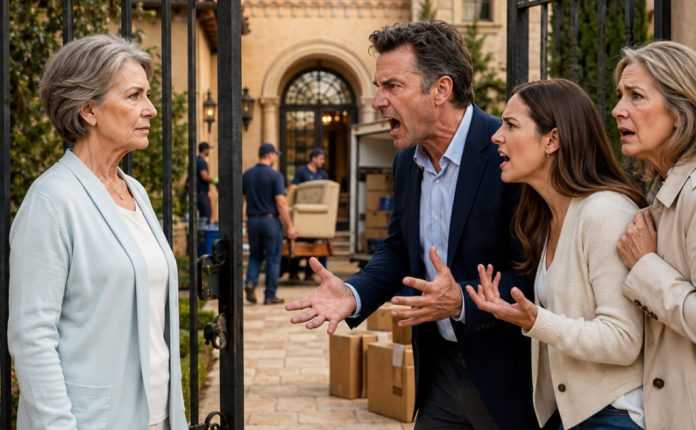
My father appeared. “This is a private event.” Marcus looked at him. “Yes, sir.” “Then leave.” “No, sir.” Dad stared. “I’m Robert Campbell. I reserved this ballroom.” Marcus did not appear impressed. “Congratulations.” Someone nearby coughed to hide a laugh. Dad’s face darkened. “If you’re looking for the corporate conference, it’s in the west wing.”
Then the doors opened wider. Adrian stepped through them, and the entire emotional temperature of the room changed. He had come directly from Logan Airport in a dark charcoal suit with no tie, his overcoat folded over one arm, his hair still slightly disordered from the flight. For me, he looked like home. For several other people in that ballroom, he apparently looked like something else entirely.
Bradford’s father stood so suddenly his chair moved backward. “Oh, my God.” Uncle Harold stopped with his champagne glass halfway to his mouth. A man from my father’s law firm whispered, “That’s Adrian Vale.” The name traveled quickly through the room. Vale. Adrian Vale. Vale Systems. My mother looked from him to the whispering guests, then back to Adrian.
My father’s expression changed too. He knew exactly who Adrian was. Robert Campbell had represented enough corporate clients to recognize one of the most influential infrastructure executives in the country. Adrian did not look at any of them. He looked only at me. His eyes went to my wet hair, then the black dress, then the red mark beginning to appear on my upper arm.
His face changed. Not dramatically. That was worse. “Meredith?” I crossed the ballroom. Allison stared. My mother stared. My father looked as if someone had removed the floor beneath him. Adrian met me halfway and touched my arms carefully. “Are you hurt?” “My side.” “What happened?” I glanced at my father, and Adrian followed my eyes.
Dad found his voice. “This has been blown completely out of proportion.” Adrian looked back at me. “What happened?” “My father pushed me into the fountain.” The silence became absolute. Adrian’s gaze moved toward Robert. My father gave an awkward laugh. “Oh, for God’s sake. It was a joke.” Adrian said nothing.
Dad looked around as if searching for support. “She was being disrespectful.” Still nothing. “She lost her balance.” “I didn’t,” I said. My father glared at me. “Meredith.” Adrian turned slightly. “Don’t speak to her like that.” Dad stared at him. “I don’t know what Meredith has told you—” Adrian interrupted him with two words. “My wife.”
My mother made a strange sound. Allison whispered, “What?” Adrian looked at my father. “Her name is Meredith.” Then he placed his hand around mine. “And she is my wife.” No one moved. My mother looked at our hands, then at my face, then at Adrian. “Your… what?” “My wife.” For three years, I had imagined how my family might learn. Never once had I imagined silence.
My mother recovered first. “You’re married?” “Yes.” “How long?” “Three years.” Her face drained. “Three years?” I nodded. Allison stepped forward. “You got married without telling us?” “Yes.” “You didn’t invite us?” “No.” Her shock turned into offense almost instantly. “How could you do that?” I stared at her. “How could I?”
Patricia’s eyes filled with tears, but not because her daughter had been married for three years. Almost two hundred people had just learned that she did not know. That distinction mattered. “You kept your marriage from your own mother.” “I protected my marriage from my family.” She flinched. Dad stepped forward. “This is some kind of stunt.”
Adrian looked at him. “A stunt?” Dad accused him of arriving with security and making a spectacle at his daughter’s wedding, then questioned whether I was really his wife. “Claims?” Adrian repeated when Dad said I “claimed” to be married. I felt Adrian’s hand tighten slightly around mine. My father realized too late how insulting he had sounded.
Bradford’s father, Charles Wellington, approached us. “Adrian.” Adrian nodded once. “Charles.” Charles said they had been trying to reach his office and thought Tokyo had delayed a committee decision. “It didn’t,” Adrian replied. Dad looked between them. “What decision?” Charles’s face tightened. “Robert, not now.” My father did not like being dismissed.
Before the business matter could continue, Allison stepped between us. She was trembling. “No. You don’t get to do this.” I stared at her. “Do what?” “Turn my wedding into some performance.” She accused me of showing up alone while secretly married and deliberately making everyone look stupid. I actually laughed. “You made yourselves look stupid.”
“You could have told us,” she snapped. “You could have asked me one sincere question about my life in the last three years.” Allison insisted she asked me things. “You ask whether I’m still single, whether I still have the same boring job, whether I’ve gained weight, whether I regret not going into private law. You don’t ask about me. You check whether I’m still beneath you.”
Dad stepped forward. “That’s enough.” I turned toward him. “No. You don’t get to say that anymore.” His face sharpened. I reminded him that he had stood in front of two hundred people and called me a failure because I arrived without a man. He said he was teasing. I reminded him that he pushed me into a fountain. He said I had been hysterical.
“You’ve always been too sensitive,” he said. Adrian’s jaw tightened, but I touched his hand. This part was mine. “I used to believe you,” I told my father. I used to think maybe I was too sensitive, maybe I misunderstood him, maybe if I dressed differently, spoke less, smiled more, dated the right people, or chose the right career, he would stop treating me like I was defective.
“But there was never anything wrong with me.” My voice broke slightly, and I let it. “There was never anything wrong with me.” No one spoke. I told him he needed one daughter to be the success and one to be the disappointment because it made our family story easy. He scoffed and called it pop psychology, but I continued.
“And Allison learned that being loved by you meant helping keep me in my place. Mom learned that if you were criticizing me, you weren’t criticizing her.” Patricia went white. “That is cruel.” “Is it false?” She did not answer. I turned back to my father. “You pushed me tonight because I told you no.” He called that ridiculous. “That’s exactly why.”
He told me I had no idea what it took to build a family like ours. I looked around the ballroom at the crystal, orchids, money, status, and fear. “Yes,” I said. “I do.” Bradford’s father tried to interrupt, but my father demanded to know about the committee decision. Charles finally said, “The Vale acquisition.” Dad stared. “What about it?” “It isn’t happening.”
Bradford’s face changed. Charles admitted that negotiations were over despite telling his son they were nearly finished. Adrian explained that Vale Systems had considered acquiring Wellington Data but rejected the transaction. My father suddenly looked at me with suspicion. “You did this.” I blinked. “What?” “You killed the deal.” Adrian immediately said, “No.”
Dad accused me of interfering because I worked in cybersecurity. I told him I had not even known Wellington Data was under acquisition review. Adrian’s voice became cold. “My wife had absolutely no involvement in our acquisition review.” He explained that independent due diligence had identified undisclosed debt, unresolved contractual exposure, and discrepancies in several representations.
Charles Wellington looked sick. Bradford stared at his father. Adrian clarified that the risk committee had made the decision while he was in Tokyo and that I had no access to the process. Dad’s anger began to look like fear. He accused Adrian of implying fraud. Adrian calmly replied that he was merely explaining why his company declined the transaction.
My father snapped that Adrian had no right to bring business into the room. Adrian stared at him. “You asked.” Then Dad looked back at me and searched for another way to restore the old order. “You think marrying money makes you successful?” I felt Adrian stiffen, but I smiled. “No.” Dad laughed harshly. “You finally found someone wealthy enough to impress people.”
“No,” I said. “That’s how you measure people.” I told him I had married Adrian before I understood the full scale of his wealth. Adrian smiled faintly and confirmed that. Then I added that he had married me when I was still eating microwave noodles several nights a week because I kept forgetting to grocery shop. Adrian corrected me from three nights to four, and a few people laughed.
For one tiny second, I forgot the room. Adrian smiled at me, and I understood exactly why I had kept him from them. Not because I was embarrassed. Because I loved who I was when I was with him. My family had spent my entire life making love feel like an audition. With Adrian, I had never auditioned. I had simply been.
My father stepped toward us. “This entire thing is humiliating.” “Yes,” I said. He blinked. “Yes, Dad. It is.” I looked toward the fountain beyond the terrace doors. “But not for me.” Adrian wanted a doctor to examine my ribs. I resisted for about ninety seconds, then took a breath too quickly in the car and nearly cried.
The X-rays showed no fracture, just heavy bruising. By one in the morning, we were back at our house in Brookline. I stood in the bathroom wearing one of Adrian’s old shirts while he carefully cleaned a scrape on my shoulder. Neither of us spoke for a while. Then he asked, “Why didn’t you call me?” I told him he had been on a plane.
“Before that,” he said. I reminded him that I did not know Dad was going to push me. “You knew you were miserable.” I stared down. Adrian softened his voice. “You do not have to wait until someone hurts you badly enough to deserve help.” The sentence hit harder than I expected. I sat on the edge of the tub while he crouched in front of me.
I started blaming myself for not telling my family about our marriage. Maybe Dad would not have treated me that way if he had known. Adrian stopped me. “Your father pushed you into a fountain because you told him to stop humiliating you. He did not do that because he thought you were single. He did it because he believed he had the right to punish you.”
Some truths hurt because they are new. Others hurt because you have always known them. My phone began vibrating in the bedroom again and again. By the time I checked it, I had forty-three unread messages from Mom, Allison, Rebecca, relatives, my father, and unknown numbers. The first message from my mother said, Please call me. We need to get ahead of this.
Not: Are you injured? Not: I am sorry. Get ahead of this. The next messages warned that someone might have taken video and that Dad could lose clients if the incident was “misunderstood.” I laughed and handed Adrian the phone. His face went blank as he read them. “Don’t answer tonight.” “I wasn’t planning to.”
Then I opened Allison’s messages. She demanded to know how I could hide a marriage from her, complained about how humiliating the revelation had been, blamed me for fighting with Brad, and said his father had lied about the family finances. There was not one word about the fountain. I locked my phone. “I think I’m done.” Adrian asked quietly, “With tonight?” “With them.”
He did not say good. He did not tell me what to do. He simply asked what done meant. “I don’t know.” “That’s okay.” I leaned against him. For years, I had fantasized about my family discovering that I was successful. I had imagined Dad learning what I really did, Mom discovering Adrian, and Allison realizing I had a life she knew nothing about.
In those fantasies, their shock made me feel victorious. The real thing felt empty. There is a terrible truth about people who spend their lives withholding approval. You can win. You can become everything they said you would never become. You can have money, love, achievement, and respect, and it still does not heal the part of you that once wanted your father to simply say, I’m proud of you.
That part of me was still twelve years old. Still waiting. I started crying. “I thought it would feel better,” I told Adrian. “Them finding out.” He understood immediately. I admitted that I thought if they knew, they would finally understand they were wrong about me. Adrian kissed my hair. “They were wrong before you met me.”
That made me cry harder because he was right. My worth had nothing to do with marrying Adrian Vale. Nothing. I had wanted my father’s measurement system to condemn itself, but I was still using that system—successful career, powerful husband, expensive house, influence, money. What if I had truly been single? What if I had worked an ordinary job and rented a small apartment?
What if no powerful man had ever walked through those ballroom doors? Would pushing me into a fountain have been less cruel? No. That realization changed everything. By breakfast, the video was online. A guest had uploaded a thirty-eight-second clip showing my father mocking me, my attempt to leave, his hands on me, the push, the fall, and finally me climbing from the fountain.
“Remember this moment,” I said in the video. By noon, it had been copied hundreds of times. By evening, it was everywhere. Someone identified my father, his law firm, the Wellingtons, and eventually me. But the internet did something my family had not expected. People did not laugh with them. They were horrified.
My father’s firm issued a statement saying it was reviewing a private incident involving one of its partners. Dad called twenty-two times. I did not answer. Mom left a voicemail asking me to call before people destroyed my father’s reputation over a “family misunderstanding.” I listened twice, then deleted it. Adrian found me at the kitchen counter.
“She thinks the video is destroying his reputation,” I told him. Adrian poured coffee. “What do you think?” I stared at my cup. “I think the video is showing his reputation.” The sentence did not feel angry. It felt true. Later that day, Naomi arrived carrying Thai food and righteous fury. She hugged me carefully because of my ribs.
“I want to commit several crimes,” she announced after mentioning the video. “You’re an attorney,” I reminded her. “Which means I know exactly which crimes are inefficient.” I laughed, but then she became serious. “Are you filing a police report?” I stared at her because I had not decided. She asked whether I would report it if a stranger had pushed me.
“Yes.” “Then why does being your father give him more permission?” It should not have, but somehow in my mind it always had. Family was the place where normal rules disappeared. Dad could insult me because he was Dad. Mom could manipulate me because she was Mom. Allison could mock me because she was my sister. I was expected to forgive because we shared blood.
Naomi explained that the hotel had cameras and there were witnesses. I worried about Dad’s career. She reminded me that his career was not my responsibility. That night, Dad sent me an email with the subject line Enough. He accused me of allowing a family joke to become a public scandal and claimed Adrian had intimidated guests with security.
Then came the sentence that decided everything: If you have any loyalty left to your family, you will release a statement confirming that the fountain incident was accidental. I read it three times. Then I looked at Adrian. “I’m filing the report.” He nodded. “Okay.” Not congratulations. Not finally. Just okay, because he understood this was not revenge.
It was the first time in my life I had allowed my father to experience the consequences of his own behavior.
The hotel security footage was clearer than the guest video. Too clear. Robert grabbed my arm. I pulled free. I stepped away. He followed. He placed both hands on my shoulders and pushed. There was no stumble, no accident, no ambiguity. The detective paused the recording and asked whether I wanted to continue. I stared at the frozen image of my father’s hands extended toward me. “Yes.”
The interview lasted nearly two hours. When I left the station, my mother was waiting outside alone. She hurried toward me. “Meredith.” I asked how she knew I was there. “Your father’s attorney.” Of course. She looked exhausted, her perfect blond-gray hair tied back, no pearls, no makeup. For once, Patricia Campbell looked like a person rather than an image of one.
She wanted me to come home. I refused, so we went to a café around the corner. For several seconds, she simply held her coffee. Then she told me Dad was being asked to step away from the firm temporarily and might lose his position on the management committee. “Why are you telling me?” Her eyes filled. “Because you can stop this.”
“How?” “Withdraw the complaint.” “No.” She accused me of not even thinking about it. “I’ve thought about Dad my entire life.” She reminded me that he was my father. “And I’m his daughter.” She said people make mistakes. I asked whether reading my diary aloud, insulting my intelligence, missing my award ceremonies, and telling me no man would tolerate my personality were also mistakes.
She tried to minimize each memory. That was inappropriate. That was years ago. He had been stressed. She was trying. Finally, I said, “No, Mom. You’re trying to make his behavior sound small enough that I will keep carrying it.” Her eyes hardened. “You have become very harsh.” There it was. The pivot. I asked the question that mattered. “Why didn’t you help me?”
She stared at me. “At the fountain.” She claimed everything happened quickly. “You had time to laugh,” I said. She went completely still. “I saw you.” Her face changed. She admitted she had laughed because she was nervous. I reminded her that she could have helped me out, told Dad to stop, or apologized afterward.
“I am here now,” she said. “No. You are here because his firm suspended him.” Her eyes filled with tears. “That’s unfair.” “Then tell me I’m wrong.” She did not. After a long silence, she whispered, “I didn’t know you were married.” There it was. Not the push. Not my injuries. The secret. I finally asked what she actually knew about my life.
“What is my job title?” Silence. “What city did I live in before Washington?” She guessed wrong. “What is Naomi’s last name?” Nothing. “What food do I hate?” She called the questions childish. Then I asked, “What’s my middle name?” Her expression changed. “Of course I know your middle name.” “What is it?” She whispered, “Elizabeth?”
“No.” My middle name was Claire, my grandmother’s name, a name my mother herself had chosen. For several seconds, something inside me cracked, not because she had forgotten one word, but because I finally understood how little room I occupied in her mind. She began crying. “I am not a bad mother.” I did not answer. “I loved you.” “I believe you.”
She looked surprised. “I do, Mom. I think you loved me. But you loved peace with Dad more.” Her face collapsed. Suddenly, I saw her differently. Not innocent. Not forgiven. Just clearly. Patricia Campbell had spent thirty-five years smoothing Robert’s moods, redirecting his anger, keeping the house beautiful, and protecting the family image.
Somewhere along the way, she had discovered an easy way to keep him satisfied. Give him a designated disappointment. Me. “If he was angry at me, he wasn’t angry at you,” I said. “If he was criticizing me, the room was safe for everyone else.” She told me to stop. I continued. “You let me be the family punching bag because it made your life easier.”
My mother stood suddenly, her chair scraping against the floor. People looked toward us, but for once I did not care. Her face was wet with tears. “You have no idea what it was like being married to your father.” I looked at her. “You’re right.” She breathed hard. “But you knew what it was like being his daughter.” She froze.
Finally, she sat again and whispered, “I thought you were stronger.” The sentence hurt more than I expected. She explained that Allison would fall apart when Dad criticized her, while I got quiet and survived. “So you gave me more to survive?” She covered her mouth. For years, I had wanted a confession, apology, or explanation. When it finally came, it felt tragic rather than victorious.
She whispered, “I’m sorry.” I looked out the window at people walking through Boston. “I believe you’re sorry today.” She asked what that meant. “It means I don’t know who you’ll be tomorrow when Dad tells you this conversation never happened.” I stood and told her I would not withdraw the complaint or make a statement protecting him.
“He may lose everything,” she whispered. “No.” I picked up my bag. “He may lose some things he believed he could keep while treating people however he wanted.” I left the café, and my mother did not follow.