What I remember most is the moment I stopped asking permission to believe what was happening in front of me. “Please write down exactly what my daughter said.” That was the first boundary. The first sentence of the rest of my life. After that came another: “I don’t want either of them answering questions for me.” Then another: “Get out.” Then another: “No contact.” Then, “I don’t agree.” Then, finally, “I know what I saw.”
Recovery did not arrive as one giant act of courage. It arrived through sentences—short, clear sentences I once would have been afraid to say because somebody might call me difficult. I learned that difficult is sometimes what people call you when obedience stops working. I learned that anxiety can distort reality, but arrogance can too. I learned that people who repeatedly call you irrational may sometimes benefit from you doubting yourself.
I also learned that a child’s description can sound simple while containing the most important truth in the room. Purple sleepy medicine. Real medicine. Three nights. Daddy held the baby. Those were simple words, but their meaning wasn’t simple at all. Eli is healthy now. Loud, stubborn, impossible, and exactly the way I like him. At seventeen, he still complains if anyone wakes him too early.
Sophie jokes that after everything our family has been through, Eli should never receive “sleepy medicine” without three witnesses and a signed affidavit. I tell her the joke is terrible. She keeps making it. Sometimes healing includes terrible jokes. Sometimes it includes a teddy bear sitting on a college dorm shelf. Sometimes it means standing in a pharmacy reading a medication label without hearing somebody’s voice in your head calling you obsessive.
Sometimes healing is realizing you have gone an entire day without thinking about the person who tried to make you doubt your own mind. I once believed the most frightening part of the story was the fever—104 degrees, my baby burning in my arms. It wasn’t. The most frightening part was how close I came to accepting everyone else’s version of reality over the evidence right in front of me.
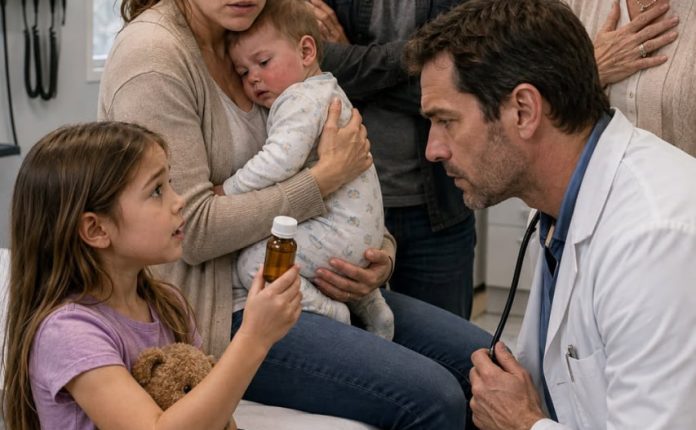
The fever was dangerous. The medication switch was dangerous. But so was being convinced that noticing danger made me unreliable. That is why, whenever someone asks what saved Eli, I never say only the hospital, the antibiotics, or the police. All of those things mattered, but before any of them could help, someone first had to speak. A seven-year-old girl with trembling hands did exactly that.
She stood in a room full of adults who were certain they understood everything. She held a teddy bear against her school jacket with an amber prescription bottle hidden beneath its faded denim overalls. Her grandmother called her confused. Her father tried to dismiss what she remembered. A doctor had already been prepared to see anxiety instead of danger. Yet Sophie refused to disappear beneath all that adult certainty.
“I’m not confused,” she said. She wasn’t. And once she said it, neither was I.