My mother’s jade plant had survived seven years on the sill beside my sunroom. My brother’s truck destroyed the wall behind it in less than three seconds. I bought my little three-bedroom house on Delmare Street after Mom died. Her life insurance paid $68,000, split evenly between Dad and me. My father, Gordon, put his $34,000 into savings. I used mine as a down payment. Everything after that was mine to carry.
I worked dispatch for a trucking company, made about $48,000 a year, paid my mortgage every month, skipped vacations, and eventually paid off my dark-gray SUV. I also built the sunroom myself from a kit—tempered glass, aluminum framing, ceramic tile—about $12,000 total by the time I finished. For two years, I quietly paid Gordon’s $85 phone bill and my younger brother Dylan’s $140 auto insurance. Neither ever thanked me. I never asked them to.
I told myself family was family, and helping them was simply easier than listening to Dad complain every month about how hard everything had become after Mom died. Dylan was turning twenty-five when things finally broke. Dad hosted dinner at his rental. Dylan’s girlfriend, Megan, was there, along with two guys from the tire shop where Dylan worked part-time. I brought him a canvas jacket and a $200 gift card. He opened both, barely reacted, then looked straight at me.
“I want your SUV.” At first, I thought he was joking. He wasn’t. “You barely use it,” he said. “You drive to work and home. I actually have places to be.” I told him no. His face tightened as if I had insulted him. “Claire, I’m serious.” I told him I was serious too. Then came the sentence that made the room go still. “It was bought with Mom’s money anyway.” I told him that wasn’t true. My share had gone into my house, and I had paid for the SUV myself.
“Then give me the house,” Dylan said with a smile that wasn’t really a joke. Dad put down his fork and told me not to be selfish because my brother was asking for one thing. I looked around the folding table at the cheap garlic bread, Megan staring down at her plate, and Dylan’s friends suddenly fascinated by their food. Something had clearly been decided before I arrived. Just not by me. “If you want something from me,” I said, “ask me. Don’t tell me it’s already yours.”
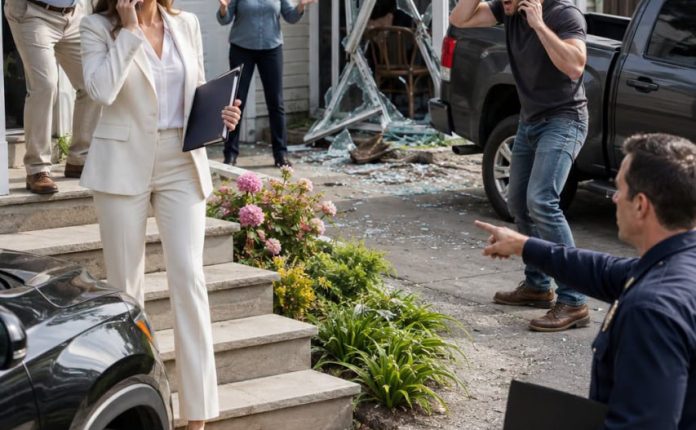
Nobody answered, so I left. At home, I made tea, checked the jade plant, and went to bed. At 10:14 p.m., a crushing metallic scream ripped through the back of my house. I ran into the kitchen and stopped cold. Dylan’s truck was halfway inside my sunroom. Glass had folded inward, aluminum framing twisted around the hood, and my ceramic tile was split beneath his front tire. Cold air poured through the wreckage carrying the smell of exhaust, broken ceramic, and wet soil.
The jade plant lay on the floor, its pot cracked in half. Dylan climbed out of the truck, looked at the destruction, and smiled. “Guess my foot slipped.” Dad’s car was parked at the curb. He walked through my gate only after the truck stopped, stared at my ruined room, and said, “A stingy nobody like you doesn’t deserve nice things.” Then he and Dylan left me standing there. I didn’t chase them. I didn’t scream. I didn’t even answer.
I picked up my mother’s plant, pressed loose soil carefully around its roots, and set it safely on the kitchen counter. Then I reached for my phone because dispatch had taught me something my family never understood. When everything goes wrong, emotion can wait. Evidence can’t. The first thing I did was call 911. The second thing I did was photograph everything—not just the truck-shaped hole in my house, but the tire marks, broken gate latch, damaged patio, shattered glass, and gouges across my yard.
I photographed the places where Dylan’s rear tires had churned mud beside the fence before he lined himself up with the sunroom. That detail mattered. People imagine driving a pickup truck through a house happens in one chaotic motion. It doesn’t. My backyard wasn’t directly accessible from the street. Dylan had entered through the side gate, backed across nearly forty feet of yard, corrected his angle twice, and then accelerated toward the room. His foot hadn’t slipped. He had aimed.
My security cameras had seen nearly all of it. I installed them three years earlier after somebody stole packages from my porch. Dad had mocked me for wasting money on “spy toys.” That night, those spy toys recorded Dylan driving slowly down the alley behind my property, stopping, reversing, repositioning his truck, and then accelerating directly into the sunroom. One camera captured audio too. Just before the truck hit, Dylan’s window was down, and I could clearly hear Dad’s voice.
“Do it.” Then came the crash. I watched the video once. That was enough. By the time Officer Ramirez and Officer Henson arrived, Dylan and Dad were gone. Dylan had managed to reverse the truck out after the impact, leaving pieces of my sunroom attached to his front grille. The officers stood in my kitchen staring through what used to be a wall. Ramirez asked if anyone had been in the room or injured. I said no. Then she asked whether I knew the driver.
“My brother.” She paused and asked whether it had been an accident. I held out my phone and said no. I played the recording. Neither officer spoke while the video ran. Then Henson asked if I could send them a copy. I told him I already had copies saved in cloud storage, emailed to myself, sent to my coworker Rachel, and stored on an external drive. Dispatch had taught me another useful lesson: never keep the only copy of important evidence where somebody might destroy it.
The officers photographed the damage and took my statement. I explained the birthday dinner, the SUV demand, Dad’s comments, Dylan’s deliberate collision, and the fact that both men left afterward. When I repeated Dylan’s “Guess my foot slipped” line, Ramirez raised an eyebrow and asked if he had really said that. I confirmed it. Then she asked what Dad had said. I repeated the line about being a stingy nobody who didn’t deserve nice things. She wrote every word down.
Ramirez looked through the broken opening and told me this would probably go beyond a simple accident report. When she asked whether I knew where Dylan was, I said no. “We’ll find him,” she replied. After the police left, I called my homeowners insurance. The woman on the claims line sounded half asleep until I explained that a pickup truck had intentionally entered my sunroom. She asked me to repeat that part, especially when I told her the driver was my brother.
She opened a claim immediately. At around 1:30 in the morning, I finally stopped making calls. I covered the broken opening with plastic sheeting from my garage and screwed plywood across the lower half as best I could. Then I sat at the kitchen table. Mom’s jade plant was beside me in an old mixing bowl because its ceramic pot was destroyed. One thick green leaf had snapped off. Mom had loved that plant more than its five-dollar price tag ever suggested.
She had bought it from a supermarket clearance rack for $4.99 because she said plants deserved second chances too. After she died, it became one of the few living things in the house that still felt connected to her. I touched one of its leaves and, for the first time that night, cried. Not about the sunroom. Not about the money. About Mom. Because if she had still been alive, none of this would have happened in quite the same way.
Dad had always favored Dylan, but Mom had balanced him. She knew when Dylan was manipulating people and when Dad was making excuses. She had a way of cutting through nonsense with one sentence: “You can love someone without rewarding their bad behavior.” She said it constantly. After she died, I forgot it—or maybe I ignored it because helping Dad and Dylan felt like keeping some piece of her alive. So I paid bills, covered meals, and fixed things they should have handled themselves.
Every time Dylan failed to pay something, Dad called me. Every time Dad needed help, he reminded me I had “done better” with Mom’s insurance money, as though my mortgage payments had magically made themselves, as though the dealership had handed me a paid-off SUV out of sympathy, and as though everything I owned somehow belonged to the family. At 2:08 a.m., my phone buzzed. Dad’s name lit up the screen. I stared at it before answering.
“You called the cops?” His voice wasn’t angry so much as offended. I told him yes. He asked how I could call police on family. I asked how family could drive a truck through my house. Dad insisted it was an accident. I said I had video. There was a long silence before he cautiously asked what the video showed. “Everything,” I said. Another silence followed, even longer this time. Then Dad changed direction and said Dylan had been upset.
I told him being upset didn’t matter. Dad said Dylan had consumed a few beers. I asked whether he was now saying Dylan drove drunk through my house. Dad immediately backtracked. I warned him to think carefully before explaining Dylan’s behavior. He told me not to be dramatic. I looked across my kitchen at the pickup-truck-shaped hole in the wall and nearly laughed. Dad insisted Dylan didn’t mean to do it. I reminded him the video showed Dylan aiming.
Dad said I couldn’t know that. I told him I also had audio of Dad himself standing there saying, “Do it.” His breathing stopped for a second. I heard the tiny intake of air before silence. When he spoke again, his tone had changed. He insisted I misunderstood what he meant and claimed “do it” referred to something else. I told him he could explain that to the police. Then I hung up, turned off my phone, and tried unsuccessfully to sleep.
At 6:40 a.m., I was awake on the couch when somebody knocked hard at the front door. Through the window, I saw a man in khaki pants and a navy jacket beside a tow truck. For one ridiculous second, I thought my insurance company had moved unbelievably fast. Then I noticed the paperwork in his hand. I opened the door but left the chain latched. He asked whether I was Claire Benton and said he was looking for Dylan Benton.
I told him Dylan didn’t live there. The man checked his paperwork and said my address was attached to a vehicle loan for a 2019 Ram 1500—Dylan’s truck. I told him it wasn’t my vehicle and that I had never given Dylan permission to use my address. He explained that he was a repossession agent and the lender had been trying to recover the truck. I stared at him because Dylan had always bragged that his truck was completely paid off.
The man handed me a card and said that if the truck appeared at my property, I should call. I nearly closed the door before one thought stopped me. I asked if the lender would care that the front of the truck had been destroyed the night before. That got his attention. He asked what happened. I told him Dylan had driven the truck through my sunroom. He stared at me and asked whether it had been deliberate. I told him the police report would say yes.
He asked if I knew where the truck was. I said no. He took out his phone, asked which police department was handling the case, thanked me, and left. I stood at the door watching the tow truck disappear while replaying Dylan’s old boasts in my head. Apparently, he didn’t own the truck outright at all. At 7:12, I switched my phone back on and found thirty-seven notifications from Dad, Dylan, Megan, and several unknown numbers.
I ignored them and made coffee. At 7:26, the insurance adjuster called. At 7:39, Officer Ramirez called to say police had located Dylan’s truck parked behind Dad’s rental. At 7:52, Rachel from work texted to ask whether I seriously planned to come in after my house had been hit by a truck. I told her probably not. Her reply came instantly: YOUR HOUSE GOT HIT BY A TRUCK. TAKE THE DAY. Twelve minutes later, my front door started shaking.
At exactly 8:04 a.m., pounding exploded against the door. “CLAIRE!” Dylan screamed from outside. I walked into the entryway and saw him standing in my driveway with his face bright red. Dad stood behind him. Between them, attached to a tow truck, was Dylan’s battered Ram—or what was left of it. The front bumper was crushed, one headlight hung loose, and a piece of aluminum framing from my sunroom was still wedged beneath the grille.
A repossession agent was tightening chains around the truck’s rear axle. Dylan saw me and screamed, “YOU DID THIS!” I opened the door but remained inside. I asked what exactly he meant. He pointed wildly toward the tow truck and shouted that they were taking his vehicle. I said I could see that. He accused me of calling them and telling them where to find it. I calmly reminded him I hadn’t even known where he had hidden it.
Dad stepped forward and demanded that I tell the repossession agent to stop. I asked why anyone there would listen to me. Dad said the whole situation was my fault and insisted I could fix it. When I asked how, he gave the same answer that had started everything: “Give him the SUV.” There it was—even now, after the police, the destroyed room, and the repo truck, Dad still believed the solution was handing Dylan something that belonged to me.
I said no. Dylan kicked the porch step and started calling me selfish until the repo agent advised him not to damage anything else. Dylan spun toward the man and told him not to tell him what to do. The agent simply pointed toward the street. A police cruiser sat half a block away. Officer Ramirez stepped out and walked toward us. Dylan’s face changed instantly. She greeted us, ignored Dad’s attempt to call it a family misunderstanding, and addressed Dylan.
“Mr. Benton, I need to speak with you about last night.” Dylan backed up and asked, “About what?” Ramirez glanced at the aluminum frame sticking from his grille and said, “Take a guess.” The repossession agent stepped aside. Dylan looked at me, no longer angry but frightened, and said my name. I said nothing. Ramirez told him to turn around. Dad stepped between them, protesting that his son had only had an accident.
“We have video,” Ramirez said. Dad froze. Then she looked directly at him and added, “You’re in it too.” That was the moment Gordon Benton finally understood I had not been bluffing. He stepped aside. Dylan was arrested in my driveway at 8:11 a.m. Dad wasn’t arrested that morning—not yet—but he left looking older than he had the night before. The tow truck drove away with Dylan’s Ram, the police cruiser left with Dylan, and I closed my door.
Then I made another cup of coffee. By lunchtime, the story had already spread through the family. My Aunt Caroline called first and asked what happened. When I told her Dylan had driven into my sunroom, she said Dad claimed I had him arrested over a scratch. I looked at the plywood covering twelve feet of missing wall and sent her a photograph. She called back immediately. “Oh,” she said. “That’s not a scratch.” I told her I was glad we had clarified that.
Caroline asked whether Dylan had been drunk. I told her I didn’t know. She said Dad claimed he accidentally backed into the room. I reminded her that Dylan had driven forward and that I had video. There was another uncomfortable silence before she changed the subject and asked whether everything could be worked out privately. When I said no, she reminded me Dylan was my brother. I said I knew. She told me I only had one brother.
“So he should probably stop driving trucks into my house,” I answered. Caroline sighed and said my mother wouldn’t want any of this. That sentence hit harder than I expected, not because it was true but because it wasn’t. I told her not to use Mom as a reason for me to tolerate what happened. She insisted she wasn’t doing that. I told her she was and ended the call. Then I blocked family calls for the rest of the afternoon.
My insurance adjuster, Linda Patel, arrived around two. She was practical, experienced, and completely unimpressed by drama. She walked through the wreckage using a tablet and measuring device. She asked how much the addition had originally cost, how old it was, and whether it had been properly permitted. I showed her everything. When I asked whether insurance would cover it, she said deliberate acts by a third party were handled differently from damage caused by the homeowner.
She crouched near a fractured tile and asked about the truck’s vehicle insurer. I said I didn’t know whether Dylan had one. Then I remembered something. For two years, his insurance had been on autopay from my checking account. I opened my banking app. The most recent payment—$143.82—had processed eight days earlier. I stared at the charge. My brother had destroyed my sunroom using a truck whose insurance I was still paying for.
Linda blinked when I explained that. She asked why I paid the policy. I answered that apparently I was an idiot. She didn’t laugh. Instead, she asked whose name was on the policy and which vehicle was insured. When I told her it was Dylan’s policy covering the Ram, she told me to call immediately. I did. The representative confirmed the policy existed, and then the story became even more complicated.
Dylan had never told the insurance company the truck was financed. He had also apparently failed to disclose a previous suspension on his license. Worse, according to company records, he had changed his mailing address to mine eight months earlier. My house again. The representative couldn’t discuss every detail, but she said the incident would be investigated. Then she asked the important question: “Was the collision intentional?” I answered yes.
That single word changed the tone of the call. Intentional vehicle damage did not fit neatly into normal accident coverage. The insurer requested the police report, videos, photographs, and information from my homeowners claim. I sent everything. Then I called my bank and stopped Dylan’s insurance autopay. After that, I stopped Dad’s phone payment. Two recurring charges that had run for years disappeared from my account in less than six minutes.
I had spent years feeling responsible for those men. It took six minutes to stop. At 4:20 p.m., Dad called from another number. The first thing he said was that I had canceled his phone. I told him yes. He reminded me that he had bills tied to that number and was on a fixed income. I reminded him he had savings and could pay for his own service. He accused me of punishing him. I said I wasn’t punishing anybody; I was simply ending a favor.
Dad complained that I had paid the bill for years, as if duration had somehow transformed generosity into a legal obligation. Then he said Dylan needed a lawyer and expected me to help pay for one. I told him no. He warned that Dylan could go to jail. I said yes, that was possible. Dad reduced the whole thing to “breaking a window.” I reminded him it wasn’t a window. It was a room. Then he accused me, somehow, of being obsessed with money.
The absurdity almost made me smile. Dad had spent an entire day demanding my SUV, defending destruction of my property, complaining about his phone bill, and requesting money for Dylan’s attorney, yet somehow I was the one obsessed with money. I tried to end the conversation, but Dad said something that caught my attention. He claimed Dylan was already upset because he was “behind.” I asked what he meant. Dad immediately said it was nothing.
I pressed him until the truth came out. Dylan owed nearly $27,000 on the truck. It had been worth around $19,000 before he drove it through my house. He had rolled debt from an older vehicle into the loan, accepted a terrible interest rate, and was three payments behind. The repossession had already been authorized before his birthday. Suddenly the SUV demand made perfect sense. Dylan didn’t want my SUV because he loved it. He wanted it because his truck was about to disappear.
Dad had known that. I asked whether the plan had actually been for me to simply hand over my vehicle when the bank repossessed Dylan’s truck. Dad said they thought I could help. I reminded him that nobody had asked; they had announced what I would give. Then, astonishingly, he asked again. “I’m asking now.” I said no. Dad warned Dylan would have nothing. I reminded him Dylan had a job and was twenty-five years old.
Dad answered, “Not everybody has your discipline.” There it was again—my responsibility presented as if it were an unfair advantage. I told him I was done discussing it. Predictably, he said Mom would have helped Dylan. This time, I answered with the sentence she had taught us: “Mom helped people who were trying. She didn’t reward people for destroying things.” Dad hung up without another word.
Two days later, Dylan was released pending charges and called me using his girlfriend Megan’s phone. He opened with, “Please don’t hang up.” I almost did anyway. Then he said he was sorry. It was the first apology I had heard, but it didn’t sound like one. It sounded like somebody testing a password. I waited. He said he had been drunk. I reminded him he drove to my house, opened the gate, lined up with the sunroom, and told me his foot slipped.
He claimed he panicked. I reminded him Dad told him to do it. Dylan said Dad had been joking. I pointed out that Dad had been standing in my yard at ten o’clock at night while Dylan aimed at my house. Dylan said he wasn’t thinking. Then he asked me to tell police I didn’t want charges. I refused. He said they were discussing felony property damage. I told him that sounded serious. He accused me of not understanding how much trouble he was in.
Then Dylan admitted the truck was gone and said he had also lost his job. The tire shop had fired him after police showed up. I didn’t feel satisfied, but I also didn’t feel guilty. I told him he wasn’t losing things because of me; he was losing things he hadn’t been maintaining. The truck was already being repossessed. His employer didn’t fire him because of my feelings. They fired him after learning he had used a vehicle to deliberately crash into someone’s home.
Dylan insisted the truck hadn’t been a weapon. I reminded him there had been a person living ten feet away. He went quiet. For the first time, I wondered whether he had ever considered that. The sunroom was attached directly to my kitchen. If I had been making tea instead of sleeping upstairs, I could have been standing behind the glass. If the frame collapsed differently, I could have been badly hurt. Dylan’s anger had endangered more than property.
Then he asked me to tell insurance the collision was accidental so they would cover his damaged truck. I refused to commit insurance fraud. He asked if I would rather bankrupt him. I told him he had already done that himself and ended the call. The next morning, I received the first repair estimate. Temporary stabilization alone would cost nearly $3,700. The full rebuild would exceed $17,000 because material and labor costs had risen since I built the room.
Once structural inspections, debris removal, replacement framing, tile matching, electrical work, and temporary weatherproofing were included, the claim reached around $19,400. The original $12,000 sunroom had become a nearly $20,000 loss. That number spread through the family too. Suddenly Dad stopped calling it “a window.” Now he called it “an overpriced porch.” The prosecutor assigned to the case, Elena Brooks, met with me three weeks later.
She explained that Dylan faced criminal property-damage charges, reckless endangerment, and related offenses. When I asked about Dad, she said prosecutors were still reviewing his role. I reminded her he had told Dylan to do it, had driven there with him, and parked at the curb before the crash. A neighbor’s camera later revealed that Dad had actually entered the rear alley first and then moved his car. Brooks said investigators had subpoenaed more footage.
She explained that Dad could potentially face complicity or conspiracy-related charges depending on the evidence and applicable statutes. The word conspiracy sounded too dramatic for my father and idiot brother fighting over an SUV. Brooks told me people imagine conspiracies as sophisticated operations, but legally, two people agreeing to commit an offense may be enough. Dad had already claimed his recorded “do it” meant something entirely different.
According to his statement, he thought Dylan planned to scare me by revving the engine outside. Dad said “do it” referred to honking the horn. I laughed when Brooks told me. The crash occurred seconds after the words. She did not laugh. For the first time since this started, I felt something close to peace. Not happiness, not revenge—just relief that I no longer needed to convince anybody. The evidence was doing the talking for me.