The criminal case developed slowly. Linda was charged first, facing offenses connected to child endangerment, administering inappropriate medication, and interfering with prescribed treatment. I won’t pretend I understood every legal term. I didn’t. Mark faced separate charges connected to his participation and failure to protect Eli. Prosecutors considered Sophie’s recordings significant, along with pharmacy records, toxicology reports, medical testing, and the nearly full antibiotic bottle.
Police also recovered the nighttime medication from Linda’s bedroom. Then investigators obtained messages between Linda and Mark. Those messages were worse than the recordings because they revealed how deliberate the campaign against me had become. In one exchange, Linda wrote that I needed to stop calling doctors every time Eli sneezed. Mark replied that he knew. Linda told him people needed to see what I was really like.
Mark answered, “Sterling already knows she’s anxious.” Linda replied, “Good. Keep using that word.” Another exchange occurred two days before Eli’s fever reached 104. Mark wrote that I believed Eli felt hotter. Linda told him to say he had checked and the baby was fine. Mark admitted Eli did feel warm. Linda dismissed it and said babies became warm. Mark wrote that I wanted urgent care. Linda answered, “Absolutely not. Every visit becomes another performance.”
Then Mark wrote, “I’ll handle her.” I read that line repeatedly. Not “I’ll handle Eli.” Not “I’ll call the doctor.” Her. Me. I had become the problem requiring management. Another message from the night Sophie first saw them showed Linda asking if I was finally asleep. Mark said yes. Linda told him to bring Eli downstairs. Mark said Sophie was awake. Linda told him to send her back to bed. Mark replied, “Done.”
I stopped reading. My attorney, Marissa Cole, reached across the table and told me I didn’t have to keep going. I insisted I needed to know because I had spent months believing I imagined everything. Marissa nodded and said, “Then read enough to know you weren’t.” That sentence saved me from reading every ugly message. I didn’t need every word. I needed the truth. There was a difference.
Family court was brutal in a quieter way than criminal court. Nobody shouted, but hearing strangers discuss your parenting feels like its own kind of violence. Mark’s attorney portrayed him as a father caught between an anxious wife and an overbearing mother. He argued Mark had made poor decisions under pressure and never intended to harm Eli. He emphasized repeatedly that Mark loved his children. I believed that part, and that made everything harder.
I don’t think Mark wanted Eli dead. I don’t think he sat in our kitchen imagining an ambulance or hospital room. I think he wanted something simpler and more selfish. He wanted me quiet. He wanted Linda satisfied. He wanted to avoid conflict. He wanted control. He wanted the future advantage of calling me unstable if our marriage ended. He wanted all those things badly enough that our baby’s actual illness became secondary.
People do not have to want tragedy in order to create conditions where tragedy becomes possible. The judge reviewed the recordings, messages, medical records, Sophie’s forensic interview, and Dr. Sterling’s testimony about Mark’s call before the appointment. Then Mark testified. I hadn’t expected that. He looked tired and older. He admitted he knew Linda had stopped the antibiotic after the first dose.
Mark claimed he believed Linda would substitute something safe. My attorney asked whether he consulted the prescribing doctor, any physician, or a pharmacist. He answered no each time. She asked whether he told me. Again, no. When Marissa asked why, Mark said because I would have been upset. She repeated the answer carefully: upset that he had discontinued our infant son’s prescribed treatment without medical advice. Mark quietly said yes.
Then Marissa asked whether Mark had documented my medical calls for possible use in a custody dispute. His attorney objected, but the judge allowed the question. Mark whispered yes. I closed my eyes. Marissa asked whether Mark had told the pediatric office I was spiraling before Eli had even been examined. He admitted he had. Then she asked the question I needed to hear answered in open court: “Was she spiraling?”
Mark looked toward me. For the first time in months, our eyes met. “No,” he said. The courtroom became silent. Marissa asked why he had claimed otherwise. Mark’s voice cracked as he admitted Linda had told him that if people already believed I was unstable, nobody would question him later. Sophie’s small hand slipped into mine. She wasn’t testifying, but she had been allowed to sit with Jenna behind us for part of the hearing.
Marissa asked whether Mark truly believed I was dangerous to the children, neglectful, or fabricating their illnesses. He answered no each time. “Then what exactly were you building a case against?” she asked. Mark began crying quietly. He wiped his face and said, “I don’t know.” But I knew. He had been building a case against resistance—against a wife who might say no, challenge Linda, or refuse to accept their version of reality.
The temporary order became more restrictive. Mark retained supervised visitation, Linda remained barred from contact, and I received temporary sole authority over medical decisions. When the judge said those words, I almost laughed. For months, I had been told my medical decisions were excessive. Now the court was specifically placing them in my hands. The criminal cases eventually ended through plea agreements rather than full trials.
Part of me hated that. I wanted every message read aloud in a courtroom. I wanted Linda forced to listen while someone explained what she had done. Then prosecutors told me that plea agreements would reduce the possibility of Sophie ever having to testify. That decided it. My daughter had already done enough. Linda accepted responsibility for unlawfully interfering with Eli’s care and exposing him to inappropriate medication.
She received legal penalties, probation conditions, mandatory counseling, and a lengthy no-contact order involving both children. Mark’s sentence reflected a different level of involvement but still carried serious consequences. His professional life suffered too. He worked in financial services, and once the case became public, his employer placed him on leave before eventually terminating him. For months, Linda blamed me for that outcome.
She sent letters through relatives. I never opened them. One aunt called to say Linda wanted me to understand her side. I told her, “Her side was poured down my sink.” My aunt said Linda loved the children. I answered, “Love without safety isn’t enough.” She called it a mistake. I reminded her that a mistake was forgetting a dose. This happened deliberately over three nights, in secret, while the adults involved worked to make me doubt myself.
My aunt sighed and said families had survived worse. I looked toward Sophie, who was helping Eli stack plastic cups on the floor, and said, “I’m not trying to survive worse. I’m trying to stop worse from happening.” That ended the conversation. The hardest person for me to forgive wasn’t Linda. It was Dr. Sterling. His mistake wasn’t more malicious, but I had gone to him specifically because I needed help.
Months after Eli recovered, the clinic invited me to meet with its medical director. They had completed an internal review. Policies were changed, staff received additional training about parental labeling and diagnostic bias, and new procedures were introduced for documenting conflicting caregiver reports. Dr. Sterling attended the meeting and apologized again. This time, I asked him something I had thought about for months.
“If Sophie hadn’t spoken, what would you have done?” His face fell. “I don’t know.” I told him that answer scared me. “It should,” he replied. I appreciated the honesty. He didn’t rewrite history to make himself heroic or promise he would eventually have figured everything out. He admitted a seven-year-old girl had interrupted his bias. I asked whether he would remember Sophie. He said yes.
“Not as the clever little girl with the teddy bear,” I told him. “Remember her as the reason you checked yourself.” Dr. Sterling nodded and promised he would. That was enough for me. I didn’t file a lawsuit, although people assumed I would. Another person might have and might have been right to do so. I wanted meaningful changes more than money, and the clinic had made them. A year passed, and Eli turned two.
He had no lasting complications from what happened. The first time a doctor told me that, I cried in the parking lot. Sophie turned nine and still carried her teddy bear. Its overalls were stretched from years of being stuffed with objects no stuffed animal was designed to carry. Once, I offered to repair the worn pocket. Sophie refused and said it was supposed to look like that because it was where she had hidden Eli’s medicine.
I asked whether looking at the bear made her sad. Sophie thought about it and said no. When I asked why, she answered simply, “Because it worked.” That was Sophie. Children find meaning differently from adults. I had spent months seeing the teddy bear as evidence from the worst day of our lives. Sophie saw it as the thing that helped her tell the truth. Therapy helped her understand that she was not responsible for protecting adults.
That lesson took time. For months, she asked me before telling teachers small things, “Will somebody get in trouble?” I would tell her maybe. Then she asked whether she should still say it. I told her if something was true and an adult needed to know, yes. Sophie had learned silence too early. I had to teach her that truth did not make her dangerous. Mark remained in the children’s lives through supervised visits at first.
Eventually, after evaluations, counseling, and time, the court allowed limited unsupervised contact with strict conditions. That decision terrified me. I fought parts of it and lost some of those battles. Family court doesn’t always give one parent complete control simply because the other parent did something terrible. Mark was still their father. He completed programs, attended counseling, and followed court orders. Over time, his behavior changed.
The first time Sophie returned from a visit and said, “Dad apologized,” I didn’t know how to respond. I asked what he had said. Sophie told me Mark admitted he should have listened to me. I asked what she answered. “I said he should have listened to me too.” I almost smiled. “That was fair.” She said he cried. I asked how that made her feel. Sophie thought about it and said, “Weird.” That was fair too.
Three years after the hospital, Mark asked to speak with me privately during a custody exchange. We stood in the parking lot of a family services center. He said he owed me an apology. I reminded him he had apologized before. Mark said he knew but wanted to explain something. “I thought saying you were anxious made me the calm one,” he admitted. He said he liked being seen as the reasonable parent whenever I worried.
Mark told me Linda encouraged that dynamic. I reminded him that she may have encouraged it, but he had chosen it. He nodded and said, “I know.” No “but.” No “however.” No claim that his mother had forced him. Just I know. He admitted that whenever I called doctors, he saw my concern as weakness. He hadn’t understood I was doing the work he didn’t want to do—paying attention.
He also admitted that when Linda began discussing custody, documenting my behavior felt like protection in case our marriage failed. I told him he had helped make the marriage fail. Again, he said, “I know.” Then he told me he had never wanted to hurt Eli. I surprised him by saying I believed that. I also told him something else: I believed he didn’t want Eli hurt, but wanting Eli safe had not been important enough to him in those moments.
Mark looked away. That was the difference. Good intentions do not erase priorities. Eventually, he remarried. So did I, though that came much later. For almost four years, I didn’t date. I wasn’t afraid of men. I was afraid of losing my own voice again. There is a difference. Then I met Owen, a widowed father at Sophie’s school. He was quiet, patient, and never tried to convince me he knew my children better than I did.
The first time Eli developed a fever while Owen was at our house, I watched him carefully without even realizing it. The thermometer read 100.9. Owen asked whether I wanted him to get the medicine. I froze. He noticed and stopped immediately. Instead of touching anything, he said, “Tell me what would help.” That sentence nearly made me cry. Not “you’re overreacting.” Not “I know what to do.” Simply: tell me what would help.
I asked him to read the label while I measured the medication. He did. No jokes, no sighs, no trying to take control. Trust returned through moments that small. Owen and I eventually married when Sophie was twelve and Eli was five. Before the wedding, Sophie asked him one question. “If Mom says something’s wrong, will you believe her?” Owen answered immediately that he would. Sophie narrowed her eyes.
“Even if you think she’s being dramatic?” Owen smiled slightly and said, “I can think someone’s worried and still check.” Sophie considered his answer for a moment and said, “Good.” Then she walked away. Owen looked at me and asked whether that had been an interview. I told him yes. He asked if he had passed. “Barely,” I said. He laughed. Years later, the hospital incident became something we discussed carefully, but never secretly.
Eli learned a simplified version first. We told him that when he was a baby, he became very sick because some adults made unsafe choices with his medicine, and Sophie told the doctor what happened. When he was seven, he asked whether Sophie had saved him. I said she helped the doctors understand what was happening. Eli grinned. “She saved me.” Sophie, fourteen by then, rolled her eyes and said she hadn’t fought a dragon.
“You had a teddy bear,” Eli said. “That’s worse.” He ran across the room and hugged her while Sophie pretended to be annoyed. She wasn’t. When Sophie turned sixteen, she asked whether I still thought about that day. I said yes, but not every day. “Good,” she said. I asked why. She shrugged and answered, “I don’t want it to be the biggest thing I ever did.” That sentence stopped me.
For years, adults had praised her courage. Police officers, doctors, therapists, relatives, and I had all called her brave and observant. We told the story of the teddy bear again and again. But Sophie deserved a life larger than the worst thing she witnessed at seven. So I stopped using that moment as the main example whenever I talked about her strength. She became strong in a hundred other ways.
She defended a bullied classmate, auditioned for a school play even though she hated public speaking, failed her first driving test and went back two weeks later, and survived her first heartbreak at seventeen. She became more than the little girl with the teddy bear, just as I became more than the anxious mother nobody believed. Linda never returned to our lives. The no-contact order eventually expired, but contact did not resume.
When Sophie turned eighteen, Linda sent her a letter. Sophie showed me the envelope but didn’t open it. She asked whether she could throw it away. I told her yes. Then she asked whether refusing to forgive Linda made her a bad person. I said no. Sophie told me Mark believed forgiveness was something people did for themselves. She asked whether I had forgiven Linda.
I thought about the question for a while. “I stopped carrying her around in my head,” I finally said. Sophie frowned and told me that wasn’t really an answer. I smiled. “It’s the only one I have.” She looked at the unopened letter one last time, dropped it in the trash, and said, “That works for me.” Mark eventually rebuilt a decent relationship with both children, though never the relationship he might have had.
Consequences do not disappear simply because someone improves. Sophie loved her father, but she never trusted him automatically again. Eli barely remembered the incident directly, so his relationship with Mark was less complicated. Sometimes that hurt Sophie. Once she told me it felt unfair that Eli got to have a father without remembering why our family had broken. I told her she was allowed to feel exactly that way.
Children do not need every painful emotion corrected. Sometimes they need it witnessed. The final time Mark and I discussed the hospital day was at Sophie’s high school graduation. We stood in the crowded gym watching her laugh with friends. Mark quietly said, “She’s incredible.” I agreed. He said she always had been. Then he looked toward me and said, “I almost taught her not to trust herself.”
I didn’t answer. Mark continued, “You taught her back.” I finally looked at him and shook my head. “No. She taught me.” That was the truth. Sophie taught me to stop apologizing for noticing. She taught Dr. Sterling to question assumptions. She taught Mark that calmness and competence were not the same thing. She taught Linda, whether Linda accepted it or not, that children remember what adults do when they think nobody important is watching.
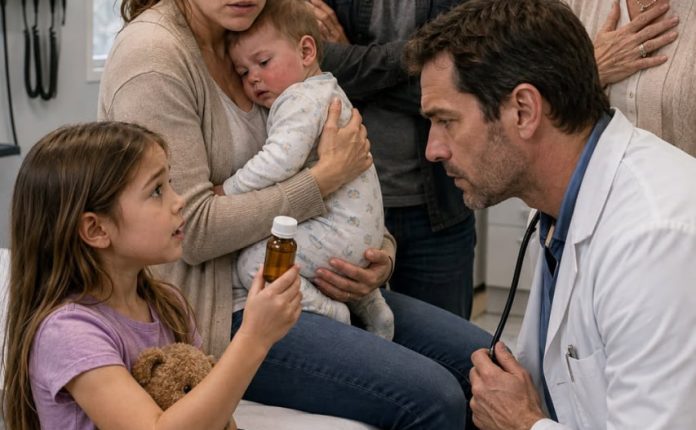
Most importantly, Sophie taught herself that being seven years old did not make the truth smaller. I still remember the exact moment everything changed. Not the ambulance, the hospital, or the police. I remember the examination room—the paper crinkling beneath me, Eli burning against my chest, Linda smirking, Mark standing with his arms crossed, and Dr. Sterling barely concerned while I wondered whether I had somehow become the problem.
Then Sophie’s small voice cut through the room. “Dr. Sterling?” Everyone turned. She lifted the teddy bear and asked, “Should I tell you what Grandma gave the baby instead of his real medicine?” That question broke the entire story open. For months, I believed I needed to become less afraid, less sensitive, and less watchful. What I actually needed was to stop treating other people’s confidence as proof that they were right.
Linda sounded confident. She was wrong. Mark sounded calm. He was wrong. Dr. Sterling sounded experienced, and at first, he was wrong too. Sophie’s hands were trembling. She was right. That distinction changed my life. Years later, when Sophie prepared to leave for college, she packed the teddy bear. I watched her place it carefully into a cardboard box between sweaters and books. “You’re taking him?” I asked.
“Obviously.” I told her the bear looked terrible. Sophie said he was historic. She picked him up and straightened the faded denim overalls. The stitching beneath one side was still uneven where she had once hidden the prescription bottle. I touched the worn fabric and asked whether she remembered being scared. She said yes. Then I asked what finally made her decide to speak.
Sophie thought for a moment before saying, “Because Eli stopped crying.” I stared at her. She explained that morning he had become so quiet, and babies weren’t supposed to get quieter when they were that sick. My eyes filled. At seven years old, Sophie had noticed the same thing I did. His cries had grown weaker. Everyone else heard less noise and saw less urgency. We heard danger.
Sophie hugged me and said, “You were right too, Mom.” I held her tighter. For a long time, I had believed her revelation proved she was the only person who had seen clearly. She corrected me. We had both seen it. I had simply been taught not to trust myself. That is the part of the story I remember most now—not that I failed to stop Linda sooner, not that I trusted Mark, and not even that a doctor dismissed me.