The final hearing took place on a cold morning in January.
The courtroom was smaller than I expected.
There was no jury, no dramatic audience, and no grand staircase outside. Just wooden benches, fluorescent lighting, files stacked beside the clerk, and a judge named Elena Ramirez who had spent months reading the worst accusations strangers could make about one another.
Lily sat in a private waiting room with her court-appointed advocate.
She had already spoken to Judge Ramirez twice in chambers.
I did not know exactly what she had said.
I had told her only one thing.
“Tell the truth. You do not have to protect my feelings.”
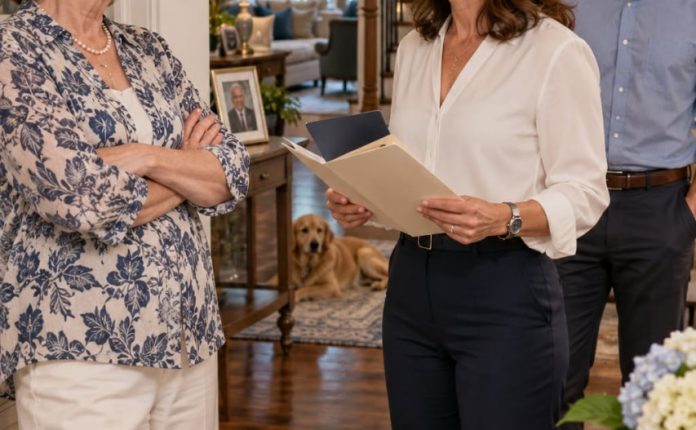
The Harpers arrived together.
Margaret wore cream.
Charles wore charcoal gray.
Vanessa sat behind them, holding a leather folder.
They looked composed and almost cheerful.
Richard Cole had built their case around a simple argument: Whatever mistakes the Harpers had made after Michael’s death, Lily now deserved access to her paternal family, their resources, their guidance, and the heritage I had allegedly denied her.
They no longer asked to overturn the adoption completely.
Instead, they sought expanded visitation, a formal role in major educational decisions, and removal of Northbridge as trustee in favor of a family-controlled financial institution.
Their revised position appeared reasonable.
That made it more dangerous.
Samuel represented the trust. My own attorney, Dana Brooks, represented me.
Northbridge submitted nine years of records showing that I had never requested a distribution.
Not for private school.
Not for household expenses.
Not even when Lily needed braces and I used a payment plan.
Dana presented the letter in which the Harpers declined guardianship and regular care.
She showed the unanswered notices from the adoption.
She introduced phone records demonstrating that no one from the family had called Lily for nine years.
Margaret cried when questioned.
“We believed Nora wanted us gone.”
“Did she ever say that?” Dana asked.
“Not in those words.”
“Did she prevent you from sending birthday cards?”
“No.”
“Did she prevent you from calling?”
“We feared conflict.”
“Did you ask a lawyer to arrange contact?”
“No.”
“Did you attend Lily’s adoption hearing?”
“No.”
“Did you object to the adoption?”
“No.”
“Did you attempt to contact her in the year before learning about the trust?”
Margaret looked toward Charles.
“No.”
“Did you contact her within twenty-four hours of learning that the trust might contain substantial assets?”
Cole stood.
“Objection.”
“Overruled,” Judge Ramirez said.
Margaret lowered her eyes.
“Yes.”
Charles was less emotional.
He admitted that the trust had created urgency.
“Michael was inexperienced with significant wealth,” he said. “I was concerned that he may have created an inefficient structure.”
“An inefficient structure managed by a licensed corporate trustee?” Dana asked.
“Large institutions make mistakes.”
“And you wanted your company’s private bank to take control?”
“I wanted experienced family advisers involved.”
“Would your company have earned fees from managing the assets?”
“Standard fees.”
“So your family’s business would have benefited financially?”
“That was not the primary purpose.”
“Was it a purpose?”
Charles paused.
“It may have been an incidental benefit.”
For the first time, Judge Ramirez looked openly displeased.
Vanessa testified that she had always loved Lily.
Dana handed her a copy of the affidavit she had signed nine years earlier.
“Is this your signature?”
“Yes.”
“You wrote that your household could not accommodate Lily because her emotional needs might negatively affect your children.”
“I was grieving.”
“You also wrote that long-term contact would be difficult.”
“My situation was different then.”
“You lived eight miles from Lily’s school.”
“I had responsibilities.”
“So did Nora.”
“That was her choice.”
Dana became very still.
“Raising Lily was Nora’s choice?”
“Yes.”
“And staying away was yours?”
Vanessa’s attorney whispered something, but it was too late.
“Yes,” Vanessa said.
The word remained in the courtroom long after she finished speaking.
During a recess, Lily came to sit beside me.
She wore a navy dress and the small silver necklace Michael had given her for her fifth birthday.
“How are you?” I asked.
“I want to go home.”
“We will.”
“What if the judge lets them manage the trust?”
“Northbridge will appeal if necessary.”
“What if she makes me visit?”
“We’ll follow the order and make sure you’re safe.”
“What if I don’t want to hate them?”
“You don’t have to.”
She looked toward Margaret, who was speaking quietly with Cole.
“Sometimes Grandma seems sorry.”
“She may be.”
“Can someone be sorry and selfish at the same time?”
“Yes.”
“Can I forgive her without trusting her?”
“Yes.”
Lily took my hand.
“Did Dad know this would happen?”
“I don’t know.”
Samuel, who was sitting in front of us, turned around.
“There may be an answer to that.”
Before I could ask what he meant, the clerk called everyone back into session.
Samuel stood when Judge Ramirez returned.
“Your Honor, the trust requests permission to present a supplemental item.”
Cole immediately objected.
“This hearing has been scheduled for months. We have received no notice of new evidence.”
“The item was referenced in the original trust certification provided during discovery,” Samuel replied. “Its release was conditional.”
Judge Ramirez adjusted her glasses.
“What condition?”
Samuel looked toward Charles and Margaret.
“A legal attempt by any member of Michael Harper’s birth family to obtain guardianship authority, trustee authority, or financial control over Lily’s inheritance.”
The courtroom became silent.
Cole turned toward his clients.
Charles’s face had lost its color.
“What item?” the judge asked.
“A recorded statement made by Michael Harper thirteen months before his death, witnessed by two attorneys and authenticated by Northbridge. The trust directs that it remain sealed unless the specified condition occurs.”
“Why was it not disclosed when the petition was filed?”
“The instrument required that the court first hear the petitioners’ testimony regarding their motives. Those statements have now been given under oath.”
Cole stood again.
“This is theatrical and prejudicial.”
“It may also be directly relevant to the settlor’s intent,” Judge Ramirez replied. “Did your clients know such a recording existed?”
Cole looked toward them.
Charles whispered something.
Margaret shook her head.
“No,” Cole said.
Judge Ramirez called a brief recess to review the trust language and authentication documents.
For twenty-seven minutes, no one spoke to us.
Lily pressed her knee against mine beneath the table.
When the judge returned, she ruled that the recording could be played for the limited purpose of determining Michael’s intent regarding trust management and his nominated guardian.
A monitor was placed on a table facing the court.
Samuel inserted a secure drive.
The screen flickered.
Then Michael appeared.
For the first time in nine years, I saw my husband moving.
Not in a silent home video.
Not in a memory.
He sat in Samuel’s old conference room wearing a blue shirt with the sleeves rolled to his elbows. His hair was slightly too long, and there was a faint coffee stain near his cuff.
My breath left me.
Lily made a small sound beside me.
Michael looked directly into the camera.
“My name is Michael Andrew Harper. Today is December twelfth. I am making this statement voluntarily and while fully capable of understanding its purpose.”
He gave his address and identified the attorneys in the room.
Then his expression softened.
“If you are watching this, something has gone wrong. Either I am no longer here, or someone has decided that my daughter’s inheritance matters more than my daughter.”
Margaret covered her mouth.
Michael continued.
“I hope I am being unfair. I hope my family proves me wrong. But I have spent most of my life watching money turn affection into a transaction, so I am leaving a record that cannot be rewritten after I am gone.”
Charles stared straight ahead.
Michael explained the trust.
The life-insurance policy had been purchased before our marriage. The planning software he developed had been licensed to a larger firm. The proceeds had been placed into an independent trust because he did not want any relative, including me, to control the principal.
“I want to make one fact clear,” he said. “Nora does not know the value of this trust. She knows I have made arrangements for Lily, but she has never asked how much she will receive. She is not a beneficiary. She cannot withdraw the money. She cannot redirect it. She cannot use it for herself.”
Cole stopped taking notes.
Michael leaned closer to the camera.
“My parents may claim that Nora married me for money. They made that accusation before our wedding, even though Nora signed a prenuptial agreement without requesting a payment, a property interest, or a guaranteed inheritance.”
I looked at Samuel.
I had forgotten about the agreement. Michael and I had signed it because his parents threatened to disrupt the wedding. The document protected assets I did not know existed and that he did not yet fully possess.
Michael’s voice became quieter.
“After we married, Nora used twelve thousand dollars left to her by her grandmother to pay debts from my company during a difficult year. She never asked for ownership. She said we were a family.”
I felt tears move down my face.
I had not known he remembered the exact amount.
“I asked Nora once what she would do if I died,” Michael continued. “She became angry and told me not to speak that way. Then she said she would raise Lily, because losing one parent should not mean losing another.”
Lily squeezed my hand.
Michael looked down briefly, gathering himself.
“My daughter’s biological mother has been absent for most of her life. My parents know this. My sister knows this. They also know that Nora is the person Lily calls when she is frightened, hurt, excited, or proud.”
Margaret’s shoulders began to shake.
“If my family supported Lily after my death—if they visited her, remembered her birthdays, helped Nora, and loved her without asking what they would receive—then I apologize for doubting them.”
He paused.
“But if they stayed away while she had little and returned only after learning she had millions, then their own actions have answered every question this court needs to ask.”
No one moved.
Michael turned slightly toward someone off-camera.
Samuel’s younger voice asked, “Do you want to identify specific incidents?”
“Yes.”
Michael faced us again.
“When Claire left, I asked my parents whether Lily and I could stay with them for two weeks while I arranged childcare. My father said bringing a crying toddler into their home would disrupt my mother’s health. I slept on a friend’s sofa with Lily beside me.”
Charles lowered his head.
“When Lily was three, Vanessa refused to include her in a family photograph because she said Claire’s history made the situation uncomfortable. Nora found Lily crying behind the garden wall and sat with her for an hour.”
Vanessa’s lips parted, but no sound came out.
“When I told my parents I intended to marry Nora, my mother asked whether Nora understood that Lily would never truly belong to her.”
Margaret whispered, “Michael…”
On the screen, he continued as though he had heard her across time.
“Mother, if you are watching this, I need you to understand something. Belonging is not something blood automatically gives. It is something love repeatedly proves.”
Lily began to cry.
Michael’s expression changed. For a moment, he was no longer speaking to the court or the attorneys.
He was speaking to her.
“Lily, my beautiful girl, I hope you never see this video. I hope I live long enough to embarrass you at graduation, criticize your first boyfriend, and complain about whatever career you choose.”
A faint smile touched his face.
“But if I am gone, none of this is your fault. You were not too difficult to love. You were not the reason anyone left. Adults make choices because of who they are, not because a child failed to be enough.”
Lily pressed her fist against her mouth.
“Nora loves you. I have watched her choose you on ordinary days, which is where real love lives. She chooses you when you are sick, loud, stubborn, frightened, and covered in paint. She chose you before there was a trust. She chose you before she had any legal right to remain in your life.”
My vision blurred.
“If Nora raises you, respect her. Do not place her on a pedestal—she hates that, and she is terrible at accepting compliments. But understand that she stayed when staying was hard.”
A few people in the courtroom laughed softly through their tears.
Michael took a breath.
“Regarding the trust, Northbridge must remain the independent trustee. No member of the Harper family may replace it, manage the assets, collect advisory fees, or direct investments. If any relative challenges this provision, all legal costs of defending the trust are to be paid from a separate reserve established for that purpose, not from Lily’s share.”
Charles shut his eyes.
“The family may have a relationship with Lily only if Lily wants one and if that relationship is healthy. Money must never be used to purchase access, obedience, forgiveness, or affection.”
Michael looked directly into the camera one final time.
“Judge, attorney, trustee—whoever is watching—I cannot control what happens after I die. I can only tell you what I know while I am alive.”
He lifted a photograph from the table.
It showed the three of us sitting on our front steps. Lily was four, laughing between us. Michael held one of her hands. I held the other.
“This is my family.”
He touched the photograph.
“Please protect it from anyone who notices its value only after seeing a dollar sign.”
The screen went black.
For several seconds, the courtroom was completely silent.
No papers moved.
No one coughed.
Margaret stared at the empty screen as if waiting for Michael to return.
Charles had both hands clasped tightly on the table.
Vanessa was crying.
The confident smiles they had carried into court were gone.
Judge Ramirez removed her glasses and placed them beside the file.
She looked first at the Harpers, then at me, and finally toward the waiting-room door behind which Lily’s advocate had been sitting before Lily joined me.
“I will issue a written decision,” she said. “But several matters can be addressed now.”
She found the letter the Harpers had signed after Michael’s death.
“You declined guardianship. You declined regular care. You did not object when Nora adopted Lily. You made no documented attempt to communicate with the child for nine years. You contacted her immediately after learning of the trust and then sought to transfer trust management to an institution connected to your family’s business.”
Cole rose slowly.
“Your Honor—”
“I have not finished.”
He sat.
“The court recognizes that grief can lead people to make poor choices. But grief does not explain nine years of continued absence. Nor does it justify rewriting that absence as an act committed by Nora.”
Margaret wiped her face.
“The request to review or disturb the adoption is denied. The petition to remove Northbridge as trustee is denied. The request for decision-making authority is denied.”
My legs nearly gave way beneath me.
Judge Ramirez continued.
“Regarding visitation, this court will not force a fourteen-year-old child into a personal relationship with relatives she does not trust. Any future contact must occur voluntarily, with Lily’s informed consent, and under the recommendations of her therapist.”
She looked directly at Charles.
“The court also prohibits either petitioner from discussing distributions, investments, gifts, schools, property, or financial opportunities with Lily as a means of influencing contact.”
Charles nodded once.
“The trust’s separate litigation reserve will cover Northbridge’s defense costs. The petitioners will be responsible for Nora’s reasonable legal fees due to material misrepresentations contained in their affidavits.”
Vanessa looked at Cole in alarm.
Judge Ramirez closed the file.
“One final observation. The child at the center of this case is not an inheritance with a person attached. She is a person with an inheritance attached. Every adult in her life would do well to remember the order.”
The hearing ended.
I did not celebrate.
There was no victorious music, no applause, and no moment when nine years of hurt disappeared.
There was only Lily turning toward me and falling into my arms.
“You stayed,” she whispered.
“I promised.”
Across the courtroom, Margaret stood alone.
Charles had gone into the hallway with his attorney. Vanessa was gathering her papers.
Margaret looked smaller than she had when she arrived.
She approached us slowly.
“I am sorry,” she said.
I did not know whether she was speaking to Lily, to me, or to the son she could no longer reach.
Lily stepped back but did not turn away.
“Did you know Dad felt that way?” she asked.
“No.”
“Would it have changed anything?”
Margaret’s mouth trembled.
“I would like to say yes.”
“But?”
“I don’t know.”
It was the first honest thing I had ever heard her say.
Lily nodded.
“I don’t want to visit right now.”
“I understand.”
“Maybe someday.”
Hope flashed across Margaret’s face.
Lily continued.
“But not because of the trust. And no more expensive presents.”
Margaret lowered her eyes.
“All right.”
“You can send me a letter,” Lily said. “Not about money. Tell me something true about Dad.”
Margaret pressed a hand to her chest.
“I can do that.”
She left without asking to hug her.
That mattered.
The first letter arrived two weeks later.
Margaret wrote about the summer Michael was twelve and tried to build a treehouse without instructions. The floor tilted, the ladder broke, and he refused to admit anything was wrong until a squirrel moved into it.
Lily laughed when she read it.
She did not answer immediately.
A month later, another letter came.
Then another.
Charles did not write.
Vanessa sent an apology that contained too many explanations and not enough accountability. Lily placed it in a drawer.
Margaret kept writing.
She told stories without asking for forgiveness.
After six months, Lily agreed to meet her at a café with the therapist nearby.
Their relationship never became simple.
Some wounds close slowly. Others become scars that ache when the weather changes.
But Margaret learned, at least partially, that love offered without control might be accepted.
Charles refused to admit wrongdoing. He appealed part of the legal-fee decision and lost. He sent Lily a formal letter on her sixteenth birthday, offering to discuss “future financial stewardship.”
She returned it unopened.
Vanessa tried twice to reconnect. Lily remained polite but distant.
Northbridge continued managing the trust.
At Lily’s request, the trust paid for an advanced summer architecture program when she was sixteen. It later covered university tuition, a laptop, and the materials she needed to build increasingly ambitious models.
We stayed in our house.
Lily said she did not want a mansion.
“Too many rooms,” she explained. “People can disappear inside them.”
On the tenth anniversary of Michael’s death, we visited the grocery-store parking lot where he had collapsed.
For years, I had avoided the place.
Lily brought a small paper model of the Staying Room and placed it beneath a tree near the edge of the lot.
“Do you think he would like it?” she asked.
“He would ask why the roof has no drainage system.”
She laughed.
Then she cried.
So did I.
Grief had changed over the years. It no longer filled every corner of our lives, but it still knew the way home.
When Lily turned eighteen, she received copies of the complete trust documents and a letter Michael had written specifically for that birthday.
She read it alone first.
Then she brought it to my bedroom.
It was after midnight.
She stood beside the bed wearing an old university sweatshirt and holding the letter against her chest.
For one impossible second, she looked five years old again.
“Can I sleep here?” she asked.
I lifted the blanket.
She climbed in beside me, although she was now almost as tall as Michael had been.
For several minutes, neither of us spoke.
Then she handed me the letter.
Near the bottom, Michael had written:
You may someday believe Nora saved you. She did. But remember that you also gave her a reason to continue when she thought her own life had ended. That is what family does. We carry one another until we can stand again.
Lily rested her head on my shoulder.
“Nora?”
“Yes?”
“Are you going to leave me too?”
Her tone was playful, but her voice broke at the end.
I turned toward her.
“Not by choice.”
“Good.”
She took my hand.
“Because I have plans.”
“What plans?”
She told me she wanted to use part of her future distributions to create a nonprofit community center for children grieving a parent, entering foster care, or living through family separation.
At the center would be a quiet room with comfortable chairs, warm blankets, books, and stuffed animals.
No clocks.
No questions.
No pressure to speak.
Only a trusted adult willing to remain nearby.
“What will you call it?” I asked, although I already knew.
“The Staying Room.”
Four years later, Lily graduated from architecture school.
The ceremony took place beneath a wide white tent on a bright spring afternoon.
I sat in the front row holding Michael’s photograph.
Margaret sat two seats away.
Over time, we had learned how to occupy the same spaces without pretending the past had not happened.
Charles did not attend.
Vanessa sent flowers.
When Lily’s name was announced, she crossed the stage wearing a blue graduation gown and the silver necklace her father had given her.
She looked toward us.
Toward me.
Toward Margaret.
Toward the photograph resting in my lap.
Then she smiled.
After the ceremony, she found me among hundreds of families taking pictures.
“We did it,” she said.
“You did it.”
“No.” She placed one arm around me. “We did it.”
Margaret approached with a small package.
“I know you asked for no expensive gifts,” she said.
Lily raised an eyebrow.
“It isn’t expensive.”
Inside was a faded photograph of Michael standing beside his crooked childhood treehouse.
On the back, Margaret had written:
He never stopped trying to repair what he built badly. I wish I had learned that from him sooner.
Lily read the message twice.
Then she hugged her grandmother.
It was not a perfect ending.
Perfect endings belong to stories that pretend pain can be erased.
Ours was better.
Ours was honest.
Margaret had lost years she could never reclaim. Vanessa remained mostly distant. Charles chose pride over reconciliation.
The trust did not heal anyone.
The courtroom did not transform selfish people into saints.
Michael’s video did not give Lily her father back.
But it protected the life he wanted her to have.
It revealed that the woman accused of staying for money had stayed through years when there was none.
It reminded a judge that family was measured not by blood, wealth, or public appearances, but by the person who answered the frightened question in the dark.
The Staying Room opened two years after Lily’s graduation.
It occupied the center of a renovated brick building surrounded by a garden. Children could receive counseling, educational support, temporary supplies, and guidance through complicated family transitions.
Above the entrance, a simple plaque read:
MICHAEL’S HOUSE
No child should have to earn the right to be loved.
On opening day, Lily asked me to enter the Staying Room before the guests arrived.
The walls were painted a soft blue. Shelves held books and stuffed animals. Sunlight came through a large circular window.
In the center were two comfortable chairs.
Lily sat in one and pointed to the other.
“That one is yours.”
“Why?”
“Because you taught me what staying looks like.”
I sat beside her.
For a moment, we listened to the sounds of families gathering in the hallway.
“Do you ever wish your father had told us about the trust?” I asked.
“Sometimes.”
“We could have had an easier life.”
She smiled.
“Maybe. But then I might have spent my childhood wondering whether people loved me or my money.”
“And now?”
“Now I know.”
She reached into her bag and removed the stuffed rabbit she had carried into my bed after Michael’s funeral.
One ear was nearly detached. The fabric had faded from white to gray.
“You kept it?”
“Of course.”
She placed it on the shelf nearest my chair.
“For the first child who needs it.”
I looked at the rabbit and remembered pink pajamas, silver stars, and fingers wrapped around my sleeve.
“I was terrified that night,” I admitted.
“You didn’t look terrified.”
“I had no idea how I would raise you.”
“You could have left.”
“Yes.”
“But you didn’t.”
“No.”
She leaned her head against my shoulder.
Outside, someone called her name. Reporters were waiting. Donors, counselors, families, and volunteers were filling the building.
Lily stood, but I caught her hand before she could walk away.
“Your father would be proud of you.”
Her eyes filled.
“Do you think he would be proud of us?”
I looked around the room she had imagined as a child—the room created from grief but built for hope.
“Yes,” I said. “The biggest.”
She smiled at the phrase she had once used to measure her father’s love.
Then we walked toward the door together.
For nine years, Lily had feared that love always ended with someone leaving.
Her mother had disappeared.
Her father had died.
Her grandparents had chosen distance.
But she eventually learned that the people who leave are not the only ones who shape a life.
Sometimes the person who matters most is the one who remains.
The one who answers the same frightened question a hundred times without becoming tired of it.
The one who stretches soup across three dinners, builds a terrible moon-shaped cake, attends every school concert, and sits awake during thunderstorms.
The one who does not love perfectly but loves consistently.
Michael left Lily a trust worth $2.4 million.
It paid for her education, protected her future, and helped her create a place where grieving children could feel safe.
But the greatest inheritance he left her could not be measured by a bank.
It was the knowledge that family is not proven by who returns when the money appears.
Family is proven by who stays when there is nothing to gain.
And every night that frightened little girl climbed into my bed and asked whether I would leave her, I gave her the answer that eventually became the foundation of both our lives.
“No, Lily.
I’m staying.”