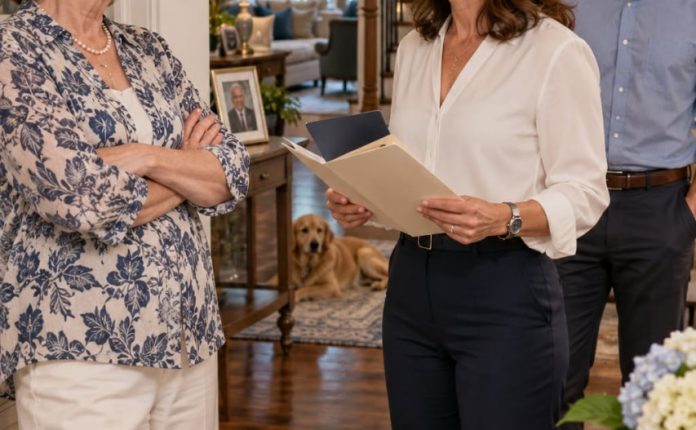
The letter arrived in a thick cream envelope on a Tuesday afternoon.
It came from Northbridge Fiduciary Services, a company I had never heard of.
I almost placed it with the advertisements until I saw Lily’s full legal name printed beneath mine.
Inside was a formal notice requesting that I contact a trust administrator regarding an account established by Michael Harper.
I read the letter three times.
Then I called Samuel.
He was silent for several seconds after I gave him the account number.
“Nora,” he said carefully, “I think you should come to my office.”
“Is something wrong?”
“Not necessarily.”
“Did Michael owe money?”
“No.”
“Then what is this?”
“Come tomorrow morning. Bring identification and Lily’s adoption papers.”
Samuel had aged in nine years. His hair was almost completely gray, and he wore reading glasses on a cord around his neck.
A woman named Evelyn Price joined us through a video call. She introduced herself as senior trust officer for Northbridge.
“The trust was established by Michael eleven months before his death,” Evelyn explained. “It was funded through a combination of life-insurance proceeds, the sale of his interest in a proprietary architectural-planning system, and investments held through a separate business entity.”
I stared at the screen.
“How much money are we talking about?”
Evelyn glanced down at a document.
“As of yesterday’s closing valuation, approximately two million, four hundred and twelve thousand dollars.”
I felt as if the office had tilted.
“There has to be a mistake.”
“There is no mistake.”
“Why wasn’t I told?”
“You were not the trustee or a beneficiary. The governing instrument instructed Northbridge to maintain the assets privately until Lily reached fourteen, unless funds were needed earlier for extraordinary medical, educational, or welfare expenses.”
“Why fourteen?”
Samuel opened a folder.
“Michael left a letter stating that fourteen was old enough for Lily to begin understanding the trust without allowing it to define her childhood.”
I looked at him.
“You knew?”
“I knew a trust existed. I did not know its final value. Michael directed me not to disclose it unless the conditions in the document were met.”
Anger rose through my shock.
“For nine years, I worried about electricity bills. I worked weekends. I nearly sold the house twice.”
Samuel did not defend himself.
“I know.”
“He could have helped us.”
“The trust could have reimbursed certain expenses if you had been unable to provide for Lily. Michael’s instructions required me to monitor her welfare discreetly. I spoke with her school twice. I also communicated with your adoption attorney, although you did not know I was requesting updates on behalf of the trust.”
“You were watching us?”
“Protecting the trust’s beneficiary.”
“I was her mother.”
“Yes,” he said. “And every report showed she was safe, supported, and thriving.”
I stood and walked toward the window.
A part of me wanted to be furious with Michael.
Another part understood him perfectly.
He had grown up in a family where money entered every relationship. Gifts came with conditions. Assistance became control. Inheritance was used to reward obedience.
Michael wanted Lily to grow up knowing who loved her before she learned what she owned.
“Can I access the money?” I asked.
“No,” Evelyn replied. “The trust remains under professional management. It can pay approved educational, medical, housing, and developmental expenses. Lily will receive limited distributions beginning at twenty-five, with further distributions at thirty and thirty-five. She cannot withdraw the principal at fourteen.”
“Then why inform us now?”
“Michael wanted Lily included in an annual educational meeting starting at this age. The purpose is to teach financial responsibility.”
I returned to my chair.
“Does anyone else know?”
Samuel and Evelyn exchanged a look.
“What?” I asked.
Evelyn answered.
“Northbridge received an inquiry last week from an attorney representing Charles and Margaret Harper.”
My hands went cold.
“How did they find out?”
“We do not know. Some information related to Michael’s former business interests became part of a recent public filing. The trust’s name was partially referenced.”
“What did they ask?”
“They asked whether Lily was a beneficiary and whether you had authority over the assets. We disclosed nothing beyond what the law required.”
The first phone call came that evening.
I was preparing pasta when my mobile rang.
Margaret’s name appeared on the screen for the first time in nine years.
I let it ring until voicemail answered.
She called again.
Then Charles called.
Then Vanessa.
At eight fifteen, someone knocked on the door.
Lily looked up from her homework.
“Are we expecting someone?”
“No.”
Through the window, I saw Margaret standing on the porch with a gift bag in her hand.
Charles waited behind her.
They had aged, but not as much as I expected. Margaret’s hair was silver, shaped perfectly around her face. Charles wore a navy coat and held himself with the same stiff authority I remembered.
I stepped outside and closed the door behind me.
Margaret smiled.
“Nora.”
“What are you doing here?”
“We came to see our granddaughter.”
“You haven’t seen her since her father’s funeral.”
Her smile tightened.
“There has been too much pain between us.”
“You returned her belongings in garbage bags.”
“That was a misunderstanding.”
“You wrote that your family could not provide regular care.”
“We were grieving.”
“So was she.”
Charles moved closer.
“We did not come to argue on the porch.”
“Then why did you come?”
Margaret lifted the gift bag.
“We would like a chance to rebuild our relationship with Lily.”
“Why today?”
Her eyes flickered.
“We recently learned she may have been left a substantial inheritance.”
There it was.
Not hidden beneath sympathy or concern.
A substantial inheritance.
“And that made you remember where she lives?”
Charles’s expression darkened.
“We have always known where she lives.”
“That makes nine years of silence worse, not better.”
Margaret lowered her voice.
“Whatever you think of us, Lily is a Harper.”
“She is my daughter.”
“She carries our blood.”
“She carried a stuffed rabbit into my bed every night because all of you made her believe everyone would leave.”
Margaret looked toward the house.
“Does she know about the trust?”
“Not yet.”
“You kept it from her?”
“I learned about it this morning.”
Charles exhaled sharply.
“This is exactly why family oversight is necessary.”
“Family oversight?”
“That money belongs to Michael’s daughter. Someone must ensure it is not wasted.”
“The trust has an independent professional trustee.”
“And what influence do you have over them?”
“None.”
He studied my face, apparently deciding whether he believed me.
Margaret stepped forward.
“Nora, we are not your enemies.”
“You are strangers.”
“We are her grandparents.”
“Biologically.”
The word struck her harder than I expected.
Before she could respond, the front door opened.
Lily stood there.
At fourteen, she had Michael’s height, his serious gray eyes, and the small crease between her eyebrows that appeared when she sensed dishonesty.
“Nora?” she called.
Margaret’s face transformed.
“Oh, Lily.”
Lily looked at her without recognition.
“Yes?”
“I’m your grandmother.”
Silence settled over the porch.
Lily looked at me.
“The one who sent the trash bags?”
Margaret’s smile disappeared.
Children remember the truths adults expect them to forget.
Charles cleared his throat.
“We would like to speak with you.”
“About what?”
“Your father.”
Lily’s expression changed.
They had found the one door she could not immediately close.
I wanted to send them away, but I had spent nine years teaching Lily that love did not require fear. I could not make this decision for her simply because I was frightened of losing her.
I turned to her.
“You don’t have to talk to anyone tonight.”
She thought for a moment.
“Can they come inside for ten minutes?”
Margaret entered our home as if inspecting a property she might purchase.
Her eyes moved across the worn sofa, Lily’s drawings, the repaired lamp, and the stack of schoolbooks on the dining table.
Charles noticed everything too.
I could almost hear the argument forming in his mind.
Limited means.
Inadequate environment.
Financial vulnerability.
Margaret handed Lily the gift bag.
Inside was a gold bracelet.
Lily held it without putting it on.
“Thank you.”
“It belonged to your great-grandmother.”
“Why didn’t you give it to me before?”
Margaret blinked.
“We were waiting until you were old enough.”
“Did you send birthday cards?”
The question was calm.
“No, but—”
“Christmas presents?”
“We believed Nora wanted distance.”
Lily looked at me.
“Did you?”
“No.”
Margaret sat straighter.
“There were complicated adult circumstances.”
“You could have written my name on a card.”
“Lily,” Charles said, “your grandparents made mistakes. We would like to correct them.”
“Why now?”
He hesitated.
“Your father made arrangements for your future. We want to ensure his wishes are respected.”
She understood immediately.
“This is about money.”
“It is about protecting you.”
“You didn’t protect me when he died.”
Margaret’s eyes filled with tears.
I could not tell whether they were real.
“We thought Nora was the best person to care for you at the time.”
“Then why are you acting like she isn’t now?”
No one answered.
Lily placed the bracelet back in the bag and handed it to Margaret.
“I don’t want this.”
“It belongs to you.”
“No. It belonged to somebody I never knew, from people who don’t know me.”
Margaret stood.
“One day you may understand that family history matters.”
Lily opened the front door.
“Nora is my family history.”
They left without finishing the ten minutes.
Three days later, I was served with court papers.
Charles and Margaret had filed a petition seeking visitation, access to Lily’s educational and medical records, and the removal of Northbridge as trustee.
They also requested that my adoption be reviewed on the grounds that relevant financial information had allegedly been withheld from the court.
Their petition described me as “financially unstable,” “socially isolated,” and “potentially dependent upon the minor’s assets.”
I had never received one dollar from Lily’s trust.
That fact did not stop them from suggesting I had raised her for money.
Vanessa submitted an affidavit stating that I had deliberately separated Lily from the Harper family after Michael’s death.
She claimed they had repeatedly attempted contact.
She described the garbage bags as “protective storage materials.”
Samuel read the affidavit in silence.
“They’re lying,” I said.
“Yes.”
“Can they undo the adoption?”
“It is extremely unlikely. The adoption was lawful, the required notices were given, and no one objected.”
“Then what do they want?”
“Control.”
“Of Lily?”
“Of the trust. Possibly both.”
The Harpers hired a prominent family-law attorney named Richard Cole.
He appeared on local television, represented business owners and public figures, and was known for turning private disputes into moral performances.
Within a week, rumors spread through Lily’s school.
A classmate asked whether she was secretly a millionaire.
Another asked whether I had kidnapped her.
Lily stopped bringing friends home.
One evening, I found her deleting messages from her phone.
“What are people saying?”
“Nothing.”
“Lily.”
She pushed the phone across the table.
Someone using an anonymous account had sent her a photograph of the Harper estate.
This could be your real home.
Another message showed a photograph of me leaving the grocery store.
Ask Nora why she kept your father’s fortune secret.
I documented every message and gave the screenshots to Samuel.
Lily sat with her arms folded.
“Did you know about the money?”
“No.”
“Would you tell me if you did?”
“Yes.”
“Would Dad?”
I struggled with that question.
“He wanted you to know now. I don’t agree with every choice he made, but I think he was trying to protect your childhood.”
“From what?”
“From becoming valuable to people who should have loved you when you had nothing.”
Her eyes lowered.
“They don’t love me.”
“I don’t know what they feel.”
“They love the trust.”
“That may be part of it.”
“What if the judge makes me live with them?”
“You’re fourteen. The judge will listen to you. And I will fight for you.”
Her voice became small again.
“What if fighting isn’t enough?”
I reached across the table.
“Then I fight harder.”
The Harpers began their campaign slowly.
Margaret sent letters filled with stories about Michael’s childhood.
Charles offered to pay Lily’s private-school tuition directly, outside the trust.
Vanessa invited her to her cousin’s birthday.
Lily declined each invitation.
Then they changed tactics.
They asked the court for temporary family counseling.
The judge approved three supervised sessions with a licensed therapist, explaining that reconnecting with extended family could benefit Lily if it was handled carefully.
I did not object.
I wanted Lily to have every opportunity to know them safely. I also wanted the court to see that I was not isolating her.
At the first session, Margaret brought a photograph album.
She showed Lily pictures of Michael as a child—missing front teeth, holding a fishing pole, standing beside a science-fair volcano.
For the first time, Lily softened.
She asked questions.
What was his favorite subject?
Was he afraid of thunderstorms?
Did he always draw buildings?
Margaret answered beautifully.
For forty minutes, she became the grandmother Lily should have had.
After the session, Lily cried in the car.
“I liked her,” she admitted.
“You’re allowed to.”
“Does that make me disloyal to you?”
“No.”
“What if she’s pretending?”
“Then time will reveal it.”
At the second session, Charles told stories about teaching Michael to drive. He apologized for staying away, although he described the absence as “a breakdown in communication.”
At the third session, Margaret asked Lily whether she would like to visit their estate.
The therapist reminded her that invitations needed to be discussed through the agreed process.
Margaret smiled.
“Of course. I was only imagining how much Lily would enjoy the art studio we could prepare for her.”
Later, Lily asked me whether she could visit.
Every fearful part of me wanted to say no.
Instead, I asked the court-appointed supervisor to accompany her.
Lily spent four hours at the Harper estate.
When she returned, she carried shopping bags, a new tablet, and a brochure for an exclusive boarding school.
“How was it?” I asked.
“Big.”
“Did you enjoy yourself?”
“Some of it.”
She placed the brochure on the table.
“Grandpa says this school sends students to the best universities.”
“It has a strong reputation.”
“He said the trust can pay for it.”
“It probably can.”
“He said you kept me in public school because you didn’t know how much I was worth.”
My chest tightened.
“What did you say?”
“I said my school has teachers who know my name.”
She opened one of the shopping bags and removed an expensive coat.
“Grandma cut the tag off so we can’t return it.”
“Do you want to keep it?”
“No.”
I sat beside her.
“You’re allowed to keep gifts without accepting everything they say.”
“That’s what the therapist said.”
“She’s right.”
Lily stared at the coat.
“Nora, do rich people think every problem can be solved by making the gift too expensive to refuse?”
“Some do.”
“What do the others do?”
“They learn to apologize.”
Lily folded the coat carefully.
“I don’t think Grandma knows how.”
The legal case continued for six months.
Every document from the Harpers rewrote our history.
When I worked extra shifts, I was an absent caregiver.
When I reduced my hours to attend school events, I lacked professional ambition.
When we stayed in our small house, I deprived Lily of opportunity.
Had I moved somewhere larger, they would have accused me of planning to use her trust.
There was no life I could have lived that Richard Cole could not reshape into evidence against me.
The worst moment came during my deposition.
Cole sat across from me in a conference room and arranged his papers with deliberate care.
“Mrs. Bennett—”
“Harper-Bennett,” my attorney corrected.
I had kept Michael’s surname alongside my own after adopting Lily.
“Mrs. Harper-Bennett,” Cole continued, “you were aware when you married Michael that he came from substantial family wealth.”
“I knew his parents were wealthy.”
“And you expected Michael to inherit?”
“No.”
“Never?”
“He had been largely estranged from them.”
“But you understood he could eventually receive millions.”
“I never discussed his parents’ estate with him.”
Cole glanced at a document.
“Your income in the year before marrying Michael was twenty-eight thousand dollars.”
“Approximately.”
“His income was more than four times that amount.”
“Yes.”
“So the marriage significantly improved your financial circumstances.”
“The marriage combined our circumstances.”
“And after his death, you inherited a house.”
“A house with a mortgage.”
“You became guardian of a child who is now worth approximately two-point-four million dollars.”
I forced myself to remain still.
“Lily is not worth two-point-four million dollars. A trust established for her contains that amount.”
Cole smiled faintly.
“An important distinction?”
“To someone who loves her, yes.”
His smile disappeared.
He placed photographs on the table.
They showed our kitchen before I replaced the cabinet doors, Lily wearing a secondhand coat at age seven, and my old car parked outside her school.
“You had limited resources.”
“We had enough.”
“Did Lily ever go without?”
“She did not have everything she wanted. She had everything she needed.”
“Did you ask the Harpers for assistance?”
“Once, after Michael’s funeral.”
“And when they declined, did you become angry?”
“Yes.”
“Did that anger influence your decision to prevent contact?”
“I never prevented contact.”
“Yet no contact occurred.”
“They did not call.”
“Perhaps they believed they were unwelcome.”
“They returned her belongings in garbage bags and wrote that they could not provide care.”
“People behave imperfectly while grieving, Mrs. Harper-Bennett.”
“So did Lily. She was five. I stayed anyway.”
My attorney touched my arm, warning me not to argue.
Cole leaned forward.
“When did Lily begin calling you Mom?”
“There was no single date.”
“Did you encourage it?”
“No.”
“Did you correct her?”
“No.”
“Did it make you feel that you had replaced Claire?”
“This is not about Claire.”
“It is about whether you assumed a role that was not originally yours.”
“I did not assume it. I lived it.”
He studied me for a moment.
“Were you lonely after Michael died?”
“Yes.”
“Did keeping Lily give you a sense of purpose?”
“She was not an emotional-support object. She was a grieving child who needed a parent.”
“And you needed her too.”
The truthful answer was dangerous.
I could have denied it.
Instead, I said, “Yes.”
Cole sat back.
“No further questions.”
My attorney looked concerned.
I did not regret the answer.
I had saved Lily, perhaps.
But she had also saved me.
Love was not less genuine because it moved in both directions.