Part 4: My Father’s Hidden Compartment
I had never spoken to Dr. Marcus Hale.
I called the number listed on the evaluation while Owen contacted Rose’s attorney. The clinic receptionist refused to discuss patient records, but she confirmed that Dr. Hale had performed a “document-based capacity review” requested by a legal representative.
“Did he meet Rose Mercer?” I asked.
“I cannot answer that.”
“Did he speak to me?”
“I cannot answer that either.”
“My name is listed as the family informant.”
There was a pause.
“Then you should contact your attorney.”
The line disconnected.
Graham had used my identity twice.
Once to steal money.
Once to suggest my sister could not make decisions about her own life.
The second betrayal felt worse.
We drove to the orchard before dawn.
Mother stayed at the hospital. Owen did not want to leave Rose, but their attorney needed the original estate documents before the guardianship hearing scheduled for that afternoon.
The orchard house had been empty for five years. Dust covered the furniture. The kitchen still smelled faintly of cedar cabinets and dried apples.
Dad’s workshop stood behind the barn.
When we were children, he repaired farm equipment there, built shelves, and carved small wooden animals for Rose. She kept every one.
The door groaned when Owen opened it.
Sunrise entered through the dirty windows, illuminating suspended dust.
The workbench remained against the far wall.
Owen knelt and examined the underside.
“There’s a keyhole.”
The silver key turned.
A narrow wooden panel dropped open.
Inside were three sealed envelopes, a flash drive, and a leather binder.
One envelope was labeled for Mother.
One for me.
One for Rose.
The binder contained my father’s estate plan.
The trustee named in the document was North River Fiduciary Services, not Graham.
A clause specified that neither family member nor beneficiary could alter the trustee without approval from the county probate court.
There was also a trust protector—someone authorized to demand audits and remove a trustee for misconduct.
That person was me.
I sank onto a stool.
“I didn’t know.”
Owen read over my shoulder.
“Graham removed the entire section.”
“How?”
“Forgery. Undue influence. Maybe both.”
I opened the envelope with my name.
Inside was a letter.
My dear Clara,
You have always believed protecting Rose means making hard choices for her. As you grow older, I hope you learn that real protection sometimes means helping her make her own choices, even when they frighten you.
Rose will need support with complicated matters, but support is not control. Listen to her. Ask what she wants. Never permit anyone—especially family—to use her diagnosis as permission to ignore her voice.
I have chosen you as trust protector because you love her fiercely. I pray you will also learn to trust her fiercely.
I stopped reading.
Owen stood quietly beside me.
“I failed him,” I whispered.
“No.”
“I failed Rose.”
“You still have time.”
“What if she dies?”
His eyes closed.
For several moments, he could not speak.
Then he said, “She made me promise that if anything happened, I would finish this.”
“This is why you married her.”
“It is one reason.”
I looked at him.
“Tell me all of it.”
He sat on the edge of the workbench.
“Rose and I started dating almost two years ago.”
“Why didn’t she tell me?”
“She wanted to. Every time she mentioned dating, your mother warned her that men might exploit her. You sent her articles about financial scams.”
I remembered those articles.
I had believed I was helping.
“She thought you would investigate me instead of being happy for her,” Owen continued.
“She was right.”
“Yes.”
The answer hurt because he did not soften it.
“How did it begin?”
“At Bluebird. I was repairing a storage cabinet. Rose asked if I wanted to attend a movie with her.”
“She asked you?”
“She did.”
“What did you say?”
“I said yes.”
He smiled through his exhaustion.
“She bought her own ticket because she didn’t want it to be confusing. Then she explained the plot to me during the entire film.”
“That sounds like Rose.”
“Afterward, she asked whether I liked her as a friend or as a woman.”
My throat tightened.
“What did you say?”
“I told her I needed time to answer honestly.”
“Why?”
“Because I knew what people would say. I knew what you would say. I also needed to be certain I wasn’t responding from protectiveness or loneliness.”
“And were you?”
“No.”
He looked toward the orchard through the window.
“Rose pays attention to people. Not their jobs, not their achievements, not what they pretend to be. She notices when I am tired before I admit it. She tells me when I’m being arrogant. She remembers every promise I make. She loves without being impressed by performance.”
His voice became quieter.
“I fell in love with her.”
“Then why tell me there was another reason?”
“Because Rose did not want our marriage reduced to romance while Graham was attacking her rights.”
He picked up the flash drive.
“She proposed to me three days after we learned about the guardianship plan.”
“She proposed?”
“She said, ‘I love you. I want to marry you. Also, Graham thinks no one will stand beside me in court. He is wrong.’”
Despite everything, I laughed.
It sounded exactly like her.
“She didn’t marry you for protection,” I said.
“No. She married me because she chose me. She also understood that a spouse would make it harder for Graham to isolate her.”
“So the plan was hers.”
“Most of it.”
That was the truth I had missed.
I had assumed Owen must be the architect because Rose had Down syndrome.
Even in defending her, I had erased her.
We connected the flash drive to Owen’s laptop.
A video appeared.
My father sat in the workshop, thinner than I remembered him, his skin gray from cancer treatments.
“If you are watching this,” he said, “then something has gone wrong.”
He explained that Graham had pressured him to appoint a family trustee. Dad refused because Graham had once borrowed money from the orchard accounts without permission.
“I forgave my brother,” Dad continued, “but forgiveness is not the same as trust.”
He held up the original documents.
“These copies remain here because I fear Graham may interfere after my death. Helen is overwhelmed, Clara is young, and Rose is too often dismissed. If the estate papers presented to the court differ from these, contact attorney Evelyn Park.”
Owen paused the video.
“Evelyn Park is retired, but she can verify the documents.”
My phone rang.
Mother was crying.
“Graham is here with hospital security.”
“What?”
“He has a temporary court order. They say Owen cannot make decisions for Rose until the hearing.”
“We found the original trust.”
“Clara, come back.”
“We’re coming.”
Her voice shook.
“There is something else. Graham brought two men from a residential care facility.”
My blood turned cold.
“What for?”
“He says if the court appoints him temporary guardian, Rose will be transferred as soon as she is medically stable.”
Owen grabbed the binder.
“No one is taking her.”
Mother began to sob.
“Hurry.”
We ran toward the truck.
As Owen started the engine, my phone received a photograph from Mother.
Graham stood outside Rose’s intensive care room beside a hospital administrator.
In his hand was a signed order bearing a judge’s seal.
Across the bottom, beneath the words IMMEDIATE TEMPORARY AUTHORITY, was a directive authorizing him to control Rose’s visitors, medical records, residence, and communication.
The order also instructed the hospital to exclude Owen from her bedside.
And before we reached the main road, Graham sent Owen a message:
By the time you return, she will no longer be your wife in any way that matters.
Part 5: The Hearing Beside Her Hospital Bed
Owen drove faster than I had ever seen him drive.
He gripped the steering wheel so tightly that his knuckles turned white.
“Slow down,” I said.
“I promised her.”
“You cannot help her if we crash.”
He reduced his speed, but every red light seemed unbearable.
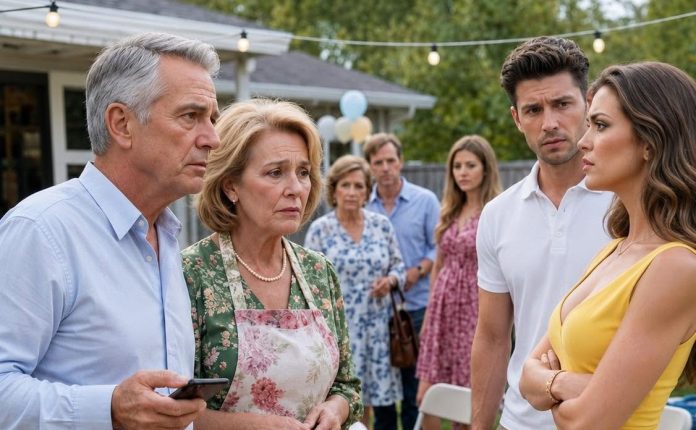
At the hospital, security guards stood outside the intensive care unit.
Graham waited with the hospital administrator and a lawyer named Simon Kessler. Two representatives from Willow Ridge Residential Services sat nearby with folders on their laps.
My mother stood alone beside the vending machines.
When Owen approached, a guard raised one hand.
“You cannot enter.”
“My wife is in there.”
“We have been given a court order.”
“The order is fraudulent.”
Kessler stepped forward.
“Mr. Mercer, the order is valid until the hearing.”
“The marriage is valid.”
“That remains disputed.”
Owen looked through the glass doors.
Rose was somewhere beyond them, unconscious after open-heart surgery.
“Does she know I’m not there?”
No one answered.
I walked toward Graham and struck him across the face.
The sound echoed through the corridor.
Mother gasped.
Graham touched his cheek.
“You are upset.”
“You used my name.”
“I have no idea what you mean.”
I held up copies of the forged forms.
“You stole from Rose.”
Kessler moved between us.
“Any financial concerns should be handled through proper legal channels.”
“They will be.”
I lifted the binder from Dad’s workshop.
“We found the original estate plan.”
For the first time, Graham’s control slipped.
His eyes moved toward the binder.
“That document is invalid.”
“You haven’t seen it.”
“I know my brother revised his will.”
“We also found a video.”
Graham said nothing.
Our attorney, Priya Shah, arrived ten minutes later. She was a compact woman with a precise voice and the kind of calm that made everyone else lower theirs.
She reviewed the temporary order.
“This was issued without notice because Graham claimed Rose faced immediate exploitation,” Priya said.
“Can we stop it?” Owen asked.
“The hearing begins at two. The judge agreed to conduct it by secure video because Rose cannot be moved.”
“I need to see her.”
Priya spoke with the hospital administrator. After reviewing the marriage certificate, prenuptial agreement, medical proxy, and evidence of potential fraud, the administrator allowed Owen a five-minute supervised visit.
He entered Rose’s room alone.
Through the observation window, I watched him sit beside her.
He touched her hair.
Then he placed her hand against his cheek.
I had spent six months imagining he wanted something from her.
Watching him now, I understood that what he wanted was simply for her to wake up.
The emergency hearing took place in a hospital conference room.
A judge appeared on a large screen.
Graham’s lawyer argued first.
He described Rose as “a cognitively impaired adult with limited understanding of legal, romantic, and financial consequences.”
He claimed Owen had isolated her from family, encouraged distrust of her trustee, and married her secretly to gain standing over the trust.
Priya objected repeatedly to the language.
The judge allowed Kessler to continue.
He introduced the psychological evaluation by Dr. Hale and financial records showing Rose’s increasing legal expenses after beginning her relationship with Owen.
Then he presented photographs.
One showed Owen entering Rose’s bank.
Another showed him carrying boxes from her apartment.
A third showed them leaving an attorney’s office.
Ordinary moments had been arranged to resemble a crime.
Graham testified that he loved Rose “like a daughter.”
“I have protected her since her father died,” he said. “Mr. Mercer exploited her longing for independence.”
Priya stood.
“Mr. Bennett, did Rose request an audit of her trust?”
“She did not understand what she was requesting.”
“That was not my question.”
“Yes.”
“Did you provide one?”
“No.”
“Did you cancel cardiology appointments?”
“I adjusted providers to control unreasonable expenses.”
“Did Rose’s trust lack sufficient funds for her established cardiologist?”
Graham hesitated.
“The trust has long-term obligations.”
“How much money is currently in the trust?”
“That information is confidential.”
“She is the beneficiary.”
“She is not capable of interpreting raw figures.”
The judge leaned toward the screen.
“Mr. Bennett, answer the question.”
Graham’s lawyer whispered to him.
“Approximately eight hundred thousand dollars,” Graham said.
I stopped breathing.
The trust should have held more than three million dollars, even before accounting for investment growth.
Priya looked at me.
The theft was no longer theoretical.
More than two million dollars was missing.
Graham blamed market losses, medical expenses, and property maintenance.
Priya submitted Rose’s records showing payments for nonexistent services. She submitted the forged documents bearing my name. She submitted the original estate plan and my father’s video.
Then Owen testified.
Kessler approached him.
“You were aware of Rose’s inheritance before dating her?”
“Yes.”
“You had significant business debt at the time?”
“My company had a construction loan.”
“More than two hundred thousand dollars?”
“Yes.”
“And six weeks after Rose requested an audit, you married her.”
“Yes.”
“You expect this court to believe those facts are unrelated?”
“They are related,” Owen said.
The room became still.
Even Priya looked surprised.
Kessler smiled.
“Please explain.”
“Rose learned Graham planned to use a guardianship petition to prevent the audit. We were already planning to marry. She decided not to wait.”
“So you married her to defeat her trustee.”
“I married her because I love her and because she asked me to stand with her while she fought for her rights.”
“Did you expect to benefit financially?”
“No.”
“Every spouse benefits financially.”
Priya submitted the prenuptial agreement.
Kessler read it in silence.
Owen had waived inheritance, trust access, spousal support, and any claim against the orchard. He had also signed an agreement requiring separate legal counsel for Rose before marriage.
Rose’s lawyer had recorded two meetings confirming she understood the agreement.
One recording was played for the court.
Rose appeared on screen wearing her yellow cardigan.
Her attorney asked, “Why do you want a prenuptial agreement?”
“Because people think Owen wants my money,” Rose answered.
“Do you believe he does?”
“No.”
“Then why sign it?”
“So they have to find a new insult.”
Even the judge smiled.
Her attorney continued.
“What does marriage mean to you?”
“It means we are partners. It does not mean Owen controls me. It does not mean I control him.”
“Can you end the marriage?”
“Yes. Divorce is expensive and sad.”
“Can Owen use your trust?”
“No.”
“Can you use his company?”
“No. Also, I do not want his company. Construction workers wake up too early.”
Owen lowered his face into his hands.
The judge watched the entire recording.
Then Priya called me.
I admitted that I had distrusted Owen.
I admitted that I had allowed Graham to use my concern as evidence against Rose.
“I thought I was protecting her,” I said. “But I never asked whether she wanted my protection. I treated her diagnosis as proof that my fear mattered more than her decision.”
Kessler asked whether I believed Rose understood marriage.
“Yes.”
“How can you be certain?”
“Because she understands it better than I did.”
The hearing paused when a nurse entered.
Rose had regained consciousness.
Owen stood so quickly that his chair fell backward.
“Can I see her?”
The nurse looked toward the administrator.
The judge spoke through the screen.
“Allow the husband access.”
Owen ran from the room.
The rest of us followed.
Rose’s eyes were half open when we entered. A breathing tube prevented her from speaking.
Owen approached slowly.
“Hi, Rosie.”
Her fingers moved.
He took her hand.
Graham appeared in the doorway.
Rose saw him.
The monitor began beeping faster.
She pulled weakly against the breathing tube and pointed toward the door.
Graham stepped forward.
“Rose, I’m here.”
She shook her head violently.
A nurse blocked him.
Rose looked at Owen.
Then at me.
She lifted one trembling finger and traced letters against Owen’s palm.
He watched carefully.
“What is she saying?” I asked.
Owen’s face changed.
“She says there is another recording.”
“Where?”
Rose traced again.
“Her wedding shoes.”
Mother whispered, “They’re at the apartment.”
Rose squeezed Owen’s hand, then pointed toward Graham.
She formed one word silently around the breathing tube.
Medicine.
A warning sounded from the monitor.
Her blood pressure dropped.
Nurses rushed us from the room.
The surgeon was called.
Owen stood outside the closing doors, still pressing his palm where Rose had traced the message.
Then the cardiac alarm became a single continuous tone.
And someone inside shouted, “She has no pulse.”