PART 6 — THE FALL OF JULIAN MERCER
Sabrina agreed to meet us in a private conference room at Renee’s law office.
She arrived wearing oversized sunglasses and a cream coat despite the warm weather. Without makeup, she looked younger and far more frightened than the woman who had posed beside Julian in Maui.
Two attorneys and a federal investigator attended.
Sabrina’s lawyer sat close enough to stop her whenever she approached dangerous territory.
She brought emails, recordings, account statements, and a second phone Julian had given her.
“I met Julian at a company branding event,” she began. “He told me his marriage had been over for years.”
I felt Audrey watching me.
I kept my expression still.
“He said Clarissa stayed for money and social status. He said Evelyn disliked her but depended on her because of illness.”
“That was a lie,” Audrey said.
“I know that now.”
Sabrina described how Julian created Aster Blue Holdings and used her name as its owner. At first, she believed the company handled confidential real-estate acquisitions.
Later, she noticed money moving without corresponding purchases.
“When I questioned him, he said wealthy families used complex structures to prevent hostile takeovers.”
“And you continued accepting payments,” the investigator said.
“Yes.”
“How much?”
“About $280,000.”
She looked at me.
“I spent most of it.”
Her honesty did not earn forgiveness, but it made her useful.
The second phone contained recorded conversations. Sabrina had begun recording Julian months earlier after realizing he might sacrifice her if the scheme failed.
One recording captured him discussing me with Marcus.
“We tie every transfer to Clarissa’s access,” Julian said. “She handled Mom’s bills. No one will question how she obtained the information.”
Marcus responded, “The login records won’t survive a serious forensic review.”
“They only need to survive long enough to freeze her assets and remove her credibility.”
“What if she hires experts?”
“She won’t have money for experts.”
“And Audrey?”
“She believes whatever protects the family name.”
Audrey closed her eyes.
Another recording had been made in Hawaii.
Waves and music played beneath Julian’s voice.
Sabrina asked whether he should return after learning Evelyn was dying.
“No,” he replied. “If I go home now, Clarissa will pull me into the hospital drama. Mom could last for days.”
“And if she dies?”
“Then the trust activates, the internal review starts, and Clarissa takes the fall. We return when the stage is ready.”
“Doesn’t that bother you?”
“My mother chose Clarissa years ago. Let Clarissa hold her hand.”
I left the room before the recording ended.
In the hallway, I pressed both palms against the wall.
For weeks, I had believed the worst pain came from Julian ignoring my calls.
But hearing his calm voice revealed something deeper.
He had not been distracted.
He had not misunderstood.
He had made a calculation.
My presence at Evelyn’s death allowed him to remain comfortably absent.
I had given him twenty years of loyalty, and he had converted that loyalty into evidence for a crime.
Renee found me.
“You do not have to listen to the rest.”
“Yes, I do.”
“Why?”
“Because for twenty years, he taught me to doubt what I saw. I need to hear him say it.”
We returned.
By the end of the meeting, investigators had enough evidence to request warrants.
The company board scheduled an emergency session for Monday morning. As successor trustee, I held temporary voting authority over Evelyn’s shares.
It was the first time I entered Mercer Coastal’s headquarters without being introduced as Julian’s wife.
Employees filled the lobby.
Some looked frightened.
Others applauded quietly.
I stopped near the reception desk.
“Please don’t applaud yet,” I told them. “We have work to do.”
During the board meeting, the forensic accountant presented the preliminary results.
The losses were larger than Evelyn had known.
Julian and Marcus had moved approximately $11.2 million through false consulting contracts, inflated property purchases, and unauthorized loans.
Some money had funded investments.
Some had paid for Sabrina’s apartment, travel, jewelry, and private accounts.
Some had covered Julian’s personal debts.
The company remained solvent, but only barely.
A planned sale of two major properties would have stripped it of its most valuable assets.
The board voted to remove Julian permanently as chief executive.
They also approved my proposal to establish the employee ownership trust immediately.
At 10:37, Julian entered the conference room with two attorneys.
“This vote is invalid,” he announced.
Samuel Price remained seated.
“You are no longer authorized to enter this building.”
“I am the founder’s son.”
“You are a former employee under criminal investigation.”
Julian looked at me.
“You did this.”
“No. Your mother did everything possible to stop you from doing this to yourself.”
He dropped an injunction petition onto the table.
“My mother lacked capacity. Clarissa manipulated her and stole confidential company documents.”
Miriam placed three medical evaluations beside his petition.
“She anticipated that argument.”
“She hated me.”
“She loved you beyond reason,” I said. “That was why you had so many chances.”
His composure disappeared.
“You think sitting in her chair makes you important?”
“I never wanted her chair.”
“You wanted my life.”
“I gave you mine.”
He looked around the table.
“These people will destroy the company. Clarissa has never closed a deal, financed a development, or managed a corporation.”
“That is why the board will appoint an experienced chief executive,” I said. “I will serve as trustee and chair during the transition. Leadership does not require pretending to know everything.”
“It requires strength.”
“No. What you call strength is fear with an expensive suit.”
Two investigators entered through the side door.
They approached Marcus first. He had arrived earlier with his attorney and had spent most of the meeting staring at the table.
One investigator spoke quietly.
Marcus nodded and stood.
Then he turned toward Audrey.
“I am sorry.”
She did not respond.
The investigator placed him under arrest.
Julian stepped backward.
His attorney whispered something, but he shook his head.
“This is a family company,” he said. “You cannot do this to me.”
I remembered the hospital monitor.
The thirtieth call.
The champagne receipt.
“No, Julian. You did this while believing family meant no one would stop you.”
The second investigator approached him.
Julian looked at me with an expression I had never seen before.
Not love.
Not regret.
Disbelief.
He could not comprehend a world in which I no longer protected him from consequences.
As they led him from the room, employees watched through the glass walls.
His face—the face from magazine covers, charity galas, and corporate advertisements—was finally exposed without its performance.
That afternoon, I returned to Evelyn’s house.
Miriam waited in the library holding a sealed brown envelope.
“Evelyn instructed me to give you this only after Julian lost control of the company.”
“What else could there possibly be?”
“This is not about Julian’s recent fraud.”
I opened the envelope.
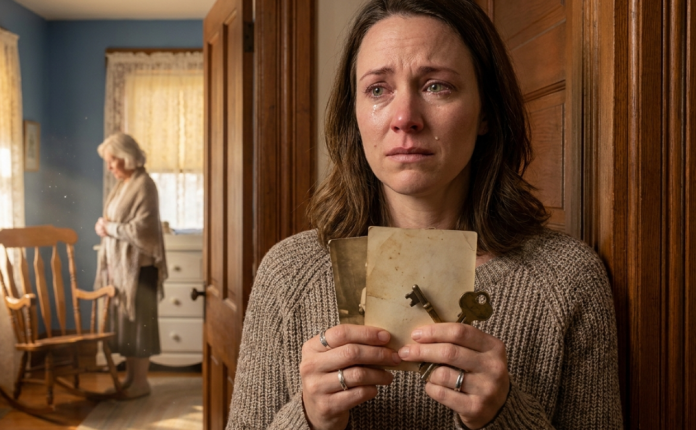
Inside was a black-and-white photograph taken more than fifty years earlier.
A young Evelyn stood beside her husband, Charles, outside a small construction office.
A third man stood between them.
He had my eyes.
My father, Thomas Hart, had died when I was eight. I had been told his business failed and left him with nothing.
Beneath the photograph was an original partnership agreement.
Mercer & Hart Coastal Construction.
Ownership:
Charles Mercer — 60 percent.
Thomas Hart — 40 percent.
I looked at Miriam.
“This company belonged to my father?”
“Forty percent of it did.”
“Then what happened to his shares?”
Miriam placed Evelyn’s final letter in my hands.
“According to Evelyn, Julian’s father stole them after your father died.”
PART 7 — WHAT EVELYN RETURNED
I carried the partnership agreement to the rose garden.
For several minutes, I could not open Evelyn’s letter.
My father existed in my memory as fragments.
Sawing wood in our garage.
Lifting me onto his shoulders during a street parade.
The smell of cedar on his jacket.
A hospital corridor where adults spoke in whispers.
After his death, my mother sold our house. We moved into a small apartment, and she worked two jobs until illness took her too.
I had believed my father left no inheritance except a toolbox and three photographs.
Yet the company whose name had defined my marriage had once carried his name.
Mercer & Hart.
Someone had erased half of it.
At last, I unfolded the letter.
My dearest Clarissa,
The truth I am about to tell you is the reason I first welcomed you into my family and the reason I later came to love you independently of any debt.
Your father, Thomas Hart, was Charles’s closest friend and business partner. Thomas supplied the practical knowledge, many of the first clients, and a portion of the original capital. Charles supplied land connections and financing. Together, they created Mercer & Hart Coastal Construction.
When Thomas died unexpectedly, Charles promised your mother he would protect Thomas’s ownership until you reached adulthood. Instead, he produced an agreement claiming Thomas had sold his shares months before his death.
I believed the agreement was genuine. Years later, after Charles died, I found correspondence proving the sale was fabricated. Charles had copied Thomas’s signature and backdated the transfer.
My hands began to shake.
The same crime had crossed generations.
Julian forged my signature because his father had taught him, through example and inheritance, that documents could transform theft into respectability.
I wanted to return the shares immediately, but your mother had already died and I could not locate you. Then Julian brought you home from university and introduced you as the woman he intended to marry.
I remembered that first dinner.
Evelyn had stared at me for a long time after hearing my maiden name.
Hart.
She dropped her spoon.
Julian laughed and said she was becoming forgetful.
She had not forgotten anything.
At first, I wondered whether your relationship was justice arranging itself. I remained silent because I feared the truth would destroy your engagement and expose Charles’s crime publicly. That silence was cowardice.
Over time, you became my daughter in every way that mattered. I watched you surrender opportunities to support Julian. I watched you care for me while he used work as an excuse to remain absent. I began transferring assets into the trust so that a portion corresponding to your father’s stolen ownership would someday return to you.
The thirty percent left directly to you is not charity. It is partial restitution. Additional investments placed in a separate account will bring the total value close to what your father’s stake would reasonably represent after accounting for growth and prior distributions. Miriam has the details.
I know money cannot restore your parents’ lost security or the years you lived believing your father had failed. But I need you to understand this: Thomas Hart did not fail his family. He was betrayed by mine.
I lowered the letter.
All my life, I had carried a quiet embarrassment about my father.
I believed he had taken risks, lost everything, and left my mother to struggle.
Now that shame belonged somewhere else.
Evelyn’s letter continued.
Do not preserve the Mercer name merely because powerful people fear its decline. Build something honest. Protect the employees. Give Audrey the chance to choose differently. And when you are ready, restore your father’s name.
As for Julian, I ask you for neither revenge nor mercy. Let the truth decide what he deserves.
Thank you for holding my hand when my son would not.
With all the love I should have spoken more often,
Mom
I pressed the letter against my chest and cried.
Not the desperate tears I had shed in the emergency room.
These tears carried grief, anger, relief, and the release of a burden I had never known I was carrying.
Audrey found me there an hour later.
I handed her the letter.
She read it slowly.
When she finished, she sat beside me.
“Our father was a criminal,” she said.
“Yes.”
“And Mom protected the truth for years.”
“Yes.”
“Do you hate her?”
I looked at the roses.
“No. But loving her does not require pretending she acted perfectly.”
Audrey nodded.
“That may be the first honest definition of love anyone in our family has used.”
The criminal case lasted almost a year.
Marcus cooperated with prosecutors and admitted falsifying reports, processing fraudulent payments, and helping frame me. He received a reduced sentence but still went to prison.
Audrey divorced him.
She never taught her daughters to hate their father, but she refused to disguise his actions.
Sabrina surrendered financial records and testified against Julian. Her cooperation reduced her sentence, though she was ordered to return assets purchased with stolen money.
She wrote me an apology before sentencing.
I did not answer.
Forgiveness was not something she was entitled to request on her preferred schedule.
Julian fought every charge.
He blamed Marcus.
He blamed Sabrina.
He blamed Evelyn’s illness.
He blamed me.
During the trial, his attorney suggested I had encouraged Evelyn to change the trust because I knew about my father’s claim.
Miriam proved I had not learned the truth until after Julian’s removal.
The hospital provided records of my thirty calls.
The resort confirmed the dinner charge.
A telecommunications specialist testified that Julian listened to my voicemail warning him his mother had less than an hour to live.
Then prosecutors played his message to Sabrina.
She says Mom is dying. We may finally be free by morning.
For the first time during the trial, Julian lowered his head.
The jury convicted him of wire fraud, conspiracy, forgery, obstruction, and theft from the company.
He received a prison sentence and was ordered to pay restitution.
The newspapers called it the fall of the Mercer empire.
They were wrong.
An empire depends on one powerful name.
What we built afterward belonged to many people.
Six months after the trial, the board approved a new company identity:
Mercer Hart Cooperative Development.
My father’s name returned to the building.
The employee trust received its forty-percent interest. Workers elected two board representatives. We sold Julian’s private aircraft and canceled the executive retreat program. The recovered funds stabilized the company and preserved hundreds of jobs.
Audrey joined the ethics and oversight committee.
She was careful, skeptical, and unexpectedly talented.
I remained chair for two years before stepping back.
I had spent too much of my life supporting other people’s ambitions. I wanted to discover what my own life looked like when no one demanded that I shrink it.
The divorce became final on a bright October morning.
Julian appeared by video from a detention facility for the final hearing.
His hair had turned gray near the temples.
Without the tailored suit and polished conference room, he looked smaller.
Before the judge ended the session, Julian asked to speak to me privately.
My attorney advised against it, but I agreed to five minutes with the call recorded.
His face appeared on the monitor.
“Did you ever love me?” he asked.
The question surprised me.
“Yes.”
“Then how could you do this?”
“I told the truth.”
“You took my company.”
“It was never only yours.”
“You enjoyed watching me lose everything.”
“No.”
He leaned closer.
“I saw you outside the courthouse smiling.”
“My father’s name had just been restored.”
His expression hardened.
“Your father would have lost those shares eventually. Charles made the company what it became.”
“Perhaps. But he never had the right to decide that through forgery.”
“You sound like my mother.”
“That is a compliment.”
For a moment, the anger left his face.
“Did she ask for me at the end?”
I could have lied.
I could have punished him with uncertainty.
Instead, I gave him the truth.
“Yes.”
His eyes closed.
“What did she say?”
“She could not speak.”
“Then how do you know?”
“Because I knew her.”
He swallowed.
“Did she hate me?”
“No. That was the tragedy.”
Tears appeared in his eyes, but I no longer rushed to comfort him.
“I thought there would always be more time,” he whispered.
“There was time. You spent it elsewhere.”
The call ended.
I never spoke to him again.
On the first anniversary of Evelyn’s death, Audrey and I gathered in the rose garden with her daughters, several longtime employees, Miriam, and Dr. Patel.
We placed Evelyn’s remaining ashes beneath the white roses.
Beside them, we installed a small plaque.
EVELYN ROSE MERCER
She chose truth before silence could become another inheritance.
Nearby stood a second plaque bearing my father’s name.
THOMAS HART
Co-founder, builder, father. His work and honor are restored.
After everyone left, I remained in the garden.
The silver key rested in my palm.
Its purpose had been fulfilled.
It had opened a bank box, but that was not what Evelyn truly gave me.
She gave me permission to stop defending the person who harmed me.
She gave Audrey permission to question the family story.
She gave employees ownership of the future they had helped create.
She returned my father’s name.
Most importantly, she forced the Mercer family to learn that silence did not protect love.
It protected betrayal.
I placed the key beneath Evelyn’s plaque and covered it with soil.
Then I touched the bare place on my finger where my wedding ring had once rested.
For months, the absence had felt like evidence of failure.
Now it felt like space.
I walked away from the rose garden as sunlight spread across the house, the company, and the life waiting beyond both.
For the first time in twenty years, I was not Julian Mercer’s wife.
I was Clarissa Hart.
And nothing that belonged to me was hidden anymore.