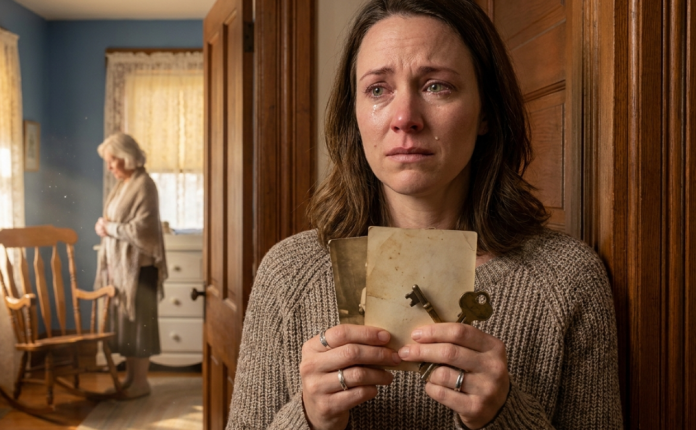
By the time my husband finally answered his phone, his mother had already died, been cremated, and laid to rest without him. Julian claimed he had been trapped in critical negotiations in Boston, but I could hear Hawaiian waves behind his voice and the delighted laughter of the mistress drinking champagne beside him. He expected me to apologize for interrupting his vacation. Instead, I stared at the empty place where my wedding ring had rested for twenty years and closed my fingers around the tiny silver key his mother had pressed into my palm with her final breath. Julian believed he had abandoned one dying woman and deceived one loyal wife. He did not yet understand that Evelyn had spent years preparing for that exact betrayal—or that her key could expose the crime beneath his fortune.
PART 1 — THE THIRTIETH CALL
The first call went unanswered at 7:12 on Thursday evening.
At that moment, Julian’s mother was still conscious.
Evelyn Mercer lay in an emergency room at St. Catherine’s Medical Center, her silver hair spread across the pillow and an oxygen mask covering most of her face. Her chest rose in shallow, uneven movements. Every few seconds, the heart monitor released a thin electronic beep that seemed too small to represent an entire human life.
I stood beside her bed with my phone pressed against my ear.
“Please pick up,” I whispered.
Julian’s voicemail answered.
“You’ve reached Julian Mercer. Leave a message.”
The tone sounded.
“Julian, it’s Clarissa. Your mother collapsed at home. We’re at St. Catherine’s. The doctors say it’s serious. Call me immediately.”
I ended the message and turned toward Evelyn.
Her eyes were open.
She had heard every word.
“I’ll reach him,” I promised.
Her fingers moved weakly against the blanket.
For twenty years, Evelyn had been more than my mother-in-law. When Julian worked late, traveled, entertained clients, or disappeared into the endless demands of Mercer Coastal Development, Evelyn and I had built a quiet life around one another.
We attended Sunday concerts in the park. We planted white roses along the southern wall of her home. We watched old mystery films on rainy afternoons and argued over which character was lying.
After her arthritis worsened, I drove her to appointments.
After her first stroke, I helped her relearn how to button a blouse.
When she began forgetting names, I labeled the family photographs but never corrected her harshly.
Julian paid the medical bills and called that devotion.
I gave her my time, my patience, and pieces of my own life that could never be recovered.
He called that responsibility.
At 7:24, I called him again.
At 7:31, I called a third time.
At 7:43, a fourth.
The doctor entered shortly before eight. Dr. Lena Patel was young enough to be my daughter, but there was nothing uncertain in her expression.
“Mrs. Mercer has suffered a massive pulmonary embolism,” she said quietly. “We’re giving medication to dissolve the clot, but her blood pressure is unstable. Her heart is under severe strain.”
“Can you save her?”
“We are doing everything possible.”
Evelyn stared at the ceiling while the doctor spoke.
I reached for her hand.
“Her son is away on business,” I explained. “I’m trying to reach him.”
Dr. Patel glanced at the phone in my hand.
“If there are close relatives who need to come, they should come now.”
The words struck harder than any declaration of death.
They should come now.
I called Julian again.
And again.
By the tenth call, my hands were shaking.
By the fifteenth, I was no longer leaving polite messages.
“Julian, this is not something you can postpone.”
“Your mother is asking for you.”
“The doctor says you need to come.”
“Please answer.”
At 9:18, Evelyn’s condition deteriorated.
Nurses rushed around the bed. One adjusted the medication line while another called out her blood pressure.
I stepped back until Dr. Patel told me I could return.
“Talk to her,” she said. “She may still hear you.”
I took Evelyn’s hand again.
“I’m here, Mom.”
I had called her Mom for nineteen years. At first, the word had felt borrowed. Later, it became more natural than the one I used for my own mother, who had died when I was thirty.
Evelyn opened her eyes.
“I’m not leaving,” I promised. “And Julian will call. He may be in a meeting. His phone may be somewhere else.”
Even while saying it, I knew I was defending him out of habit.
Julian’s phone was never somewhere else.
He slept with it on the nightstand. He carried it into the shower when major deals were pending. He interrupted anniversaries, dinners, and funerals to answer executives whose names appeared on the screen.
He was not missing my calls.
He was choosing not to answer them.
At 10:06, I called for the twenty-third time.
A message appeared seconds later.
I told you I’m busy. Stop calling unless it is an emergency.
I stared at the words.
I had already written the word emergency seven times.
I typed slowly.
Your mother may die tonight.
The message showed as delivered.
No reply came.
At 10:47, Evelyn’s breathing became more strained.
I made the twenty-ninth call.
Voicemail.
At 11:03, Dr. Patel returned and pulled a chair close to the bed.
“The medication has not worked the way we hoped,” she said. “Her heart is failing.”
I closed my eyes.
“How long?”
“Minutes, perhaps an hour.”
I dialed Julian for the thirtieth time.
The phone rang once.
Then it went directly to voicemail.
I leaned close to Evelyn.
“I’m so sorry, Mom,” I whispered. “I can’t reach him.”
Tears ran down my cheeks and fell onto the hospital blanket.
“I tried. I really tried.”
Her fingers tightened around mine.
It should not have been possible. She had barely been able to move for the last hour, but suddenly her grip became deliberate.
Her eyes found mine.
No anger remained in them. No fear.
Only certainty.
Her lips moved beneath the oxygen mask.
No sound emerged, but I understood.
No more crying. It’s time.
With her other hand, she struggled beneath the edge of the blanket.
“Don’t move,” I said. “You need to rest.”
She ignored me.
Her hand emerged closed around something small. She pressed it into my palm and folded my fingers over it.
The metal was cold.
A silver key.
Its head was shaped like a narrow oval. A tiny number had been engraved along one edge.
317.
“Mom, what is this?”
Her eyes shifted toward the handbag resting on the chair.
Then back to me.
“Is there something inside your bag?”
Her breathing stopped for several seconds.
The monitor alarmed.
Dr. Patel and two nurses moved forward, but Evelyn’s gaze remained fixed on my face.
Her final expression was not a request.
It was an instruction.
Protect yourself.
Then the line on the monitor flattened.
The room filled with a continuous tone.
Someone touched my shoulder.
Someone else switched off the alarm.
But I could not look away from Evelyn.
The woman I had bathed, dressed, defended, and loved was gone.
And the son whose name she had whispered during every illness was drinking somewhere beneath a tropical sky.
I sat beside her for another hour.
Before leaving, a nurse handed me Evelyn’s handbag, coat, and jewelry. Inside the handbag, I found an envelope bearing my name.
The envelope contained no letter.
Only a white card printed with the logo of First Atlantic Private Bank and a handwritten sentence beneath it.
Ask for Miriam Shaw. Show her the key. Trust no one until you know what Julian has done.
The funeral took place three days later.
Julian still had not returned.
His uncle complained that I had scheduled the service too quickly.
His cousin accused me of trying to keep Julian away.
Audrey, Julian’s younger sister, stood beside the grave with anger burning beneath her grief.
“You should have made him understand,” she said.
“I called him thirty times.”
“You know how consumed he becomes with work.”
“His mother was dying.”
Audrey folded her arms.
“He said he was negotiating a deal that could save the company.”
I looked at the polished urn being lowered into the Mercer family plot.
“Then the company has one more sacrifice to add to its records.”
That evening, I returned to the home Julian and I had shared for twenty years.
I removed my wedding ring.
I placed it on his desk beside signed divorce papers prepared by an attorney I had contacted after leaving the hospital.
Then I packed one suitcase and took Evelyn’s small memorial urn from the mantel. At her request, a portion of her ashes had been reserved for the white rose garden.
Before walking out, I looked at the framed photograph from our wedding.
Julian stood beside me, handsome and confident, one hand around my waist.
Evelyn stood behind us.
Her expression was warm, but now I noticed something I had never seen before.
She was not looking at her son.
She was looking at me.
As though even then she knew I would someday need protection from him.
I closed the door and checked into a small motel near the train station.
Only after locking the room did I place the key beneath the bedside lamp.
Its silver surface shone against the cheap wooden table.
On the reverse side, nearly hidden by years of wear, three more words had been engraved:
MERCER FAMILY CONTROL.
PART 2 — THE LIFE HE HID
The motel room smelled of detergent, old carpet, and coffee that had burned hours earlier.
I sat at the narrow desk wearing the same black dress I had worn to the funeral. Evelyn’s memorial urn rested beside the television. My suitcase remained unopened near the door.
For twenty years, I had never spent a night in a motel alone.
Julian preferred hotels with marble bathrooms, ocean views, and staff members who remembered his name. Even during difficult financial years, he insisted appearances were an investment.
“People trust success,” he often said.
I understood now that he had built his entire life around that principle.
People trusted what looked successful.
A respected executive.
A devoted son.
A faithful husband.
A grieving businessman trapped in Boston while his mother died unexpectedly.
I connected an old tablet to the motel Wi-Fi. Julian had used it during a family trip months earlier and forgotten to remove his email account.
Notifications flooded the screen.
Flight confirmations.
Restaurant reservations.
Resort charges.
One message froze me.
Grand Wailea Resort, Maui — $3,500 charged.
The payment had been processed at 11:07 p.m. Thursday.
Four minutes after my thirtieth call.
Four minutes after Evelyn handed me the key.
Less than twenty minutes before she died.
I opened the attached receipt.
The charge covered a private oceanfront dinner, champagne, floral arrangements, and a couples’ spa package.
At the bottom appeared the name of the guest who had signed the bill.
Julian Mercer — Villa 14
Beneath his signature, another guest’s name had been added.
Sabrina Cole.
I knew the name.
Sabrina had worked as a branding consultant for Mercer Coastal Development for almost two years. She attended company functions in pale dresses, carried folders she rarely opened, and laughed too loudly at Julian’s jokes.
She was thirty-one.
I had once complimented her earrings.
The memory made me feel physically ill.
Another notification appeared.
A message from Audrey.
Is Julian really in Boston? My friend just saw him at Honolulu Airport with a blonde woman.
The message had been sent the morning before Evelyn’s funeral.
Julian had not answered it.
I opened his sent folder.
Most messages had been deleted, but an archived conversation remained between Julian and Sabrina.
The recent lines were vague.
Everything changes after this week.
Are you certain she suspects nothing?
Clarissa sees what she wants to see.
And your mother?
Mom won’t be a problem much longer.
I pushed the tablet away.
For a moment, grief became something hotter.
Not rage exactly.
Rage is explosive. It burns fast and demands movement.
What I felt was colder.
It settled inside me like iron.
There were more emails.
Julian had told the company board he was traveling to Boston to negotiate financing with an investment group. He had submitted a fabricated itinerary and scheduled video calls using a virtual background.
Meanwhile, he and Sabrina had flown first-class to Maui.
The trip was not merely an affair.
They were celebrating something.
At 2:00 a.m., I replayed every voicemail I had left him.
My voice changed with each recording.
Concern.
Urgency.
Fear.
Desperation.
Then defeat.
I imagined him seeing my name on his screen while sitting beside Sabrina beneath palm trees. I imagined him turning the phone face down.
Around three, I noticed a voicemail icon attached to his synchronized telephone account.
Julian had received thirty calls.
He had listened to only one message.
The system did not identify which one.
Before I could investigate further, the account disconnected. A password-change notification appeared.
Julian had finally realized the tablet was still linked.
Seconds later, my phone rang.
His name filled the screen.
I answered without speaking.
“Stop calling me like a lunatic, Clarissa!” he shouted. “I’m in the middle of critical negotiations.”
Waves crashed behind him.
A champagne glass clinked.
Then a woman laughed.
He lowered his voice.
“Do you have any idea how damaging this could be if my partners think I can’t control my personal life?”
I looked at Evelyn’s urn.
“Your mother is dead.”
Silence.
Not shock.
Not grief.
Only silence.
“What?”
“She died Thursday night.”
“That’s impossible.”
“I called you thirty times.”
“I thought you were exaggerating.”
“I said she was dying.”
“You always make things sound worse than they are.”
I closed my eyes.
The cruelty of that sentence was so familiar that for a second I nearly accepted it.
Then I remembered Evelyn’s grip.
No more crying.
It’s time.
“The funeral was this morning,” I said.
“You buried her without me?”
“You abandoned her without me.”
His breathing changed.
“Clarissa, listen carefully. I am getting on the first flight home.”
“Enjoy the rest of your negotiations.”
“Do not speak to anyone about where I am.”
“You mean Hawaii?”
The silence returned.
Behind him, Sabrina said, “Julian?”
He covered the phone, but I heard the urgency in his whisper.
When he spoke again, his voice was controlled.
“You are emotional. We will discuss this privately.”
“There is nothing private left between us.”
“What does that mean?”
“It means you should look at your desk when you get home.”
I ended the call.
He called eleven times.
I answered none of them.
At eight the next morning, I dressed in a plain navy suit and drove to First Atlantic Private Bank.
The building occupied the corner of a quiet financial district, its stone entrance guarded by brass doors and discreet cameras.
Inside, I approached the reception desk.
“I need to speak with Miriam Shaw.”
The receptionist studied me.
“Do you have an appointment?”
“No.”
“May I ask the nature of your business?”
I placed the silver key on the counter.
Her expression changed.
She made a quiet telephone call and asked me to wait.
Ten minutes later, a woman in her early sixties entered the lobby. Miriam Shaw had closely cropped gray hair and the posture of someone who had spent her career listening to lies without reacting.
“Mrs. Mercer?”
“For the moment.”
She glanced at the key.
“Please come with me.”
Her office overlooked a courtyard filled with bright summer flowers.
Miriam closed the door.
“I was Evelyn Mercer’s estate attorney for twenty-seven years,” she said. “She informed me that you might come here.”
“When?”
“Six months ago.”
“Why didn’t she tell me?”
“She believed knowledge would put you at risk.”
“Risk from Julian?”
Miriam did not answer immediately.
“Before we proceed, I need to confirm your identity.”
I gave her my license and answered several personal questions. She then opened a folder and showed me a private-vault agreement.
My name appeared beside Evelyn’s.
“You were added as a co-lessee,” Miriam explained. “You have legal access independent of the estate.”
I stared at the signature.
Evelyn had prepared this without telling me.
Miriam led me below the bank through two secured doors. The vault attendant checked the key number and guided us to a wall of steel compartments.
Box 317 was larger than I expected.
The attendant inserted a bank key. I inserted Evelyn’s.
Together, we turned them.
The lock released.
Inside a private viewing room, Miriam placed the box on a long table.
I lifted the lid.
There were share certificates, property deeds, sealed envelopes, a flash drive, two old photographs, and a thick accounting ledger bound in blue leather.
On top rested a letter addressed to me.
My hands trembled as I unfolded it.
My dearest Clarissa,
If you are reading this, then I have died, Julian has failed the final test I prayed he would pass, and you have learned that your marriage was not the only thing built on deception.
I stopped breathing.
Below that line, Evelyn had written:
Julian did not simply betray you. He intended to make you legally responsible for the theft of $8.4 million.
PART 3 — EVELYN’S EVIDENCE
I read the sentence three times.
The words remained the same.
Eight point four million dollars.
Theft.
Legally responsible.
I looked across the table at Miriam.
“What is she talking about?”
“Continue reading.”
The next page was written in Evelyn’s steady, formal handwriting.
Two years ago, I noticed irregularities in the company’s quarterly distributions. Julian said the decline resulted from market conditions. I believed him because he was my son and because parents are often the last people willing to recognize corruption in their own children.
I asked questions privately. Julian answered them with impatience. When I asked again, he suggested my memory was deteriorating.
I remembered the arguments.
Julian telling Evelyn she had already approved documents she insisted she had never seen.
Julian moving company files from her home office.
Julian asking me whether his mother had become confused about money.
At the time, I thought he was frightened by her age.
Now I understood.
He had been building a defense.
With Miriam’s help, I hired a forensic accountant. We discovered payments to three shell companies: Aster Blue Holdings, Meridian Advisory Group, and Pacific Crown Strategies. All three eventually transferred money to accounts controlled by Julian Mercer, Sabrina Cole, or Marcus Hale.
Marcus Hale was Audrey’s husband.
He had served as Mercer Coastal’s chief financial officer for nine years.
I looked at Miriam.
“Marcus?”
“Yes.”
“Does Audrey know?”
“We have no evidence that she does.”
I kept reading.
Julian required someone to blame when the missing funds were discovered. He chose you.
For years, you helped me organize household expenses, medical records, charitable accounts, and correspondence. Julian used that access to create the appearance that you also controlled financial records belonging to the company. Several fraudulent transfers were authorized using a digital signature copied from documents you signed while managing my care.
I remembered Julian bringing papers home.
Insurance renewals.
Property maintenance forms.
Hospital authorization documents.
“Just sign where I marked,” he would say.
I had trusted him.
Miriam opened the blue ledger.
Rows of dates and transaction numbers filled the pages.
Beside several entries, Evelyn had written notes.
Clarissa supposedly signed while physically present at my cardiology appointment.
Clarissa’s signature used, but she was attending funeral in Vermont.
Computer authorization originated from Julian’s office.
Every line dismantled a lie I had not known existed.
“There is enough evidence to clear you,” Miriam said. “But Evelyn wanted you to understand the full situation before deciding how to proceed.”
“Why didn’t she go to the police?”
“She was preparing to. The audit was incomplete, and she feared Julian would destroy evidence or move the remaining assets. She also hoped he might confess when confronted.”
“She was dying.”
“She knew her health was declining.”
I reached for another envelope.
Across the front, Evelyn had written:
To be opened with Miriam before Julian returns.
Inside was an amended trust agreement.
Miriam explained each section carefully.
Mercer Coastal had been founded by Evelyn’s late husband, Charles. After his death, Evelyn retained fifty-one percent of the voting shares through the Mercer Family Stewardship Trust. Julian served as chief executive, but he did not control the company as completely as he claimed.
Six months earlier, Evelyn had amended the trust.
Julian had been removed as successor trustee.
I had been appointed in his place.
Thirty percent of the company would pass to me directly.
Thirty percent would pass to Audrey.
Forty percent would be placed in an employee ownership trust protecting hundreds of workers from liquidation or reckless sale.
Julian would receive no shares.
Not because of his affair.
Not because of his absence at the hospital.
Evelyn had made the decision after discovering the stolen money and forged documents.
“Does he know she changed it?” I asked.
“No.”
“He believes he inherits control?”
“Yes.”
The Hawaii celebration suddenly made sense.
Julian believed his mother’s death would complete his victory.
He was celebrating before she was even gone.
Miriam handed me the flash drive.
It contained scanned contracts, bank records, copies of emails, and video statements recorded by Evelyn.
In the first video, she sat in the library of her home wearing a blue cardigan. A physician, a notary, and Miriam were visible beside her.
“My name is Evelyn Rose Mercer,” she said clearly. “I am seventy-four years old, and I am making this statement voluntarily and with full understanding.”
She explained the fraud.
She explained my innocence.
She explained why Julian had been removed.
Then her expression changed.
“Clarissa, I am sorry I did not warn you sooner. I needed evidence stronger than a mother’s suspicion. I also needed to know whether my son retained enough humanity to come when I called.”
My eyes filled.
“He did not come,” she continued. “If you are watching this, then he failed you as he failed me.”
The video ended.
At noon, Miriam contacted the company’s independent directors and requested an emergency meeting. She also notified the forensic accounting team that Evelyn had died and authorized them to preserve company records.
“Julian will fight,” she warned.
“I know.”
“He may accuse you of manipulating Evelyn.”
“I know.”
“He may use your marriage against you.”
“He has already used it against me.”
We returned the most sensitive documents to the vault and removed copies of the evidence.
Before leaving, Miriam gave me the number of a criminal-defense attorney.
“Why would I need one if the evidence proves I’m innocent?”
“Because Julian has spent months preparing a story in which you are guilty. Truth is powerful, but it does not always arrive first.”
When I returned to the motel, a black sedan was parked outside my room.
Julian stood beside the door.
He had returned from Hawaii wearing a gray suit, though the red burn across his face revealed days in the sun. His eyes moved immediately to the document case in my hand.
“What is that?”
“Something your mother left me.”
His expression tightened.
“Give it to me.”
“No.”
“Clarissa, this is not the time for theatrics.”
“You missed your mother’s death, Julian. You missed her funeral. You took your mistress to Maui and billed part of the trip through a company account.”
His face changed.
Only slightly.
But enough.
“You went through my email.”
“You left it open.”
“That is unauthorized access.”
“You forged my signature.”
For the first time, he looked afraid.
Then the fear vanished behind anger.
“I don’t know what Mom told you, but she was confused.”
“She was competent enough to hire a forensic accountant.”
He stepped closer.
“Get inside the room.”
“No.”
“We are not discussing private financial matters in a parking lot.”
“Our private matters became public when you used my name to steal millions.”
His eyes moved toward the urn visible through the motel window.
“You took my mother’s ashes?”
“A small portion. She asked me to scatter them in her rose garden.”
“You had no right.”
“I was there when she asked.”
“You were always there,” he snapped. “That was the problem. You made her depend on you.”
The accusation hurt because it transformed love into manipulation.
“You were free to be there too.”
“I was running her company.”
“You were robbing it.”
His hand closed around my wrist.
The grip was not hard enough to leave an obvious bruise.
Julian was always careful.
“Tell me what she gave you.”
I looked down at his hand.
“Release me.”
“Tell me.”
A motel door opened two rooms away.
Julian let go.
I unlocked my room but blocked the entrance.
“I left divorce papers on your desk.”
“I saw them.”
“My attorney will contact you.”
“You are upset.”
“I am finished.”
His voice softened.
It was the voice he used with investors, reporters, and employees he planned to dismiss.
“Clarissa, I made a mistake.”
“You made thousands of choices.”
“Sabrina means nothing.”
“Your mother meant nothing either.”
His jaw tightened.
“Do not say that.”
“You listened to me tell you she was dying, and you stayed in Hawaii.”
“I never heard that message.”
I studied his face.
It was an excellent performance.
Had I not seen the telephone record, I might have believed him.
“You listened to one voicemail,” I said. “The system recorded it.”
“That proves nothing.”
“Which message did you hear?”
“I don’t remember.”
“You remember every word spoken during a negotiation from ten years ago.”
“This is different.”
“Yes,” I said. “This was only your mother.”
He stared at me.
Behind his anger, calculations were taking place.
How much did I know?
What had Evelyn preserved?
Who had copies?
At last, he stepped away.
“You are making a serious mistake.”
“No, Julian. I made my serious mistake twenty years ago.”
He returned to the sedan and drove away.
That evening, Miriam called.
Her technical investigator had recovered the voicemail Julian played at 10:19 on Thursday night.
It was not my first message.
It was not one of the vague early warnings.
It was the twenty-sixth.
My recorded voice filled the motel room:
“Julian, the doctor says your mother’s heart is failing. She may have less than an hour. Please answer. Please come home. She is dying.”
The playback log showed he had listened to the entire message.
Three minutes later, he ordered another bottle of champagne.
But Miriam had discovered something worse.
At 10:25, Julian sent Sabrina a text.
She says Mom is dying. We may finally be free by morning.