Part 6: The Night Before the Fall
I did not cry when I learned my father might have helped silence my biological father.
I became calm.
It was not peace. It was the kind of cold clarity that arrives when grief has gone beyond tears and turned into purpose.
Luke spread the contents of the safe-deposit box across his conference table while my mother sat beside me, white-faced and silent.
“Jonah Hale died in a brake-failure crash seven months before Mara was born,” Luke said. “At the time, it was ruled accidental.”
Mother closed her eyes. “He had been working on a story.”
“What story?” I asked, though I already knew.
“About the scholarship trust. About the land parcels. About the girls whose promised grants had been delayed while Briar Development suddenly found capital.” She opened her eyes again, and they held the pain of thirty years. “He said if the Whitmores buried the truth, he would print it.”
“And then he died.”
She nodded.
I stared at Father’s handwriting on the clipping until the letters blurred.
All my life, people had spoken about Thomas Whitmore as a stern, brilliant patriarch. Hard, yes. Demanding. But “committed to legacy.”
Legacy.
That was the word people used when cruelty wore a tailored suit.
“We take everything to the authorities,” I said.
“We take everything strategically,” Luke corrected. “There are statutes, authentication issues, chains of custody. If we misstep, Gabriel will turn it into melodrama and claim fabrication.”
I almost snapped back, but I knew he was right.
So we worked.
The cassette went to an audio forensic specialist. The documents went to a handwriting examiner. Luke coordinated with a financial investigator he trusted from a prior charitable-fraud case. I gave sworn statements. My mother gave sworn statements. Mrs. Dorsey, after one trembling but fierce phone call, agreed to do the same.
Meanwhile Gabriel offered terms.
His lawyer sent a settlement proposal wrapped in civility and poison.
If I agreed to a confidentiality arrangement, withdrew public allegations, and transferred a 51% controlling interest in Marrow & Pine into a family-managed holding structure, the Whitmores would “decline further inquiry into historical misunderstandings.”
I read it once and laughed so hard Luke looked concerned.
“They really think I’ll sell my mother for majority shares in my own company.”
“What’s your answer?”
I picked up a pen, wrote one sentence across the cover page, and handed it back to him.
No amount of paper can make theft into inheritance.
For the first time in days, Luke smiled.
The hearing on Gabriel’s injunction was set for Thursday morning.
It would not settle the entire historical truth, but it would be public, on record, and impossible for the Whitmores to keep politely contained. Local press had already sniffed enough scandal to become interested.
The night before the hearing, I met my mother at the apartment where Luke had arranged for her to stay.
She was packing a small overnight case.
“You’re early,” I said.
“I thought I’d come to court straight from here.”
I nodded and leaned against the doorframe. We were still learning each other, still stepping around the crater left by missing decades. Yet in only a handful of days, her presence had begun to feel less like discovery and more like recovery.
“I used to imagine you,” I admitted.
She looked up. “What did you imagine?”
“That if I ever met you, I’d know immediately. Which is ridiculous, because life isn’t a movie.”
She smiled sadly. “And yet.”
“And yet.”
She zipped the case, then reached into the top drawer and pulled out a small knitted baby bonnet edged in blue.
“I made this while I was pregnant with you,” she said. “Lillian kept it in the blue room. When she found me again years later, she mailed it to me without a note.”
I took it carefully.
The yarn was soft with age.
“I don’t know how to do this perfectly,” she whispered. “I don’t know how to be your mother after being denied the chance.”
I looked at her. “I don’t know how to be your daughter without wanting all the years back.”
Her eyes filled.
“Maybe,” I said, my throat tightening, “we start by not pretending.”
She nodded. “That I can do.”
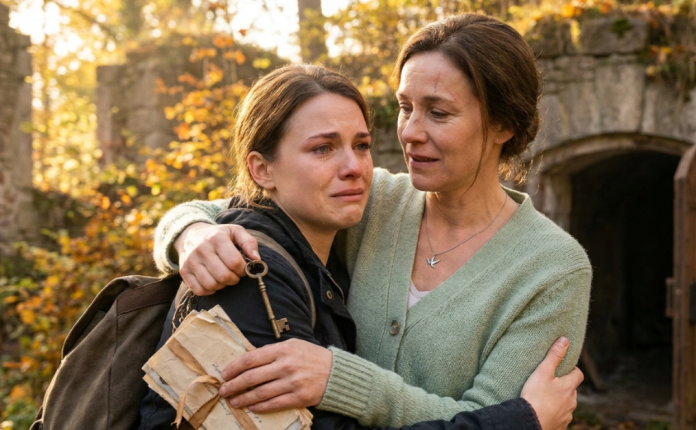
We hugged, and for one fragile moment, something within me softened enough to hope.
Then her phone buzzed on the table.
She frowned. “Unknown number.”
“Don’t answer.”
But she glanced at the preview and went pale.
“What is it?”
She showed me the screen.
A text message.
You think Jonah was the only one who could disappear? Come alone if you want the rest of the truth. Lake house. 9 p.m. No police.
Attached was a recent photograph of the old Whitmore lake house thirty miles outside town.
I snatched the phone. “This is Gabriel.”
Mother grabbed my wrist. “He knows about Jonah.”
“Then all the more reason not to go.”
“If there are still records—”
“It could be a trap.”
She went still, and in her face I suddenly saw the same desperation that must have driven her thirty years ago—the terrible hope that one more act of courage might finally fix what cowardice and force had ruined.
“We call Luke,” I said firmly.
She nodded.
I turned to reach for my phone.
The apartment lights went out.
Everything dropped into darkness.
My mother gasped.
From the hallway came the sound of a door slamming.
Then feet running.
By the time emergency lights from the corridor filtered weakly under the front door, my mother was gone.
All that remained on the table was the blue-edged baby bonnet—and a second text flashing across her phone:
If you want her back, bring the Hale file to the lake house. Come alone.
Part 7: The Truth That Brought Them Down
Luke called the police before I finished saying the words.
“Kidnapping?” the responding officer repeated.
“Yes,” Luke said with lethal calm. “And if you move slowly because the suspect is a Whitmore, understand that I will make that part of the record as well.”
The officer moved faster after that.
I wanted to drive straight to the lake house and tear the doors down myself. Luke stopped me with both hands on my shoulders.
“Mara. Look at me.”
I did.
“If Gabriel wants the Hale file, then he’s desperate. Desperate men make mistakes. We will use that. But if you go in blind, you give him chaos. He has survived for decades on chaos.”
“He has my mother.”
“And we are getting her back.”
The lake house stood on the far end of Ravenmere Lake, hidden by pines and privilege. It had once hosted Whitmore summers so photogenic they ended up in the society pages. I remembered canoe lessons, cold lemonade, Father shouting into phones on the deck.
I also remembered never seeing the lower boathouse unlocked.
By the time we arrived, the county sheriff’s office had placed units at a discreet distance. Luke had persuaded them to hold position for a coordinated entry unless circumstances changed. I wore a wire. The Hale file in my hands was a duplicate. The originals were already secured.
The plan was simple.
I would go in. I would keep Gabriel talking. If we had probable cause and audible threat or admission, law enforcement would move.
Simple plans never feel simple when your mother may be somewhere inside.
Gabriel opened the front door before I knocked.
He was not wearing a suit.
For the first time in my life, he looked disordered—shirt open at the collar, eyes bloodshot, hair slightly wild. Not less dangerous. More.
“You came alone?” he asked.
I lifted the file. “Close enough.”
He stepped aside.
The lake house smelled like cedar, dust, and stale whiskey. Lamps glowed warm in the living room. No sign of my mother.
“Where is she?”
“Safe, for the moment.”
“If you hurt her—”
He laughed once. “Your sudden maternal devotion is touching.”
My hands curled around the file. “You don’t get to talk about devotion.”
He shut the door. “You have always been sentimental, Mara. That was your weakness.”
“No,” I said, “trusting this family was my weakness.”
His face tightened.
“Father should have told us long ago that you were your mother’s daughter in all the inconvenient ways.”
“Inconvenient. Is that what you call women who tell the truth?”
“It’s what I call people who don’t understand consequences.”
I let silence stretch just enough to make him fill it.
He did.
“Celeste would have collapsed everything,” he said. “The trust, the bank partnerships, the development approvals. Do you have any idea how many people depended on this family name?”
“You mean how many people depended on your fraud.”
He took a step closer. “I saved what Father built.”
“No. You preserved what he stole.”
His mouth flattened.
“Where is my mother?”
He tipped his head toward the back hallway. “Downstairs.”
I swallowed my panic. “Take me to her.”
“In a moment.”
“No. Now.”
Instead of obeying, he reached for the file. I held it back.
“You get nothing until I see her.”
For a second I thought he might strike me.
Then a voice came from the hallway behind him.
“She’s here.”
My mother stepped into the room.
Relief slammed into me so hard my knees nearly gave.
Her wrists were untied, but red-marked. She looked shaken, angry, alive.
I took one step toward her.
Gabriel blocked me.
“You’ll get your reunion,” he said. “After we settle this.”
My mother’s voice was steady. “There is nothing to settle.”
He turned on her. “There could have been if you had stayed gone.”
She lifted her chin. “That worked for thirty years. You don’t deserve thirty more minutes.”
Something in him cracked.
“Deserve?” he snapped. “You think this is about deserve? Father spent his life making sure this family remained untouchable. I spent mine maintaining it. Do you know what scandal does? It does not punish the dead. It devours the living.”
“You mean it devours your reputation,” I said.
“It devours power,” he shot back. “And power is the only thing that keeps people from tearing you apart.”
I looked at him then and saw the emptiness beneath all that control. Gabriel wasn’t protecting legacy. He was addicted to domination. The family secret had become his identity.
“You could have told the truth years ago,” I said quietly. “You could have apologized. You could have left my company alone.”
He gave a cold smile. “And watch you build what Father should have entrusted to me?”
So there it was.
Not duty. Envy.
“You hated that I made something you couldn’t control.”
“I hated that you carried the Whitmore advantage while pretending you rose alone.”
I laughed in disbelief. “Whitmore advantage? You mean the childhood built on lies? The silence? The constant knowledge that affection in this family had terms?”
“You still had the name.”
“I would have traded it for the truth.”
He stared at me, breathing hard.
Then he said, “Jonah Hale should have understood the same thing Celeste never did.”
The room went still.
My mother went pale.
I kept my voice level with effort. “Say that again.”
He realized too late what he had given away.
But ego is a terrible editor.
“Jonah thought one article could burn the whole structure down,” Gabriel said. “Father tried to reason with him.”
“Tried?” my mother whispered.
He looked at her with open contempt. “You really want the final truth now? He refused to back off. He called Father a thief and said he’d go to the attorney general. Father told me to handle it. I only meant to scare him.”
My heart pounded so hard it hurt.
“What did you do?”
His gaze flicked to me, then away.
“I had someone tamper with the car.”
My mother made a sound I will never forget. Not a scream. Something deeper. The sound of an old wound being opened with a blade.
Outside, tires crunched on gravel.
Gabriel heard it too.
His eyes widened.
“You wired this.”
I dropped the file and moved toward my mother.
He lunged.
In the next instant, everything broke open at once—shouted commands from the porch, the front door slamming inward, Gabriel grabbing my arm, Luke’s voice somewhere behind the deputies, my mother striking Gabriel across the face with the heavy metal lamp from the side table.
He staggered.
Sheriff’s deputies surged in.
“Hands where we can see them!”
Gabriel reached for nothing, everything, air.
Then they had him.
Pinned. Cuffed. Furious.
He twisted his head toward me as they hauled him up.
“You think this makes you clean?” he hissed. “You are still a Whitmore.”
I met his gaze.
“No,” I said. “I’m Celeste Hale’s daughter.”
He laughed once, bitter and broken, as they dragged him outside.
My mother collapsed into my arms.
I held her while flashing blue lights painted the walls and Luke spoke quickly to the sheriff in the background. The wire had captured enough. The confession about Jonah. The coercion. The attempt to extort the Hale file. More than enough for the immediate arrest, and enough to pull the rest of the old structure apart with subpoenas, publicity, and legal force.
The days that followed were brutal, public, and strangely clean.
Gabriel’s arrest detonated across every local outlet within hours. Once the first article hit, others followed: the scholarship trust discrepancies, the altered audits, the guardianship fraud, the long-buried questions around Briar Development land transfers, the affidavit from the former accountant, the testimony from Mrs. Dorsey, the authenticated recording of Thomas and Gabriel discussing “the Celeste problem.”
Evelyn ultimately testified.
She cried through parts of it and looked relieved when it was over.
Mother—Eleanor—did not fare as well in public. Her statement, when it came, was part confession, part defense, all ruin. She admitted participating in the guardianship deception, insisted she had convinced herself she was giving me stability, and finally said the one sentence that landed hardest with me:
“I wanted the child, and I chose wanting over what was right.”
I believed her.
I also could not forgive it quickly.
Perhaps not ever fully.
The town that had adored the Whitmores turned with astonishing speed once documents replaced rumor. Boards asked for resignations. Donors withdrew. The hospital removed Thomas Whitmore’s portrait from the founder’s corridor. The scholarship trust was placed under independent review, and eventually reconstituted under court supervision after recovered assets and settlements restored much of what had been misused.
Luke won the injunction hearing so decisively it almost felt impolite. Gabriel’s claims against my company collapsed under scrutiny, especially once evidence showed coordinated bad-faith pressure designed to leverage me into surrendering control. We countersued. We won. The damages did not erase the stress, but they funded the next phase of my business without one Whitmore signature attached to it.
As for my mother—Celeste—justice came not as a miracle, but as restoration.
Her original birth record was corrected in the official file.
The false theft narrative was formally withdrawn.
A public statement from the restructured trust acknowledged that she had attempted to report financial misconduct and had been falsely discredited in retaliation.
When she read that statement at her kitchen table in Asheville two months later, she cried so hard she had to take off her glasses twice.
“I don’t know what to do with being believed,” she said.
“Get used to it,” I told her, smiling through my own tears.
We were sitting in the blue room at Whitmore House when I said it.
Yes, the blue room.
After the legal dust settled and the estate entered reorganization, I bought the house—not because I wanted the Whitmore legacy, but because I refused to let that room remain a tomb. I kept some parts of the place. I changed others. The library became the headquarters for a new nonprofit design fellowship for young women from underfunded communities. The east wing became offices. The blue room stayed blue.
On a clear Saturday in late spring, we opened the newly named Celeste Hale Scholarship for Truth and Design—funded partly by recovered trust assets, partly by my own contribution, and partly by donors who preferred repair over prestige.
Luke stood beside me during the dedication.
At some point in the months between court filings and shared takeout dinners and midnight strategy sessions, friendship had become something warmer, quieter, more inevitable. He took my hand not because I needed steadying anymore, but because he knew I liked the honesty of it.
My mother saw and smiled.
Mrs. Dorsey sat in the front row wearing a lavender hat and looking pleased with the entire world.
Evelyn attended too, subdued but present.
Mother Eleanor did not. She wrote instead. A long letter. No requests, no manipulations, just acknowledgment. I was not ready to answer, but for the first time, I believed she had finally run out of lies.
When my turn came to speak, I stepped to the podium and looked at the gathered crowd.
For most of my life, I had been told that preserving a family’s reputation was the same thing as preserving its worth.
I knew better now.
“Some families,” I said, my voice carrying farther than I expected, “teach silence as loyalty. They mistake control for love and appearances for honor. For thirty years, the truth about my mother was buried because powerful people believed reputation mattered more than justice. Today, we are not here to celebrate scandal. We are here to celebrate what survives it.”
I turned toward Celeste.
She was crying already.
“You were betrayed,” I said to her, though everyone heard it. “You were erased, lied about, and punished for telling the truth. But none of that changed who you were. It only revealed who they were. And today, your name comes home clean.”
The room rose in applause before I had finished.
My mother covered her mouth with both hands and wept openly.
Later, when the guests had thinned and evening sunlight poured warm and golden through the old windows, I stood with her in the blue room once more.
She touched the rocking chair with careful fingers.
“I used to imagine holding you here again,” she said.
“You are,” I answered.
She looked at me then—really looked.
“Do you ever wish you’d never found out?”
I thought of the life I had lived inside a polished lie. I thought of Gabriel in handcuffs, of Father’s dead handwriting, of Eleanor’s broken letter, of Grandmother’s trembling courage arriving too late but not uselessly. I thought of the company I had built, nearly stolen and finally secured. I thought of all the years lost.
Then I thought of truth.
“No,” I said. “I wish it had come sooner. But not knowing would have kept them powerful.”
She nodded.
Outside, laughter drifted up from the lawn where Luke and Mrs. Dorsey were arguing affectionately about folding chairs. The house no longer felt like a monument to silence. It felt like a place where the windows had finally been opened.
Grandmother had been right.
Truth mattered more than comfort.
It had destroyed the reputation my family worshipped.
It had returned my mother’s name.
It had protected what I built.
And in the end, it had done what thirty years of money, fear, and influence could not stop.
It brought justice home.