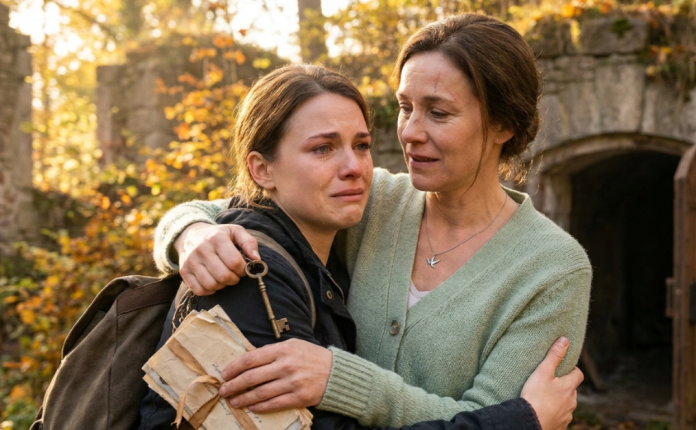
Part 4: My Mother, Found Under Another Name
I left before dawn.
I didn’t tell anyone except Luke, who texted me three times before I crossed the state line.
- Send me the address.
- Do not confront anyone alone if the family is already tracking this.
- Eat something that isn’t coffee.
I ignored the third instruction but obeyed the first two.
Asheville greeted me with mountain air, bright storefronts, and the kind of clean morning light that made people believe healing was a place, not a process. St. Agnes Home for Women sat on a hill above a small church, a red-brick building with white trim and a front garden full of yellow daisies.
I parked, turned off the engine, and sat motionless for nearly a minute.
I had spent thirty-eight years not knowing I had been stolen.
What if I was too late now?
Inside, the receptionist wore lavender scrubs and kind eyes.
“I’m looking for someone who used to work here,” I said, forcing steadiness into my voice. “Celia Hale.”
The woman hesitated. “May I ask who’s inquiring?”
I swallowed. “My name is Mara.”
Something changed in her expression.
Not surprise. Recognition.
“Please sit,” she said softly.
My pulse thundered.
She disappeared down the hall. I remained standing.
A minute passed. Then two. Then a door at the far end opened.
The woman who stepped through it had my eyes.
That was the first thing I knew.
Not resemblance. Not possibility. Recognition.
She was older than the photograph, of course. Her dark hair had silver at the temples, and her face carried the fine, patient lines of a life that had required endurance. But the dimple in her left cheek appeared when her mouth trembled. Her hands covered her lips as if they could hold back thirty years by force.
“Mara?” she whispered.
No one had ever said my name like that.
I crossed the hall before I felt my legs move.
When we reached each other, we stopped—two strangers bound by blood and theft and time.
Then she touched my face with both hands.
A sob tore out of me so suddenly I had no chance to contain it.
“Oh, my God,” she said, crying too. “Oh, my beautiful girl.”
And then we were holding each other in the middle of a hallway while my whole life rearranged itself around the fact of her body and warmth and grief.
We sat in a private garden afterward because neither of us was fit for a room.
Her name now was legally Celia Hale. Hale had been the surname of the man she loved when she was twenty-two.
“Jonah?” I asked. “Was he my father?”
She nodded, smiling through tears. “A local reporter. Stubborn. Gentle. Too honest for this world. He died before you were born.”
“I’m sorry.”
“So am I.” She drew a breath. “But that isn’t the betrayal you came here to learn.”
No. It wasn’t.
She told me everything.
How she had discovered missing scholarship funds while reviewing documents for Father.
How the money had been diverted into land acquisition fronts for Briar Development.
How she threatened to go to the board and to the press.
How Father laughed at first—until she told him she had copied pages.
“How did they know about the baby?” I asked.
Celeste—my mother—looked down at her hands. “Because Eleanor found out. She told me a child born in scandal would finish what my accusations started. She said Father would lose the bank, Gabriel would lose his political ambitions, Evelyn would never marry well. Everything was always about what a truth would cost them.”
I thought of every gala photograph, every scholarship luncheon, every polished Whitmore speech about service and integrity. I felt physically ill.
“When you had me…” My voice failed. I tried again. “What happened?”
Her eyes closed briefly.
“They let me keep you for thirteen days.”
I stared at her.
“Only thirteen?”
She nodded. “Lillian helped me. She brought you to the blue room because it was once hers, and she said it would be our sanctuary until the dust settled.” She laughed bitterly. “It never settled. It hardened.”
Her fingers tightened around the teacup.
“One afternoon Eleanor said she was taking you downstairs so I could sleep. I woke in Briarcrest Clinic. They said I had become hysterical and needed rest. I remember screaming that you needed feeding. A nurse told me formula would do.” Her voice shook now, but she kept going. “By the time I got out, Thomas had guardianship papers and Gabriel had three witnesses ready to swear I was unwell. They told me if I fought publicly, they would charge me with theft and say I endangered you.”
“And you believed them?”
“I knew them,” she said quietly. “That was worse.”
I looked away because the grief of that answer was too large to hold directly.
“Why didn’t you come back later? Why not tell me when I was older?”
“I tried once, when you were ten.” She reached into her bag and withdrew a faded envelope. “This was returned unopened.”
It was addressed to Miss Mara Whitmore in a careful hand.
Stamped across the front in bold blue ink: Refused.
My throat closed.
“I sent Christmas cards for years,” she said. “Lillian warned me Thomas burned some. Then Gabriel came to see me.”
I looked up.
“He said you were thriving, and if I loved you I would stay away. He said if I tried to contact you again, he would expose my ‘history,’ reopen the theft accusations, and make sure I lost the nursing assistant work I had finally found. I was a coward, Mara.”
“No,” I said fiercely. “You were cornered.”
Tears slipped down her face. “I hated every birthday I missed.”
I reached across the table and took her hand.
The contact steadied us both.
Then she said, “I still have copies.”
“Of the ledgers?”
“Yes. More than that.” She stood. “Come with me.”
Her apartment was small but warm—bookshelves, plants, a yellow throw blanket, framed watercolors of mountains. A life built carefully after destruction.
From the back of her closet, she brought out a metal lockbox.
Inside were photocopied ledgers, old letters from Grandmother, and a cassette tape labeled in Father’s handwriting:
Meeting with G. re: Celeste problem
Luke, I thought instantly. He would know how to digitize it.
But before I could speak, my phone rang.
It was Luke.
I answered. “Tell me you’ve got good news.”
“I’ve got urgent news,” he said. “Gabriel filed a police report in Asheville an hour ago claiming Celia Hale is a vulnerable adult being manipulated by you into false testimony for financial leverage.”
My stomach dropped.
Mother turned pale. “He found me.”
Luke kept talking. “And Mara—there’s more. Someone broke into your Raleigh office last night. Nothing obvious was taken except the archive cabinet.”
I gripped the phone harder. “The cabinet with our original formation papers?”
“Yes.”
I looked at my mother. She already knew what it meant.
Gabriel wasn’t just defending the past.
He was preparing to rewrite the present.
And then a hard knock thundered against the apartment door.
Part 5: The Price of Telling the Truth
My mother froze.
Another knock came, louder this time.
“Celia Hale?” a male voice called through the door. “Police department. We need to speak with you.”
Luke’s voice sharpened through the phone. “Do not open it until she asks for identification and a warrant if they try to enter.”
I put him on speaker.
My mother—my mother—straightened her spine in a way that suddenly reminded me of Grandmother, not Eleanor. “One moment,” she called.
She opened the door only a crack.
Two uniformed officers stood outside, polite but alert. One explained that a concern report had been made regarding potential coercion.
My mother listened, then opened the door wider.
“My name is Celia Hale,” she said calmly. “I am sixty years old, fully competent, and in the presence of my adult daughter, whom I have every wish to see. The only coercion in this situation has been performed by the Whitmore family for thirty years. If you require a statement, I will provide one with counsel present.”
The officers exchanged a glance.
Luke’s voice came clearly from my phone. “Officer, my name is Luke Mercer, attorney for Ms. Mara Whitmore. Any further inquiry can be directed to my office. We are prepared to document the retaliatory nature of this complaint.”
That changed the temperature immediately.
After brief, awkward assurances, the officers left.
The moment the door closed, my mother sat down heavily in the nearest chair.
“He always used institutions,” she said quietly. “Law, medicine, banks, churches. Gabriel learned from Thomas.”
I crouched beside her. “Not this time.”
She smiled faintly. “You sound like Lillian.”
That undid me a little.
By evening we were back in Raleigh, installed in Luke’s guest suite because he refused to let either of us stay somewhere predictable. He digitized the cassette himself in his office while I sat opposite him, knees bouncing.
When Father’s voice filled the room, my whole body went cold.
The recording quality was rough, but unmistakable.
Father spoke first. “She has copies?”
Gabriel’s younger voice answered. “She says she does.”
“Then we discredit her.”
“She’s pregnant.”
A pause.
Mother’s name came next.
Eleanor.
Father again: “That may solve more than one problem. If she will not be reasonable, then we proceed with the clinic.”
I closed my eyes.
Luke stopped the tape and looked at me. “This is explosive. But we need authentication and full context before we use it.”
My mother stared at the speaker like she was looking at a ghost she had once begged to spare her.
The next forty-eight hours became a war measured in paperwork, statements, and carefully timed silence.
Gabriel’s legal team intensified their pressure. Anonymous gossip posts appeared online suggesting I was fabricating claims against my “grieving family” after being denied a larger share of Grandmother’s estate. A local columnist, conveniently friendly with Evelyn’s charity circle, ran a sympathetic piece about the burden of “false memory and inheritance disputes.”
Then the bank financing one of my firm’s largest restoration projects requested immediate clarification regarding “pending ownership instability.”
I nearly put my fist through my office wall.
“Breathe,” Luke said, standing in the doorway as I paced.
“That family could set a church on fire and still get praised for warming the poor.”
“We are not fighting their dinner-party narrative,” he said. “We are building a record.”
I turned toward him. “And if the record isn’t enough before they bleed me dry?”
“It will be,” he said.
The certainty in his voice steadied me more than I wanted to admit.
On the third morning, Evelyn called.
I nearly didn’t answer.
But curiosity won.
“What?” I said.
Her exhale came sharp through the line. “You’ve turned this into a spectacle.”
“No. I uncovered one.”
“Mara, listen to me carefully. Gabriel is furious. Mother is not well. If you come to the house tonight, alone, we may still settle this quietly.”
I laughed bitterly. “Quietly is what got us here.”
“Mara—”
“Did you know?” I cut in. “All these years, did you know Celeste was my mother?”
Silence.
Then, very softly: “I knew enough.”
The honesty stunned me.
“Why didn’t you tell me?”
“Because in this family,” Evelyn said, her voice trembling in a way I had never heard, “the first child learns obedience, the second learns decoration, and the third learns survival. I learned not to touch Father’s secrets.”
“Too late,” I said, and hung up.
That evening, however, she came to me.
Not the house. My office.
She arrived in a beige trench coat and sunglasses despite the fact that the sun had set twenty minutes earlier. She looked less elegant up close, more exhausted.
“I have ten minutes before Gabriel notices I’m not where I said I’d be,” she said.
Luke, who happened to be there, stepped out only after I insisted. He remained in view through the glass wall.
Evelyn set a small key on my desk.
“Safe-deposit box,” she said. “First Federal. It was Father’s. Mother never knew about it. I did because I once drove him there after a board meeting. He thought I wasn’t listening when he told Gabriel the box held ‘the real insurance.’”
I stared at the key.
“Why give me this?”
Her perfectly manicured hand trembled. “Because I am tired. Because Grandmother was right. Because when I was sixteen, I heard Celeste screaming for her baby, and I closed my bedroom door.”
The room went silent around us.
Guilt had altered her face more than age ever could.
“Will you testify?” I asked.
She looked stricken. “I don’t know if I’m that brave.”
“At least you’re honest.”
Evelyn nodded weakly. “Father told us Celeste was selfish, unstable, dangerous. But every year after you were born, Mother went into the blue room alone on your birthday. She would come out with red eyes and straighten the silver as if nothing had happened.” Evelyn swallowed. “I think she loved you in the only broken way she knew how.”
“I needed the truth more than her version of love.”
“I know.”
She turned to go, then stopped at the door.
“There’s one more thing,” she said without facing me. “If the box contains what I think it does, you may learn that what happened to Celeste wasn’t the only life this family destroyed.”
When she left, Luke came back in.
“You trust her?”
“No.”
“You still going to the bank tomorrow?”
“Yes.”
The safe-deposit box was smaller than I expected, but what it contained made my hands shake.
An original birth certificate naming Celeste Anne Whitmore as my mother.
A set of scholarship audit pages with altered and unaltered versions side by side.
A notarized affidavit signed by a former Whitmore accountant recanting earlier statements about Celeste’s “theft.”
And a sealed envelope in Father’s handwriting.
If this is opened, then matters have gone farther than intended. Gabriel—destroy the Hale file. No one must connect Jonah’s accident to the article draft.
I read it twice before the words made sense.
Then not at all.
I looked at Luke.
He had gone still.
“Who is Jonah?” he asked quietly.
My mouth went dry.
“My father,” I said. “I think.”
I broke the seal with numb fingers.
Inside was a newspaper clipping about a fatal car crash and a half-burned draft article accusing Briar Development of fraudulent land acquisition tied to scholarship fund misuse.
At the bottom, in ink, Father had written three words:
Handled before publication.
Luke met my eyes.
And in that instant I understood that the secret my family buried thirty years ago was even darker than the one I had already unearthed.