Part 4: The House at Lake Briar
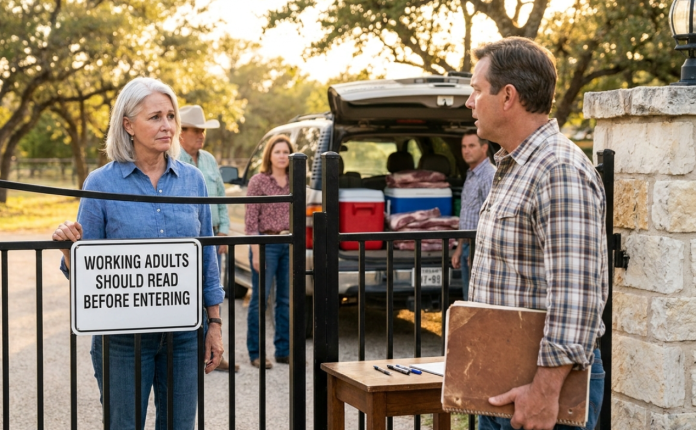
Lake Briar was seventy miles north of Dallas, hidden behind cedar trees and a rusted iron gate.
As a child, I loved it more than our actual home.
Grandmother Evelyn taught me to swim from the stone dock. Owen and I caught fireflies in jars along the path. Paige once carved her initials beneath the kitchen windowsill and blamed me until Grandmother made her confess.
After Evelyn died, my father announced that the property needed repairs and locked it.
No one had been allowed inside since.
Amelia refused to let me go without security.
Samuel contacted the county sheriff’s office, explained that estate records might be at risk, and asked deputies to meet us. But the lake house sat far outside town, and the nearest patrol unit was dealing with an accident.
We arrived first.
Amelia drove. I sat beside her. Owen was in the back seat.
He was not supposed to be there.
When I told him to stay at a friend’s house, he climbed into Amelia’s car and locked the door.
“Dad has used me as an excuse for two days,” he said. “I deserve to know what he’s doing.”
The gate stood open.
Fresh tire tracks cut through the dust.
“We wait for the deputies,” Amelia said.
Then I saw smoke rising beyond the trees.
I opened my door.
“Elena.”
“The house.”
I ran.
The smoke came not from the roof, but from a metal barrel in the courtyard. Papers burned inside it, their edges lifting in the heat.
My father stood beside the barrel.
Conrad Voss was carrying boxes out through the library doors.
For one moment, the scene froze.
My father looked at me.
Then at Owen.
His face twisted.
“What are you doing here?”
“What are you burning?”
“Old business records.”
“Grandmother’s records?”
He stepped toward me.
“You have no idea what you are involving yourself in.”
Amelia raised her phone.
“Martin, law enforcement has been notified. Do not remove or destroy anything else.”
Conrad set down the box he was carrying.
“Counselor, this property belongs to Hartwell Holdings.”
“It remains part of the Evelyn Hart estate trust,” Amelia replied. “You have no authority to be here.”
My father pointed at Owen.
“Take your brother to the car.”
“No,” Owen said.
The word surprised everyone.
My father stared at him.
“Excuse me?”
“You heard me.”
Conrad gave a quiet laugh.
“Wonderful. A family rebellion.”
I moved toward the library.
My father blocked me.
“Go home.”
“You used my identity.”
“To prevent a collapse you are too young to understand.”
“You forged my signature because you were afraid I would understand.”
His face reddened.
“I built everything you have.”
“Grandmother built Hartwell.”
“I turned it into an empire.”
“And now it’s failing.”
His hand rose.
For a terrifying second, I thought he would strike me.
Instead, he pointed toward the driveway.
“Leave.”
A siren sounded in the distance.
Conrad looked toward the road.
Then he grabbed the nearest box and ran toward the side of the house.
“Conrad!” my father shouted.
Owen moved without thinking.
He stepped into Conrad’s path.
Conrad shoved him.
Owen fell backward against the stone edge of a planter. His head struck with a sound I would hear in my dreams for months.
“Owen!”
I dropped beside him.
Blood appeared near his temple.
My father went white.
Conrad did not stop.
He disappeared through the trees carrying the box.
Amelia called emergency services while the first sheriff’s vehicle entered the courtyard.
Owen opened his eyes.
“I’m okay,” he whispered.
“You’re bleeding.”
“I noticed.”
My father knelt beside us.
“Owen, son—”
“Don’t touch me.”
My father froze.
Deputies separated us, secured the property, and extinguished the fire. Paramedics treated Owen and recommended stitches but found no sign of a serious head injury.
While he was transported to the hospital with Amelia, I remained at the lake house to identify estate property.
My father sat on the front steps under supervision.
For the first time in my life, he looked small.
Not powerless.
Just human.
I almost felt sorry for him.
Then a deputy carried a stack of half-burned documents from the barrel.
My forged signature appeared on the top page.
Inside the library, Grandmother’s writing desk had been pulled away from the wall.
The bottom drawer lay on the floor.
The false panel was open.
But the hidden compartment was empty.
My heart sank.
“They got here first.”
A crime-scene technician examined the compartment with a flashlight.
“Not entirely.”
He pointed to a narrow groove at the rear.
A small brass key remained wedged inside.
Taped beneath it was a handwritten card.
Safe-deposit box 417. Briar County Trust.
The bank had closed years earlier, but its safe-deposit vault remained under the management of a regional institution. Amelia reached the branch manager from the hospital and secured an emergency hold.
The box could not be opened until the following morning.
Owen received six stitches.
When I arrived at the hospital, Paige was sitting beside him.
She stood as soon as she saw me.
“Dad called me from the sheriff’s car.”
“He wasn’t arrested.”
“Not yet.”
“Conrad shoved Owen.”
“I know.”
She glanced toward our brother.
“He told me.”
Owen looked exhausted but alert.
Paige folded her arms tightly across herself.
“I didn’t know about the forged documents.”
“You knew they wanted my money.”
“I thought Dad was going to ask you to invest.”
“You laughed when I protected it.”
Her eyes filled.
“I was angry.”
“Why?”
“Because Grandmother chose you.”
The honesty silenced me.
Paige looked down.
“I spent my whole life trying to become what she wanted. I studied finance. I joined Hartwell. I worked weekends. I accepted every criticism she gave me. And then she left you three million dollars because you sat with her in the garden and read novels.”
“She didn’t leave it to me because of novels.”
“I know that now.”
“Do you?”
Paige took a slow breath.
“Dad promised I would run the company after him. He said your inheritance would stabilize our balance sheet, and then he would create a new division for me. I wanted to believe him.”
“You wanted my money.”
“I wanted what he promised.”
“That is not better.”
“No,” she said. “It isn’t.”
The next morning, Amelia, Samuel, and I met at the bank managing the old vault.
The safe-deposit box required two keys—Grandmother’s brass key and the institution’s control key.
Inside were three bound ledgers, six flash drives, a bundle of contracts, and a small digital recorder.
There was also a photograph of Grandmother standing beside my grandfather at the original Hartwell construction site.
On the back, she had written:
A company is only worth saving if saving it does not require us to become thieves.
We spent hours reviewing the files.
The ledgers documented transfers from Hartwell Development to entities controlled by Conrad Voss. Some were labeled as land-option fees. Others were described as consulting payments.
Millions had moved out.
Several transfers carried my father’s authorization.
The recorder contained dated conversations.
Grandmother had confronted him eighteen months before her death.
“You are stripping the company,” her voice said.
My father answered, “I’m expanding our position.”
“With employee retirement funds?”
“They are temporary internal loans.”
“You have become very fond of that word.”
Conrad’s voice appeared in another recording, urging my father to conceal the transfers until the Austin project was refinanced.
Then we reached a recording labeled Family Capital Plan.
The date was nearly three years old.
My father spoke first.
“When Mother dies, the inheritance will be held until Elena turns eighteen.”
Conrad replied, “Three million covers the immediate deficiency.”
“She’ll cooperate.”
“And if she doesn’t?”
A long pause followed.
Then my mother’s voice entered the conversation.
Calm.
Clear.
Familiar.
“When Elena turns eighteen,” she said, “we will have access. She may resist at first, but she has always been the easiest one to make feel guilty.”
Part 5: The Family I Thought I Knew
The recording did not sound like my mother.
That was the worst part.
If she had sounded cruel, I could have separated the woman on the recording from the woman who braided my hair before school, sat beside me when I had the flu, and drove across town at midnight when I called from a sleepover feeling homesick.
Instead, she sounded practical.
Almost tired.
As though manipulating me were an unpleasant household task that still needed to be completed.
I listened once.
I could not listen again.
Amelia stopped the recorder.
“You do not need to decide anything today.”
But decisions were already happening.
The bank’s fraud division referred the forged guarantee and identity theft to law enforcement.
Hartwell Development’s primary lender froze its accounts.
Conrad Voss disappeared.
My father hired a criminal defense attorney.
Aunt Celeste surrendered her notary journal and claimed she had been misled into believing I had verbally authorized my mother to sign.
No one believed her.
My mother returned home and stopped answering calls.
By afternoon, Hartwell employees were learning that payroll might not clear.
The story reached the local business press.
HARTWELL DEVELOPMENT LOAN COLLAPSES AMID INTERNAL DISPUTE
Our relatives began calling.
My aunt Margaret left a voicemail saying, “Your parents may have made errors, but family matters should remain private.”
My cousin posted a vague message about spoiled children who valued money more than blood.
People who had toasted me three nights earlier now described me as unstable, vindictive, and easily influenced by lawyers.
Paige sent me screenshots from a family group chat.
My father had written:
Elena has been manipulated into withholding emergency support from the company that provided her privileged life.
I read the message twice.
Then I blocked him.
Owen stayed with Paige temporarily because our home had become unbearable. My mother moved through the rooms like a ghost. My father held meetings with attorneys in his office and shouted whenever anyone interrupted.
Paige brought Owen to my hotel the following evening.
He carried a backpack and a paper bag containing three chocolate muffins.
“Hospital food made me appreciate baked goods,” he said.
The bandage at his temple made him look younger.
Paige remained near the door.
“May I stay?”
I wanted to say no.
Instead, I nodded.
We sat around a small table while rain struck the hotel windows.
For the first few minutes, none of us touched the muffins.
Then Owen said, “Are we poor now?”
Paige closed her eyes.
I answered honestly.
“I don’t know.”
“Are Mom and Dad going to jail?”
“I don’t know.”
“Are you?”
“No.”
“Good.”
He tore a muffin in half.
“Dad says all of this happened because you moved the money.”
Paige whispered, “Owen.”
“What? That’s what he says.”
I looked at my brother.
“The company was in trouble before my birthday. Dad and Conrad moved money they weren’t supposed to move. They planned to use my inheritance to cover it.”
“So the trust didn’t cause the hole.”
“No. It stopped them from filling it with something that belonged to me.”
Owen nodded slowly.
“That sounds different.”
“It is.”
Paige stared at the table.
“I’m sorry,” she said.
I waited.
She looked at me.
“I’m not saying it because I need forgiveness. I’m saying it because I knew enough to ask questions, and I chose not to.”
“Why?”
“Because Dad made me feel important.”
Her voice cracked.
“He kept saying I was the one who understood business. The one who could carry the family name. Every time I ignored something wrong, he rewarded me with another promise.”
I thought of Grandmother’s warning.
Judgment without independence can be crushed by people who call obedience love.
“Did you know about Conrad’s companies?” I asked.
“Some of them.”
“Did you help move money?”
“No. But I created presentations for investors using numbers Dad gave me. Some of the numbers may have been false.”
“Will you tell the investigators?”
“Yes.”
Her answer came without hesitation.
I believed her.
The following morning, Paige met voluntarily with the financial-crimes unit.
By evening, she had turned over her company laptop, internal emails, and access credentials.
At nine, she called me.
“Elena, you need to come to Amelia’s office.”
“What happened?”
“I found something before they took my laptop.”
We met in the conference room.
Paige connected a copied file to an isolated computer.
It contained internal authorization schedules for Hartwell’s accounts.
One transaction was marked for release at eight the following morning.
Amount: $2.4 million.
Source: Hartwell Employee Retirement Reserve.
Destination: Briar Crest Strategic Holdings.
Briar Crest was one of Conrad’s companies.
“Can the bank stop it?” I asked.
“They will,” Amelia said. “We are notifying them now.”
Paige scrolled lower.
The transaction required two authorizations.
The first belonged to my father.
The second belonged to an external guarantor.
My name appeared beside it.
“They forged me again.”
Samuel examined the digital certificate.
“This was created yesterday.”
“After the trust?”
“Yes.”
“What would the authorization do?”
Paige’s face had gone pale.
“It makes it appear that Elena approved the transfer as part of an emergency recapitalization agreement.”
“But they can’t access the trust.”
“They don’t need to,” Amelia said. “They may be trying to create evidence that you agreed to support the company. If the retirement money disappears, they can claim it was transferred in reliance on your commitment.”
“Conrad is setting her up,” Paige whispered.
The door opened.
Amelia’s assistant entered carrying a sealed envelope delivered by federal courier.
Samuel read the notice first.
His expression changed.
“What?”
He handed it to Amelia.
The financial-crimes unit had found the transfer authorization on a server registered to Conrad’s holding company.
But the login used to create my forged digital approval had originated from my father’s home office.
At the bottom of the page was a recovered internal message sent from Conrad to my father.
Once the wire clears, the girl becomes the public explanation. You keep the family story consistent.
My father replied twelve minutes later.
Understood. Elena will take the blame.