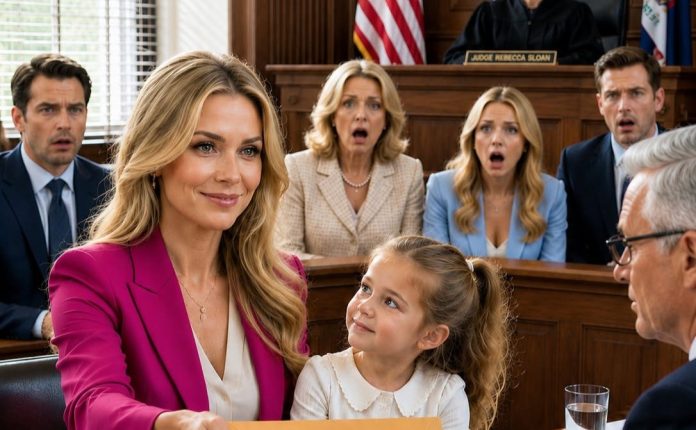
Six hours before a judge was expected to sentence me to life in prison for murdering my wife, they allowed me one final visit with my eight-year-old daughter. Emily had not spoken since the night Laura vanished. She only stared at me through the scratched glass, her small fingers trembling around a yellow crayon. When the guard finally let me hold her, she pressed her mouth against my ear and whispered the first words I had heard from her in eighteen months. “Daddy… I saw Mom last Tuesday.” Then she drew a building with three blue windows, a broken clock, and a man wearing a silver watch. The deputy behind us stopped breathing.
Part 1: The First Words
The last time I held my daughter, I was wearing shackles.
They had removed the chain around my waist for the visit, but the cuffs remained around my wrists, cold and heavy against Emily’s back. I tried to angle my hands so the metal would not touch her skin. She was smaller than I remembered, though only eleven days had passed since the jury returned its guilty verdict.
Eleven days could shrink a child.
Emily’s hair had been cut to her shoulders. Laura used to keep it long, brushing it every night and braiding it loosely before bed. Now it curled untidily beneath her ears. She wore a pale green sweater that belonged to her cousin and carried the same cloth rabbit she had clung to during the trial.
The rabbit’s name was Sunny.
Laura had sewn it when Emily was four.
“Hey, bug,” I whispered.
Emily buried her face against my chest.
My attorney, Mara Bell, stood near the wall of the visitation room. She had fought to secure this meeting before sentencing, arguing that there was no guarantee I would be placed in a prison near home. The prosecutor had objected. The judge had allowed fifteen minutes.
Fifteen minutes to say goodbye to my only child.
Behind the observation window stood Deputy Carver and a county social worker named Patrice Lowe. Emily had lived with Laura’s younger sister, Rachel, since my arrest. Rachel had brought her to the courthouse that morning but had refused to enter the room.
I did not blame her.
Rachel believed I had killed Laura.
Nearly everyone did.
The state said I had murdered my wife in our garage after she discovered I was having an affair. They showed the jury edited email messages, a life-insurance policy and traces of Laura’s blood beneath the concrete workbench. They played a recording of our final argument, captured by the smart speaker in our kitchen.
They did not play what came afterward because, according to the prosecution, nothing came afterward.
Laura’s phone stopped transmitting at 10:17 p.m. Her car was found abandoned beside the river. Her body was never recovered.
I told them Laura had been frightened for weeks. I told them she believed someone at the Harbor House Foundation, where she worked as chief financial auditor, was stealing millions from charitable accounts.
No one listened.
The police said I invented the story after realizing the evidence pointed at me.
The jury deliberated for four hours.
Now Judge Elena Shaw was expected to sentence me at four that afternoon.
Emily’s arms tightened around my neck.
“I love you,” I said. “You know that, don’t you?”
She did not move.
“You haven’t done anything wrong. None of this is your fault.”
Her breathing changed.
For eighteen months, Emily had not spoken to anyone. Doctors called it trauma-induced mutism. She communicated with drawings, gestures and occasional written words, but even those were rare.
I felt her lips move near my ear.
At first, I thought she had taken a breath.
Then I heard a sound so soft I almost missed it.
“Daddy…”
Every muscle in my body froze.
Emily pulled back just enough to look at me. Her brown eyes were wide with terror.
“I saw Mom last Tuesday.”
I stared at her.
Mara stepped away from the wall.
“What did you say, sweetheart?” I asked.
Emily’s gaze darted toward the observation window. She saw the officials watching us and immediately pressed her lips together.
“Emily, where did you see her?”
Her hands began shaking.
Mara approached slowly. “No one is going to be angry with you. Can you show us?”
Emily looked at the yellow crayon sticking from the pocket of her sweater. Mara immediately found a legal pad in her briefcase and placed it on the table.
The guard started to object.
“Let the child draw,” Mara said.
Emily climbed onto a chair. Her fingers wrapped around the crayon so tightly that the knuckles turned white.
She drew a large square building.
Three narrow blue windows appeared along the front. Above them she drew a circle with two black hands, one pointing down and the other broken halfway across. Beside the building she drew a bent tree and a fence covered in looping shapes.
Then she selected a red crayon.
Behind the middle window, she drew a woman.
The woman had long red lines for hair and one hand pressed against the glass.
“That’s Mommy?” I asked.
Emily nodded.
My breath left me.
She drew herself in the lower corner, sitting inside a vehicle. Rachel was beside her. An arrow pointed from Emily’s eyes toward the window.
“Were you driving past the building?” Mara asked.
Another nod.
“When?”
Emily held up three fingers, then two.
“Tuesday at three?” Patrice asked through the speaker.
Emily shook her head, frustrated, and wrote beneath the picture:
3:20.
She drew another figure standing behind Laura.
A tall man.
His face was a blank oval, but on his left wrist she drew a square shape with lines around it. A silver watch.
Deputy Carver stepped closer to the glass.
“What is it?” Mara demanded.
Carver opened the door and entered without waiting for permission.
“Let me see the drawing.”
Mara turned the paper toward him.
The color drained from the deputy’s face.
“That building,” he said. “I know it.”
“Where is it?”
Carver pointed to the broken clock over the three blue windows.
“Northbridge House. It was a private neurological recovery center outside Millhaven. My brother did electrical work there before the county shut part of it down.”
My heart pounded.
“When was it shut down?”
“Two years ago. At least, that’s what the public was told.”
Mara took the drawing and hurried toward the door.
Carver grabbed her arm. “You can’t just go there. The property is sealed.”
“Then call Judge Shaw.”
“The sentencing begins in six hours.”
“Not anymore.”
Emily seized my sleeve.
I turned back to her.
She picked up the black crayon and added something beneath the tall man’s feet. It looked like two overlapping half-circles with a vertical line through the middle.
Mara stared at the symbol.
I knew it instantly.
It was the logo of the Harbor House Foundation.
Laura’s employer.
The organization whose missing money she had been investigating before she vanished.
Mara carried the drawing into the judge’s chambers twenty minutes later. Judge Shaw postponed sentencing and signed an emergency search order after Emily repeated five words in front of a child psychologist:
“I saw my mother alive.”
At 12:46 p.m., county investigators reached Northbridge House.
The front gate was locked. The grounds appeared deserted.
But when officers accessed a traffic camera half a mile from the entrance, they found footage from the previous Tuesday.
At 3:18 p.m., a dark medical transport van had entered the property.
A woman sat in the rear passenger seat.
Her hair was shorter. Her face was thin. But the facial-recognition comparison produced a ninety-four-percent match.
Laura Mercer had entered Northbridge House alive.
And she had not come out.
Part 2: The Woman in Room Twelve
Judge Shaw suspended my sentencing for forty-eight hours.
The prosecutor, District Attorney Marcus Hale, fought the decision so aggressively that even the judge seemed disturbed.
“A traumatized child’s drawing does not overturn a murder conviction,” Hale argued.
“No,” Judge Shaw replied. “But video footage of the alleged victim eighteen months after her supposed murder may justify a closer look.”
I remained in county custody while investigators searched Northbridge House. Mara sat beside me in a secure conference room, refreshing her phone every few seconds.
Emily had been taken to the courthouse’s child interview suite with Dr. Lena Cho, the psychologist who had evaluated her after Laura disappeared.
“What if it isn’t her?” I asked.
Mara stopped refreshing the screen.
“You recognized her.”
“The footage was grainy.”
“You recognized the way she touched her neck.”
Laura had a habit of resting two fingers beneath her left ear when she was anxious. The woman in the van had done exactly that.
Mara leaned forward.
“Daniel, the state’s case depended on Laura being dead. They never found a body. They argued the amount of blood in your garage proved she could not have survived, but even their own expert admitted the sample could not determine total blood loss.”
“They said the cleanup chemicals altered it.”
“They said many things.”
The door opened.
Deputy Carver entered with an expression I could not read.
“They found a patient room,” he said.
My knees weakened.
“Was she there?”
“Recently.”
He placed photographs on the table.
Room Twelve was small and painted white. A narrow bed stood against one wall. Leather restraint straps hung from its frame. There were no personal belongings, except for a stack of paper hidden behind a loose radiator cover.
Every sheet contained the same three names.
DANIEL.
EMILY.
LAURA.
Some were written backward. Some in circles. Others were surrounded by dates.
On the wall beside the bed, someone had scratched four words through the paint:
DAN DID NOT DO IT.
I touched the photograph with my cuffed fingers.
“Laura wrote this.”
Carver nodded. “A handwriting examiner is comparing it to known samples, but your attorney and your sister-in-law both made a preliminary identification.”
“Where is she now?”
“Transferred.”
“By whom?”
“The facility director claims federal officers removed a patient using the name Anna Gray at six forty Tuesday evening.”
“Three hours after Emily saw her?”
“Yes.”
“Where did they take her?”
“He says the order was sealed.”
Mara stood. “Federal officers leave paperwork.”
“None has been located.”
“Then he’s lying.”
Carver’s jaw tightened. “The staff computers were wiped. Medical records were destroyed. We found sedatives, antipsychotics and memory-suppressing medications in a locked cabinet. Some were labeled for Anna Gray.”
I felt sick.
Laura had always been afraid of strong medication. Even after her emergency cesarean, she had refused anything more powerful than standard painkillers because she hated feeling disconnected from her own mind.
“They drugged her,” I said.
“That is one possibility.”
“One possibility?”
Carver looked toward the observation window.
“I have to be careful about what I say. Your conviction is still legally valid.”
“My wife was locked in a room while your department called me a murderer.”
“I wasn’t assigned to the original investigation.”
“No. Detective Owen Rusk was.”
At the mention of Rusk’s name, Carver looked away.
Rusk had led every search, conducted every interrogation and testified for nearly six hours at my trial. He said my grief appeared rehearsed. He told the jury I had asked how long it took for a body to surface in the river.
What I had actually asked was whether Laura could have survived if her car entered the water.
The prosecution shortened my question.
Mara noticed Carver’s reaction.
“What aren’t you telling us?”
Carver took out another photograph.
It showed Northbridge’s rear parking area. Several muddy tire tracks crossed the pavement. Beside them lay a torn strip of gray fabric.
“The staff member who cleaned Room Twelve said Anna Gray was terrified of one particular visitor,” Carver explained. “A man who came every few weeks. She called him the Watchman.”
My mind returned to Emily’s drawing.
The tall man.
The silver watch.
“Did the staff member describe him?”
“Tall. Mid-fifties. Gray at the temples. Wore a square silver watch and usually carried law-enforcement identification.”
Mara and I exchanged a look.
“Owen Rusk wears a silver watch,” I said.
Carver did not respond.
He did not need to.
Detective Rusk’s watch had been visible during every day of the trial. It was a retirement gift from his first precinct, large and square with a dark-blue face.
“Where is he?” Mara asked.
“Officially, he retired three months ago.”
“Unofficially?”
“No one has been able to contact him since this morning.”
The door opened again. Dr. Cho entered, carrying Emily’s cloth rabbit and several more drawings.
“Emily has remembered something,” she said.
“Can I see her?”
“Not yet. She is speaking, but only in short phrases. She becomes distressed when she hears male voices.”
My heart tightened.
“What did she remember?”
Dr. Cho laid out the drawings.
The first showed our house.
The second showed Laura in the garage with another man. The man wore a blue coat and the same square watch.
The third showed Emily hiding beneath the basement stairs.
In the fourth, Laura was being forced into a vehicle.
Beside her stood the man with the silver watch.
A second figure waited near the driver’s door.
Emily had colored that man’s tie bright red.
“What does the red tie mean?” Mara asked.
Dr. Cho looked at me.
“Emily said he came to your house for dinner.”
Many men had come to our home for dinner.
Coworkers. Neighbors. Friends.
Mara asked, “Did she say his name?”
Dr. Cho nodded.
My skin went cold.
“Who was it?”
Before Dr. Cho could answer, Carver’s phone rang.
He listened for several seconds, then put the call on speaker.
A technician’s voice filled the room.
“We recovered exterior footage from a secondary storage unit at Northbridge. It shows the Tuesday transfer.”
“Can you identify the officers?”
“One of them.”
The technician sent a still image.
Carver turned his phone toward us.
Laura was being guided into a black SUV, her wrists hidden beneath a blanket. The man holding her arm looked older than I remembered, but there was no mistaking him.
Detective Owen Rusk.
The officer who had built the murder case against me.
Dr. Cho looked down at Emily’s drawing.
“The man in the red tie was with him,” she said.
I stared at the second figure.
Then the blurred face sharpened on Carver’s screen.
It was Adrian Vale, executive director of the Harbor House Foundation.
Laura’s boss.
My oldest friend.
And Emily’s godfather.
Part 3: The Man We Trusted
Adrian Vale had sat behind me every day of the trial.
When the prosecution described Laura’s blood in the garage, Adrian lowered his head and wept.
When they showed photographs of her abandoned car, he placed a hand on Rachel’s shoulder.
After the jury found me guilty, he told reporters that justice could never bring Laura back but might allow the family to begin healing.
He had paid for Emily’s therapy.
He had organized Laura’s candlelight vigil.
He had looked me in the eyes through the bars of the courthouse holding cell and said, “I wish you had told me the truth.”
Now Emily had placed him at our house on the night Laura disappeared.
Mara requested an immediate warrant for Adrian’s home, office, vehicles and financial records. District Attorney Hale objected.
Again.
“This entire proceeding is becoming contaminated by emotional speculation,” Hale said during an emergency hearing.
Judge Shaw held up Emily’s drawing.
“The missing woman was filmed alive at a private facility connected to her employer. The lead detective in the defendant’s case removed her from that facility using false credentials. A child witness has identified the employer’s director as being present during the original disappearance. Which part do you consider speculation?”
Hale’s face tightened.
“Children are suggestible.”
“So are juries, Mr. Hale. That is why prosecutors have a duty to disclose exculpatory evidence.”
The words hung in the courtroom.
For the first time, I saw uncertainty among the reporters.
Mara had spent eighteen months telling anyone who would listen that Laura’s financial investigation mattered. Police dismissed it because Harbor House claimed there was no missing money.
Adrian personally produced an audit showing every dollar accounted for.
Now a forensic accounting team began examining that audit.
Within three hours, they discovered thirteen shell companies.
All thirteen received money from Harbor House.
Nine were registered to post-office boxes. Three were controlled by a holding company that owned Northbridge House. The final company had purchased the black SUV used to move Laura.
Every signature authorizing the payments belonged to Laura.
But Laura’s digital certificate had been used repeatedly after she disappeared.
Someone had kept her alive to approve transactions.
“They needed her fingerprints and voice authorization,” Mara explained. “The foundation’s larger transfers required biometric confirmation from the chief auditor.”
“They drugged her and forced her to approve them.”
“Or they used her while she was confused enough not to understand.”
I imagined Laura waking in a locked room, unsure of her own name, while Adrian stood over her with that calm, sympathetic expression.
I wanted to tear the chains from the floor.
At 5:30 p.m., Detective Rusk walked into a state-police station forty miles away and surrendered.
He refused to speak without immunity.
Judge Shaw approved a limited agreement: truthful information in exchange for consideration, not complete protection.
Rusk appeared by secured video.
He looked exhausted. His face was unshaven, and the famous silver watch was missing from his wrist.
“Where is Laura Mercer?” Mara asked.
“I don’t know.”
“You removed her from Northbridge.”
“I transported her.”
“Where?”
“To a handoff point outside Bellhaven.”
“Who took her?”
Rusk’s eyes shifted.
“Adrian Vale.”
“Why did you help him?”
“He had information on me.”
“What information?”
Rusk swallowed. “Years ago, I altered evidence in a narcotics case. A confidential informant died. Vale obtained the internal files. He said he would destroy my career and send me to prison.”
“So you framed an innocent man.”
“I followed evidence.”
“You planted evidence.”
Rusk looked directly at me through the screen.
“I planted the blood sample in the garage.”
The room seemed to tilt.
Rachel, sitting in the back of the courtroom, covered her mouth.
I had known the blood was planted. Knowing was different from hearing the man who did it admit the truth.
“Where did the sample come from?” Mara asked.
“Laura’s hospital records. Vale had a contact at Millhaven Medical Center. She donated blood before a surgical procedure six years ago. A portion had been preserved for research.”
“And the emails showing Daniel’s affair?”
“Fabricated.”
“The river search?”
“Directed away from where Vale transported her.”
“The argument recording?”
“Edited.”
Each answer tore apart another piece of the case.
Hale rose.
“Your Honor, this witness is an admitted corrupt officer attempting to save himself.”
Rusk laughed bitterly. “You knew.”
Silence spread through the courtroom.
Hale’s face changed.
“What did you say?”
“You knew Laura was alive.”
Judge Shaw leaned forward. “Detective, explain that statement.”
Rusk looked toward someone outside the camera’s view.
“The night before Mercer’s indictment, I told District Attorney Hale that Vale had moved Laura to Northbridge.”
Mara stood slowly.
“Did he instruct you to disclose that information to the defense?”
“No.”
“What did he instruct you to do?”
Rusk’s voice dropped.
“He told me a living victim could still become a dead one.”
Hale demanded the feed be terminated.
Judge Shaw ordered his courtroom deputy to prevent Hale from leaving.
But Hale was already moving.
He pushed through the side door before the deputy reached him. By the time officers searched his office, his phone was on the desk and his vehicle was gone.
The judge suspended my conviction pending a formal evidentiary hearing. I was not released, but the chains around my ankles were removed.
It felt like the first breath I had taken in eighteen months.
Then Dr. Cho rushed into the courtroom.
“Emily is missing.”
Rachel stood so quickly that her chair fell backward.
“What?”
“She was waiting with a child-services officer in the family room. The officer received a call claiming the judge had authorized Rachel to take her home.”
“I made no such call,” Judge Shaw said.
Security footage was pulled within minutes.
On the screen, Rachel walked through the underground parking garage holding Emily’s hand.
A black sedan waited near the exit.
Adrian Vale stood beside the open rear door.
Rachel paused.
She looked around.
Then she lifted Emily into the car.
And climbed in after her.