Part 6: The Door Silence Opened
We reached the recovery center before Vivienne could remove Lily.
The forged consent form carried a valid digital seal, but the center’s director refused to act without confirming it directly with Adrian. Vivienne stood in the lobby wearing a cream suit, surrounded by attorneys and private guards, when Adrian entered.
For the first time since I had known her, she looked frightened.
“You forged my signature,” he said.
“I used the authority you gave me.”
“I gave you access to sign charity correspondence, not guardianship documents.”
“You told me to protect Lily if you became overwhelmed.”
“I did not tell you to take my child.”
Vivienne looked at the people around them and lowered her voice.
“Adrian, you are grieving and surrounded by people exploiting your guilt. Mara has inserted herself into your family. Miriam is using Celeste’s paranoia to seize control of the trust. Your mother is being accused of murder over a private conversation taken out of context.”
“We heard you threaten Lily.”
“I was trying to stop a traumatized child from repeating fantasies.”
“You gave her drugs.”
“Hale said they were safe.”
“You discussed making her appear unreliable.”
Vivienne’s mask slipped.
“Do you think your world survives on innocence? Your company, your board, your mother’s alliances—every one of them depends on decisions you prefer not to examine. I did what was necessary to keep control from passing to a servant with a grievance.”
I stepped toward her.
“I do not want control.”
“Everyone wants control.”
“No. Some people want a child to wake up without fear.”
Vivienne laughed bitterly.
“You think loving Lily makes you her mother?”
“No.”
The answer surprised her.
“I think loving her means I never ask her to erase Celeste so I can take her place.”
Adrian’s attorneys formally revoked Vivienne’s authority. Police officers arrived moments later and arrested her for child endangerment, fraud, conspiracy, and evidence tampering. She did not resist.
As she was led away, she turned toward Adrian.
“You will make Mara into a saint because it saves you from admitting you failed your wife.”
Adrian did not answer.
Her accusation was cruel, but it was not entirely false.
The emergency guardianship hearing proceeded the following morning. Helena’s attorneys argued that the recordings were illegally obtained and emotionally manipulated. They claimed Celeste had suffered postpartum anxiety and developed irrational suspicions about the Vale family. They portrayed the car tampering as an unauthorized act by a mechanic seeking money.
Then Dr. Hale testified.
He admitted Helena had paid his clinic through her foundation. He admitted Vivienne had asked him to create records describing Lily as unstable, suggestible, and prone to invented memories. He admitted the blue medication had been used to suppress Lily’s resistance and make her statements appear inconsistent.
Daniel testified next.
He described the envelope, Helena’s blackmail, the altered security archive, and the planted evidence in my room. His voice shook when he apologized to Lily, who watched from a protected video room with a child advocate.
“I spent years calling myself loyal,” he said. “I was loyal only to my fear.”
The forensic accountant presented the financial trail. Thirty-eight million dollars had been moved from Lily’s trust-related entities. Crosswell used part of the money to cover collapsing investments. Helena used another portion to purchase board support and conceal losses in the family foundation.
The digital specialist proved that Adrian’s guardianship consent had been signed while he was onstage at a technology conference in Tokyo. The access came from his office network, using a device registered to Vivienne’s assistant.
Then the court played the music-box recordings.
Helena sat motionless while her own voice filled the courtroom.
“He was paid to disable the warning system, not drive Celeste through a barrier.”
Her attorneys objected repeatedly. The judge overruled them.
When the recording ended, Helena asked to address the court.
She rose slowly.
“I loved my son,” she said. “Everything I did was to preserve what his father built.”
Adrian stared at her.
“You destroyed my wife.”
“I did not intend her death.”
“You ordered someone to interfere with her car.”
“To frighten her. She was preparing to accuse the family publicly days before a merger. She would have destroyed the company.”
“She was protecting Lily.”
“She was emotional and reckless.”
“She was right.”
Helena’s composure cracked.
“You think this woman beside you would have survived one year of the choices required to keep Vale Meridian alive? Celeste enjoyed moral purity because you and I carried the dirt beneath it.”
Adrian stepped toward the witness rail.
“No. You taught me to mistake cowardice for responsibility.”
Helena’s eyes narrowed. “You signed the internal report.”
The courtroom changed.
Miriam looked at Adrian.
“What report?” the judge asked.
Helena smiled without warmth.
“The vehicle diagnostics report Celeste sent to him eleven days before her death.”
Adrian closed his eyes.
The prosecutor stood. “Mr. Vale, did you receive a report indicating possible tampering with your wife’s car?”
He did not answer immediately.
I remembered Celeste’s final recording: I asked you to investigate, and you told me not to create another scandal before the merger vote.
“Adrian,” I whispered.
He turned toward Lily’s video screen. She was watching him.
“Yes,” he said.
The admission moved through the courtroom like a cold wind.
“I received an alert showing the diagnostic system had been accessed by an unauthorized technician. Celeste believed my mother was involved. I ordered Daniel’s department to conduct an internal review.”
Daniel looked stricken. “I never received that order.”
“I sent it through my mother’s office because she controlled family security at the time.”
Helena sat back.
Adrian continued.
“Two days later, my mother told me the technician was a dealership subcontractor and the issue had been resolved. Celeste asked me to contact the police. I refused. I was negotiating a merger, and I thought a public investigation would damage the company.”
The prosecutor’s voice hardened. “Did you tell your wife to continue using the vehicle?”
“I told her the system had been checked.”
“Had you verified that?”
“No.”
“Why not?”
Adrian looked toward his mother.
“Because I wanted to believe the answer that demanded the least from me.”
Helena’s attorneys objected that his statement was irrelevant to guardianship. The judge disagreed.
Lily’s voice came through the courtroom speaker.
“Daddy?”
The child advocate attempted to mute the connection, but the judge raised a hand.
Adrian faced the screen.
Lily sat in a small room holding the silver swan.
“Did you know Mommy was scared?”
His face crumpled.
“Yes.”
“Why didn’t you help her?”
No attorney could protect him from that question.
“I thought there would be more time,” he said.
Lily began to cry.
I wanted to go to her, but I remained still. This pain belonged between father and daughter, and Adrian had spent too many years allowing someone else to stand where he should have stood.
“I was wrong,” he told her. “I failed your mother. I failed you. I am not going to ask you to forgive me today.”
Helena turned toward him in disgust.
“You are surrendering your company to a child’s emotions.”
Adrian looked at her.
“No. I am surrendering the lie that the company was worth more than the people we buried beneath it.”
He announced that he would temporarily step down as chief executive, surrender his voting authority over Lily’s shares to an independent fiduciary, and cooperate with every criminal investigation, including any examination of his own conduct.
Helena’s expression finally revealed fear.
The judge denied her guardianship petition, suspended all authority held by Vivienne, and formally recognized my role as interim trust protector pending a full review. Lily would remain with Adrian under court supervision, supported by a child psychologist and independent advocate.
Court officers moved to return Helena to custody.
Before they reached her, the prosecutor received a message and requested permission to introduce newly recovered evidence.
Owen Pike had been detained while attempting to cross from Argentina into Uruguay. He had given investigators the original work order for Celeste’s car.
It bore Helena’s authorization.
It also contained a handwritten addition made after the first inspection:
FULL BRAKE-PRESSURE INTERRUPTION. NO WARNING LIGHT.
Beside the instruction were Vivienne’s initials.
Helena stared at the document.
“That was not the order I gave.”
Vivienne’s attorney, seated across the courtroom, received the same evidence on his tablet. His face went gray.
The prosecutor looked toward Adrian.
“This was not an attempt merely to frighten Celeste. Someone changed the instruction to ensure the brakes would fail.”
Helena slowly turned toward Vivienne’s empty chair.
And for the first time, we understood that even she had not known the whole truth.
Part 7: The Choice That Wasn’t a Choice
Vivienne confessed nine days later.
Not out of remorse. She confessed because Owen Pike had preserved their messages, the work order contained her initials, and a traffic camera had captured her meeting him behind a private clinic two days before Celeste’s death.
Helena had hired Owen to interfere with the diagnostic system and create a frightening but nonfatal malfunction. Her intention, according to prosecutors, had been to intimidate Celeste into postponing a board presentation that would expose the stolen trust money.
Vivienne changed the order.
Crosswell Strategic Holdings was near collapse. She had hidden hundreds of millions of dollars in losses from investors, Helena, and Adrian. If Celeste presented the trust records, auditors would follow the transfers into Crosswell and discover everything. Vivienne believed postponement was not enough. Celeste had copies, legal counsel, and a determination Vivienne could not control.
So she instructed Owen to create a complete brake-pressure failure that would not trigger a dashboard warning.
She claimed she expected Celeste to discover the problem before driving. The jury did not believe her.
The rain began during Celeste’s trip. On the mountain descent, she pressed the brake pedal and found nothing beneath her foot. Investigators later reconstructed her final actions from the vehicle’s data. She steered away from two other cars, choosing the barrier rather than striking a family traveling ahead of her.
Even in her last seconds, Celeste had protected strangers.
Vivienne was convicted of murder, conspiracy, financial fraud, child endangerment, and evidence tampering. She received a sentence that ensured she would spend most of her remaining life in prison.
Helena pleaded guilty to conspiracy, trust fraud, obstruction, blackmail, and reckless endangerment. Because she had authorized the original tampering and concealed evidence after Celeste’s death, she received a lengthy prison sentence. She lost her board position, her foundation, and nearly all authority over family assets.
At sentencing, she asked to speak to Adrian.
He listened without approaching her.
“I built everything around you,” she said.
“No,” he replied. “You built a cage and named it inheritance.”
She looked toward Lily, who was not present.
“Will you tell her I loved her?”
Adrian’s face remained still.
“I will tell her you were given chances to protect her.”
Helena closed her eyes.
It was not the absolution she wanted, but it was the truth she had earned.
Dr. Hale lost his medical license and served prison time for drugging Lily, falsifying records, and participating in the conspiracy. His testimony reduced his sentence, but not his responsibility.
Daniel resigned from security and pleaded guilty to obstruction and evidence destruction. Because he had preserved the backup archive and later cooperated fully, he received probation and community service rather than prison. He sold his house and used part of the proceeds to fund legal assistance for families threatened by powerful employers.
Before leaving the estate, he asked to speak with me.
We met beside the greenhouse door through which I had reentered the mansion on the night Lily became ill.
“I cannot ask you to forgive me,” he said.
“No.”
“I thought protecting my son justified anything.”
“You protected him from consequences by handing those consequences to a child.”
He nodded.
“I know that now.”
“Knowing does not repair it.”
“No.”
“But what you do with the knowledge still matters.”
He looked at me, surprised.
It was not forgiveness. It was simply the door I could leave open without betraying Celeste.
The stolen money was recovered through seized accounts, insurance claims, and the liquidation of Crosswell assets. Not every dollar returned, but the court restored enough to secure Lily’s trust and fund the charities Celeste had intended to support.
As trust protector, I ordered a complete restructuring. No member of the Vale family could serve as sole trustee. Every major transaction required independent review. The trust’s annual reports would become public when legally possible, and a child advocate would represent Lily’s personal interests separately from corporate interests.
Then I resigned.
Miriam stared at the letter.
“Celeste selected you because she trusted your judgment.”
“And this is my judgment. Lily’s inheritance should not depend forever on one person’s loyalty, including mine.”
“You could remain as co-protector.”
“For one year, during the transition. After that, the independent panel takes over.”
Miriam studied me with something close to pride.
“You know most people would hold on to this authority.”
“That is why it should be designed to survive people.”
I also refused Adrian’s offer to return to Vale Manor as head of Lily’s household.
It was the hardest refusal I had ever made.
Lily cried when I told her.
“You’re leaving again.”
“I’m leaving the job. I am not leaving you.”
“That sounds like the same thing.”
“It won’t feel the same once we build something different.”
“How?”
“You can call me without asking permission. I can visit without wearing a uniform. And nobody can fire me from loving you.”
She thought about this.
“Can Daddy fire you from visiting?”
“No.”
She looked at Adrian, who stood in the doorway.
“Can you?”
He shook his head. “No.”
“Can Grandmother?”
“No.”
“Can a judge?”
“Only if Mara does something unsafe.”
Lily looked back at me.
“You don’t do unsafe things.”
“I broke into your house.”
“That was safe for me.”
Adrian almost smiled.
I enrolled in a pediatric nursing program the following autumn. Celeste had once encouraged me to continue my education, but after her death I had remained in the estate because Lily needed someone familiar. I had told myself postponement was sacrifice. In truth, part of me had been afraid to build a life that did not depend on being needed.
I completed my training and later joined a nonprofit clinic serving children affected by domestic coercion, custody disputes, and financial abuse. Miriam helped establish the clinic’s legal partnership. We named its family advocacy wing the Celeste Project.
Adrian remained away from Vale Meridian for eighteen months.
The board appointed an independent chief executive. He cooperated with investigators and paid a regulatory penalty for failing to disclose the vehicle report connected to Celeste’s death. Although prosecutors did not charge him criminally, he publicly accepted responsibility for suppressing concerns that should have gone to the police.
Many advisors urged him to protect his image.
He stopped listening to advisors who used the word image when they meant truth.
He began therapy. So did Lily. They created a weekly ritual called “the question dinner.” Every Thursday, they ate without staff, phones, or prepared speeches. Lily could ask anything. Adrian had to answer honestly or say he was not ready—but he could never lie.
The first question was, “Did you love Mommy more than the company?”
He answered, “I loved her more, but I behaved as though the company mattered more. Love does not excuse behavior.”
The second was, “Do you like Mara?”
He answered, “Very much.”
The third was, “Are you scared of her?”
He answered, “Sometimes.”
“Why?”
“Because she notices when I am avoiding the truth.”
Lily considered that an excellent quality.
For nearly a year, Adrian and I saw each other only in connection with Lily. He brought her to the clinic garden. I attended school performances and therapy milestones. We learned to speak without the old hierarchy between us.
He never asked me to return to the estate.
He never offered money.
When he apologized, he did not ask whether I forgave him. He learned that regret was not a transaction.
One evening, after Lily had fallen asleep during a movie at my apartment, Adrian carried her to the guest room and tucked the blanket beneath her chin. When he returned, he stood beside the window looking down at the laundromat sign, which had finally been repaired.
“Celeste would have liked the clinic,” he said.
“She would have corrected everything I did wrong.”
“She would have funded it anonymously and then complained that the chairs were uncomfortable.”
I laughed.
It was the first time laughter between us did not feel disloyal.
He grew serious.
“Vivienne was right about one thing.”
“That is a dangerous opening.”
“She said I might turn you into a saint to avoid facing how I failed Celeste.”
I waited.
“I did that for a while. I spoke about your courage because it was easier than speaking about my cowardice.”
“You were also brave in court.”
“After there was nowhere left to hide.”
“That is where bravery usually begins.”
He looked at me.
“I do not deserve to ask you for anything.”
“People do not earn the right to ask. They earn the quality of the answer.”
He absorbed that.
“Would you have dinner with me? Not about Lily. Not about the trust. Not because I owe you gratitude.”
I should have said no.
Instead, I asked, “Will there be photographers?”
“No.”
“Your mother?”
“Definitely not.”
“A ballroom?”
“Never again.”
“Then yes.”
We moved slowly.
There were no secret weekends or dramatic declarations. There were ordinary meals, disagreements, awkward conversations about power, and long discussions with therapists and attorneys. I kept my apartment, my work, and my finances. Adrian did not pay my debts or invest in my clinic. When he donated to the nonprofit, the board reviewed the gift without my participation.
Lily knew we were dating, but we made it clear that she was not responsible for our relationship.
“You cannot choose whether Mara and I marry,” Adrian told her.
“I already chose.”
“You pointed during a crisis. That was different.”
“I still have opinions.”
“You are allowed opinions. You are not responsible for our decision.”
She sighed heavily. “Being six was easier.”
“Compared with being eight?”
“Much.”
Two years after the ballroom gala, we returned to Vale Manor for the anniversary of Celeste’s death. The estate no longer felt like Helena’s kingdom. Several rooms had been opened to the Celeste Project for training sessions, and the ballroom where everyone had laughed was being converted into a public arts space for children.
Lily led us into the garden carrying the silver swan.
She placed it beneath the tree where Celeste used to read to her.
“I don’t need to hide it anymore,” she said.
“No,” I replied. “You don’t.”
Adrian stood beside me. He held no microphone and had invited no audience.
He looked nervous.
Lily noticed immediately.
“Are you going to do it now?”
He frowned. “You promised not to interfere.”
“I’m not choosing. I’m observing.”
“Go observe near the fountain.”
She walked away five steps, then turned around and folded her arms.
Adrian laughed softly.
He faced me.
“I once asked a child to give me permission for a decision I had already made. I did it because I wanted applause to make the decision feel safe.”
The late-afternoon sun passed through the leaves, covering his face in warm, moving light.
“I will not ask Lily to choose for us. I will not ask Celeste’s memory to bless us. And I will not ask you to forget who I was when you had less power than I did.”
He took a ring from his pocket but did not kneel.
“I am asking whether you want to continue building a life with me as my equal, with every protection you need to remain yourself.”
I looked toward Lily. She was pretending not to listen.
“Does the ring come with control of eighteen percent of your company?” I asked.
“No. Miriam made certain it comes with nothing except a ring.”
“Good.”
“Is that a yes?”
“Not yet.”
His face fell.
I touched his hand.
“You forgot one thing.”
“What?”
“To ask whether I love you.”
He let out a breath that sounded almost like a laugh.
“Do you?”
“Yes.”
Lily cheered from beside the fountain.
Adrian looked at her. “You are interfering.”
“I’m emotionally supporting.”
I turned back to him.
“And yes,” I said. “I want to build that life.”
He slid the ring onto my finger.
There was no chandelier, no orchestra, and no ballroom full of wealthy strangers waiting to approve. There was only a child laughing beneath a tree, a dead woman’s music box resting safely in the sunlight, and two imperfect people choosing each other without pretending the past had disappeared.
Lily ran toward us and wrapped her arms around our waists.
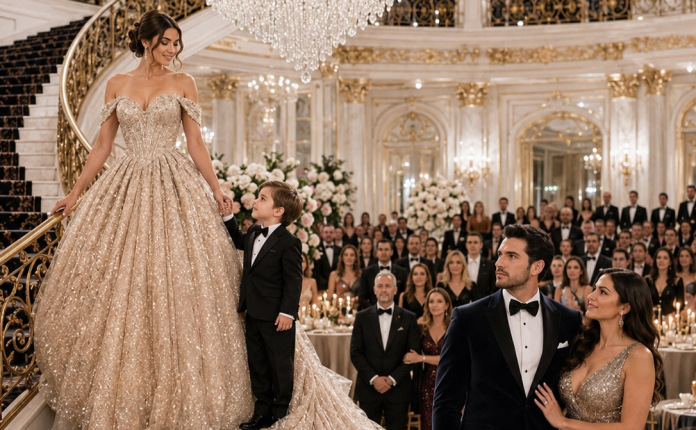
For years, people repeated the story of the billionaire’s daughter who chose the maid while an entire ballroom laughed. They treated it like a fairy tale about a servant becoming a bride.
They misunderstood.
Lily had never chosen her father’s wife.
She had chosen the person who believed her.
And because one frightened child had pointed toward the woman everyone else refused to see, the truth finally had somewhere to stand.