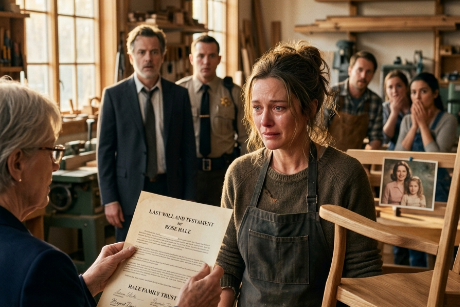
The first sign that my brother had stolen our inheritance was not a phone call from a lawyer or a suspicious bank statement. It was a red demolition notice nailed to the front door of the house where our mother had died and our father had raised us. Beneath it stood a developer’s sign announcing forty-two luxury homes. When I called Daniel, he did not deny selling the property. He laughed softly and said, “You should have answered your emails.” Then the buyer’s attorney sent me the deed. My signature appeared beside Daniel’s, perfectly copied, authorizing the sale of land worth nearly nine hundred thousand dollars. I had never signed it. By sunset, my brother had emptied the estate account, the locks had been changed, and everyone in town believed I was a bitter sister trying to undo a deal I had approved.
Part 1: The Red Notice
The demolition notice slapped against the old farmhouse door in the October wind, one loose corner rising and falling like a hand trying to warn me away. I stood on the cracked stone step with my overnight bag still hanging from my shoulder, staring at the words STRUCTURE SCHEDULED FOR REMOVAL until they stopped looking like language.
Behind me, Willowmere spread across sixty-two acres of pale grass, oak trees, and low stone walls built by my grandfather. The fields had turned gold after the first frost. From the hill, I could still see the roof of the abandoned dairy barn and the narrow creek where Daniel and I had spent our childhood catching minnows in jars.
A white sign had been planted beside the mailbox.
BLACKRIDGE COMMUNITIES
COMING SOON: WILLOWMERE ESTATES
An artist’s rendering showed identical gray houses with three-car garages standing where our orchard had grown for eighty years.
I walked back to the sign and touched its smooth plastic surface, as if the image might disappear under my fingers.
My father had been dead for nine months.
The property was still tied up in probate.
Or at least that was what I had believed.
I called Daniel.
He answered on the fifth ring, music and conversation murmuring behind him.
“Elena?”
“Why is there a demolition notice on Dad’s house?”
There was a pause, but not the shocked pause of someone hearing terrible news. It was the measured silence of a man deciding how much truth he needed to give.
“Where are you?” he asked.
“At Willowmere.”
“You shouldn’t be there.”
My grip tightened around the phone. “It belongs to us.”
“No,” he said. “It belonged to the estate.”
“What does that mean?”
“It means the estate sold it.”
I looked toward the kitchen window. The lace curtain our mother had made was still hanging crookedly inside.
“You sold the property?”
“I completed a sale that needed to happen.”
“Without telling me?”
“I told you repeatedly.”
“You sent two emails saying you wanted to discuss maintenance costs.”
“I sent documents.”
“You sent proposals. I never agreed.”
His voice hardened. “You also never paid your half of the property taxes.”
“I paid every invoice you gave me.”
“You paid late.”
“Three days late once, because you changed banks without telling me.”
“Elena, I’m not doing this with you.”
The casual dismissal in his voice struck harder than shouting would have. Daniel had always possessed that skill. He could make his betrayal sound like my inconvenience.
I stepped down from the porch and walked toward the side door. A new silver lock had been installed.
“Who changed the locks?”
“The buyer.”
“Who is the buyer?”
“Blackridge.”
“How much?”
Another pause.
“How much did you sell our family property for?”
“Six hundred and forty thousand.”
The world seemed to tilt.
The property had been appraised at eight hundred and ninety-two thousand dollars during probate. A second appraiser had rounded it to nine hundred thousand because of the road frontage and water rights.
“You sold nine hundred thousand dollars’ worth of land for six-forty?”
“It needed work.”
“It has sixty-two acres.”
“It also has mold, a collapsing barn, unpaid insurance, and a septic system from the Stone Age.”
“Where is the money?”
“In the estate account.”
“Then why did the bank reject the property-tax payment yesterday?”
He went silent.
I heard a woman laughing near him. Glasses clinked. He was not in an office. He was in a restaurant or bar while I stood outside the house he had sold.
“Daniel,” I said. “Where is the money?”
“I have to go.”
“No.”
“Elena—”
“You will tell me exactly what you did.”
His voice dropped. “I did what Dad should have done years ago. I turned dead land into cash.”
“This was our inheritance.”
“This was my responsibility.”
“You were temporary executor because I was in Toronto when Dad died. That did not make you the owner.”
“You signed the consent.”
The wind moved through the grass with a dry hiss.
“What consent?”
“The sale authorization.”
“I signed nothing.”
Daniel exhaled. “You always do this. You agree to something, then when the consequences arrive, you rewrite history.”
“I did not sign a sale authorization.”
“Talk to the closing attorney.”
The line went dead.
I called him back twice. He rejected both calls.
My hands had begun to shake. I set my bag on the ground and searched through old emails on my phone. Daniel had sent messages about repairs, taxes, and a possible sale. I had replied that we could consider listing the property after probate, provided we obtained independent valuations and agreed on the terms.
I had never approved Blackridge.
I had never approved six hundred and forty thousand dollars.
Most importantly, I had never approved demolition.
A truck appeared at the end of the drive, raising dust as it approached. It stopped beside the farmhouse, and a broad-shouldered man wearing a Blackridge jacket climbed out.
“Can I help you?” he asked.
“My name is Elena Marlowe. This is my family’s property.”
His expression changed from irritation to caution. “Former property.”
“The sale was not authorized.”
“I don’t know anything about that.”
“Then tell whoever does know that no one touches this house.”
“We have permits.”
“You also have a forged consent.”
He studied me for a moment. “Ms. Marlowe, I’m just the site manager.”
“Then manage the site. No demolition.”
“We begin environmental clearing Monday.”
“You begin nothing.”
He glanced at the house and then at me. “You need to speak with Blackridge’s attorney.”
“Give me the name.”
He pulled a business card from his pocket. “Graham Pike.”
The name felt familiar, though I could not place it.
I drove directly into town, stopping first at the county bank where the estate account had been opened. The manager, Louise Barrett, had known my family for decades. She met me in a glass office and closed the door.
“I’m sorry about your father,” she said, though she had attended his funeral.
“I need the balance of the estate account.”
Her polite expression tightened. “You’re not an authorized signer.”
“I am a beneficiary.”
“Daniel is the executor.”
“Co-executor. The will named both of us.”
“The court issued temporary letters to Daniel.”
“Because I was overseas for eight weeks.”
Louise folded her hands. “I can’t release account information without authorization.”
“Can you at least tell me whether the Blackridge funds were deposited?”
“I can’t.”
“Louise, my brother sold the farm with a forged signature.”
The color left her face.
She looked toward the office door before saying, “Then you need a lawyer immediately.”
“Did he move the money?”
“I didn’t say that.”
“You didn’t have to.”
She stood, ending the conversation. As she opened the door, she lowered her voice.
“Ask your attorney about a wire transfer made three days after closing.”
“To whom?”
“I’ve already said too much.”
That afternoon, I met attorney Miriam Cole in a narrow office above a pharmacy. Miriam had handled property disputes for thirty years and wore her silver hair cropped close to her head. She listened without interrupting as I explained the emails, the altered locks, the demolition notice, and Daniel’s claim that I had signed.
When I finished, she asked, “How was your relationship with your brother before your father died?”
“Complicated.”
“That is not a legal description.”
“He was Dad’s favorite until he wasn’t.”
“When did that change?”
“About two years ago. Daniel borrowed money for a construction business. It failed. Dad refused to invest again.”
“How much did your father lose?”
“Daniel said thirty thousand. Dad told me it was closer to one hundred and twenty.”
“Did Daniel have access to your father’s accounts?”
“He helped with bills after Dad’s stroke.”
Miriam’s pen stopped moving.
“How serious was the stroke?”
“He recovered physically, but his speech was slower. His memory was fine.”
“Did your brother ever obtain power of attorney?”
“Yes, temporarily. Medical and financial.”
“Was it revoked?”
“Dad told me he revoked it six months before he died.”
“Do you have the revocation?”
“No.”
Miriam leaned back. “Then the first step is obtaining the closing file. The second is requesting an emergency restraining order against demolition. The third is auditing the estate.”
“And the sale?”
“If your signature was forged, the sale may be voidable. But if Blackridge qualifies as a good-faith purchaser, the fight becomes more difficult.”
“They bought it for two hundred and fifty thousand under appraisal. How good could their faith have been?”
“That is a useful question.”
She called Graham Pike while I sat across from her. His assistant transferred her immediately.
“Mr. Pike,” Miriam said, “I represent Elena Marlowe regarding Willowmere.”
I could hear his deep voice faintly through the phone.
“No,” Miriam replied. “My client disputes the validity of the sale consent and requests that all demolition activity cease.”
Another pause.
“She denies signing it.”
His response was longer this time.
Miriam’s eyes lifted to mine.
“Send it,” she said. “Entire closing file. Today.”
She hung up.
“He says the deed was signed by both beneficiaries in front of a notary.”
“I was in Montreal on the date Daniel claimed the closing happened.”
“Do you have proof?”
“Flight records. Hotel charges. I presented at a conference.”
“Good.”
Her computer chimed. An email had arrived with an encrypted attachment. Graham Pike had sent the closing file faster than either of us expected.
Miriam opened the documents one by one: purchase agreement, title report, executor’s deed, beneficiary consent, notarial acknowledgment.
Then she stopped.
On the final page were two signatures.
Daniel’s was broad and slanted.
Mine was neat, narrow, and nearly perfect.
I stared at it, feeling something colder than anger spread through me.
“That looks like my signature.”
“Is it?”
“No.”
“Could anyone have copied it from another document?”
“My brother had access to everything in Dad’s office.”
Miriam enlarged the page. Beneath the signature was a notary stamp belonging to Cynthia Vale.
The name pulled me backward twenty years. Cynthia had been Daniel’s high school girlfriend. She had also worked as the bookkeeper for his failed construction company.
Miriam scrolled lower.
My forged signature was not the only problem.
The consent included a sworn statement that I had received three hundred and twenty thousand dollars as my half of the sale proceeds.
“I never received a cent,” I whispered.
Miriam’s expression sharpened. “Then someone did more than forge your approval.”
She opened the payment schedule attached to the closing statement. Two transfers had been made after the sale. One went to the estate account.
The other—one hundred and eighty thousand dollars—went to a company called Marlowe Heritage Consulting.
I had never heard of it.
But the listed manager was Daniel Marlowe.
At the bottom of the file, beneath a declaration that the transaction had been completed fairly and with the full knowledge of both beneficiaries, was a scanned copy of my driver’s license.
Not an old one from Dad’s records.
My current license.
The one that had disappeared from my purse during my father’s funeral.
Part 2: The Story Daniel Told
Miriam filed for an emergency injunction before the courthouse closed. By six that evening, the judge had issued a temporary order preventing Blackridge from altering the farmhouse, removing trees, or beginning construction until a hearing could be held.
It was a small victory, but it did not feel like one.
Someone had stolen my license while I stood beside my father’s coffin.
Someone had copied my signature, impersonated me before a notary, and declared under oath that I had received money I had never seen.
The only person who had access to my purse for most of the funeral reception was family.
I spent the night at the Cedar House Inn because the new owners refused to give me a key to Willowmere. The inn was less than a mile from the courthouse, but from my second-floor window I could see the church steeple where we had buried Dad.
Sleep came in fragments.
At seven in the morning, Daniel texted.
You got a court order? Are you insane? Call me.
I waited until Miriam arrived before responding.
Meet us at her office at ten. Bring the estate records.
He appeared at ten twenty wearing an expensive navy coat I had never seen before. His hair was neatly trimmed. A gold watch showed beneath his cuff.
Daniel had always been handsome in a way that encouraged people to forgive him before he apologized. At forty-two, he still had the confident smile that had persuaded teachers to overlook unfinished homework, banks to extend loans, and our father to believe the next business would succeed.
He did not smile at me.
“You embarrassed me in front of the entire development company,” he said as he entered Miriam’s office.
I remained seated. “Sit down.”
“You froze the project.”
“I stopped you from bulldozing our mother’s kitchen.”
“That house is rotting.”
“It was not yours to sell.”
Daniel tossed a leather folder onto Miriam’s desk. “You signed.”
“I did not.”
“Then explain how your license and signature are in the file.”
“You explain it. My license disappeared at Dad’s funeral.”
His jaw tightened for half a second.
Miriam noticed.
“Mr. Marlowe,” she said, “where were the sale documents executed?”
“Cynthia’s office.”
“Was your sister physically present?”
“Yes.”
“What was she wearing?”
Daniel turned toward her. “Excuse me?”
“You signed a document beside her less than a year ago. What was she wearing?”
“I don’t remember.”
“What did you discuss before signing?”
“The sale.”
“Did she object to the price?”
“She had already agreed.”
“By email?”
“By phone.”
Miriam opened a notebook. “When?”
“I don’t know. August.”
“Ms. Marlowe was in Canada during most of August.”
“She came back.”
“I did not,” I said.
Daniel looked at me with such deliberate disappointment that for a moment I felt twelve years old again, accused of breaking something he had hidden in my room.
“You’re actually going to lie under oath?” he asked.
“You forged my name.”
His chair scraped against the floor as he stood. “I saved the estate.”
“By selling it below value?”
“Appraisals are fantasies. Blackridge paid what the property was worth in its condition.”
“And the one hundred and eighty thousand dollars sent to Marlowe Heritage Consulting?”
His face changed.
Not much, but enough.
Miriam slid the closing statement across the desk.
Daniel looked down, then back at her. “Consulting fee.”
“For what?”
“I introduced the property to the buyer, coordinated inspections, settled the tax issues, handled zoning questions, and kept the deal alive.”
“As executor, you charged the estate a one-hundred-eighty-thousand-dollar fee through a company you own?”
“It was paid by Blackridge.”
“It appears in the settlement deductions.”
“The contract allowed it.”
“Did Elena approve the fee?”
“She approved the sale.”
“I did not,” I said again.
Daniel turned on me. “What did you expect me to do? You left.”
“I returned after eight weeks.”
“You left me alone with Dad’s death, the funeral expenses, the creditors, the property taxes, the insurance, and every person who wanted something.”
“I called you every day.”
“You called to ask for updates. You never came home to carry anything.”
The words found their mark because they contained a piece of truth.
When Dad died, I had been preparing to lead the restoration of a historic courthouse in Montreal. The project was the largest of my career. I returned for the funeral, stayed twelve days, and then left again after Daniel promised he could manage the initial probate filings.
I had believed him because I wanted to.
I had believed him because grief had made Willowmere unbearable.
“I should have stayed,” I said. “But leaving did not give you permission to steal.”
Daniel’s anger faltered, then returned stronger. “You think this is about permission? Dad spent his entire life waiting for you to come home. Every Christmas, every birthday, he set a place for you even when you told him you had work. You showed up for four days, criticized the roof, then disappeared again.”
“I paid for that roof.”
“With money. You solved everything with money.”
“So you solved the estate by taking it.”
He leaned across the desk. “Dad wanted the farm sold.”
“No, he didn’t.”
“He told me.”
“When?”
“Before he died.”
“Dad told me he wanted the orchard preserved.”
“He told you what kept you emotionally attached. He told me what had to be done.”
Miriam interrupted. “Do you have written instructions?”
Daniel opened the folder he had brought and removed a printed transcript.
“I have a recording.”
He placed his phone on the desk and pressed play.
Our father’s voice filled the small room.
It was weaker than I remembered, rough after the stroke, but unmistakably his.
“Daniel, the property is too much for both of you. Elena will fight because she remembers it the way it was. She doesn’t understand what it costs now.”
Daniel’s recorded voice asked, “Do you want me to sell it?”
Dad answered, “I want you to take care of everything. Do what needs to be done.”
The recording ended.
Daniel looked at me. “He authorized me.”
My throat closed. Hearing Dad’s voice was like seeing him step through a locked door.
Miriam remained unmoved. “That does not authorize forgery.”
“I didn’t forge anything.”
“Then Cynthia Vale did.”
“She notarized what Elena signed.”
“I was in Canada.”
“You keep saying that like no one can travel.”
Miriam asked for the full recording.
“That is the full recording,” Daniel replied.
“Metadata?”
“I don’t know what that means.”
“The original audio file.”
“I changed phones.”
“Convenient.”
Daniel gathered his documents. “The court will hear Dad’s wishes. Blackridge will sue if this deal collapses, and when the estate loses everything, Elena can explain why preserving a rotten house mattered more than our father’s final instruction.”
At the door, he looked back at me.
“You always thought Dad trusted you more because you were careful,” he said. “He trusted me because I was the one who stayed.”
After he left, I sat without speaking.
Miriam switched off her desk lamp, though the room was still bright.
“Do you believe the recording?” she asked.
“It is his voice.”
“That was not my question.”
I closed my eyes, replaying each sentence.
Dad had complained about the cost of maintaining Willowmere. He had worried about the septic field and the barn roof. He might have told Daniel to sell.
But he would never have told him to copy my name.
“He may have wanted a sale,” I said. “He did not want this sale.”
“Then we prove the distinction.”
We spent the next three days reconstructing the months before Dad’s death. I obtained airline records, hotel receipts, passport data, and photographs from the Montreal conference. On the exact date my signature had supposedly been notarized in Cynthia Vale’s office, I had been standing before two hundred architects presenting a restoration plan.
Miriam subpoenaed Cynthia’s notary journal.
Cynthia claimed it had been destroyed when her basement flooded.
The county clerk confirmed no flood damage had been reported at her address.
The bank disclosed that the estate account had received four hundred and twenty-eight thousand dollars after deductions. Within seventy-two hours, Daniel transferred two hundred thousand into an investment account under his control, paid off a ninety-six-thousand-dollar business loan, and withdrew forty thousand in cashier’s checks.
Only ninety-two thousand remained.
Then we traced Marlowe Heritage Consulting.
Daniel had formed the company sixteen days before Dad’s death.
The registered address belonged to Cynthia.
“What was he planning before Dad died?” I asked.
Miriam did not answer.
The next morning, we met Blackridge’s attorney, Graham Pike, in the courthouse conference room. He was tall, silver-haired, and so calm that even his anger sounded rehearsed.
“My client relied on facially valid documents,” he said. “Your family dispute does not invalidate our purchase.”
“You paid well below appraisal,” Miriam replied.
“We accepted substantial risk.”
“You also paid the executor a secret fee.”
“It was disclosed in the closing statement.”
“Not to my client.”
“Your client signed a waiver.”
“She was in another country.”
Pike slid a photograph across the table.
It showed a woman seated beside Daniel at Cynthia’s office, signing papers.
The angle concealed most of her face. Her hair was dark like mine. She wore glasses similar to mine and a cream coat I recognized instantly.
It belonged to Daniel’s wife, Rachel.
I stared at the image.
“That isn’t me.”
Pike studied it. “The notary identified the woman as you.”
“That is Rachel.”
Miriam picked up the photograph. “Where did this come from?”
“Closing security footage.”
“Then provide the complete recording.”
“The system retained only still images.”
“Of course it did.”
Pike gathered his file. “Blackridge will proceed aggressively. Unless Ms. Marlowe withdraws her challenge, we will seek damages for delay, financing costs, and lost sales.”
“Your client may have purchased stolen property,” Miriam said.
“My client purchased land from the court-appointed executor.”
“Using forged beneficiary consent.”
“That remains an accusation.”
When Pike left, I remained frozen in my chair.
Rachel had attended my father’s funeral. She had held my hand while I cried. She had told me Daniel was overwhelmed and begged me not to judge his temper.
She had worn my coat home by mistake that night.
Or so she claimed.
I drove to Daniel and Rachel’s house before Miriam could stop me. Rachel’s car was in the driveway. I knocked until she opened the door.
Her eyes were swollen.
“Elena.”
“Did you pretend to be me?”
She glanced past me toward the street. “You need to leave.”
“You wore my coat, used my license, and sat beside my brother while he sold Willowmere.”
“I didn’t know what the papers were.”
“You signed my name.”
“Daniel said you had already agreed. He said the documents had to be signed again because the originals were damaged.”
“And you believed him?”
“He told me you knew.”
“You impersonated me before a notary.”
“I was trying to keep our family from falling apart.”
“You helped him steal nine hundred thousand dollars.”
Her face crumpled. “You think I don’t know that now?”
I pushed the door wider. “Tell me everything.”
She looked toward the staircase.
A floorboard creaked above us.
Daniel was home.
Rachel stepped outside and pulled the door nearly shut behind her.
“He has been listening,” she whispered.
“To what?”
“To your calls. Your lawyer. The bank. He put software on the family phone plan.”
“Why are you telling me this?”
“Because he lied to me too.”
She pressed a small flash drive into my palm.
“What is this?”
“The recording he played for you. Not the version he brought to your lawyer. The original file from his old phone.”
I closed my fingers around it.
Rachel’s voice shook as she added, “Your father said something after Daniel stopped the clip.”
Behind her, the front door opened.
Daniel stood in the gap, his face pale with rage.
Rachel backed away from me.
I ran to my car, locked the doors, and drove directly to Miriam’s office. We loaded the flash drive onto her computer and opened the only audio file.
Dad’s voice began exactly as before.
“The property is too much for both of you. Elena will fight because she remembers it the way it was. She doesn’t understand what it costs now.”
Daniel asked, “Do you want me to sell it?”
“I want you to take care of everything. Do what needs to be done.”
In the version Daniel had played, the recording ended there.
This one continued.
I heard a chair move.
Then Dad said, more clearly, “But nothing happens without Elena’s written agreement. Do you understand me?”
Daniel’s recorded voice became hard. “She will never agree.”
“Then it is not sold.”
“You’re giving her control again.”
“I am protecting both of you.”
“You always protect her.”
Dad exhaled slowly.
Then he said the words that made Miriam stop the recording and look at me.
“Because I know what you did with the first document, Daniel. And Elena must never know until I can prove it.”
Part 3: The Missing Drawer
The sentence followed me through the night.
I know what you did with the first document.
I listened to it so many times that the words began to lose meaning. Dad’s voice carried fatigue, disappointment, and something I had rarely heard in him when speaking to Daniel.
Fear.
The next morning, Miriam sent the audio to a forensic examiner who confirmed that Daniel’s courtroom version had been cut at precisely the moment Dad imposed the condition requiring my written consent. The original file had been created four months before Dad’s death and transferred intact to the flash drive.
“What first document was he talking about?” Miriam asked.
“I don’t know.”
“Your father kept records?”
“Obsessively. Receipts, insurance policies, property surveys. He had a filing cabinet in the study.”
“Did Daniel clear the house?”
“He said he stored everything.”
“Where?”
I called him. He did not answer.
Rachel did.
Her voice was barely audible. “He knows I gave you the file.”
“Are you safe?”
“Yes. He shouted. He broke a lamp. He left an hour ago.”
“Where did he put Dad’s records?”
“Some are in the garage. Some went to storage.”
“Which storage facility?”
“I don’t know. He handled it.”
“Rachel, what did Dad mean by the first document?”
Silence.
“Please.”
“I heard them arguing once,” she said. “Your father kept asking for a blue folder. Daniel said it never existed.”
“What was in it?”
“I don’t know. But after your father died, Daniel spent three nights at the farmhouse. He came home covered in dust and said he had been cleaning.”
“Was he?”
“No. The house looked worse afterward.”
I drove to Willowmere with Miriam and a locksmith authorized under the temporary court order. Blackridge’s site manager objected, then allowed us inside after Miriam threatened contempt proceedings.
The farmhouse smelled of cold wood, dust, and the faint lavender soap Dad used until his final week.
Nothing had been demolished, but almost everything personal was gone. The framed family photographs had been removed from the hallway. The dining room table was missing. In the kitchen, pale rectangles marked the places where copper pans had hung.
I entered Dad’s study last.
The room had always felt protected from time. Even after computers arrived, Dad kept his rolltop desk, brass reading lamp, and wall of leather-bound farm journals. Now the shelves were empty.
The gray filing cabinet remained beside the window.
Its top drawer held utility bills and old tax receipts.
The second contained medical statements.
The third was locked.
The locksmith opened it in less than a minute.
Inside lay a few empty folders and a layer of dust interrupted by a clean rectangle.
“Something was removed,” Miriam said.
I knelt and ran my fingers over the metal base. On the underside of the drawer, secured with yellowed tape, I found a small silver key.
It opened nothing in the room.
We searched the study for four hours. Behind the desk, I found a handwritten list of dates on a piece of cardboard. Three corresponded to meetings with Dad’s estate attorney, Leonard Shaw. Another matched the date Daniel formed Marlowe Heritage Consulting.
At the bottom Dad had written:
Ask H. about 1998 covenant. Original not in house.
“H?” Miriam asked.
“Maybe Helen. Dad’s sister.”
Aunt Helen lived in a nursing residence forty miles away. She had advanced arthritis but a mind sharper than most people half her age.
When I called, she said, “It took you long enough.”
“You know why I’m calling?”
“I know your father feared that boy would do exactly what he has done.”
“Daniel?”
“Who else?”
“What is the 1998 covenant?”
“Not on the telephone.”
We drove to see her that afternoon.
Aunt Helen sat beside a sunny window wrapped in a red cardigan, her silver cane resting against the chair. She did not hug me. She had never been sentimental in ordinary ways.
“You look exhausted,” she said.
“I am.”
“Good. Exhaustion sometimes removes vanity.”
Miriam raised an eyebrow, but I almost smiled.
Aunt Helen asked to see the court papers, the forged deed, and the photograph of Rachel signing in Cynthia’s office. She studied each carefully.
“Your brother has your father’s charm and your grandfather’s appetite,” she said. “A dangerous combination.”
“What appetite?”
“For owning what belonged to others.”
She directed me to close the door.
“In 1998, your grandfather learned he had pancreatic cancer. He had seen three neighboring farms broken apart by inheritance fights. One son sold timber. Another mortgaged land without telling his siblings. By the time the lawsuits ended, nothing remained.”
“So he created a covenant?”
“He created several protections. Your father and I signed them.”
“Where are they?”
“Leonard Shaw prepared the documents.”
“Dad’s estate lawyer?”
“He was a junior associate then.”
Miriam leaned forward. “What did the covenant do?”
Aunt Helen considered her answer.
“It prevented any single heir from selling, mortgaging, or transferring Willowmere without unanimous consent. It also required that any sale occur at independently appraised value unless a court approved otherwise.”
My heart pounded. “Was it recorded?”
“It was supposed to be.”
“Was it?”
“I don’t know.”
“If it was not recorded, Blackridge may argue they lacked notice,” Miriam said.
Aunt Helen gave her a thin smile. “Thomas anticipated that.”
“What did he do?” I asked.
“He placed the land into a family holding trust. Or he intended to. There was a disagreement about taxes. Your father later told me he had completed it after your mother became ill.”
“When?”
“Around 2009.”
Miriam and I exchanged glances. The title report showed Dad owned Willowmere individually.
“Daniel sold it through the estate,” I said.
“Then either your father never completed the transfer, or someone concealed it.”
“Why did Dad write ‘Original not in house’?”
“Because he stopped trusting the house.”
Aunt Helen directed me to the bottom drawer of her dresser. Inside, beneath neatly folded scarves, was an old photograph of Dad, Aunt Helen, and my mother standing outside the county courthouse.
On the back, Dad had written:
Safe with Margaret. Box 314.
“Who is Margaret?” Miriam asked.
“Margaret Bell,” Aunt Helen said. “Your grandfather’s legal secretary. She handled every family document for forty years.”
“Is she alive?”
“She died last winter.”
“Where is Box 314?”
Aunt Helen tapped the photograph. “That is what Thomas expected you to discover.”
The small silver key from Dad’s filing drawer was stamped with the number 314.
We drove back to the county courthouse. The basement archives had been renovated twice since the photograph was taken. No one knew of any private boxes. A clerk searched old logs and found that the courthouse once maintained sealed evidence compartments for original wills, land contracts, and probate exhibits.
Box 314 had been assigned to the estate of my grandfather, Samuel Marlowe.
The inventory listed one item:
Family land agreement and related instruments, sealed by court order.
But when the clerk checked the archive, Box 314 was empty.
The chain-of-custody ledger showed that it had been signed out eleven months earlier.
Two months before my father died.
The signature on the release line belonged to Daniel.
“He could not lawfully access a sealed probate exhibit,” Miriam said.
The clerk looked uncomfortable. “He presented letters of authorization.”
“From whom?”
The clerk turned the ledger toward us.
The authorization had supposedly been signed by my father.
The date fell three weeks after Dad had been hospitalized following a second stroke. At that time, he could barely hold a spoon.
The clerk retrieved a scanned copy of the release authorization.
Dad’s signature looked uneven but plausible.
A witness had countersigned it.
Cynthia Vale.
When we returned to Miriam’s office, she filed another emergency motion seeking an order requiring Daniel to surrender all estate documents.
At five thirty, an email arrived from an unknown address.
There was no message, only an attachment titled Box314Inventory.pdf.
The file contained photographs of several documents spread across Dad’s desk. Most pages were too blurred to read, but one showed a cream-colored instrument with a raised notarial seal.
Across the top, in bold letters, were the words:
IRREVOCABLE MARLOWE FAMILY PROPERTY TRUST
At the bottom of the image, a handwritten note from Dad was visible:
If Daniel removes this, contact Judge Warren. The second original was deposited with the court in 2016 under another case number.
Miriam immediately called the sender. The number was blocked.
A second email arrived moments later.
Stop searching the Marlowe estate file. Daniel knows about Box 314. He does not know about the guardianship case.
“Whose guardianship?” I asked.
Miriam typed the courthouse database search.
Only one sealed guardianship proceeding appeared under our family name.
It had been opened six years earlier.
The proposed protected person was my father.
The petitioner seeking control over his property and finances was Daniel.
The petition had been dismissed before I ever learned it existed.
And the judge who dismissed it had ordered all supporting documents sealed.