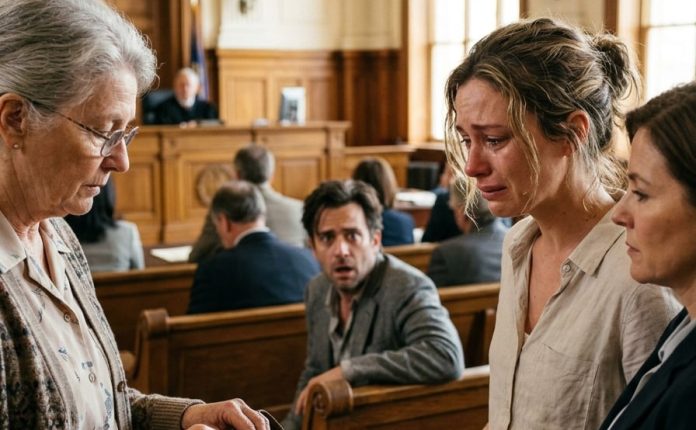
Part 4: The Price of Public Loyalty
Miriam filed three emergency motions the following morning: one to suspend Grant’s appointment as executor, one to prevent the sale or transfer of Maple Ridge, and one demanding an accounting of all financial actions he had taken under Dad’s power of attorney. By noon, a judge issued a temporary restraining order blocking the Blackridge transaction.
Grant responded by calling a company-wide meeting.
He chose the Hale Millworks showroom, where polished tables and carved mantels stood beneath warm pendant lights. Employees gathered between the displays. Several had worked for our parents longer than Grant had been alive. Luis stood near the production doors with his arms folded. June remained beside me, gripping a folder against her chest.
Grant entered with Walter Reed, two representatives from Blackridge, and a local public-relations consultant.
That was when I realized he was not merely defending himself. He was staging a performance.
“Thank you for coming,” he began. “As many of you know, our family is grieving. Unfortunately, grief can sometimes cause confusion, suspicion, and behavior that harms innocent people.”
Every face turned toward me.
Grant continued. “My sister Clara has filed legal actions based on documents she does not understand. Those actions have frozen a transaction designed to eliminate company debt and preserve your jobs.”
A murmur passed through the room.
Luis stepped forward. “The transaction would sell the shop.”
“The company would relocate to a modern facility.”
“Where?” June asked.
Grant smiled patiently. “Those negotiations are confidential.”
“They don’t exist,” I said.
The public-relations consultant moved closer to him, whispering, but Grant waved her away.
“This is a family matter,” he said.
“No. You used company money. You pledged employee livelihoods and our father’s home.”
“My father authorized every legitimate transfer.”
“Then release the records.”
“They are being reviewed.”
“By whom?”
“My attorneys.”
Someone near the back called, “Are we losing our pensions?”
Grant’s confidence flickered.
“No one is losing anything,” he said.
June opened her folder. “The retirement contribution has not been funded for two quarters.”
The room erupted.
Grant’s voice hardened. “June, you are disclosing confidential financial information.”
“I am telling employees where their money went.”
“You are terminated.”
Silence fell.
June looked wounded for one second. Then she placed the folder on a display table.
“You cannot fire me before I give you this.”
She slid a copy of the loan ledger toward him.
Grant did not touch it.
I faced the employees. “Three hundred and twenty-six thousand dollars left Hale Millworks through businesses connected to Grant. Another four hundred and fifty thousand was borrowed against the company and Maple Ridge. We are asking the court to determine whether Dad authorized those transactions.”
Grant laughed. “Listen to how she says we. Clara has not worked here for fifteen years.”
“I left because Dad would never allow me to lead while you were in the room.”
“You left because you thought this company was beneath you.”
“I became a restoration architect because of what Mom and Dad taught me here.”
“And when your firm passed you over for partnership, you came home and called it sacrifice.”
The cruelty of the remark stunned me because it contained a piece of truth. I had not told my family that I had been passed over. I had planned to leave the firm even before Dad’s stroke. Grant must have learned it from someone in Chicago.
He saw the pain in my face and pressed harder.
“She wants you to believe she abandoned a glorious career for our father. She returned because she had nowhere else to go.”
Luis said, “That doesn’t explain the money.”
“No,” Grant snapped, “but it explains why she is trying to steal an estate Dad deliberately left to me.”
The Blackridge representatives shifted uneasily.
Beth entered through the showroom doors.
She wore her school clothes, a gray skirt and blue cardigan, and looked terrified. Yet she walked directly to my side.
“Dad did not deliberately exclude us,” she said.
Grant stared at her. “You don’t know that.”
“He asked me to witness a new will.”
Employees began whispering.
Grant lowered his voice. “Beth, think carefully.”
“I have spent my whole life thinking carefully so you would never be angry with me.”
“This is not the place.”
“You chose the place.”
She turned toward the employees. “Grant gave my family thirty thousand dollars and told me it was from him. The money came from Hale Millworks. In return, he expected me to stay quiet when Dad tried to change his estate plan.”
“I never said that.”
“You didn’t need to.”
Grant stepped toward her. “Your husband signed a repayment agreement.”
“With Northline Strategy,” Beth replied. “A company you own.”
The public-relations consultant left without speaking.
Grant looked around the showroom, measuring the room. Then he changed tactics.
“Our family has private problems,” he said, softer now. “I have made mistakes. Clara has made mistakes. Beth has made mistakes. Dad understood that leadership means carrying burdens other people do not see.”
I thought of every birthday dinner where Dad praised Grant’s leadership while Mom quietly corrected payroll after midnight.
“You don’t carry burdens,” I said. “You transfer them.”
Grant’s face darkened.
“You want honesty?” he said. “Fine. Dad did not trust you. He told me you were too emotional, too proud, and incapable of separating personal resentment from business. He said if he left you control, you would dismantle everything he built just to prove you could.”
The words struck the oldest wound in me.
For a moment, I was sixteen again, standing in Dad’s workshop with a cabinet design I had spent all summer drawing. Dad studied it, nodded, and said, “Pretty work. Grant will handle clients. You take things too personally.”
I forced myself to remain standing.
“Maybe he did say that,” I replied. “Dad could be unfair.”
Grant smiled as if I had surrendered.
“But unfair is not the same as incompetent,” I continued. “And being loved by him did not make you honest.”
The showroom doors opened again.
Vanessa stood there.
Her hair was uncombed, and she wore no makeup. Noah waited in the car outside, visible through the glass.
Grant looked irritated. “What are you doing here?”
She walked past the employees until she stood between us.
“You did not answer your phone,” she said.
“I’m busy.”
“I know.”
Grant reached for her arm. She stepped away.
“What happened to the cedar box?” I asked.
Vanessa looked at me, then at Grant.
His voice became warningly quiet. “Do not involve yourself in this.”
She laughed, but the sound broke in the middle.
“You involved me when you made me lie to your father.”
The room became so still that I heard machinery humming beyond the production wall.
Grant’s face drained of color.
Vanessa turned to me.
“The morning Thomas died, Grant went to the bank. He brought the cedar box home. Inside was a blue envelope, a leather folder, company documents, and a letter addressed to Noah.”
“Vanessa,” Grant said.
“He told me Thomas had become paranoid. He said Clara had manipulated him into changing the will.”
“Stop talking.”
“He ordered me to burn the envelope.”
My breath caught.
“Did you?”
Tears filled her eyes.
“Yes.”
The employees reacted with a collective murmur. Grant moved toward her, but Luis stepped between them.
Vanessa pressed one trembling hand to her mouth.
“I burned what was inside the blue envelope in our fireplace,” she said. “Grant watched until the pages turned to ash.”
I felt as though Dad had died again.
Miriam had the original will, but whatever supporting documents Dad had protected were gone. The letter to Noah was gone.
Grant straightened his coat.
“My wife is under enormous stress.”
Vanessa lowered her hand. “That is what you always say when a woman tells the truth.”
She reached into her handbag and removed a small black flash drive.
“I made a copy before I burned it.”
Grant stared at the drive.
For the first time in my life, my brother looked truly afraid.
Vanessa placed it in my palm.
“And there is something else on it,” she whispered. “A recording Grant never knew I made.”
Part 5: What Grant Said in the Car
We listened to the recording in Miriam’s office with the door locked.
Vanessa sat beside me on a narrow leather sofa, holding a paper cup of water between both hands. Beth occupied the chair across from us. Luis and June had provided written statements but were not present. Miriam sat behind her desk, while a digital forensic specialist copied the flash drive and verified its metadata.
The recording began with the sound of a car engine.
Vanessa’s voice was faint. “Why are you doing this now?”
Grant answered from the driver’s seat.
“Because if Dad dies before the transfer is completed, Clara will interfere.”
“You said the will leaves everything to you.”
“The March will does.”
“What other will is there?”
A turn signal clicked several times.
“Dad met with Miriam Bell. He thinks I don’t know.”
“How did you find out?”
“Beth told me he had asked her to witness something. Then I checked his calendar.”
“You checked his private calendar?”
“I manage his affairs.”
“You manage his money.”
“I am protecting the company.”
There was a long pause.
Vanessa said, “Did he sign the bank loan?”
Grant’s answer came quickly. “He authorized it.”
“That is not what I asked.”
“You sound like Clara.”
“Did he physically sign it?”
Another pause.
“He understood the company needed capital.”
“He was sedated in the hospital.”
“I had authority.”
“Your power of attorney did not allow you to transfer money to yourself.”
“GTH Development is not myself.”
“It is registered to your post-office box.”
The engine grew louder as the car accelerated.
Then Grant spoke in the tone I knew best—quiet, contemptuous, convinced that volume was unnecessary because resistance was temporary.
“You enjoy the house we live in. You enjoy private school for Noah. You enjoy not wondering whether your card will be declined at the grocery store. Do not become morally delicate after spending the money.”
Vanessa began to cry.
Grant continued.
“Dad was going to destroy everything because Clara made him feel guilty. She played nurse for three years and turned every medication into an audition for sainthood. He started talking about employee ownership, trusts, splitting the company. He wanted to hand control to people who never built anything.”
“You mean your sisters?”
“I mean everyone.”
“What did you say to him?”
“I reminded him that Noah is my son.”
My fingers tightened around the edge of the sofa.
Vanessa whispered, “You stopped taking Noah to visit.”
“I needed Dad to understand consequences.”
“That was cruel.”
“It worked. He signed the March will because he knew I would protect the family.”
“The March will was signed before you stopped the visits.”
“He signed the loan amendments afterward.”
“So you withheld Noah until he signed financial documents?”
“I withheld nothing. I set boundaries.”
The same phrase he had used with Beth.
Vanessa asked, “What happens if the newer will exists?”
“I find it.”
“And if you find it?”
“I destroy it.”
The recording stopped.
No one spoke for several seconds.
Vanessa stared at the floor. “That was three weeks before Thomas died. Grant made me leave my phone in the kitchen when we discussed money, so I used an old voice recorder in my purse.”
“Why did you stay?” Beth asked.
The question sounded harsher than she intended.
Vanessa looked at her. “Because leaving Grant meant fighting a man with money, lawyers, and a family that believed him before he spoke. Because he told me he would prove I was unstable. Because Noah loved him. Because every time I decided to leave, Grant became the man I married for two weeks.”
Her answer silenced us.
The documents copied from the cedar box included Dad’s duplicate will, a physician’s capacity report, copies of the company transfers, the disputed loan, Mom’s original Hale Millworks stock certificates, and a handwritten memorandum describing Grant’s pressure.
The letter to Noah had not been copied. Vanessa said it was sealed, and she had not opened it before Grant burned it.
“He stood beside the fireplace,” she said. “He watched his own son’s name disappear.”
Miriam read Dad’s memorandum aloud.
“‘Grant has repeatedly threatened to prevent me from seeing Noah unless I sign documents he presents. He tells me Clara intends to institutionalize me and sell the company. These statements are false. I signed the March 2023 will after Grant said dividing the estate would force him to remove Noah from my life. I regret allowing fear to dictate my decision.’”
Beth covered her face.
I expected triumph. Instead, I felt grief.
Dad had known Grant was manipulating him, yet he had still allowed me to live beneath the punishment created by that manipulation. He had secretly corrected his will but never corrected the way he treated me.
Miriam seemed to understand.
“A later will can redistribute property,” she said gently. “It cannot repair every injury that preceded it.”
“What exactly does it distribute?” I asked.
“Tomorrow. All interested parties will receive copies before the hearing.”
“Why not now?”
“Because one document is still missing.”
She pointed to Mom’s stock certificates.
The certificates showed that Rose Hale had owned fifty-one percent of Hale Millworks when it was incorporated. Dad owned forty-nine percent.
After Mom’s death, everyone had assumed her shares passed to Dad. But no transfer appeared in the company ledger.
Beth looked confused. “Mom’s will left everything to Dad.”
“Not everything,” Miriam said. “Rose created a separate family trust two months before her death. Thomas served as trustee. The trust was supposed to terminate when Clara turned thirty-five.”
I was forty-one.
“What did the trust own?” I asked.
“Your mother’s company shares.”
My heartbeat accelerated.
“Why didn’t anyone tell me?”
“Thomas claimed the executed trust could not be located.”
“Did you prepare it?”
“I prepared a draft. Rose signed the final version with another attorney while I was caring for my husband after surgery. I received a photocopy, but a photocopy may not be sufficient if the original was intentionally destroyed.”
I looked at the stock certificates. “Did Dad destroy it?”
“I do not know.”
Vanessa raised her head.
“There was another document in the cedar box,” she said.
Miriam turned toward her.
“It was not in the blue envelope. It was folded inside the leather folder, behind the medical report. Grant opened it and said, ‘This is worse than the will.’”
“What did it look like?” I asked.
“Cream paper. A red seal on the last page. Rose’s signature appeared near the bottom.”
Miriam became very still.
“What happened to it?”
“Grant did not put it in the fireplace. He placed it inside his coat.”
The office door opened.
A receptionist appeared. “Mrs. Bell, there is a gentleman here asking to speak with Ms. Hale. He says it concerns Rose Hale’s trust.”
Behind her stood Calvin Ross, the notary whose seal appeared on the fraudulent property deed and bank loan.
His face was gray.
“Grant knows Vanessa left him,” Calvin said. “He is destroying records at the river warehouse.”