My brother had ignored our father’s calls for eleven months, refused to visit even after the doctors said Dad had only days left, and sent a single text when I told him our father had died: Let me know when the will is read. Yet before the burial was finished, Daniel arrived at the cemetery in a black luxury car, stepped between the mourners, and demanded the keys to our family home. He claimed Dad had promised him the house years ago and ordered me to remove my belongings by Monday. Then our father’s lawyer walked away from the open grave, handed Daniel a sealed envelope, and said, “Your father expected you to come for the property. He just hoped you might arrive in time to say goodbye.”
Part 1: The Son Who Was Always Too Busy
My brother Daniel had a talent for making absence sound like responsibility.
He did not abandon people. He was “protecting his energy.”
He did not ignore family calls. He was “managing an impossible schedule.”
He did not refuse to help. He was “setting healthy boundaries.”
Those explanations might have sounded reasonable if Daniel had ever applied them equally. He always found time for clients who could advance his career, friends who invited him to expensive restaurants, and strangers who praised him online. It was only our family that exhausted him.
My name is Laura Bennett. I was thirty-nine when our father, Thomas, was diagnosed with pancreatic cancer. Daniel was forty-three and lived two hours away in the city, where he ran a real estate investment company and introduced himself as a self-made entrepreneur.
He was not entirely self-made.
Dad had paid his university tuition, covered the deposit on his first apartment, and loaned him sixty thousand dollars to start the company. Daniel called that money “early support,” as if it had appeared naturally, like rain.
I received no equivalent gift, but I never asked for one.
At twenty-six, I married a man named Nathan. We had a daughter, Emily, and built a quiet life ten minutes from my parents’ house. When my mother died unexpectedly from a brain aneurysm, I began visiting Dad every day. At first, I told myself it was temporary. Dad did not know how to cook more than scrambled eggs, and the silence in the house frightened him.
Temporary became routine.
I helped him sort Mom’s clothes, transferred the utility accounts, organized his medication, and sat beside him during evenings when grief made conversation impossible. Daniel came to the funeral, stayed for three hours, and left before the family meal because he had an important property viewing.
Dad defended him.
“Your brother handles grief differently,” he said.
That sentence became the excuse for almost everything.
Three years later, Dad’s doctor found a mass.
The first surgery bought us time, but not enough. Chemotherapy weakened him. His skin turned yellow, his appetite disappeared, and the strong hands that had built half the furniture in our childhood home began trembling when he lifted a cup.
Daniel visited once during the first month.
He arrived wearing a tailored gray coat and carrying an expensive fruit basket that Dad could not eat. He spent most of the visit answering messages. Before leaving, he took a photograph with Dad and posted it online with a caption about “standing together through life’s hardest seasons.”
He did not return for six months.
Dad called him regularly at first.
“Maybe next weekend,” Daniel would say.
“I have a closing.”
“I’m traveling.”
“The kids have activities.”
Daniel’s children were nineteen and twenty-one. One lived at university. The other spent most weekends with friends.
Eventually, Dad stopped calling.
He pretended not to care.
Whenever I asked whether he wanted me to contact Daniel, he shook his head.
“A man should not have to beg his son to visit.”
Yet he kept his phone on the arm of his chair every evening.
He kept Daniel’s childhood photograph on the mantel.
He watched the driveway whenever a car slowed near the house.
During the final year, I became Dad’s primary caregiver. Nathan and Emily helped constantly. Nathan repaired the bathroom so Dad could use it safely. Emily, who was sixteen, learned how to prepare his favorite chicken soup even when he could only manage a few spoonfuls.
Daniel contributed nothing.
Not time.
Not money.
Not even reliable communication.
When Dad’s condition worsened, I sent Daniel updates after every major appointment.
The doctors are stopping chemotherapy.
Dad has been admitted again.
He’s asking for you.
Daniel often read the messages without replying.
One evening, after Dad returned from the hospital, he sat in the living room wrapped in a blue blanket. Rain tapped softly against the windows. His breathing had become shallow, and each sentence required effort.
“Did Daniel answer?” he asked.
I considered lying.
“No.”
Dad looked toward the mantel.
“He is angry with me.”
“About what?”
“The company loan.”
I stared at him.
“You gave him sixty thousand dollars.”
“He asked for more.”
“How much?”
“Another hundred thousand.”
“When?”
“Two years ago.”
I had known nothing about it.
Dad explained that Daniel wanted to buy a row of rental properties. The deal was supposedly guaranteed to double in value. Dad refused because most of his savings were intended for medical care and retirement.
Daniel called him selfish.
Then he claimed Dad had always favored me.
I laughed bitterly.
“Favored me with what? Hospital parking fees?”
Dad smiled, but the smile faded quickly.
“He believes the house should be his.”
The family house sat on eight acres at the edge of town. Dad had built most of it himself after marrying Mom. It was not a mansion, but the land had become valuable as developers expanded nearby neighborhoods.
Daniel had mentioned the property before. He often said it was “wasted” as a single residence.
“What did you tell him?” I asked.
“That the house was my home, not a business opportunity.”
“And after you’re gone?”
Dad looked down at his hands.
“I told him we would discuss it when he came to see me.”
“Did he?”
“No.”
I wanted to call Daniel and scream.
Instead, I knelt beside Dad’s chair.
“You do not have to use the house to make him visit.”
“I know.”
“Do you?”
Dad reached for my hand.
“I wanted to believe he would come for me before he came for what I owned.”
I did not know how to answer.
The next morning, I sent Daniel another message.
Dad’s condition is getting worse. He told me about the house. Whatever happened between you, please come while he can still talk to you.
Daniel replied three hours later.
I won’t participate in emotional blackmail.
I showed no one.
Not Dad.
Not Nathan.
Not even Emily.
I carried the sentence alone because I could not bear to let it become one of Dad’s final memories.
Three weeks later, the hospice nurse told us he probably had only a few days.
I called Daniel.
He answered on the fifth attempt.
“What?” he said.
“Dad is dying.”
There was silence.
Then a sigh.
“You’ve said that before.”
“No, Daniel. Hospice thinks it’s days. Maybe less.”
“I have meetings all week.”
“Cancel them.”
“You don’t understand my responsibilities.”
“I understand that our father is asking for you.”
“He always asks when he wants control.”
“He can barely stay awake.”
“I’m not going to be summoned so you can perform some dramatic reconciliation.”
“This may be your last chance.”
“Then it’s my decision.”
I looked through the bedroom doorway. Dad lay with his eyes closed, his face thin against the white pillow.
“Yes,” I said. “It is.”
I ended the call.
Daniel did not come.
Part 2: The Last Question Dad Asked
Dad remained alive for five more days.
Those days were both unbearably long and painfully short. Time inside the house moved according to his breathing. We measured hours by medicine doses, sips of water, and brief moments when he opened his eyes.
Nathan took leave from work. Emily slept on the sofa. Our neighbors brought food that no one remembered to eat.
Dad’s lawyer, Mr. Samuel Grant, visited twice.
Samuel had known our family for nearly thirty years. He was a quiet man in his late sixties who wore dark suits even in summer and carried documents in an old brown leather case. He spoke with Dad privately in the bedroom while I waited in the kitchen.
After the second meeting, Samuel asked me to sit with him on the back porch.
“Your father has made some changes to his estate plan,” he said.
I immediately shook my head.
“I don’t want to know the details.”
“He asked me to tell you one thing.”
“What?”
“You are not responsible for your brother’s reaction.”
A heaviness settled in my stomach.
“What did Dad do?”
“I cannot discuss the terms until after his death.”
“Then why tell me anything?”
“Because Thomas knows you. He believes your instinct will be to apologize for receiving something Daniel believes he deserves.”
I looked toward the bedroom window.
“I don’t want a fight.”
Samuel’s expression softened.
“Neither does your father. But avoiding a fight and surrendering to intimidation are not the same thing.”
That evening, Dad woke just after sunset.
His eyes moved around the room until they found me.
“Laura.”
“I’m here.”
“Phone.”
I handed him his phone.
He tried to unlock it, but his fingers would not cooperate. I helped him.
“Daniel,” he whispered.
“You want me to call?”
He nodded.
I dialed.
The call rang six times and went to voicemail.
Dad closed his eyes.
“Again.”
I called again.
This time Daniel rejected it after two rings.
Dad saw the screen.
He turned his face toward the wall.
I wanted to invent an excuse.
Maybe Daniel was driving.
Maybe he was in a meeting.
Maybe he would call back.
But Dad had spent his life receiving excuses on Daniel’s behalf. He did not need one more.
“I’m sorry,” I whispered.
Dad looked at me.
“For what?”
“For not being able to fix this.”
“You were never supposed to.”
He rested for several minutes before speaking again.
“Your mother used to say you tried to carry every broken thing.”
I smiled through tears.
“She said I collected injured birds and terrible boyfriends.”
Dad’s mouth moved slightly.
“She was right.”
“About the birds or the boyfriends?”
“Both.”
He squeezed my fingers with what little strength remained.
“Don’t carry Daniel.”
The words were quiet, but clear.
I leaned closer.
“I won’t.”
“Promise.”
“I promise.”
He watched my face as if deciding whether he believed me.
Then he asked the question I had feared.
“Do you think he knows I love him?”
My throat tightened.
“Yes.”
It was the truth.
Daniel might have doubted many things, but he had never lacked evidence of Dad’s love.
Dad nodded.
“That will have to be enough.”
He died the next morning at 4:18.
I was holding his hand.
Nathan stood beside the bed. Emily rested her head against my shoulder. The room was quiet except for the hospice equipment and the soft sound of rain beginning outside.
After the nurse confirmed his death, I sat there for nearly an hour.
I did not cry at first.
Grief felt too large for tears. It filled the walls, the furniture, the space beside his bed where his slippers waited.
Eventually, I took his phone from the bedside table and called Daniel.
He did not answer.
I sent a message.
Dad died this morning at 4:18. The funeral will probably be Saturday. I’ll send the details.
His reply arrived twenty minutes later.
Let me know when the will is read.
I stared at the words until the screen dimmed.
Then I placed the phone face down.
Nathan read the message later and walked outside because he was too angry to speak.
Emily did speak.
“I don’t want him at the funeral.”
“He’s Dad’s son.”
“He didn’t act like it.”
“No.”
“Then why does he get to show up and pretend?”
I looked toward the room where the funeral home attendants were preparing Dad’s body.
“Because the funeral is for everyone who needs to say goodbye.”
“He had time.”
“Yes.”
She crossed her arms and turned away.
At sixteen, Emily still believed consequences should arrive cleanly and immediately. She had not yet learned how often families protected the person who caused the pain while asking everyone else to remain gracious.
I understood her anger.
Part of me wanted to tell Daniel the funeral had already happened.
But Dad would not have wanted that.
The service was scheduled for Saturday morning at the small church where my parents had married. Burial would follow at Greenhaven Cemetery beside Mom.
I sent Daniel the details.
He did not acknowledge them.
During the next three days, I arranged flowers, selected hymns, wrote the obituary, found Dad’s navy suit, and called relatives. Every task felt impossible until it was finished.
Samuel asked to meet me at Dad’s house on Friday.
He brought two copies of the will, a sealed envelope, and a narrow wooden box.
“The formal estate meeting will be next week,” he said. “However, Thomas left specific instructions concerning the funeral.”
“What instructions?”
Samuel placed the sealed envelope on the kitchen table.
“This is for Daniel.”
“Do I give it to him?”
“I will.”
“You think he’ll come?”
Samuel looked at me for a moment.
“Your father believed he would.”
The answer hurt more than I expected.
Dad had known Daniel would miss his final days but appear when property was involved.
“What’s in the wooden box?”
“Another instruction.”
“For whom?”
“For you, but not yet.”
I rubbed my temples.
“I don’t want surprises.”
“I understand.”
“Do you? My father is dead, my brother only cares about the will, and now everyone seems to know something I don’t.”
Samuel sat across from me.
“Your father did not keep these matters private because he distrusted you. He did it because he wanted to prevent Daniel from pressuring you before the funeral.”
“Pressuring me about what?”
“The house.”
I looked around the kitchen.
Dad’s coffee cup still sat beside the sink.
The calendar remained open to the month he died.
“Did he leave it to me?”
Samuel did not answer directly.
“I can tell you that Daniel has no authority to enter, occupy, sell, or remove anything from this property.”
“Did Dad promise it to him?”
“Thomas discussed several possibilities with Daniel years ago. No binding promise was made.”
“Daniel will say otherwise.”
“Yes.”
“And you expect him to say it at the funeral.”
“Yes.”
I gave a tired laugh.
“Dad really planned for everything.”
“Not everything,” Samuel replied. “He hoped your brother would prove him wrong.”
Part 3: He Arrived Before the Burial
Saturday morning was bright and cold.
The sky was perfectly blue, which felt offensive. Grief should have changed the weather. The sun should not have shone on the day we buried Dad.
The church filled quickly.
Dad had worked as a carpenter and building inspector for forty years. He had repaired porches without charging widows, helped young couples evaluate their first homes, and volunteered at the community workshop. People I had never met came to tell me how he had helped them.
Daniel was not there when the service began.
I kept looking toward the doors anyway.
The pastor spoke about Dad’s patience, humor, and loyalty. Emily read a poem. Nathan gave a short tribute about how Dad had welcomed him into the family.
I was scheduled to speak last.
Standing at the lectern, I looked at Dad’s coffin and forgot every sentence I had written.
Then I remembered his workshop.
“Dad believed anything could be repaired if you understood where the damage began,” I said. “He believed wood remembered pressure. He believed houses settled around the lives lived inside them. He also believed showing up mattered more than saying the right thing afterward.”
My voice broke.
“He showed up for me every day of my life. I hope he knew we were trying to do the same for him.”
I returned to my seat.
The church doors remained closed.
After the service, the funeral procession drove to Greenhaven Cemetery. Dad’s grave had been prepared beside Mom’s beneath an old oak tree.
The burial prayers had just begun when a black car entered the cemetery road.
It moved too quickly between the rows of headstones and stopped near the line of parked vehicles.
Daniel stepped out.
He wore a black suit, dark glasses, and polished shoes. His wife, Rebecca, remained in the passenger seat. Their son, Caleb, sat in the back looking down at his phone.
Daniel walked toward us while the pastor was speaking.
Every face turned.
He did not look at the coffin.
He looked at me.
“You started without me,” he said.
The pastor stopped.
I stared at Daniel.
“The service began at ten.”
“I got delayed.”
“You live two hours away.”
“There was traffic.”
It was eleven forty-five. He had missed the church service and arrived near the end of the burial.
Emily moved closer to Nathan.
Daniel glanced toward the open grave.
For one second, something passed across his face. Grief, perhaps. Or shock at seeing the physical reality of death.
Then it disappeared.
He leaned toward me.
“Do you have the house keys?”
I thought I had misheard him.
“What?”
“The house. I need the keys.”
Several relatives were close enough to hear.
Aunt Margaret covered her mouth.
I lowered my voice.
“We are burying Dad.”
“I know that.”
“Then stand with the family.”
“I need to secure the property before people start removing things.”
“No one is removing anything.”
“How would I know? You’ve had access for years.”
The accusation was so familiar in tone that it almost calmed me. Daniel always entered conflict by suggesting everyone else had already behaved dishonestly.
“The house is locked,” I said.
“Give me the keys.”
“No.”
His jaw tightened.
“Dad promised me the property.”
“This is not the time.”
“It became the time when you started controlling the estate.”
“I arranged his funeral.”
“You also lived ten minutes away and had complete access to him while he was medicated.”
Nathan stepped forward.
“Be very careful.”
Daniel ignored him.
“I am speaking to my sister.”
“You’re speaking to my wife at her father’s grave.”
“Our father.”
“You refused to visit him.”
Daniel removed his glasses.
His eyes were red, although I could not tell whether from grief, exhaustion, or anger.
“You have no idea what happened between Dad and me.”
“I know he called you.”
“He manipulated people.”
“He was dying.”
“That did not erase the past.”
“What past?”
Daniel looked around at the watching mourners.
“This is not the place.”
“You brought up the house.”
His voice rose.
“Because she is already taking control of it.”
The pastor quietly moved toward the coffin, as though trying to protect the burial from our argument.
I felt heat climb into my face.
“Dad is not even in the ground.”
“That is exactly why the property must be secured. Once everyone returns to the house, things will disappear.”
Emily stepped forward.
“Like what? Grandpa’s medicine? His hospital bed?”
Daniel looked at her.
“This is an adult matter.”
“You weren’t there. I was.”
“Emily,” I said softly.
“No, Mom. He doesn’t get to come now and act important.”
Daniel’s expression hardened.
“I understand you’re upset, but you don’t know the full situation.”
“I know Grandpa asked for you.”
Daniel looked at me.
“You involved her?”
“She heard him ask.”
“You should have protected her from that.”
Emily laughed bitterly.
“You mean the way you protected yourself?”
Before Daniel could respond, Samuel Grant walked away from the other mourners.
He had been standing near Dad’s former colleagues.
“Daniel,” he said.
Daniel’s posture changed.
He recognized the lawyer immediately.
“Samuel. Good. You can clear this up.”
“I intend to.”
Daniel pointed toward me.
“Dad promised me the house. Laura is refusing to provide the keys.”
Samuel looked toward the coffin.
“The burial has not concluded.”
“This will take thirty seconds.”
“No,” Samuel said. “It will take longer than that.”
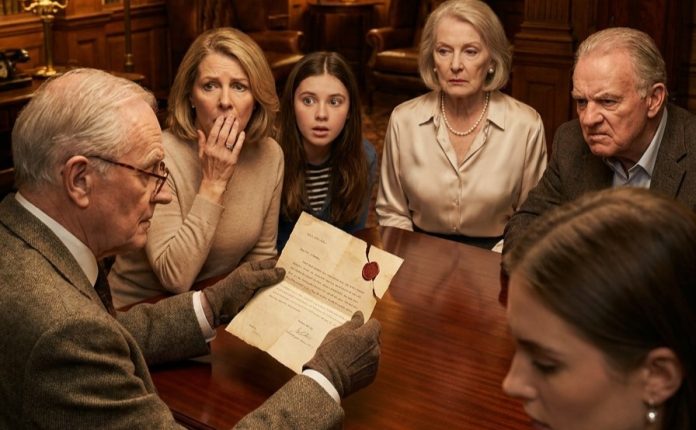
He removed a sealed envelope from inside his coat.
Dad’s handwriting appeared across the front.
For Daniel, if he arrives asking about the house before I am buried.
Everyone close enough to read it went silent.
Daniel stared at the envelope.
“What is that?”
“Your father’s final instruction.”
“He knew I would ask?”
“He feared you would.”
Daniel’s face tightened.
Samuel held out the envelope.
“Thomas hoped you might arrive in time to say goodbye. But he prepared this in case you came only for the property.”