Part Four: Sarah’s Emergency
The paramedics said Sarah had called from the hotel complaining of severe abdominal pain. She refused transportation unless they brought her to our house first.
“I need my medical records,” she cried from the porch. “Emily has them.”
The porch camera recorded every word.
I opened the door only because two paramedics and a police officer were present.
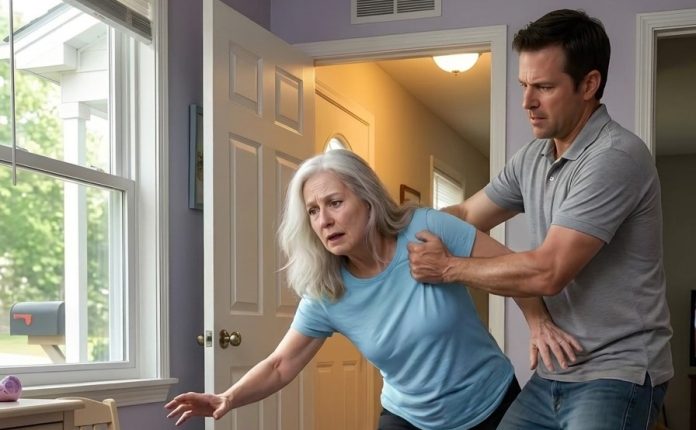
Sarah tried to step inside.
The officer blocked her.
“You are under a temporary no-contact instruction regarding the child,” he said. “You may not enter while Olivia is here.”
“My granddaughter needs me.”
“Your granddaughter is sleeping.”
“She will be traumatized if I disappear.”
I almost admired the audacity.
Sarah had hit Olivia, blamed her, and then returned claiming that her absence would be the traumatic part.
Michael came to the doorway.
“Mom, go to the hospital.”
“Tell Emily to restore my insurance.”
“That plan was hers to manage.”
Sarah stared at him.
“You’re taking her side?”
“I watched you hit my daughter.”
“I corrected her.”
“You injured her.”
“She was misbehaving!”
One of the paramedics exchanged a glance with the officer.
Michael’s face changed.
Not dramatically.
He simply stopped looking like a frightened son.
“No,” he said. “You are not coming back inside.”
Sarah’s mouth fell open.
“You would leave your sick mother outside?”
“You called an ambulance. Let them take you to the hospital.”
“You know I cannot afford it.”
“I will speak to the billing office. But you are not coming into this house.”
“Because she told you not to?”
“Because I saw what you did.”
Sarah pointed at me.
“She has poisoned you.”
I held Olivia’s medical report in my hand.
“You did not need my help poisoning this family,” I said.
Sarah’s expression turned vicious.
“Your daughter would have been better behaved if you had lost the first pregnancy like you were supposed to.”
The porch went silent.
Michael stared at her.
I felt my body become cold from the inside out.
Before Olivia, I had suffered a miscarriage at eleven weeks. Sarah visited the hospital with flowers and told me that “maybe nature knew I was not ready.”
I had never told Michael the exact words.
Now she had said something worse in front of him.
“Get off our property,” he said.
Sarah began crying again.
“My gallbladder could rupture.”
“Then go to the hospital.”
“You heartless child.”
The paramedics finally convinced her to sit on the stretcher. As they rolled her toward the ambulance, she twisted around and shouted, “You will come crawling back when that woman divorces you!”
The ambulance doors closed.
The siren remained off as it pulled away.
Michael stood on the porch long after the vehicle disappeared.
“I’m sorry,” he said.
I leaned against the doorframe.
“For tonight?”
“For every time I asked you to ignore her.”
“That is a beginning.”
He looked at me.
“Are you leaving me?”
“I don’t know.”
The answer hurt him, but I would not lie to protect him from a fear he had helped create.
The next morning, child protective services conducted a formal home assessment. Our cabinets were full. Olivia had appropriate medical care. The house was clean and safe. The investigator’s concern was not me leaving with Olivia.
It was whether Michael would enforce the boundary against Sarah.
He gave them the hotel address, confirmed that her key had been taken, and agreed to change the locks.
The police issued citations related to both assaults.
Sarah faced an investigation for child abuse.
I faced a misdemeanor assault complaint for slapping her.
My attorney explained that the video showed I was not acting in immediate defense when I struck Sarah. Olivia was already in my arms and no longer being attacked.
“You may feel justified,” the attorney said, “but legally, retaliation is different from protection.”
“I understand.”
I accepted responsibility.
That mattered to me, even if it did not matter to Sarah.
I had been right to remove Olivia.
I had been right to expose the abuse.
I had been wrong to use violence after the danger had passed.
My daughter needed to grow up knowing that protecting her did not require me to pretend every choice I made in anger was noble.
Sarah, on the other hand, denied everything.
She claimed the camera angle was misleading. She claimed Olivia had fallen before the slap. She claimed my business stress made me unstable.
Then her hospital records weakened her victim story.
Her gallbladder condition was real but non-emergent. The procedure could be scheduled through standard coverage she already qualified for independently. She had refused to complete the application because she preferred the plan I paid for.
Michael offered to help her submit the paperwork.
She refused unless he also allowed her to return home.
He did not.
For the first time, consequences remained attached to her choices.
Daniel arrived four days later.
Tyler ran into his father’s arms and sobbed.
They stayed at a nearby hotel while Daniel arranged to transfer his work assignment and take direct responsibility for his son. He apologized to Tyler for leaving him in a situation where adult convenience had been mistaken for stability.
Then he apologized to me.
“I kept sending money to Mom for Tyler,” he said.
I stared at him. “What money?”
“Eight hundred dollars a month.”
I had never seen any of it.
Daniel showed me the transfer history.
The money had gone directly into Sarah’s personal account.
She had told him it covered Tyler’s food, clothes, and school costs.
I had paid for all of those things.
Eight months.
Six thousand four hundred dollars.
Michael sat beside me as we reviewed the records.
“Did you know?” I asked.
“No.”
But he knew enough to look ashamed.
He had never asked how Sarah contributed because asking might have caused conflict.
Sarah had used that silence like an open bank account.
Daniel contacted an attorney.
The investigation expanded from child abuse to possible financial exploitation and fraud.
When confronted, Sarah said the money had compensated her for “emotional labor.”
“What emotional labor?” Daniel asked during a recorded phone call.
“Raising your son.”
“Emily raised him.”
“I supervised.”
“You sat on her couch and told him he was better than her daughter.”
Sarah hung up.
The family began choosing sides.
Some relatives supported us immediately.
Others said reporting her was excessive.
“She is old,” one cousin said.
“Olivia is two,” I replied.
“She made one mistake.”
“She defended it repeatedly.”
“She comes from another generation.”
“So does the law against hitting children hard enough to make them bleed.”
The cousin stopped calling.
Sarah’s church friends organized meals for her at the hotel. She told them she had been expelled from her son’s home after trying to teach a disrespectful child manners.
Then someone sent the security video to the church’s family-care coordinator.
I did not send it.
Michael did.
He told me afterward.
“I was tired of hearing that you had framed her,” he said.
The church removed Sarah from its volunteer nursery program pending investigation.
That consequence broke something in her.
She had built her identity around being seen as a devoted mother and grandmother. Losing access to the church nursery threatened the public version of herself more than losing access to Olivia.
She called Michael fifty-three times in one evening.
He did not answer.
The next day, she left a voicemail.
“If you let Emily do this, I will tell everyone what she did when Olivia was born.”
Michael listened twice.
Then he came into my office holding the phone.
“What is she talking about?”
I knew immediately.
There was only one secret from Olivia’s birth that Sarah could use.
And it was not mine.
It was Michael’s.
Part Five: The Account I Never Knew Existed
Two weeks after Olivia was born, I developed a severe infection and was readmitted to the hospital. I remembered very little from those days. I had assumed Michael handled the bills and Sarah helped with the baby.
According to Sarah’s voicemail, something else had happened.
Michael sat across from me in my office.
“When you were in the hospital,” he began, “Mom opened a credit card.”
“In whose name?”
His silence answered.
“Michael.”
“Yours.”
The room seemed to tilt.
“She said we needed money for medical expenses and that your credit was better.”
“You let your mother open a card in my name?”
“I signed the application.”
“How much?”
“It started at ten thousand.”
“Started?”
“The limit increased.”
“How much is on it now?”
He looked down.
“Twenty-eight thousand.”
My skin went cold.
“For what?”
“Some hospital costs. Household expenses. Tyler’s things. Mom’s medical bills.”
“I paid Tyler’s expenses.”
“I know that now.”
“And your mother’s insurance came through my company.”
“I know.”
“So where did twenty-eight thousand dollars go?”
He did not answer.
I pulled my credit report.
The account was there.
I had never noticed because Sarah had arranged electronic statements to an address I did not use, and Michael had made minimum payments from a separate account.
The balance was $28,743.
Charges included hotel stays, furniture, cosmetic dental work, jewelry, restaurant bills, and payments to a travel agency.
Sarah had used a credit card in my name to finance a life she accused me of being selfish for having.
“You hid this for two years,” I said.
Michael’s eyes filled with tears.
“I kept thinking I could pay it off.”
“With what?”
“My bonuses.”
“You gave your mother access?”
“She said it was temporary.”
“You watched her insult my business while spending money under my identity.”
“I didn’t know all the charges were hers.”
“You did not want to know.”
That was the sentence that finally broke him.
He covered his face.
“I was afraid that if I confronted her, she would fall apart.”
“So you let the debt belong to me.”
“I thought I could protect both of you.”
“You protected yourself from discomfort.”
He nodded.
There are moments in a marriage when the question is not whether love remains.
The question is whether love has enough structure to stand after the truth removes all its excuses.
I asked Michael to leave the house temporarily.
He did not fight me.
He packed a suitcase and moved into Daniel’s hotel suite.
Before leaving, he handed me passwords to every financial account, including the one he had used to make the secret payments.
I contacted an attorney and froze my credit.
The attorney advised me to file an identity-theft report even though Michael had participated in opening the account. Because my signature had been forged and I had not authorized the charges, the issue could involve both civil and criminal liability.
Michael offered to provide a written statement.
It would expose him.
He signed it anyway.
Sarah responded by claiming I had known about the card all along.
Then investigators found emails.
In one, she wrote to Michael:
Do not tell Emily. She is too emotional about money, and she will embarrass us.
In another:
Your wife earns plenty from those little creams. She owes me for helping with the baby.
A third message was sent only three months before she struck Olivia:
When Tyler inherits your father’s things, we can settle everything. There is no reason to waste family assets on a girl who will become someone else’s responsibility.
Michael read the message in the attorney’s office.
His father had died when he was twenty-one. The few remaining family items included a small parcel of land, tools, and an old savings bond.
Sarah had already assigned those things to Tyler in her mind.
Olivia did not count.
Not because she was less loved.
Because Sarah did not believe girls remained part of a family after marriage.
That contempt had been waiting long before the hot dog.
The slap had only made it visible.
My assault case was resolved first.
Because I admitted what I had done, had no prior record, cooperated with the investigation, and completed an anger-management course voluntarily, the prosecutor offered a diversion agreement. I paid a fine, attended counseling, and the charge would be dismissed after a year if I had no further incidents.
I accepted.
Some relatives said I should have fought it.
I disagreed.
Accountability was not humiliation.
It was the line separating me from Sarah.
I told the judge, “I reacted after my daughter was safe. I should have called the police instead of striking back.”
Sarah sat behind her attorney and rolled her eyes.
When her case came before the court, she did not accept responsibility.
She said Olivia’s injury had been caused by “an accidental disciplinary movement.” She said the blood was from dry air. She said the fingerprints on Olivia’s cheek could have come from my hand while I picked her up.
Then the prosecutor played the video.
Again.
The sound of the slap filled the courtroom.
Olivia’s small body fell.
Sarah’s voice followed:
That will teach you.
The judge watched without expression.
The child abuse charge, the financial evidence, the misuse of Daniel’s support payments, and the credit card fraud became part of a larger plea negotiation.
Sarah was not sent to prison for decades, as some people imagined dramatic justice should require. Real consequences are often quieter.
She received probation, mandatory counseling, financial restitution, a suspended jail sentence, and a long-term protective order prohibiting contact with Olivia.
She was required to repay Daniel.
The disputed credit-card charges were removed from my responsibility after months of investigation, though Michael remained responsible for part of the balance because of his involvement.
Sarah also lost her position at church and moved into a small apartment she could afford with her retirement income.
Her gallbladder procedure was completed through public medical coverage.
She survived without my plan.
The world did not end because I stopped carrying her.
My marriage nearly did.
Michael and I spent six months separated.
He attended individual therapy and joined a support group for adults raised by controlling parents. He stopped calling Sarah every time she left a threatening voicemail. He learned that guilt was a feeling, not an instruction.
I did not promise reconciliation.
He came to see Olivia according to a temporary parenting schedule. He arrived on time. He brought no messages from Sarah. He did not ask me to forgive faster.
One afternoon, while Olivia stacked wooden blocks between us, Michael said, “I thought being a good son meant preventing Mom from feeling abandoned.”
“And being a good husband?”
“I thought you were stronger, so you could handle more.”
I looked at him.
“That is what people say when they want the strongest person to keep bleeding quietly.”
He nodded.
“I know.”
“Do you?”
“I’m beginning to.”
He took a folded document from his coat.
It was a legal notice removing Sarah as beneficiary from his life insurance and retirement accounts. Olivia was now the primary beneficiary, with a trust managed by an independent professional.
“I should have done this when she was born,” he said.
“Yes.”
He did not ask whether that earned him something.
That mattered.
Months later, we began couples counseling.
Not because the family pressured us.
Because Michael had finally stopped treating reconciliation as his reward for admitting what he had done.
The counselor asked what I needed before considering living together again.
I answered without hesitation.
“A home where my daughter’s safety is not negotiable. Financial transparency. No secret support. No contact between Sarah and Olivia. And I will never again be expected to endure contempt to keep the peace.”
Michael agreed.
Then the counselor asked what he needed.
He looked at me for a long moment.
“A chance to become someone different from the man I was that day.”
I could not promise the outcome.
But I could recognize the honesty.
Part Six: The Last Hot Dog
A year after the slap, we held Olivia’s third birthday in Rachel’s backyard.
There were yellow balloons tied to the fence and a small inflatable pool on the grass. Daniel brought Tyler, who had moved back in with him permanently. He had become quieter in some ways and kinder in others.
When Olivia dropped her cupcake, Tyler gave her half of his.
No one told him to.
Michael and I were living together again, though not in the old version of our marriage.
The credit reports were checked monthly.
Our accounts were visible to both of us.
Sarah’s name appeared only in legal documents and occasional blocked voicemails.
The guest room had become my business studio. I moved the inventory out of the basement and painted the walls pale green. The supplemental medical plan covered only employees and immediate dependents now.
No unofficial relatives.
No guilt-based exceptions.
No one benefiting from my work while insulting it.
Olivia remembered very little about the day Sarah hit her. Sometimes she touched her cheek when she saw the stuffed bear with the faint brown stain near its ear. I had tried to wash the blood out, but a shadow remained.
I considered replacing it.
Rachel advised me not to unless Olivia wanted another one.
So the bear stayed.
Children should be allowed to decide which objects become reminders and which remain simply loved.
My relationship with Tyler changed too.
One afternoon, he asked whether I had hated him when he lived with us.
“No,” I said. “I hated how the adults handled it.”
“Grandma said Olivia got less because she had you.”
“She should never have received less.”
He stared at his shoes.
“Sometimes I liked getting more.”
“You were a child.”
“Does that make it okay?”
“It means the adults were responsible for teaching you better.”
He nodded slowly.
Then he asked, “Can I tell Olivia sorry even if she doesn’t remember?”
“Yes.”
He found her playing with sidewalk chalk and apologized for not helping when Sarah hit her.
Olivia listened, then handed him a blue piece of chalk.
“Make sky,” she said.
That was enough for her.
For me, forgiveness took a different shape.
I forgave myself slowly for trusting Sarah, for firing Ana, for ignoring warning signs, and for believing that patience was always virtuous.
Ana accepted the lost wages I paid her but did not return to work for us.
“I believe you are sorry,” she said. “But I need to work somewhere I feel trusted.”
She was right.
An apology does not purchase access to the person you hurt.
Sometimes the most respectful thing remorse can do is accept the door that remains closed.
Sarah sent one letter before the first anniversary of the incident.
It was addressed to Michael, but he showed it to me.
She wrote that she had been humiliated, misunderstood, and punished for “one moment of imperfect discipline.” She claimed Tyler had been turned against her. She accused me of destroying her legacy.
There was no mention of Olivia’s blood.
No mention of the stolen support money.
No mention of the credit card.
No apology.
Michael folded the letter and placed it in a file with the court documents.
He did not reply.
At Olivia’s birthday party, Daniel grilled hamburgers and hot dogs.
When lunch was ready, the children lined up.
Tyler reached the table first. Olivia stood behind him holding her paper plate with both hands.
For a second, the sight tightened something inside me.
A hot dog.
Two children.
An ordinary meal that once became the excuse for violence.
Tyler picked up the first hot dog.
Then he turned and placed it on Olivia’s plate.
“This one’s for her,” he said.
Daniel handed him another.
There was enough food for everyone.
There always had been.
The problem was never the hot dog.
It was Sarah’s belief that love, food, money, safety, and dignity should be distributed according to rank.
Boy before girl.
Mother before wife.
Adult pride before a child’s pain.
Public reputation before truth.
That afternoon, Olivia sat on Michael’s lap beneath the shade tree, eating watermelon with juice running down both arms. When she saw me watching, she waved.
“Mommy! Cake!”
“I see it.”
“Mine!”
“Yes,” I said. “It’s yours.”
She grinned.
Michael looked at me over her head.
There were still days when I wondered whether choosing to rebuild our marriage had been wise. Trust did not return as a grand feeling. It returned as a series of ordinary proofs.
A password shared without being requested.
A boundary held when nobody was watching.
A difficult truth spoken before it became a secret.
A mother’s call left unanswered because answering would come at his daughter’s expense.
Michael was not forgiven because he was sorry.
He was being forgiven because he had changed what he did.
After the guests left, we cleaned the yard together.
Tyler collected paper plates. Daniel folded chairs. Rachel carried sleeping Olivia inside.
Michael stood beside the grill holding the final hot dog.
“Do you want it?” he asked me.
I laughed for the first time all day.
“No.”
He looked at it.
“Feels strange throwing it away.”
“It’s just food.”
“I know.”
But we both understood.
He placed it in a container for later.
Nothing had to be wasted to prove someone mattered.
Before bed, I carried Olivia to her room and laid her beneath the quilt. She opened her eyes halfway.
“Grandma?” she murmured.
My body tensed.
Then she pointed toward a photograph on the dresser.
It was Rachel holding her at the party.
“Aunt Rachel,” I corrected gently.
Olivia smiled sleepily. “Rachel nice.”
“Yes.”
“Tyler nice.”
“Yes.”
“Daddy nice.”
I paused.
“Yes. Daddy is learning to be brave.”
She did not understand the answer, but she was already falling asleep.
I sat beside her for several minutes.
When Olivia was born, Sarah said daughters eventually left.
She said boys carried the family name as if a name were heavier than a child’s heart.
But families are not carried by names.
They are carried by people who protect the vulnerable when protection costs them something.
By people who tell the truth even when it embarrasses them.
By people who return stolen money, accept legal consequences, change the locks, attend counseling, and stop using tradition as camouflage for cruelty.
My daughter was not born to carry Sarah’s contempt.
She was not born to earn food by being obedient.
She was not born to become smaller so a boy could feel larger.
She was not born to absorb the bitterness of generations of women who had been hurt and chose to pass that hurt downward instead of ending it.
She was born with soft cheeks, curious eyes, and a hand that reached toward whatever interested her.
That day, it happened to be a hot dog.
Years from now, Olivia may hear a simplified version of what happened. She may learn that her grandmother struck her and that her mother struck back. I will not lie about either part.
I will tell her that I protected her.
I will also tell her that anger does not make every action righteous.
I will tell her that adults can be victims in one moment and still be responsible for what they do in the next.
Most importantly, I will tell her that the sound of her pain mattered.
It changed our family.
It exposed the debt, the lies, the favoritism, and the cowardice we had mistaken for peace.
The slap was not the beginning of Sarah’s contempt.
It was the moment we finally stopped pretending not to hear it.
That night, after Olivia fell asleep, I walked into the living room.
The security camera still hung above the bookshelf.
I had considered taking it down, but I left it there.
Not because I wanted to live under surveillance.
Because it reminded me of something I nearly learned too late.
Truth does not always enter a room with dignity.
Sometimes it arrives through a toddler’s scream.
Sometimes it is smeared with mustard and blood.
Sometimes it forces everyone to watch a scene they spent years helping create.
Michael joined me near the armchair.
“This is where she fell,” he said.
“Yes.”
He looked down at the floor.
“I should have asked if she was okay.”
“Yes.”
“I hear that question in my head every day.”
“Good.”
He looked at me, surprised.
I continued.
“Not because I want you punished forever. Because I want you never to forget which question comes first.”
He nodded.
Then he took my hand.
We stood there quietly in the room where everything had broken.
The walls were the same.
The clock still clicked.
The porch flag moved in the evening breeze.
But Sarah’s suitcases were gone.
Tyler was safe with his father.
The debt was no longer hidden.
The locks had changed.
And upstairs, my daughter slept in a house where nobody would ever again be allowed to teach her where a girl was supposed to stand.